
AI publishing shipping software sounds like a content problem until launch week arrives and the team is staring at thirty half-reviewed drafts, three conflicting product messages, and a changelog nobody has approved.
Teams think the problem is producing more words. The real problem is turning product intent into shipped communication without creating another operational mess.
That changes the conversation. The practical question is not whether AI can write a launch post, onboarding email, or release note. It can. The practical question is whether your team can move AI-assisted assets through a reliable publishing workflow with ownership, review, versioning, distribution, and measurement.
For founders, product managers, and solo operators, this matters because shipping software is already chaotic. Adding AI on top of a weak launch process does not create leverage. It creates faster drift.
Table of contents
- Why ai publishing shipping software is a workflow problem
- The operating model for ai publishing shipping software
- The launch stack: briefs, models, editors, CMS, analytics
- AI publishing shipping software changes the launch workflow
- Build the content state machine
- Quality gates: make human oversight enforceable
- Distribution, repurposing, and launch sequencing
- Measure shipping quality, not just content volume
- Failure modes when teams implement AI publishing badly
- Where sh1pt.com fits into an AI-assisted launch system
Why ai publishing shipping software is a workflow problem
The pain is not writing faster
Most product teams already have enough raw material. There are roadmap notes, Linear tickets, customer calls, support replies, founder voice memos, docs, demos, and half-finished launch pages.
The mistake teams make is assuming the bottleneck is drafting. In practice, the bottleneck is conversion: turning product knowledge into accurate, timely, publishable assets that support the release.
AI helps with drafting, summarizing, transforming, and repackaging. But if nobody owns the source of truth, the result is usually more work for the person who has to clean it up. Faster generation makes weak workflows more obvious.
Practical rule: If AI creates more review work than it removes, you have a workflow problem, not a model problem.
Why this matters in 2026
By 2026, many teams have moved past the novelty phase. AI writing tools are cheap, embedded, and available inside the systems people already use. The question is no longer whether a founder can generate a launch email in thirty seconds.
The question is whether that email matches the product, the positioning, the current release scope, the pricing page, and what support will tell users when they ask questions.
For small teams, this is where leverage lives. You do not need an enterprise content operation. You need a compact system that prevents obvious mistakes while letting you ship more consistently.
The shipping lens
A useful way to think about it is to stop treating publishing as a marketing side quest. Treat it as part of shipping software.
Every product change has communication debt. If you do not pay it deliberately, users pay it through confusion, ignored features, and support tickets. AI can reduce the cost of paying that debt, but it cannot decide which debt matters.
That is the core reframe: AI publishing is not a content factory. It is a release-support system.
The operating model for ai publishing shipping software
Treat content like product artifacts
A feature spec, a release note, a help doc, and a launch post are different artifacts derived from the same underlying change. If each one is written separately from memory, they will drift.
The better pattern is to create a launch brief that acts like a product requirement document for communication. It captures what shipped, who it is for, what changed, what not to claim, and what action users should take.
AI can then generate channel-specific drafts from that brief. The brief remains the controlled input. The drafts are disposable outputs.
This is how the team at bl0ggers.com thinks about scaling AI-assisted publishing: the durable asset is the editorial system, not the first draft.
Separate generation from approval
Generation is cheap. Approval is expensive. Mixing them creates trouble.
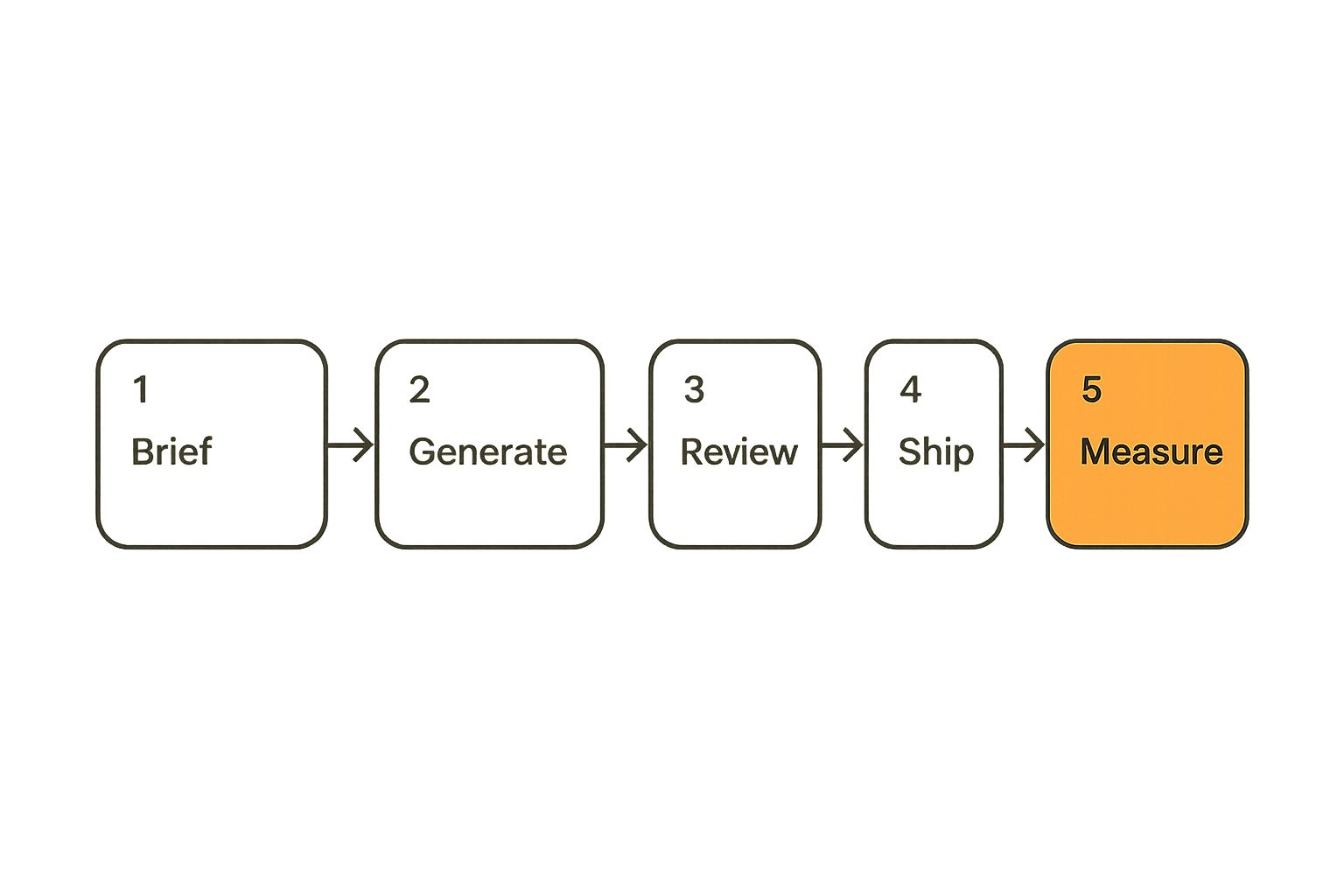
If the same person prompts, edits, approves, schedules, and measures every asset, AI just accelerates their context switching. Even for a solo founder, it helps to define separate modes of work: create, review, ship, measure.
The review step should not ask whether the draft sounds impressive. It should ask whether the asset is correct, useful, and aligned with the release.
Practical rule: Never let an AI-generated asset move directly from draft to publish without a human checkpoint tied to product accuracy.
Define ownership before tooling
Before buying or building anything, decide who owns four things:
- The launch brief
- The source product facts
- The final approval
- The post-launch corrections
For a solo operator, the answer may be the same person. That is fine. The point is not bureaucracy. The point is clarity.
What breaks in practice is invisible ownership. A draft gets generated from old roadmap notes. Nobody knows who approved it. Users see a claim that is not quite true. Support has to explain the gap. That is not an AI failure. That is an ownership failure.
The launch stack: briefs, models, editors, CMS, analytics
Briefs are your product requirements
The launch brief is the most important part of the stack because it controls the input quality.
A practical brief should include:
- Release name or feature name
- Target user segment
- Problem being solved
- What changed in the product
- What is excluded or not yet available
- Primary user action
- Proof points or examples
- Risky claims to avoid
- Internal owner
- Publish date and dependencies
This brief does not need to be long. In many teams, a one-page brief beats a detailed strategy doc nobody reads. AI systems perform better when the instructions are concrete and bounded.
Models are replaceable components
Teams often over-focus on the model. They compare tone, output length, and cleverness. That matters, but less than people think.
A model is a component in the workflow. It accepts context and produces a draft. You should be able to swap it without rebuilding the operating model.
That means your prompts, briefs, approval rules, and publishing states should live outside the model. If your process only works because one person knows the magic prompt, you do not have a system. You have a habit.
CMS and analytics close the loop
Publishing does not end when the post goes live. The CMS, newsletter tool, changelog, docs platform, social scheduler, and analytics layer all need to connect back to the release.
At minimum, every shipped asset should have a release ID or campaign ID. That lets you answer basic questions later:
- Which assets supported this launch?
- Which ones were updated after user feedback?
- Which channels drove activation or replies?
- Which claims caused confusion?
Without that loop, AI-assisted publishing becomes a pile of outputs with no operational memory.
AI publishing shipping software changes the launch workflow
From campaign calendar to release pipeline
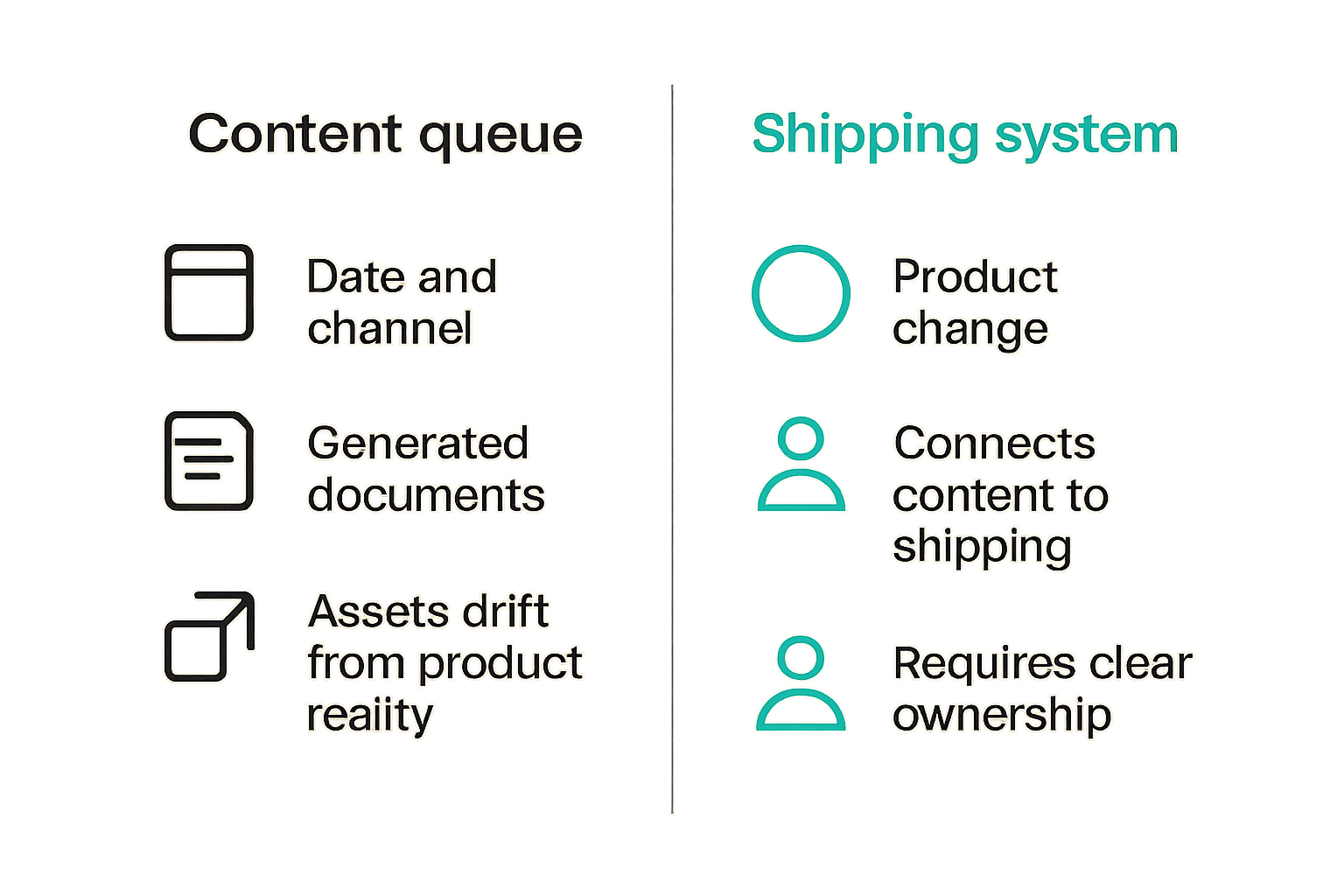
Traditional content calendars are organized around dates and channels. That is useful for planning, but weak for product shipping.
A release pipeline is organized around product changes and required communication states. It asks what needs to be true before a launch can be considered shipped.
Here is the difference:
| Approach | Primary object | Strength | Failure mode |
|---|---|---|---|
| Content calendar | Date and channel | Easy to schedule | Assets drift from product reality |
| AI draft queue | Generated documents | Fast production | Review pile grows quickly |
| Release pipeline | Product change | Connects content to shipping | Requires clear ownership |
| Manual founder publishing | Founder judgment | High context | Does not scale cadence |
The release pipeline is usually the best fit for indie teams because it preserves judgment while removing repeated manual work.
What works
The workflow that works is simple and slightly boring:
- Capture the product change in a launch brief.
- Generate first drafts for required channels.
- Review against product facts, positioning, and user action.
- Publish in a controlled sequence.
- Measure user behavior and support feedback.
- Patch the assets when reality changes.
The goal is not to automate taste. The goal is to automate the repeatable parts around taste.
Practical rule: Automate format conversion before you automate positioning decisions.
What fails
What fails is using AI as a parallel marketing brain with no connection to the release process.
Common bad patterns include:
- Generating blog posts from vague feature names
- Asking AI to invent benefits without product context
- Publishing social posts before docs are updated
- Letting multiple team members create separate versions of the same message
- Measuring pageviews while ignoring activation, replies, and confusion
These failures are not dramatic at first. They show up as small inconsistencies. Then they compound.
Build the content state machine
Minimum states that matter
You do not need a complex editorial platform to run an AI publishing workflow. You need states.
A compact state machine might look like this:
idea- possible launch or content opportunitybriefed- product facts and audience are capturedgenerated- AI drafts existreviewed- human review completedapproved- ready to schedule or publishshipped- live in the target channelmeasured- performance and feedback reviewedupdated- corrected or improved after release
The state names matter less than the handoffs. Each state should make the next action obvious.
Metadata prevents support debt
Metadata sounds like admin work until something breaks. Then it becomes the difference between a five-minute fix and a day of archaeology.
Useful metadata includes:
- Release ID
- Product area
- User segment
- Asset type
- Channel
- Owner
- Approval status
- Source brief
- Last reviewed date
- Known caveats
If a user reports that your docs promise a feature that is not available on their plan, you need to find every related asset quickly. Metadata makes that possible.
Example workflow configuration
A small team can represent the workflow in Notion, Airtable, a CMS collection, GitHub issues, or a lightweight internal tool. The important part is the shape.
release_id: billing-usage-alerts-2026-05
product_area: billing
audience: workspace_admins
asset_type: launch_post
state: reviewed
owner: maya
source_brief: brief-billing-usage-alerts
claims_allowed:
  - admins can set spend thresholds
  - alerts are sent before limit is reached
claims_avoid:
  - automatic spend blocking
  - enterprise-only controls
publish_targets:
  - changelog
  - email
  - docs
This looks basic, but it prevents a common failure: AI confidently adding one extra promise because the prompt was underspecified.
Quality gates: make human oversight enforceable
Gate the risky parts
Not every sentence deserves the same review. Product teams waste time when they review everything as if it carries equal risk.
Gate the parts that can create real problems:
- Pricing claims
- Security or compliance language
- Availability by plan or region
- Migration instructions
- Data retention statements
- Competitive claims
- Promises about roadmap timing
Low-risk transformations, such as turning a release note into a short social post, can move faster. High-risk claims need deliberate review.
Review for usefulness, not vibes
A common review comment is that a draft feels off. Sometimes that is valid. But it is not operational.
Better review questions are:
- Would the target user understand what changed?
- Is the promised outcome actually available today?
- Does the asset tell the user what to do next?
- Are screenshots, docs, and product labels consistent?
- Would support repeat the same explanation?
This keeps review grounded in shipping outcomes. You are not grading an essay. You are reducing user confusion.
Keep provenance visible
When AI participates in publishing, provenance matters. Not because every user needs a disclosure on every internal draft, but because the team needs to know where content came from.
Track the source brief, generation prompt or template, reviewer, approval date, and last update. If a claim is wrong, you want to trace whether the error came from the brief, the model output, the human edit, or the product changing after publication.
That traceability makes the system improve. Without it, every correction feels like a one-off cleanup job.
Distribution, repurposing, and launch sequencing
Ship from one source of truth
The best use of AI in publishing is repurposing from a controlled source.
Start with the launch brief or canonical release note. From there, generate the public changelog, email, help doc update, in-app announcement, social thread, founder note, and sales enablement snippet.
This keeps the message aligned. It also makes updates easier. When the product changes, you revise the source and regenerate or patch the dependent assets.
The mistake teams make is generating each channel from scratch. That creates subtle differences in claims, terminology, and emphasis.
Match assets to channel intent
Repurposing does not mean copy-pasting. Each channel has a job.
- Changelog: what changed and who it affects
- Blog post: why it matters and how to think about it
- Docs: how to use it correctly
- Email: why the user should care now
- In-app message: what action to take in context
- Social post: why the change is interesting enough to notice
- Sales note: how to explain it in a customer conversation
AI is useful for adapting structure and length. Humans still need to decide the channel intent.
Do not publish everything at once
Launch sequencing is underrated. Small teams often publish every generated asset at the same time because the drafts are ready. That can overload users and hide problems.
A better sequence is:
- Update docs and support notes.
- Publish the changelog or release note.
- Send targeted email or in-app messages.
- Publish the deeper blog post.
- Repurpose into social or community updates.
- Monitor questions and patch assets.
This gives the team a chance to catch confusion before amplifying the message.
Measure shipping quality, not just content volume
Metrics that expose bottlenecks
If you only measure output volume, AI will look successful even when the launch process is getting worse.
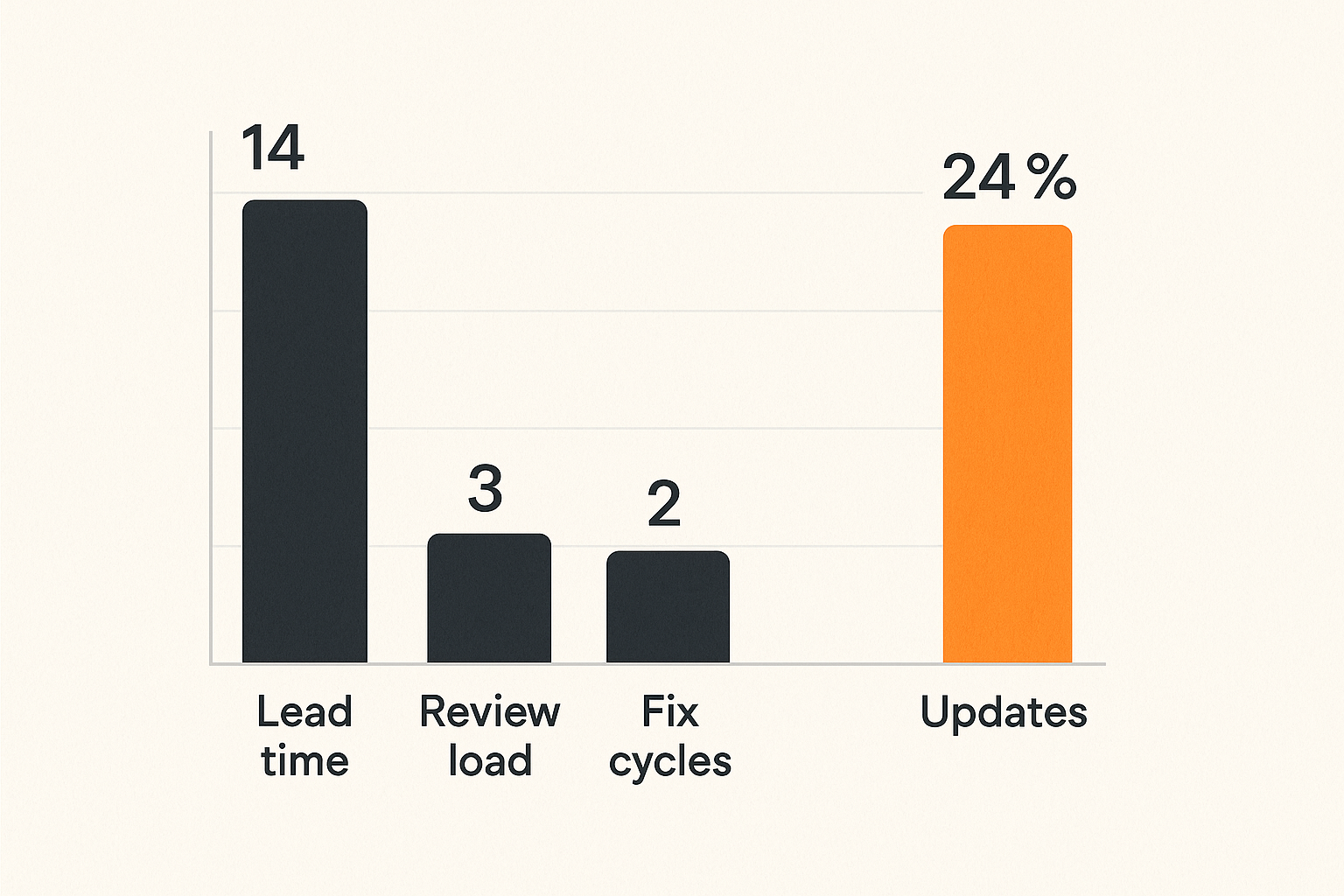
Better metrics expose the health of the workflow:
- Time from release brief to first draft
- Time from first draft to approval
- Number of review cycles per asset
- Percentage of assets updated after launch
- Support questions tied to published claims
- Activation or usage after launch communication
- Number of stale assets per product area
These metrics do not need to be perfect. Even a manual weekly review can reveal where the system is stuck.
Tie publishing to product motion
For software teams, the point of publishing is not content volume. The point is product motion.
A launch asset should help a user discover, understand, adopt, upgrade, configure, or trust something in the product. If it does none of those things, ask why it exists.
This is where AI can be dangerous. It makes it easy to create plausible assets that do not move anything. A polished post with no product action is still noise.
The practical question is: what user behavior should this asset support?
Instrument the feedback loop
You need a simple way to bring reality back into the system.
Sources of feedback include:
- Support tickets
- Reply emails
- Demo questions
- Changelog clicks
- Feature adoption
- Search queries
- Docs feedback
- Community comments
Feed those signals into the next brief. If three users ask whether a feature supports teams, update the docs, adjust the launch post, and add that question to the next related prompt template.
That is how AI-assisted publishing improves over time. Not by generating more. By learning from shipped work.
Failure modes when teams implement AI publishing badly
The rewrite treadmill
The rewrite treadmill happens when AI drafts are easy to create but hard to approve. Every draft is close enough to be tempting and wrong enough to require heavy editing.
This usually means the brief is weak. The model is guessing at audience, product details, or positioning.
The fix is not to demand better prose. The fix is to improve the input contract. Make the brief more specific. Add forbidden claims. Include examples of accepted language. Reduce the number of assets generated before review.
If one high-quality brief produces five useful assets, you have leverage. If ten weak prompts produce ten cleanup jobs, you have debt.
The duplicate-message problem
Duplicate messaging happens when different people use AI to explain the same feature in different places.
The homepage says one thing. The changelog says another. The onboarding email uses old terminology. A sales note implies a use case the product barely supports.
Users may not notice every inconsistency, but they feel the uncertainty. Internally, support and sales lose confidence in the published material.
The fix is a canonical message per release. Not a perfect brand manifesto. Just a controlled paragraph that defines the feature, audience, benefit, and boundary. All generated assets should inherit from it.
The orphaned-asset problem
AI makes it cheap to create assets and easy to forget them.
An orphaned asset is any published page, email, post, or doc fragment that no longer has an owner or update path. It may rank in search. It may be linked from onboarding. It may answer an old question incorrectly.
This is especially risky for fast-moving products. Pricing changes, plan limits move, UI labels change, and beta features graduate.
The fix is lifecycle management. Every asset needs a last-reviewed date, a product area, and an owner. If that sounds heavy, start with the top twenty assets that drive signups, activation, or support load.
Where sh1pt.com fits into an AI-assisted launch system
Product shipping needs a visible cadence
AI publishing works best when it supports an actual shipping cadence. If the product team does not know what shipped, what is next, and what needs to be communicated, publishing tools have to guess.
For indie hackers and small teams, the win is not building a giant content machine. The win is making launches visible enough that communication becomes part of the release motion.
A product shipping hub can help by keeping updates, launch notes, and product progress in one place. That gives AI-assisted publishing a cleaner input and gives humans a clearer review surface.
Use AI to support the launch, not replace it
The healthiest setup is simple: humans decide what matters, AI helps package it, and the shipping system tracks whether it actually went live.
Use AI for:
- Turning release notes into first drafts
- Creating channel variants
- Summarizing customer context
- Drafting internal enablement notes
- Finding inconsistencies across assets
- Updating older pages after product changes
Do not use AI as the source of truth for your product. The source of truth is still the shipped software, the release owner, and the user feedback after launch.
Try sh1pt.com
If you are building and launching software, sh1pt.com helps you keep product shipping visible and practical. Use AI publishing shipping software as the workflow around your launch, then use Try sh1pt.com to keep the actual shipping cadence clear.