
Your launch can be technically solid and still disappear.
The homepage is live. The docs are clean enough. The launch post goes out. Then a buyer asks ChatGPT, Perplexity, Gemini, or another answer engine what tool they should use, how your category works, or how you compare to a known alternative. Your product is missing, misdescribed, or summarized from an old sentence you forgot existed.
Teams think the problem is answer engine optimization product management. More precisely, they think it is an SEO task with a new acronym attached. The real problem is product knowledge architecture: how your product facts, positioning, documentation, release notes, comparisons, and proof points stay consistent enough for answer engines to retrieve and reuse.
That changes the conversation. This is not about gaming AI answers. It is about shipping a product whose public surface is coherent, crawlable, current, and easy to cite. In 2026, that belongs in the product workflow, not in a content backlog nobody owns.
Table of contents
- Why answer engine optimization product management matters in 2026
- What answer engines need from your product
- The AEO product management architecture
- Map answer journeys before content calendars
- Turn product knowledge into answer-ready assets
- What works and what fails in AEO execution
- Build the operating cadence
- Measure AEO without pretending attribution is perfect
- Failure modes that break answer engine optimization product management
- Build AEO into the way you ship
Why answer engine optimization product management matters in 2026
Launch visibility no longer stops at search
For a long time, product teams could treat visibility as a sequence: ship the thing, write the launch post, get indexed, wait for search demand, improve pages over time. That sequence still matters, but it is no longer the whole path.
A prospect may never search your exact category. They may ask an AI assistant for a shortlist. They may ask how to solve a workflow problem. They may paste requirements and ask for tools. They may ask whether your product supports a feature that your docs mention, but your homepage does not.
The mistake teams make is assuming the answer engine is just another traffic source. It is not. It is a synthesis layer. It reads across public sources, extracts claims, compresses nuance, and produces a recommendation-shaped answer. If your public product knowledge is fragmented, the synthesis will be fragmented too.
The product team owns more of the answer surface
Marketing can write pages. SEO can optimize metadata. But only the product team knows what is actually true: what shipped, what is beta, what is deprecated, what integrations work, which customer profile is a fit, and which edge cases need support.
That is why answer engine optimization product management is not a side quest. The public answer surface is downstream of product decisions. If pricing changes, AI answers need current pricing context. If an integration launches, answer engines need a clear page that explains what it does. If positioning shifts, old category language has to be retired.
Practical rule: if an answer engine could reasonably summarize it for a buyer, it needs an owner inside the product workflow.
Treat answers as distribution channels
A useful way to think about it is this: your product has channels you publish to, and channels that summarize you. Your website, docs, changelog, marketplace listings, and launch posts are published channels. AI answer engines are summary channels.
Summary channels reward clarity, consistency, and evidence. They punish contradiction. If your homepage says you are for agencies, your docs say you are for developers, and your comparison page says you are for enterprises, you have not created optional positioning. You have created ambiguity.
The practical question is not how do we rank in AI answers tomorrow. The better question is what public product system would make accurate AI answers more likely over the next hundred launches, updates, and experiments.
What answer engines need from your product
Clear entities beat vague positioning
Answer engines need to understand what your product is, who it is for, what category it belongs to, and how it differs from nearby options. That sounds basic. In practice, many early-stage product sites avoid specificity because they are still exploring the market.
That flexibility is understandable, but it creates a retrieval problem. If you describe your product as a smarter way to work, there is very little for an answer engine to attach to. If you describe it as a launch planning workspace for indie software teams, you have a category, audience, and use case.
This guest contribution comes from the team at crawlproof.com, where the work is focused on how AI answer engines and LLM crawlers discover, interpret, and cite public content.
Entity clarity usually means documenting:
- Product name and canonical spelling
- Primary category
- Target users
- Core use cases
- Integrations and platforms
- Pricing model or packaging structure
- Supported regions, languages, or technical environments
- Known non-fits
None of that needs to be robotic. It just needs to be explicit.
Evidence beats adjectives
AI systems can repeat your adjectives, but adjectives are weak source material. Better, fastest, easiest, and most powerful are not durable claims. They do not explain why your product should be recommended for one job over another.
Evidence is more useful. Examples include:
- Feature pages with concrete workflows
- Docs that show setup steps
- Release notes with dates
- Use-case pages with constraints
- Comparison pages that state tradeoffs
- Screenshots or product UI descriptions
- Customer proof, when available and permissioned
The best answer-ready content does not sound like a brochure. It sounds like a product manager explaining when the product fits and when it does not.
Freshness has to be observable
Answer engines cannot infer your roadmap intent. They can only see what is public and retrievable. If old docs remain indexed, stale launch posts rank for key phrases, or pricing pages do not show an update trail, outdated answers become more likely.
Freshness does not mean rewriting everything every week. It means making change visible. Add dates to changelogs. Keep docs updated when features move. Retire old claims. Link new feature pages from canonical product pages. Make sure important updates do not live only in social posts or email announcements.
Practical rule: if the product changed but the public source of truth did not, you have created answer debt.
The AEO product management architecture
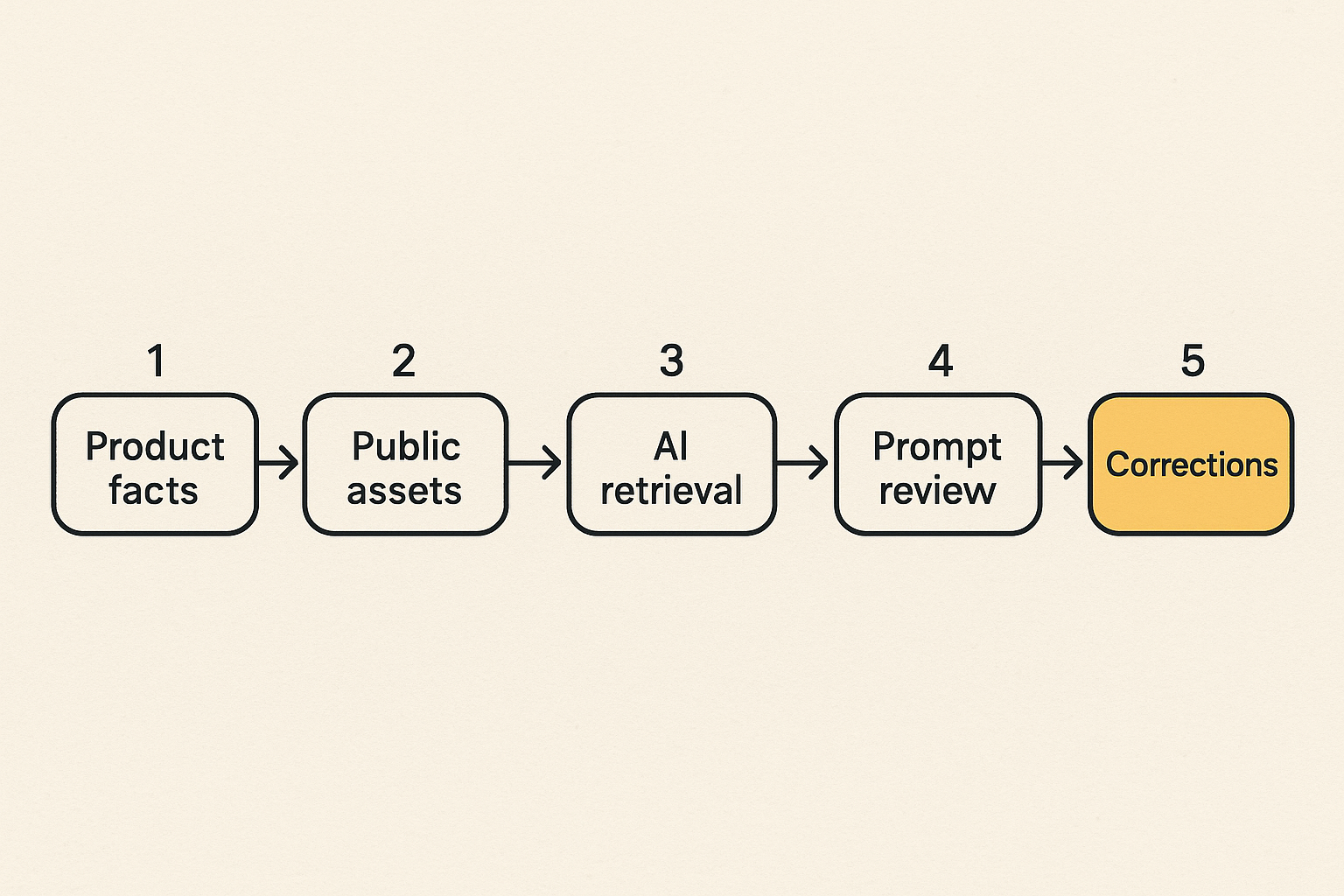
Source of truth
Answer engine optimization starts with a boring system: one internal source of truth for public product facts. Without that, every team invents its own version of the product.
For a small team, this can be a page in Notion, Linear, GitHub, or whatever tool already runs the product workflow. The format matters less than ownership and update discipline.
A simple product fact file might include:
product:
  canonical_name: ExampleApp
  category: launch planning workspace
  primary_users:
    - indie hackers
    - startup founders
    - product managers
  core_jobs:
    - plan software launches
    - coordinate release tasks
    - document shipping decisions
  current_positioning: ship product updates with less operational drift
  not_for:
    - enterprise portfolio governance
    - hardware release management
  last_reviewed: 2026-05-25
This internal file should drive the homepage, docs, launch posts, comparison pages, app store listings, and sales snippets. If each asset is written from scratch, drift is guaranteed.
Structured assets
The second layer is the public asset system. You do not need hundreds of pages. You need the right page types, kept current.
For most software products, the minimum answer-ready surface includes:
- Homepage with category and audience clarity
- Product or feature pages that map to real workflows
- Docs or help content that proves implementation details
- Pricing page with packaging boundaries
- Changelog or release notes
- Comparison or alternatives pages, if buyers ask those questions
- About page with company and product entity details
What breaks in practice is that teams publish assets for humans but forget the retrieval layer. A gorgeous landing page with vague copy may convert warm visitors, but it gives answer engines very little to cite. A dense documentation page may prove capability, but if it is not linked from product pages, it may not influence higher-level answers.
Feedback loop
The third layer is measurement and correction. You need a lightweight way to see what answer engines currently say about your product, where they cite from, and what they miss.
This is not perfect attribution. It is operational monitoring. Create a recurring set of prompts that resemble buyer questions. Capture outputs. Look for patterns:
- Is the product mentioned in relevant category answers?
- Is the description accurate?
- Are competitors mentioned but you are absent?
- Are old features still appearing?
- Are unsupported use cases being recommended?
- Which public sources appear to influence the answer?
Then feed those findings back into product facts and public assets. That is the loop: product truth, public assets, answer monitoring, correction.
Map answer journeys before content calendars
Identify decisions users ask AI to make
Do not start with a keyword spreadsheet. Start with decisions.
A founder might ask: what tools help me plan a Product Hunt launch. A product manager might ask: how should a small team coordinate release notes, QA, and marketing tasks. A solo builder might ask: what is the simplest way to avoid forgetting launch steps.
Those are not just keywords. They are decision points. If your product fits, your public content needs to make that fit legible.
A practical mapping exercise:
- List the top five decisions a buyer makes before choosing your product.
- Write the natural-language questions they might ask an AI assistant.
- Identify what evidence an answer engine would need to recommend you.
- Check whether that evidence exists on a crawlable public page.
- Create or update the missing asset.
- Re-test the prompts after the pages are indexed or discovered.
This sequence keeps the work tied to buyer behavior instead of chasing abstract AEO tactics.
Build prompts around jobs not keywords
Keywords still have value, but AI answers are often job-shaped. Users ask for help completing a task, not just finding a term.
Instead of only tracking prompts like best launch tool, track prompts like:
- How should I organize tasks for a SaaS feature launch?
- What should be included in a launch checklist for a small software team?
- Which tools help indie hackers manage launch planning and updates?
- How do I coordinate changelog, docs, and marketing for a release?
These prompts expose the workflow context. They also show where your content is thin. If your site says launch faster but never explains the launch workflow, answer engines have little reason to associate you with that job.
Separate discovery evaluation and implementation
Answer journeys usually split into three phases.
Discovery is category formation. The user is learning what kinds of tools exist. Evaluation is comparison. The user is deciding between options. Implementation is setup. The user wants to know how to use the chosen tool.
Each phase needs different assets:
- Discovery: use-case pages, category explainers, workflow guides
- Evaluation: comparisons, pricing, feature boundaries, proof points
- Implementation: docs, templates, checklists, setup walkthroughs
The mistake teams make is writing only discovery content. That may get you mentioned, but it does not help the answer engine defend a recommendation when the user asks for tradeoffs or setup details.
Turn product knowledge into answer-ready assets
Product facts
Product facts are the stable claims you want repeated accurately. They should be short, specific, and reusable.
Bad product fact: helps teams launch better.
Better product fact: helps software teams plan launches, assign release tasks, track launch readiness, and document product updates in one workspace.
The better version gives answer engines nouns and verbs. It says who, what, and how. It also creates a test: if the product does not actually do those things, the fact should not ship.
Keep a small set of canonical product facts and reuse them across pages. This does not mean duplicate copy everywhere. It means the core claims should not mutate randomly from one asset to another.
Comparison pages
Comparison pages are uncomfortable for many founders because they feel aggressive. They do not have to be. A good comparison page is a buyer aid. It explains fit, tradeoffs, and workflow differences.
If users ask AI assistants to compare you with another product, and you have no public comparison, the answer engine will rely on third-party summaries, old mentions, or competitor pages. That is not a strategy.
A useful comparison page includes:
- Who each product is best for
- Where the workflows differ
- Feature overlap and gaps
- Pricing or packaging differences, when public
- Migration considerations
- Honest non-fit cases
Practical rule: do not publish comparison pages you would be embarrassed to send directly to a buyer.
Changelogs
Changelogs are underrated AEO assets. They provide dated evidence that the product is active and evolving. They also help answer engines connect new capabilities to public proof.
A weak changelog says: improvements and bug fixes.
A stronger changelog says: added launch readiness checklist templates, improved release note export, and added owner fields for launch tasks.
The stronger version creates retrievable evidence. It names the feature, the workflow, and the change. If you ship often, your changelog becomes a structured history of product capability.
For product-led teams, the changelog should not be an afterthought. It is part of the answer surface.
What works and what fails in AEO execution
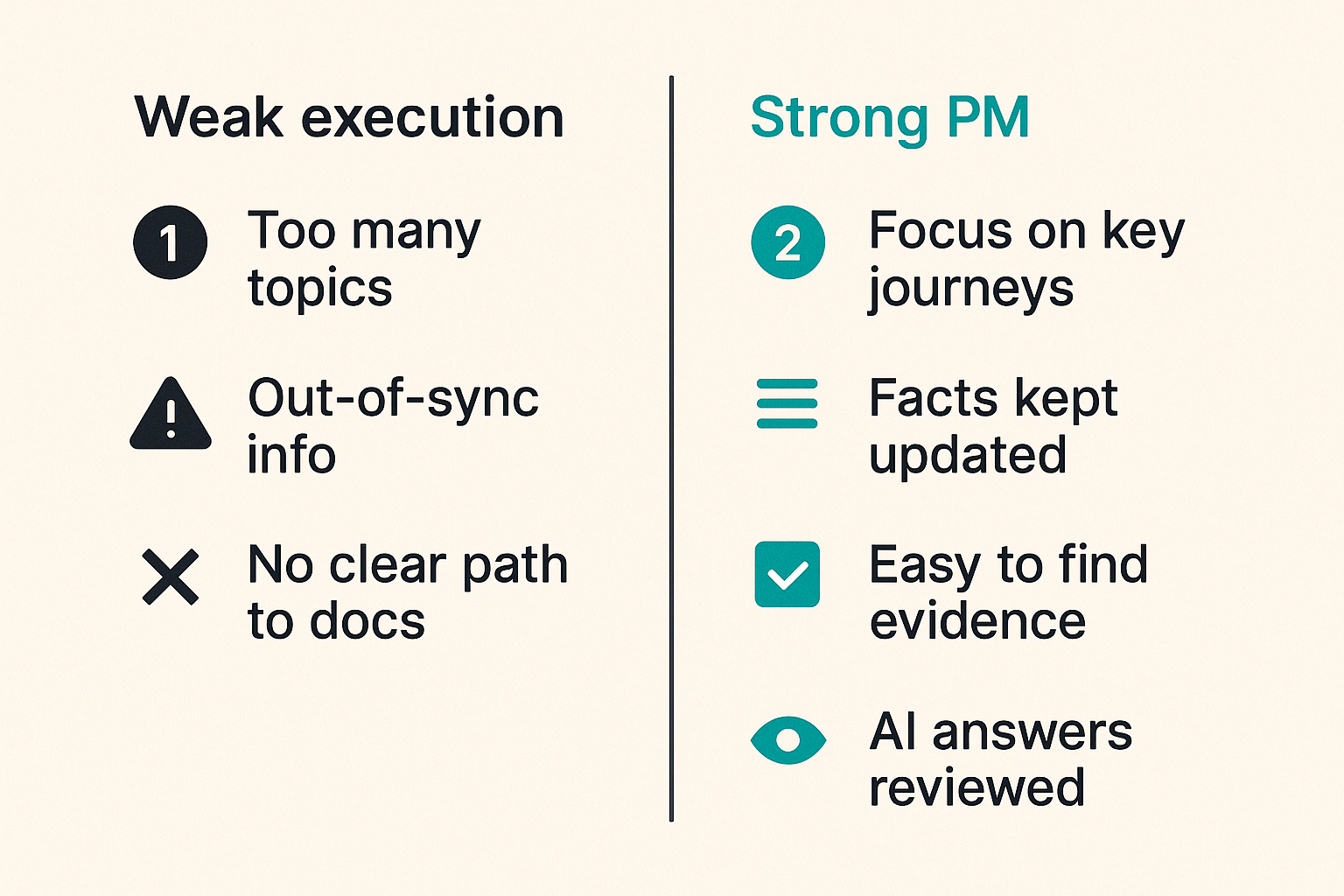
What works
What works is operationally simple and strategically disciplined.
First, pick a small number of answer journeys that matter. Do not try to be cited for every adjacent topic. If you are a launch planning tool, start with launch planning, release coordination, and shipping workflows. Own the truth there.
Second, keep product facts synced. When positioning changes, update the homepage, docs, comparison pages, and launch materials together. Drift is the enemy.
Third, make proof easy to find. Link from high-level pages to detailed docs. Link from changelogs to feature pages. Link from comparison pages to relevant implementation details. Answer engines and humans both benefit from a clean path from claim to evidence.
Fourth, review AI answers like you review analytics. Not obsessively. Not daily. But often enough to spot bad patterns before they harden.
What fails
What fails is treating AEO as a content stunt.
Publishing a pile of thin pages around AI search phrases will not fix unclear positioning. Adding schema markup will not save contradictory product claims. Asking the marketing team to optimize for answer engines without giving them current product truth creates polished inaccuracy.
Another failure mode is chasing mentions without caring about answer quality. Being listed in an AI answer is not helpful if the answer recommends you for the wrong user, wrong platform, or wrong workflow. That creates support load and damages trust.
The practical question is not did we appear. It is did we appear accurately, in the right context, with enough evidence to help the buyer move forward.
A practical comparison table
| Area | Weak AEO execution | Strong AEO product management |
|---|---|---|
| Ownership | Marketing owns pages in isolation | Product owns facts, marketing packages them |
| Positioning | Broad claims that change by page | Canonical category, audience, and use cases |
| Launch process | Publish announcement only | Update docs, facts, comparisons, and changelog |
| Measurement | Count AI mentions casually | Review answer accuracy by buyer journey |
| Corrections | Rewrite pages when traffic drops | Fix source facts and public evidence |
| Risk | More visibility with more confusion | Better retrieval with fewer contradictions |
This is why the architecture matters. AEO is not one asset. It is the behavior of the whole public product system.
Build the operating cadence
Weekly
A weekly cadence keeps AEO close to the actual shipping motion. It should be lightweight enough that a small team will actually do it.
Each week, review:
- Product changes that affect public claims
- Docs that need updates
- New support questions that reveal unclear positioning
- AI answer checks for priority prompts
- Pages that need internal links from newer assets
This can be a 20-minute product marketing review, not a meeting marathon. The point is to prevent drift while the work is still fresh.
Monthly
Monthly work should focus on patterns. Individual answer outputs can be noisy. Patterns are more useful.
Look for:
- Repeated omissions from relevant answer sets
- Competitors cited for workflows you also support
- Old positioning that keeps resurfacing
- Pages that appear to be misunderstood
- New category language users are adopting
Then decide whether the fix is product, positioning, documentation, or distribution. Sometimes the answer is not more content. Sometimes the answer is clarifying the product, renaming a feature, or retiring a confusing page.
Release-time
Every meaningful release should trigger an AEO checklist. This is where product management matters most.
Before launch, ask:
- What new public claims does this release create?
- Which existing pages now need updates?
- Does the docs site prove the feature works?
- Does the changelog describe the workflow, not just the feature name?
- Do comparison pages need adjustment?
- Are support macros and sales snippets aligned?
- Which answer prompts should we retest after publishing?
This checklist turns AEO from a cleanup task into part of the release process.
Measure AEO without pretending attribution is perfect
Track answer presence
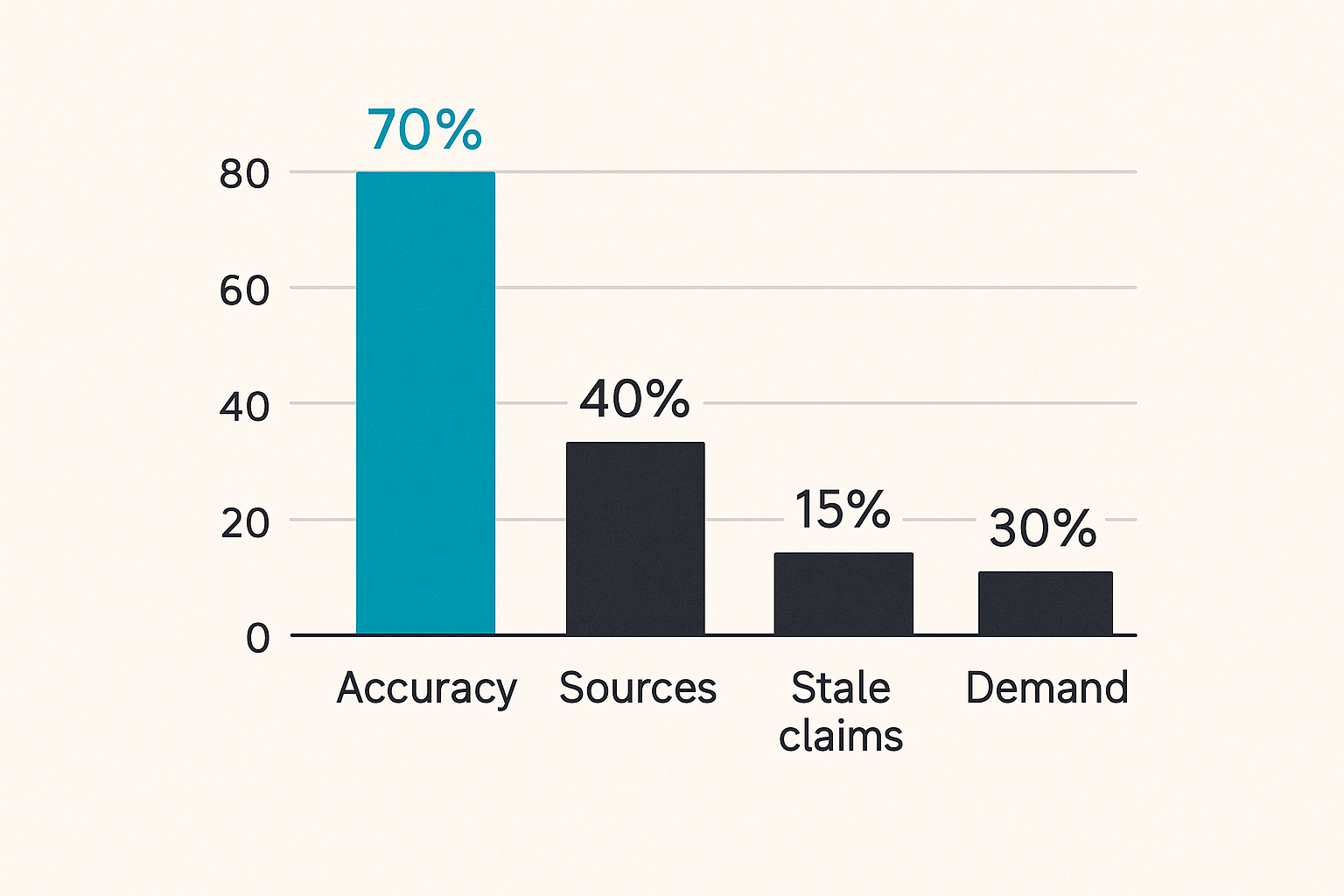
You can track whether your product appears in answer engines for priority prompts, but treat the data carefully. Outputs vary by model, location, account context, and time. A single result is not a verdict.
Use a fixed prompt set and review it consistently. Capture the answer, date, model or engine, whether your product appeared, how it was described, and which sources were cited when visible.
A simple tracker can include:
- Prompt
- Journey stage
- Engine tested
- Product mentioned: yes or no
- Accuracy score: accurate, partial, wrong
- Citation or source observed
- Action needed
The accuracy score is often more useful than the mention count. A partial or wrong mention is a product risk.
Track assisted demand
AEO often influences demand before analytics can attribute it cleanly. Buyers may see your product in an AI answer, search the brand later, visit directly, or mention it in a sales call.
Look for assisted signals:
- Brand search growth after answer presence improves
- Demo or signup forms mentioning AI tools
- Support or sales conversations referencing AI recommendations
- Increased direct traffic to comparison or docs pages
- More qualified visitors landing on implementation pages
Do not overclaim causality. Use these signals to decide whether your answer surface is improving.
Avoid vanity metrics
The vanity metric is screenshots of your product appearing in an AI answer. It feels good. It is not enough.
Better metrics are operational:
- Are priority answers accurate?
- Are the right pages cited?
- Are outdated claims decreasing?
- Are users arriving with better context?
- Are fewer prospects confused about fit?
AEO measurement should help you improve the product knowledge system. If it only produces shareable screenshots, it is not doing enough.
Failure modes that break answer engine optimization product management
The content team ships without product context
This is the most common breakage. A writer or marketer is asked to produce AEO content, but the product facts are scattered across Slack, roadmap tickets, old launch posts, and founder memory.
The result is plausible copy with small inaccuracies. Those inaccuracies get indexed, summarized, and repeated. Eventually the team wonders why AI answers describe an old version of the product.
Fix this by giving content producers a maintained product fact source and a review path. Product does not need to write every page, but product must own the truth.
Documentation is correct but not useful
Docs can be technically correct and still fail as answer assets. If they assume too much context, hide important capabilities under internal feature names, or lack links from product pages, they may not help answer engines understand the product.
Good docs answer practical questions:
- What does this feature do?
- Who uses it?
- When should it be used?
- What are the setup steps?
- What are the limits?
- What changed recently?
For shipping teams, docs are not just support material. They are proof. They show that the product can actually do what the marketing page claims.
AI crawlers see a different product
What breaks in practice is that AI crawlers may encounter a messy version of your site: outdated pages, blocked assets, duplicate product descriptions, orphaned docs, or JavaScript-heavy content that is hard to extract.
You do not need to flatten your whole site for crawlers, but you should make important information accessible. Critical product facts should exist in plain HTML. Important pages should be linked. Old pages should redirect or clearly indicate they are archived. Documentation should not require login unless the content is truly private.
AEO is partly a crawlability problem, but not only that. Crawlability gets the content seen. Product management makes sure the content is worth seeing.
Build AEO into the way you ship
Where sh1pt.com fits
For builders and small product teams, the hard part is rarely knowing that launch assets matter. The hard part is keeping the launch workflow connected: roadmap, release tasks, positioning, docs, changelog, feedback, and follow-up.
That is where a shipping-focused workspace can help. If your launch process already includes the public assets that answer engines rely on, AEO becomes a byproduct of disciplined shipping rather than a separate panic after launch day.
A practical launch record should include:
- What changed in the product
- Which user job it supports
- What claims can now be made publicly
- Which docs or help pages changed
- Which comparison pages need review
- Which prompts should be checked after launch
- Who owns each update
When those fields live near the launch work, they are more likely to get done.
What to do this week
If you are a founder, PM, or solo builder, do not turn this into a giant program. Start with one product area and one answer journey.
Do this:
- Pick a buyer question you want AI assistants to answer accurately.
- Write the ideal factual answer, without hype.
- Identify the public pages that support each claim.
- Fix missing or stale evidence.
- Add the release or changelog context if the feature is new.
- Test the prompt across a few answer engines.
- Log what is wrong and repeat next week.
This is not glamorous work. It is the same work good product teams already do: clarify, ship, document, measure, correct.
Try sh1pt.com
Use Try sh1pt.com to organize product launches, release tasks, and shipping workflows so answer engine optimization product management becomes part of how you ship, not another disconnected checklist.