
A freelancing product launch looks simple from the outside. You have service demand, client conversations, messy spreadsheets, and a software idea that should make the work easier. So you build the product, post the launch, and wait for freelancers or clients to convert.
Then the launch gets weird. People understand the pitch but ask for custom work. Early users expect concierge support. The product is too rigid for real projects, but the service work is too manual to scale.
Teams think the problem is positioning. The real problem is launch architecture.
A freelancing product launch is not just a campaign. It is a transition from human-delivered value to product-delivered value. That changes the conversation. The practical question is not only how do we get attention. It is how do we capture demand, deliver the promise, learn from edge cases, and decide what should become software.
This guide is written for founders, indie hackers, product managers, and solopreneurs who are building from a freelance workflow, a productized service, or a gig-economy insight. The goal is to help you ship a launch that creates learning and revenue without burying you in one-off delivery.
Table of contents
- Why a freelancing product launch is an architecture problem
- Pick the launch model before you pick the features
- Validate demand with work you can invoice
- Design the offer as a workflow, not a feature list
- Build a launch stack that preserves state
- The freelancing product launch workflow
- What breaks when teams launch badly
- Metrics for a freelancing product launch
- What works and what fails
- How sh1pt.com fits into the launch operating system
- Closing: make the launch smaller, not louder
Why a freelancing product launch is an architecture problem
The launch has two customers
A normal SaaS launch usually optimizes for one buyer. A freelancing product launch often has two: the freelancer doing the work and the client receiving the outcome.
That creates a product design trap. If you build only for freelancers, you may create a tool that helps them manage work but does not improve the client experience. If you build only for clients, you may create a marketplace-like workflow that ignores how freelancers actually deliver.
A useful way to think about it is this: the freelancer is not only a user. The freelancer is also part of the delivery layer. Their judgment, context, and communication are often what make the outcome valuable.
Practical rule: If the product depends on freelancer judgment, do not pretend you are launching pure automation. Launch the human workflow first, then remove the repetitive parts.
The UI is not the operating system
The mistake teams make is treating the first launch page as the product. The page matters, but it is not where the hard work lives.
The hard work lives in state:
- Who requested what?
- What was promised?
- What information is missing?
- Who owns the next action?
- What happens if the customer changes scope?
- When does the work become done?
If you cannot answer those questions, your launch will create attention but not a business. You will collect leads, manually interpret every request, and spend your launch week acting like a support desk.
What changes in 2026
AI tools have made it cheaper to build prototypes and easier for freelancers to package specialized knowledge. That is good, but it also raises the bar. Buyers have seen more demos, more templates, and more AI wrappers. They are less impressed by screenshots.
They want a specific outcome: fewer revisions, faster delivery, clearer pricing, lower operational risk, or better quality control.
For a freelancing product launch in 2026, the edge is not having the most features. The edge is proving that your workflow reliably converts messy demand into a finished result.
Pick the launch model before you pick the features
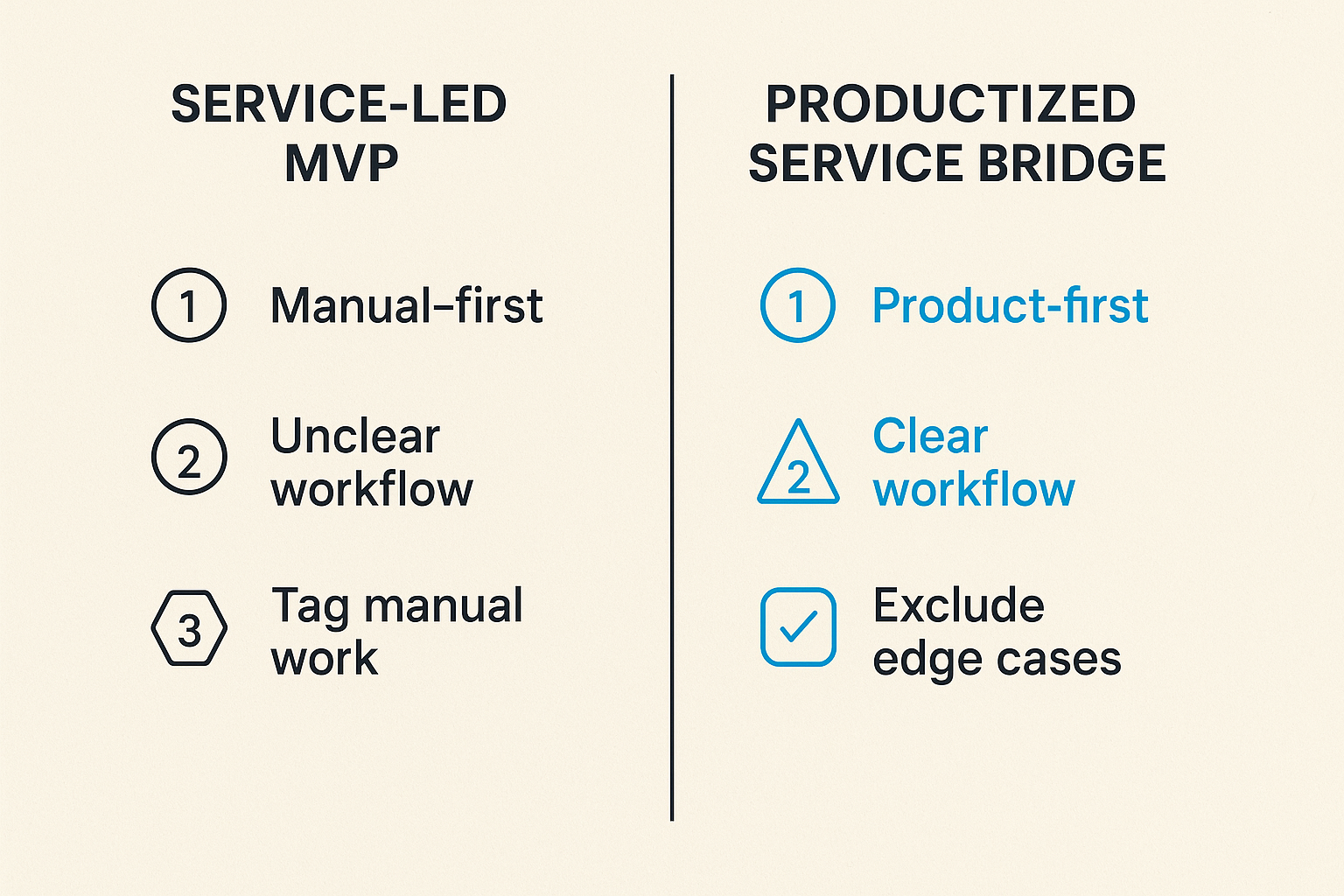
Service-led MVP
A service-led MVP starts with manual delivery. You sell the outcome first, then use the work to identify what should become software.
This is usually the best model when the customer problem is real but the workflow is unclear. For example, a founder building a proposal automation tool for freelance designers may begin by manually reviewing proposals, identifying patterns, and delivering improved versions. The product comes later.
The risk is that you stay a freelancer forever. To avoid that, tag every piece of manual work as one of three things:
- Repeatable and ready for software
- Judgment-heavy and worth keeping human
- Edge-case work that should be excluded or priced separately
Paid pilot
A paid pilot is narrower. You recruit a small group of customers, charge them, and run the workflow under close observation.
This works when you already know the target buyer and have enough product to deliver a partial outcome. The pilot should have a fixed timeline, a clear success condition, and a decision point at the end.
Example pilot structure:
pilot:
  buyer: freelance video editors serving B2B clients
  promise: reduce revision tracking time
  duration: 21 days
  price: 99
  success_condition: 3 completed client projects tracked
  decision: upgrade, churn, or interview
The important part is the decision. A pilot without a decision becomes discounted support.
Productized service bridge
The productized service bridge is the middle path. You package the outcome like software but keep some manual delivery behind the scenes.
This can be powerful for freelancers because the customer buys clarity. They do not need to know whether every step is automated on day one. They need the result to arrive reliably.
| Launch model | Best when | Main risk | Operator discipline |
|---|---|---|---|
| Service-led MVP | Workflow is still unknown | Becoming a custom agency | Track repeatable work |
| Paid pilot | Buyer is known but product is early | Over-supporting a tiny cohort | Define success conditions |
| Productized service bridge | Outcome is clear but automation is partial | Hiding too much manual work | Separate promises from implementation |
Practical rule: Choose the launch model based on workflow uncertainty, not founder preference. More uncertainty means more manual observation.
Validate demand with work you can invoice
Replace surveys with paid commitments
Survey responses are cheap. Calendar calls are better. Paid commitments are best.
This does not mean every validation step must be high-ticket. It means the buyer should give up something scarce: money, time, access, or workflow change. If they will not do any of those, you probably do not have launch demand yet.
For a freelancing product launch, paid validation can look like:
- A small audit
- A paid setup session
- A one-week workflow trial
- A paid template bundle with support
- A founder-led implementation package
The point is not to maximize revenue at this stage. The point is to prove that the pain is real enough for the buyer to act.
Use freelancers as market sensors
Freelancers sit close to operational pain. They know which client requests repeat, which deliverables create confusion, which tools are duct-taped together, and where buyers resist paying.
That makes freelancer-led products especially interesting. The team at ugig.net spends a lot of time around freelancers and gig workers using AI and workflow strategy, and the pattern is consistent: the best product ideas often start as repeated client friction, not abstract market research.
If you are building from freelance experience, keep a simple issue log:
- Request: what the client asked for
- Current fix: how you solved it manually
- Frequency: how often it happens
- Buyer language: exact phrases used
- Product candidate: what could be automated
This is more useful than a generic feature backlog because it preserves the buyer context.
Define the promise in operational terms
A weak launch promise sounds like this: project management for freelancers.
A stronger promise sounds like this: help freelance marketers collect approvals, content, and feedback from clients before kickoff so projects do not stall in week one.
The second promise is operational. It names the user, the workflow, the failure mode, and the timing. That makes it easier to build, sell, and support.
Practical rule: If your promise cannot be observed inside a real project, it is probably too vague for launch.
Design the offer as a workflow, not a feature list
The core job statement
Before you write the landing page, write the job statement.
Use this format:
When [specific user] needs to [workflow moment], they use [product] to [outcome] without [painful alternative].
Example:
When freelance copywriters onboard a new client, they use the product to collect brand inputs and approval rules without running three discovery calls.
This gives you a useful constraint. Anything that does not support the workflow moment is probably not needed for launch.
Boundaries, exclusions, and support
A freelancing product launch fails when the offer is too open-ended. Freelance markets are full of edge cases. Every client thinks their process is unique. Every freelancer has a slightly different stack.
You need boundaries before launch day.
Define:
- Supported customer type
- Supported project type
- Required inputs
- Turnaround time
- What is not included
- Support channel
- Refund or cancellation rule
This may feel restrictive, but it improves conversion because serious buyers understand what they are buying.
Pricing that matches risk
Pricing is not only a monetization decision. It is a workflow filter.
Low pricing attracts experimentation and support questions. High pricing attracts scrutiny and implementation expectations. Usage-based pricing can work, but only if customers understand what usage means. Subscription pricing can work, but only if the product is used repeatedly.
For early launches, simple pricing usually wins:
- One fixed pilot price
- One setup fee plus monthly access
- One package tied to a clear deliverable
The mistake teams make is copying SaaS pricing before they understand delivery cost. If every customer needs founder attention, price the offer like a founder-assisted workflow.
Build a launch stack that preserves state
Source of truth
Your launch stack can be simple. It cannot be state-blind.
At minimum, you need one place where every customer or pilot account has a current status. A spreadsheet, Airtable, Notion table, Linear project, or internal admin panel can work. The tool matters less than the discipline.
Track fields like:
account:
  name: acme studio
  segment: freelance design agency
  plan: pilot
  current_state: waiting_for_client_inputs
  owner: founder
  next_action: send reminder
  risk: missing approvals
  learned: needs client-facing checklist
If you cannot see the state, you cannot improve the workflow.
Handoff points
Every launch has handoffs. The buyer moves from ad to page, page to signup, signup to onboarding, onboarding to first value, first value to renewal or referral.
What breaks in practice is not always the product. It is the handoff.
Common weak handoffs:
- Signup confirmation does not explain the next step
- Onboarding asks for information the user does not have yet
- The founder promises something the product cannot track
- Support learns about bugs that never reach the roadmap
- Customers complete the pilot but never get an upgrade path
Map the handoffs before you launch. You do not need a giant process diagram. You need to know where customers can get stuck.
Lightweight automation
Automation should reduce ambiguity, not hide it.
Good early automation:
- Confirmation emails with next steps
- Reminders for missing inputs
- Status updates when work changes stage
- Internal alerts for stuck accounts
- Simple webhook logs for critical events
Bad early automation:
- Complex lifecycle campaigns before you know the lifecycle
- AI responses without escalation rules
- Auto-generated deliverables no one reviews
- Integrations that create silent failures
A good launch stack lets you see the work. A bad launch stack makes the work feel automated until a customer complains.
The freelancing product launch workflow
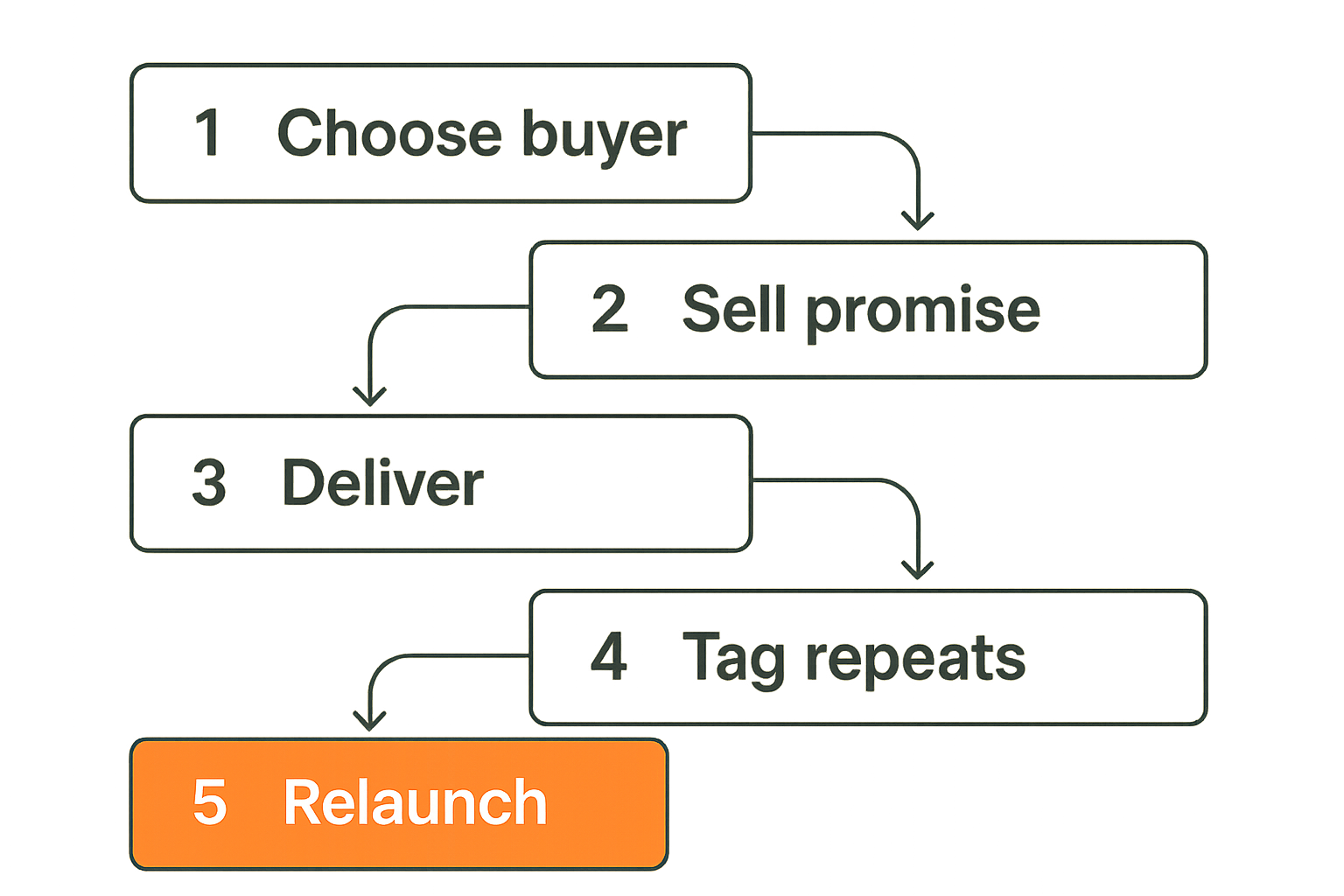
Step 1: choose a narrow buyer
Do not launch to freelancers. Launch to a specific type of freelancer in a specific workflow.
Better segments:
- Freelance SEO consultants managing monthly client reporting
- Freelance designers collecting feedback on brand concepts
- Fractional CFOs onboarding small business clients
- No-code builders scoping fixed-price projects
- Video editors managing revision notes from agencies
A narrow buyer improves your messaging and your product decisions. You can always expand later. Early breadth creates vague feedback.
Step 2: ship the smallest paid promise
The smallest paid promise is not the smallest feature. It is the smallest outcome someone will pay for.
A practical workflow:
- Pick one buyer segment.
- Interview five to ten people who recently experienced the problem.
- Write the operational promise in one sentence.
- Sell a paid pilot or productized service package.
- Deliver the outcome manually where needed.
- Record every repeated manual step.
- Build only the steps that repeat across customers.
- Relaunch the improved workflow to the next cohort.
This sequence keeps you out of the common trap: building software for work you have not delivered yet.
Step 3: convert repeated work into product
After the first cohort, review the work log. Do not ask what features users requested first. Ask what work repeated.
Look for patterns:
- Inputs customers struggled to provide
- Decisions you made more than twice
- Deliverables that followed a consistent structure
- Reminders you sent manually
- Support questions that shared the same root cause
Those patterns become product surface area. The product should absorb repeatable work, expose important state, and leave judgment-heavy moments visible.
Practical rule: Build software around repeated work, not around the loudest feature request.
What breaks when teams launch badly
Confused customer ownership
In a freelancing product launch, ownership gets blurry fast. Is the freelancer the customer? Is their client the customer? Is the agency owner the buyer and the contractor the user?
If you do not define this, your launch messaging will drift. Your onboarding will ask the wrong person for the wrong information. Your support conversations will split across stakeholders.
Write down three roles:
- Buyer: who pays
- User: who operates the workflow
- Beneficiary: who receives the outcome
Sometimes all three are the same person. Often they are not.
Manual work with no feedback loop
Manual work is not the enemy. Invisible manual work is the enemy.
If the founder manually fixes every broken onboarding, every confusing request, and every missing input without tagging the root cause, the product never learns. The launch looks successful because customers are being helped, but the system is not improving.
Use a simple failure tag list:
missing_input
unclear_promise
unsupported_use_case
bug
pricing_mismatch
customer_not_ready
manual_judgment_required
Review the tags weekly. If the same tag appears repeatedly, it deserves a product, positioning, or process decision.
Support debt after launch week
Launch week creates a temporary high. You get signups, comments, replies, and maybe revenue. Then support debt arrives.
Support debt includes unanswered onboarding questions, unclear account states, custom promises, refunds, and half-configured pilots. It is dangerous because it steals attention from product learning.
The fix is boring but effective: capacity planning.
Before launch, decide:
- How many pilots can we support this week?
- Who responds to support?
- What response time do we promise?
- What requests are out of scope?
- When do we stop accepting new pilot users?
Scarcity is not a failure. An overloaded launch is.
Metrics for a freelancing product launch
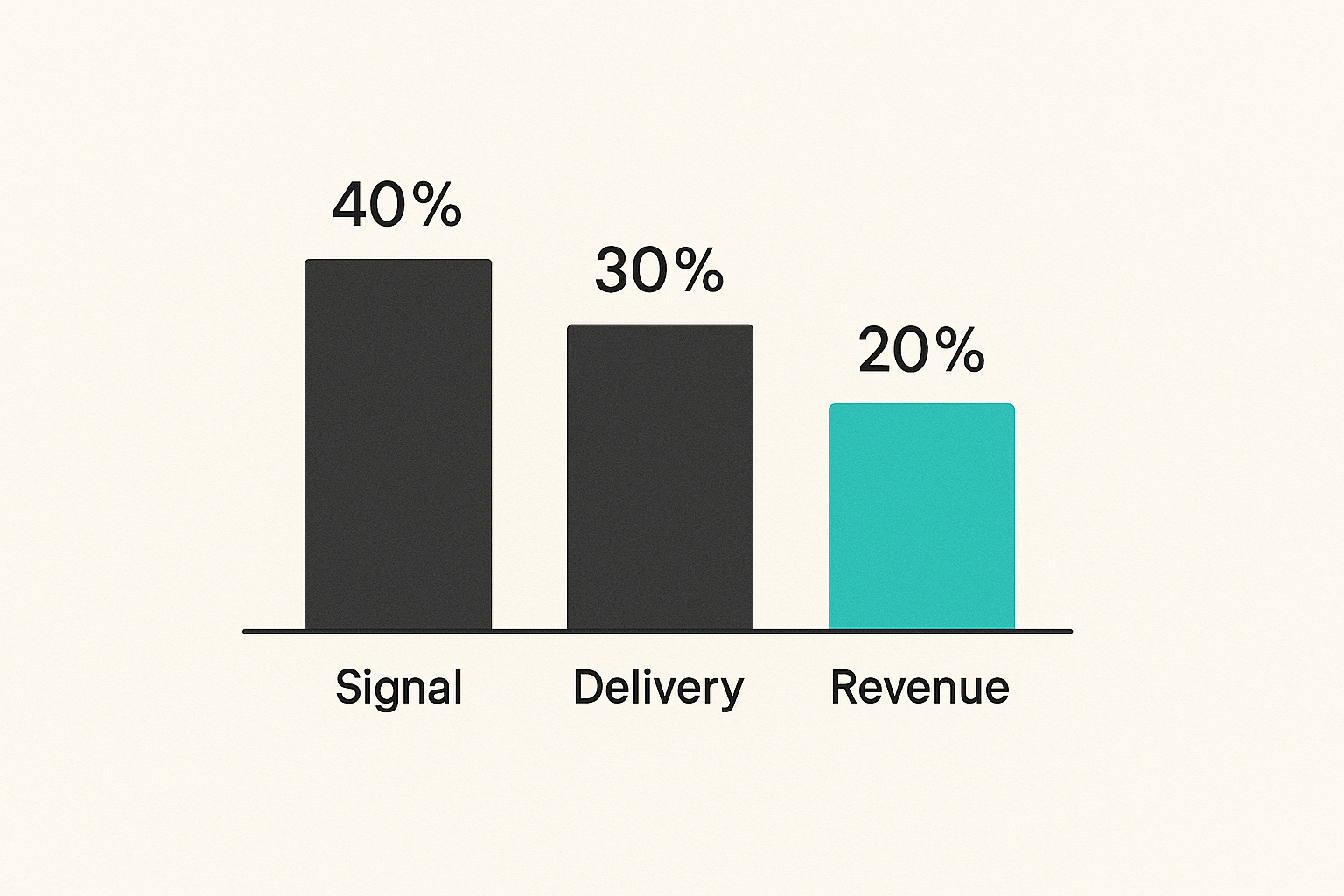
Signal metrics
Vanity metrics are especially tempting during a freelancing product launch because the story is relatable. People like founder journeys, AI workflows, and freelancer tools. Attention can feel like validation.
Signal metrics are closer to behavior:
- Qualified conversations booked
- Paid pilots sold
- Activation rate from signup to first project
- Time from signup to first useful output
- Percentage of users who invite a client or collaborator
These metrics show whether the workflow is entering real work.
Delivery metrics
Delivery metrics tell you whether the promise is operationally viable.
Track:
- Average time to complete onboarding
- Number of manual interventions per account
- Missing input rate
- Support tickets per active project
- Rework or revision count
- Time stuck in each workflow state
These are not glamorous, but they show where the product needs to improve. If every account gets stuck waiting for client input, the next feature may be a client-facing checklist, not another dashboard widget.
Revenue metrics
Revenue matters, but early revenue needs context.
Useful revenue questions:
- Did customers pay before the product was perfect?
- Did they renew after the first outcome?
- Did they expand usage across more projects?
- Did pricing cover the manual work required?
- Did customers refer others in the same workflow?
A launch with ten serious paid pilots may be more useful than a launch with hundreds of free signups. Free users can help with learning, but only if they behave like the eventual buyer.
What works and what fails
What works
The launches that work usually have less drama than people expect. They are narrow, specific, and operationally honest.
What works:
- A buyer segment with repeated pain
- A paid promise tied to a real workflow
- Founder-led delivery where the workflow is still uncertain
- A visible state model for every account
- A feedback loop from support to roadmap
- Clear exclusions for unsupported use cases
- A launch cadence that ships improvements in cohorts
This is not as exciting as a huge public launch, but it creates a better business foundation.
What fails
What fails is usually overreach.
Teams launch to every freelancer, support every project type, promise automation before the workflow is understood, and then wonder why the product feels messy.
Common failure modes:
- Broad positioning that attracts low-fit users
- Feature lists that do not map to a workflow
- Free plans that generate support but no urgency
- Manual delivery that is not measured
- No decision point after pilots
- No owner for customer state
- Roadmap driven by anecdotes instead of repeated work
The practical question is whether your launch teaches you how to build the next version. If it only creates noise, it is not a launch system.
Decision table
Use this table when deciding what to build, sell, or defer.
| Situation | Build now | Keep manual | Exclude for now |
|---|---|---|---|
| Happens in most customer workflows | Yes | Only if judgment-heavy | No |
| Happens rarely but blocks delivery | Maybe | Yes, with tag | Maybe |
| Requested by one large prospect | Not by default | Maybe | Often |
| Requires sensitive customer judgment | Not fully | Yes | No |
| Creates support confusion | Yes, if repeated | Short term | No |
| Expands outside target segment | No | No | Yes |
Practical rule: A launch roadmap should be based on repeated workflow evidence, not the emotional weight of the latest customer call.
How sh1pt.com fits into the launch operating system
Document the launch path
A freelancing product launch benefits from a visible shipping record. You need to know what changed, why it changed, and what you learned from each cohort.
That is where a launch-focused platform like sh1pt.com fits naturally. The value is not simply posting an update. It is turning shipping into a traceable product practice: what you shipped, who it was for, what feedback came back, and what you will change next.
For founder-led products, this matters because memory is unreliable. Launch week feels vivid, then details disappear. A documented launch path keeps your decisions connected to reality.
Turn shipping into a repeatable cadence
The first launch is rarely the real launch. The real launch is the sequence of improvements that follows.
A useful cadence might look like this:
- Week 1: sell and onboard pilot cohort
- Week 2: deliver manually and tag failure modes
- Week 3: ship workflow fixes
- Week 4: relaunch to a tighter segment
- Week 5: compare activation and delivery metrics
This keeps momentum grounded. You are not shipping for the sake of shipping. You are shipping against evidence from real users.
Keep the founder close to reality
Founders often want to automate themselves out of the process too early. That is understandable. Manual work is tiring. But in the early stages, the founder needs direct contact with the workflow.
The goal is not to stay manual forever. The goal is to observe enough reality to build the right product.
sh1pt.com is a good fit when you want a practical place to frame launches, track product movement, and keep the shipping narrative tied to actual user progress. For indie hackers and small teams, that operating rhythm is more useful than another disconnected marketing artifact.
Closing: make the launch smaller, not louder
A freelancing product launch works best when it is narrow enough to learn from and structured enough to survive real customers.
The mistake teams make is trying to look like a mature SaaS company on day one. They hide the manual parts, broaden the message, and optimize the page before the workflow is stable.
Do the opposite. Pick a narrow buyer. Sell a small paid promise. Deliver it with enough manual involvement to understand the work. Track state. Tag failures. Convert repeated work into product. Then launch again.
That is how a freelancing product launch becomes more than a moment of attention. It becomes a shipping system.
Try sh1pt.com
sh1pt.com helps builders document launches, share product progress, and turn shipping into a repeatable cadence. Try sh1pt.com.