
There is a specific kind of founder who has done everything right — sourced a solid peptide formulation, nailed the positioning, built a clean landing page — and then watched the launch collapse anyway. The cart converts at 0.8%. The payment processor flags the account on day three. Customer support drowns in "where is my order" tickets. The product was fine. The system around it was not.
Teams think the problem is traffic or copy. The real problem is that a peptide product launch is an architecture decision, not a campaign decision. The moment you treat it as purely a marketing problem, you build the wrong stack, pick the wrong rails, and create fragility that compounds every time you scale.
This post is about the operational and technical layer — the checkout flow, the payment rails, the compliance surface, the post-purchase state machine — that determines whether a peptide launch survives first contact with real customers. The marketing comes after you have a system that can actually fulfill demand without catching fire.
Table of contents
- Why peptide launches fail in the system layer, not the market layer
- Mapping the compliance surface before you build anything
- Choosing payment rails that will not terminate your account
- Designing a checkout flow that does not leak conversions
- Inventory and fulfillment state: the backend nobody designs upfront
- Post-purchase operations: where most launches quietly die
- Pricing architecture and the subscription trap
- The launch-day runbook: a sequenced approach
- What breaks at scale that worked in beta
- Product-fit: connecting your launch stack to the right tools
Why peptide launches fail in the system layer, not the market layer
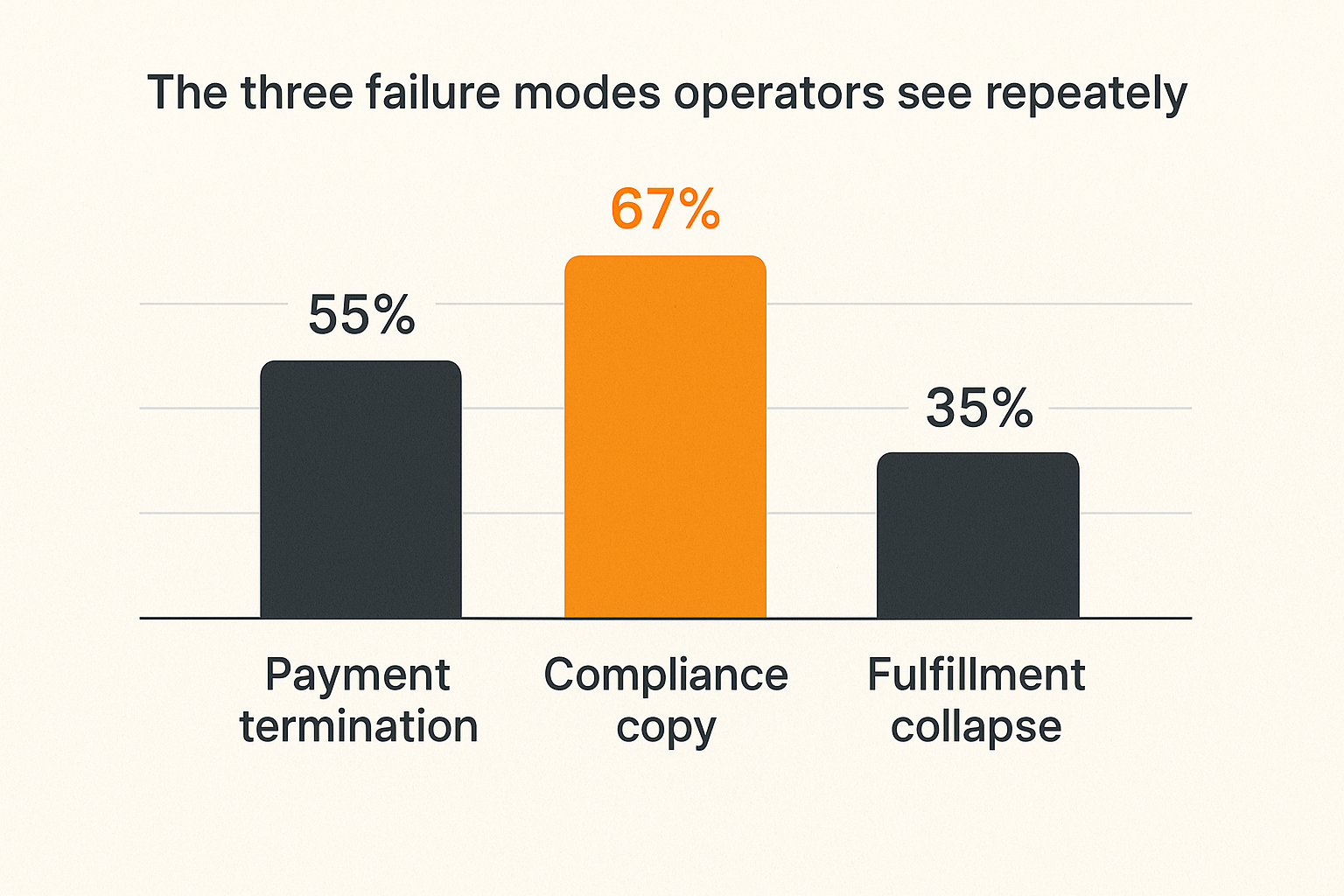
The pattern is consistent across many independent peptide operators: strong pre-launch interest, a waitlist that looked promising, and then a launch week that surfaces three or four simultaneous system failures. These are not bad products. They are products sitting on infrastructure that was never designed for the specific operational reality of peptide commerce.
The mistake teams make is treating the launch as a one-day event rather than the first stress test of a system that needs to run for years. That reframe changes what you build in the weeks before you go live.
The three failure modes operators see repeatedly
Payment processor termination. Peptides occupy a gray zone in many processors' category risk models. A successful launch — real volume, real customers — can trigger a review that freezes funds and suspends the account precisely when momentum is highest. Founders who built their entire checkout on a single processor have no fallback.
Compliance-triggered copy changes at the worst moment. A lawyer review, a platform policy flag, or an ad disapproval forces a last-minute landing page edit. If your checkout copy, product descriptions, and ad creative are not modularly separated, one change cascades into broken links, inconsistent claims across pages, and a checkout flow that no longer matches the promise that brought the customer there.
Fulfillment state collapse. Orders arrive faster than the 3PL expected. Cold-chain constraints are not encoded into the shipping logic. The system happily accepts orders for a Friday ship that will sit in a warehouse over a weekend. Customers do not know any of this until the product arrives degraded.
What makes peptides structurally different from other physical products
Peptides are not supplements in the regulatory sense, and they are not pharmaceuticals in the operational sense. That middle position creates a specific set of architecture requirements:
- Claims sensitivity: What you say on the page determines which compliance bucket you fall into. This affects not just legal exposure but which payment processors will touch your account and which ad platforms will run your creative.
- Cold-chain requirements: Unlike a vitamin that ships ambient, many research peptides require refrigeration in transit — which means your shipping logic, carrier selection, and geographic cutoffs all carry real stakes.
- Customer sophistication variance: Buyers range from informed researchers who know exactly what they want to first-time buyers who need significantly more post-purchase handholding. A single post-purchase flow does not serve both groups well.
- Repeat purchase dependency: The unit economics of most peptide businesses require a second and third order. That means the subscription or reorder architecture is not a nice-to-have — it is the business model.
Practical rule: If your launch architecture would work just as well for a generic supplement, it is not designed for peptides specifically. The compliance surface, payment rails, and fulfillment constraints are categorically different and need to be treated that way.
Mapping the compliance surface before you build anything
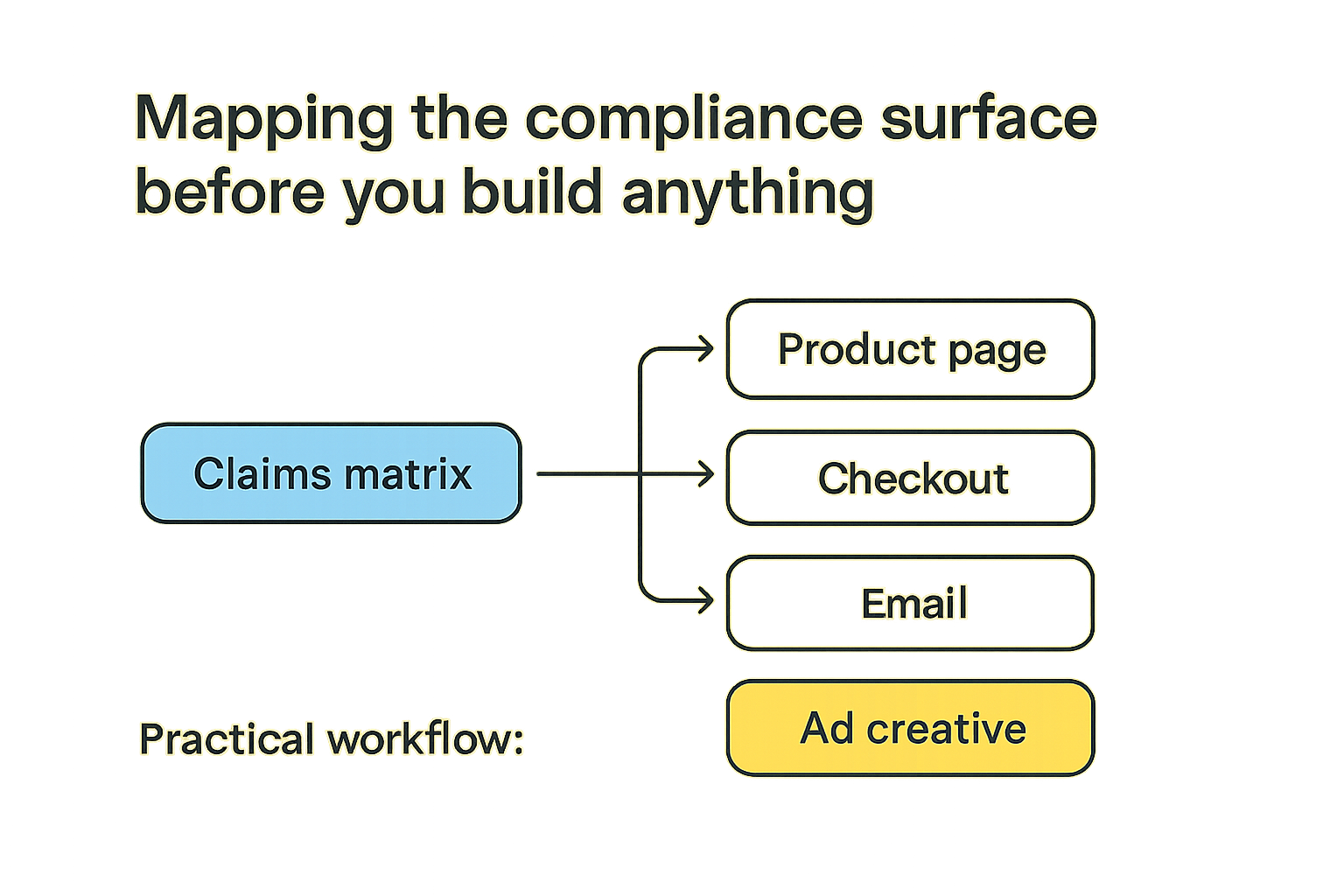
Compliance is not a legal checkbox you do once before launch. It is a continuous surface that interacts with your checkout copy, your ad creative, your email sequences, and your payment processor's risk model. The practical question is: where exactly is the line, and is your copy consistently on the right side of it everywhere it appears?
Labeling, claims, and the checkout copy problem
Most founders write the marketing copy first and figure out the compliance angle afterward. That is the wrong order. The claims you can legitimately make determine your product category, and your product category determines which channels, processors, and platforms are available to you.
For research peptides specifically, the standard approach is "for research purposes only" framing — but that framing has to be consistent across every touchpoint: product page, checkout, confirmation email, packing slip, and any retargeting creative. A single inconsistent claim on a product detail page can be enough to trigger a processor review.
The practical workflow:
- Establish the exact claims language with your legal counsel before writing any copy.
- Create a claims matrix — a simple table mapping each product to the approved language for each touchpoint.
- Build your copy templates from the matrix, not from scratch on each page.
- Run a claims audit before launch, checking every URL that a customer or processor might index.
Jurisdiction triggers you cannot paper over
Shipping geography is compliance geography. Some jurisdictions have explicit restrictions on peptide imports. Others have gray zones that create chargeback risk even when the product gets through. The mistake teams make is building a global-default checkout and adding geo-blocks reactively after the first problem surfaces.
The right architecture: define your serviceable markets before launch, encode geographic restrictions in the checkout (not just in the shipping settings), and display clear messaging to blocked geographies rather than letting them complete an order that will fail in fulfillment.
This also affects your payment rail selection. Some processors have their own country-level risk policies that are stricter than the legal reality in that market. Know both layers before you choose your stack.
Choosing payment rails that will not terminate your account
This is the single most underprepared aspect of a peptide product launch, and it is where the most expensive failures happen. A payment processor termination after a successful launch does not just pause revenue — it can freeze funds for 90 to 180 days during a review period. That can kill a bootstrapped business at its best moment.
Why standard card processors are a liability on launch day
Card processors assign merchant category codes and run ongoing risk monitoring. A peptide merchant in a health-adjacent category will typically hit elevated scrutiny at a few predictable thresholds: first real transaction volume, first chargeback, or any spike in dispute rate. The problem is that these reviews happen algorithmically and asynchronously — you do not get a warning, you get a termination email.
The comparison table below captures the structural trade-off:
| Rail | Risk tolerance | Termination risk | Chargeback exposure | Reversibility |
|---|---|---|---|---|
| Standard card (Stripe, Square) | Low for gray-zone products | High at volume | High | Low — funds can be held |
| High-risk card processor | Medium | Medium | Medium | Medium — higher fees offset risk |
| Crypto (USDC, BTC, ETH) | High | Very low | Near zero | High — settlement is direct |
| ACH / bank transfer | Medium | Low | Low | Medium — slower settlement |
| Hybrid (card + crypto fallback) | High | Low overall | Medium | High |
The practical answer for most peptide operators is a hybrid architecture: a primary card rail for mainstream buyers plus a crypto rail as a genuine operational fallback, not an afterthought. The team at coinpayportal.com builds exactly this kind of payment infrastructure for merchants operating in compliance-sensitive categories — the architecture pattern of maintaining parallel rails with independent settlement is a key operational protection.
Crypto and alternative rails as a structural backstop
The case for crypto payment rails in a peptide launch is not ideological — it is architectural. Crypto settlement is direct, irreversible, and does not pass through a processor that can terminate the account. For a merchant category with elevated processor risk, that is a meaningful operational hedge.
Practical considerations:
- Display pricing in fiat but accept settled in stablecoin (USDC) to eliminate volatility exposure.
- Use a payment processor that handles the conversion and reconciliation, not raw wallet addresses in your checkout.
- Ensure your order management system can handle both card and crypto order sources in the same fulfillment queue.
- Test the crypto checkout path with real transactions before launch — the UX drop-off for crypto-unfamiliar buyers is real and measurable.
Practical rule: Never launch a high-compliance-risk product category with a single payment rail. The question is not whether the secondary rail will be needed — it is when.
Designing a checkout flow that does not leak conversions
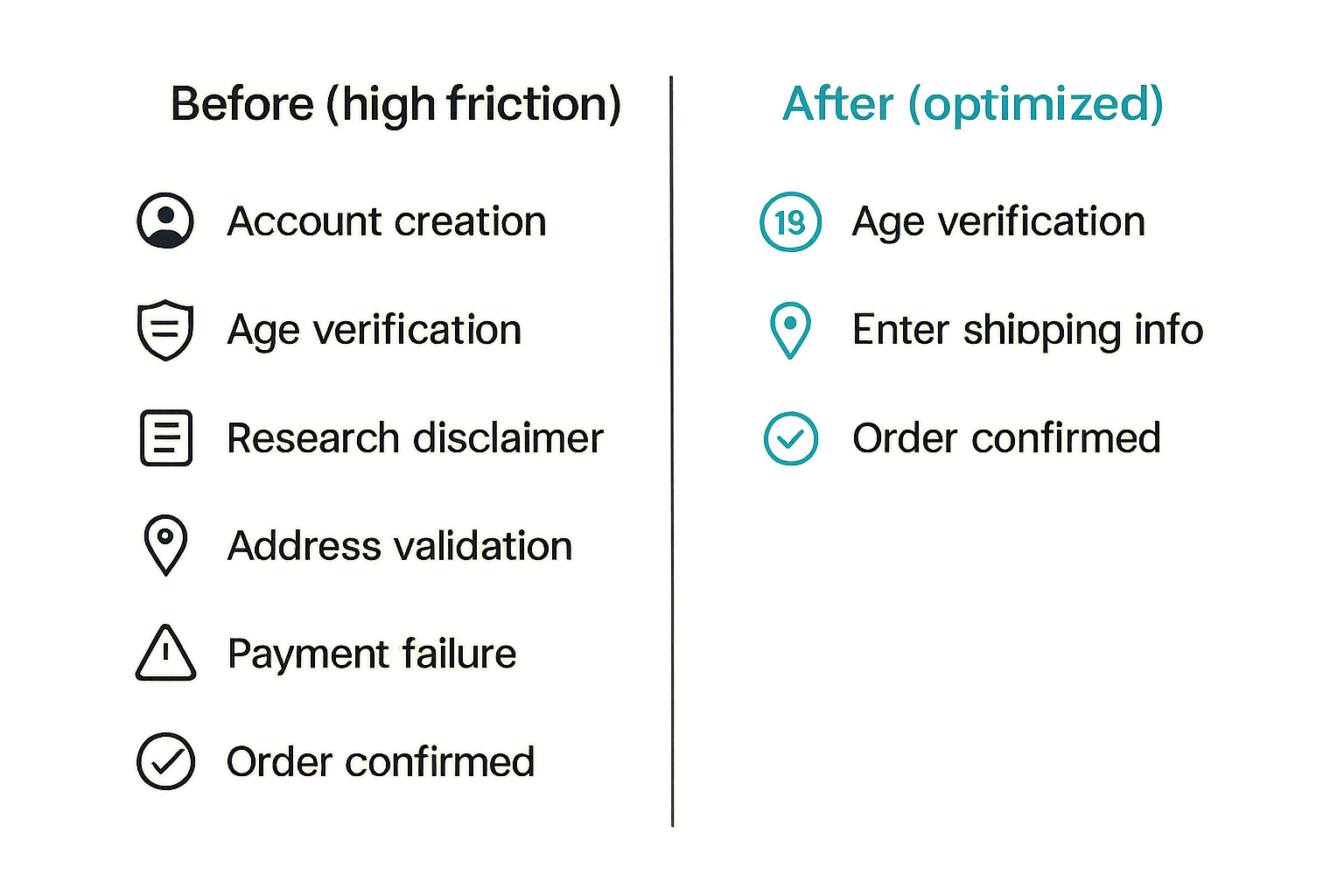
Payment rail selection gets you the ability to process. Checkout design determines whether customers actually complete the transaction. These are separate problems that interact in specific ways for peptide buyers.
The friction audit before launch
A useful way to think about checkout friction is: every field, every redirect, and every trust gap is a potential exit. For peptide buyers specifically, there is an added layer — because the product category carries some stigma in mainstream culture, buyers who feel uncertain at any point in the funnel will exit without asking for help.
Run a friction audit before launch by mapping every step from ad click to order confirmation and classifying each step as necessary friction (required for compliance, legal, or fulfillment reasons) or unnecessary friction (legacy UX, lazy default settings, or missed optimization). Cut everything in the second category.
Common unnecessary friction in peptide checkouts:
- Requiring account creation before purchase
- Age verification pages that do not auto-submit on confirmation
- Research use disclaimers that require active acknowledgment on every order (once per customer is sufficient)
- Shipping address validation that rejects valid research facility addresses
- Payment failure messages that do not suggest the crypto fallback option
Trust signals that actually move peptide buyers
Generic social proof ("5000+ happy customers") performs poorly in a category where buyers are sophisticated and skeptical. What moves peptide buyers:
- Third-party lab certificates of analysis (COAs) accessible directly from the product page, not behind a form
- Visible batch numbers that tie to the COA
- Clear sourcing and manufacturing information
- A real support contact — not just a contact form
- Transparent shipping policies, including cold-chain handling and delivery windows
None of this is marketing fluff. Each element maps to a specific buyer objection that, if unresolved, becomes a checkout exit.
Inventory and fulfillment state: the backend nobody designs upfront
The checkout converts. The payment clears. Then what? For many peptide launches, the answer to that question was not fully designed before the first order arrived. That is where fulfillment state collapse happens.
Oversell protection and the order state machine
Inventory management for peptides has a few specific wrinkles. Peptides have shelf lives and storage requirements that make overstock a real cost. That means you are often operating with tighter inventory buffers than a standard physical product — which makes oversell protection more critical, not less.
Your order state machine needs explicit states for: order received, payment confirmed, inventory allocated, picked and packed, shipped, delivered, and any failure path at each stage. The mistake teams make is building only the happy path and handling failures with manual intervention. Manual intervention does not scale past 50 orders a day.
At minimum, your system needs:
- Inventory reservation on payment confirmation (not on order creation)
- Automated cancellation and notification if inventory runs out post-reservation
- Backorder handling with explicit customer communication
- A mechanism to block new orders for out-of-stock variants without taking the product page offline
Cold-chain and shipping constraint handling
If your peptides require refrigeration in transit, your shipping logic needs to encode the following constraints:
- No Friday or pre-holiday ship dates for products requiring cold-chain (prevents weekend transit degradation)
- Carrier selection logic that prefers services with validated cold-chain capability
- Geographic cutoffs for destinations where cold-chain cannot be guaranteed in transit time
- Explicit customer notification when a cold-chain order is held for the next viable ship window
Customers who receive a degraded product do not just request a refund — they dispute the charge and leave a review. The cold-chain logic is not an operational detail; it is chargeback prevention.
Practical rule: If your shipping configuration was copied from a non-perishable product store, it is wrong for peptides. Review every shipping rule against your cold-chain requirements before taking a single live order.
Post-purchase operations: where most launches quietly die
The launch day looks like a success. Revenue is in. Then the support queue fills up, the chargeback rate climbs, and the founder is spending 6 hours a day on customer service instead of building. This is the quiet post-launch failure mode.
Notification architecture that reduces support load
The single highest-ROI investment in post-purchase operations is a proactive notification sequence that answers the customer's next three questions before they ask them. For peptide orders:
- Order confirmation (immediate): order number, itemized order, expected dispatch window, research use reminder
- Dispatch notification (on ship): tracking number, carrier, estimated delivery, cold-chain handling instructions
- Delivery window alert (24 hours before estimated delivery): reminder to receive promptly, storage instructions upon receipt
- Post-delivery follow-up (48 hours after delivery): storage confirmation prompt, COA download link, reorder link
Each notification maps to a specific support ticket category. If you eliminate the ticket, you eliminate the support cost. Teams that send only an order confirmation and a tracking number generate 3 to 5x the support volume of teams with a full notification sequence.
Returns, chargebacks, and dispute surface area
Peptide returns are operationally complex because a returned product may not be safely resellable (cold-chain break, unknown storage conditions). That means your return policy needs to be specific about what qualifies for a refund versus a replacement, and your checkout needs to display that policy clearly before purchase.
Chargeback surface area expands when:
- The business name on the card statement does not match the brand name the customer knows
- Shipping delays exceed the estimated delivery window without proactive notification
- The product description on the checkout page does not match what arrived
- Customers cannot find your support contact and go straight to their bank
All four of these are systems problems, not customer problems. Fix the system.
Pricing architecture and the subscription trap
One-time versus subscription: the operational difference
Subscription revenue looks attractive in a peptide business because repeat purchase is the unit economics engine. The operational trap is that subscription infrastructure is significantly more complex than one-time purchase infrastructure, and most founders underestimate that complexity until they have subscribers who cannot manage their own accounts.
The minimum viable subscription stack for a peptide business:
- Self-serve pause, skip, and cancel (non-negotiable — if customers have to email to cancel, your chargeback rate will tell you)
- Upcoming charge notifications (7 days and 2 days before billing)
- Failed payment retry logic with customer notification (dunning)
- Subscription-specific fulfillment handling (different picking queue, different packaging, different SLA)
Dunning, failed payments, and churn mechanics
Failed subscription payments in a high-compliance category carry a specific risk: a failed payment that is retried too aggressively looks like unauthorized charge attempts and can trigger card network flags. The practical approach:
- First retry: 3 days after failure, no customer notification
- Second retry: 7 days after failure, send customer a payment update request
- Third retry: 14 days after failure, final notice before cancellation
- Cancel: 21 days after initial failure, with a reactivation link in the cancellation email
That sequence balances revenue recovery against dispute risk. Tighter retry windows increase recovery but also increase fraud flags.
The launch-day runbook: a sequenced approach
Pre-launch validation gates
A launch runbook is only useful if it has explicit go/no-go criteria at each stage. Here is a practical sequence:
- T-14 days: Claims audit complete. Every URL checked against the claims matrix.
- T-14 days: Payment rails tested with live transactions. Both primary and secondary rails confirmed operational.
- T-7 days: Fulfillment partner briefed on expected volume range and cold-chain requirements confirmed.
- T-7 days: Notification sequences tested end-to-end with test orders.
- T-3 days: Geo-blocks verified. Blocked geographies show correct messaging, not an error page.
- T-1 day: Support team (even if that is just you) has response templates ready for the top 10 expected tickets.
- T-0: Monitor payment processor dashboard, fulfillment queue, and support inbox in real time for the first 4 hours.
Day-of monitoring and kill-switch criteria
Define your kill-switch criteria before launch day, not during it. Pre-committed thresholds remove the emotional component from a high-pressure decision:
- Payment processor flags: If the primary rail shows any account review notification, immediately route new orders to the secondary rail.
- Fulfillment queue backup: If unshipped orders exceed a threshold (define this based on your 3PL capacity), pause new orders and communicate the delay proactively.
- Support ticket spike: If ticket volume exceeds your defined threshold in the first 2 hours, identify the category causing the spike before it compounds.
What breaks at scale that worked in beta
Payment volume thresholds and processor review triggers
Beta volume — 10 to 50 orders — does not stress-test payment infrastructure. Real launch volume does. Standard card processors often have algorithmic review triggers at specific volume thresholds, and peptide merchants in gray-zone categories hit those triggers faster than mainstream categories.
What breaks: a processor that was fine during beta initiates a rolling reserve at $10K monthly volume. That means 10 to 25% of your revenue is held for 90 to 180 days. For a bootstrapped launch, that can be existential. The mitigation is knowing the threshold before you hit it — ask your processor directly, in writing, what review triggers apply to your account.
Fulfillment partner SLAs and the gap between promised and real
Fulfillment partners quote SLAs based on average conditions. Launch day is not average conditions. The practical reality: a 3PL that promises same-day pick-and-pack for orders received by 1 PM will not meet that SLA on a day when your launch drives 10x their expected order volume.
Build in a buffer between your customer-facing delivery promise and your 3PL SLA. If your 3PL promises a 2-day SLA, your customer-facing promise should be 3 to 4 days. The difference is the gap your support team does not have to explain.
Product-fit: connecting your launch stack to the right tools
Sh1pt.com is built for exactly the problem this post is about: moving from idea to market without the system falling apart in the process. The architecture decisions covered here — payment rail selection, checkout design, fulfillment state, post-purchase operations — are the same categories where launches stall or succeed.
For a peptide product launch specifically, the tooling questions that matter:
- Does your platform give you modular control over checkout copy so compliance changes do not require a full rebuild?
- Can you connect multiple payment rails to the same order management system without custom engineering?
- Does your notification infrastructure support the trigger-based sequence outlined above, or are you limited to manual sends?
- Is your subscription management exposed to customers in a self-serve interface, or is churn handled by support tickets?
A useful way to think about tool selection for a peptide launch: the tool that works for a generic DTC brand probably handles 70% of your requirements. The 30% gap — compliance copy management, payment rail redundancy, cold-chain shipping logic — is exactly where the expensive failures happen. Match your tooling to the category, not just to the product type.
Practical rule: A peptide product launch is a systems design problem wearing a marketing hat. The founders who succeed at it are the ones who build the system before they optimize the campaign.
Try sh1pt.com
sh1pt.com helps indie hackers, founders, and solopreneurs move from idea to market faster — with practical tools and strategies for every stage of the launch. If you are building a product and want to ship it without the system collapsing on day one, start here.