
Peptide startup growth looks attractive from the outside. Demand is visible, search volume exists, communities are active, and founders can point to a market that is already talking about performance, longevity, research, recovery, and clinical innovation.
Then the launch happens. Traffic arrives, but conversion is uneven. Payment providers ask questions. Support tickets pile up around shipping, labeling, documentation, and eligibility. Content performs, but the best-performing posts create the most compliance risk.
Teams think the problem is demand. The real problem is trust architecture.
That changes the conversation. Peptide startup growth is not a campaign you bolt onto a store or clinic workflow. It is a system for acquiring qualified demand, proving operational credibility, routing risky questions correctly, converting without overpromising, and retaining customers through reliable follow-up.
Table of contents
- Peptide startup growth is a systems problem, not a demand problem
- Pick the peptide business model before the growth channel
- Build trust before you buy traffic
- Design the launch funnel like a regulated product workflow
- Peptide startup growth channels that actually compound
- Payments, checkout, and fulfillment are part of growth
- Retention is a post-purchase workflow
- Metrics that matter for peptide startup growth
- Common failure modes that kill momentum
- A 90-day implementation plan for peptide startup growth
- Where sh1pt fits into the launch workflow
Peptide startup growth is a systems problem, not a demand problem
The market is interested but trust is thin
Peptides sit in a complicated category. Depending on the product and market, you may be dealing with research use, clinical workflows, compounding relationships, practitioner referrals, wellness buyers, or B2B infrastructure. The audience is curious, but the trust bar is higher than in a normal consumer supplement launch.
That means the usual startup playbook breaks quickly. A landing page, a few ads, and a checkout button are not enough. Buyers want to know what they are looking at, what it is for, what it is not for, who stands behind it, how it is sourced, how support works, and what happens if something goes wrong.
The practical question is not whether people are interested. They are. The question is whether your workflow can turn interest into qualified, compliant, supportable revenue.
Practical rule: If the category creates regulatory, medical, or trust questions, treat growth as an operating system before you treat it as a marketing channel.
Why launches stall after the first spike
Many peptide startups can create an initial traffic spike. A founder posts in the right community. A launch thread gets attention. A practitioner mentions the brand. A search article starts ranking. The first wave feels like validation.
What breaks in practice is the second week.
The company discovers that customers do not understand the boundaries. Some ask for advice the team should not give. Some orders require manual review. Some payments fail or get flagged. Shipping expectations are unclear. The founder spends evenings answering repetitive questions instead of improving the product.
This is why early peptide startup growth often feels noisy. The team is not short on attention. It is short on routing, qualification, proof, and operational context.
Pick the peptide business model before the growth channel
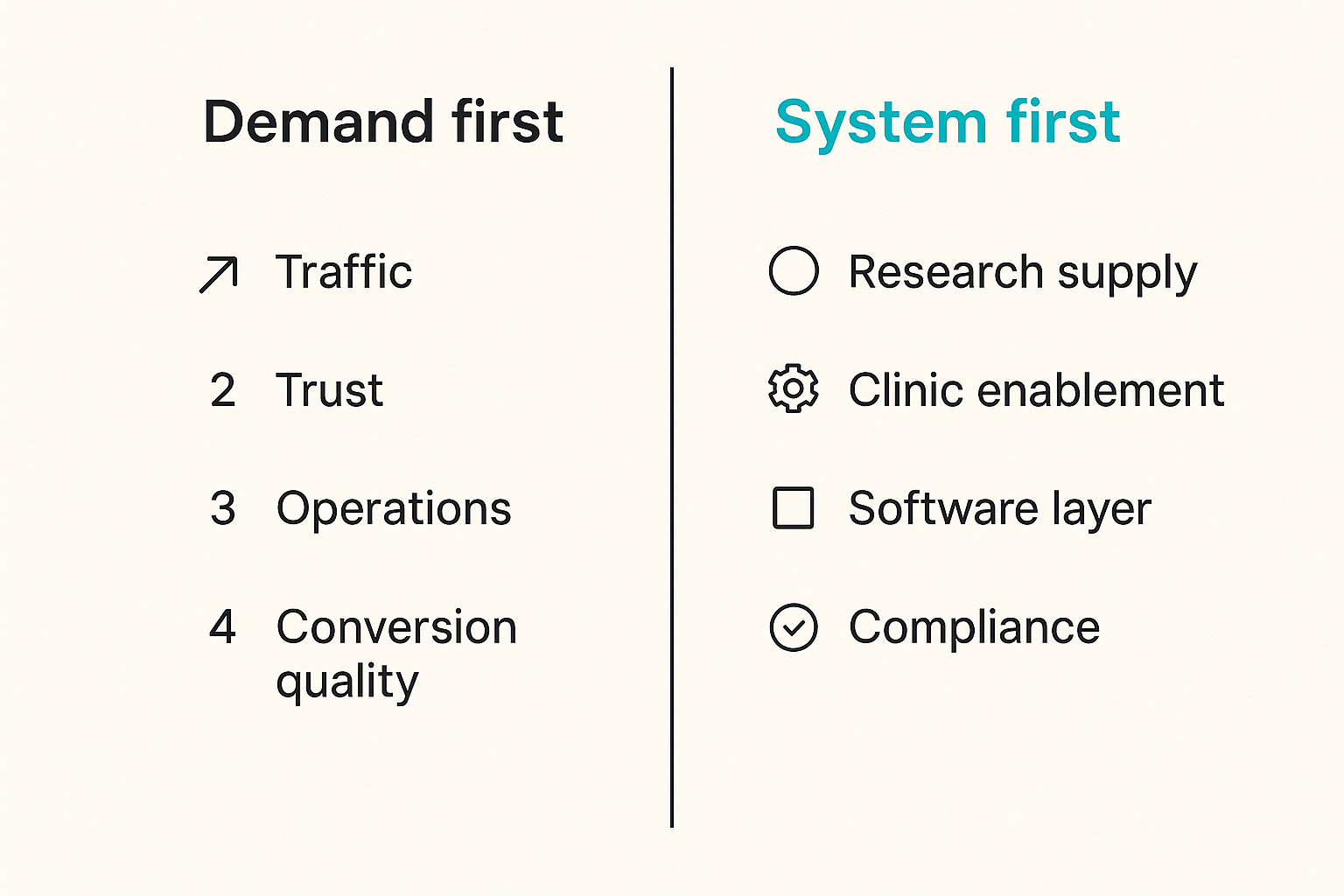
Research supply, clinic enablement, or software layer
The mistake teams make is choosing a channel before choosing the business model. They ask whether they should run SEO, community, paid search, affiliates, practitioner outreach, or partnerships. Those questions matter, but they come after the operating model.
A useful way to think about it is that most peptide startups fall into one of several lanes:
- Research supply and distribution
- Clinic enablement and practitioner workflows
- Patient or customer education platforms
- Compliance, ordering, or inventory software
- Data, logistics, or payments infrastructure around the category
Each lane has a different buyer, risk profile, conversion event, and retention loop. A research supply business may need documentation, batch visibility, and clear usage boundaries. A clinic enablement business may need provider onboarding, intake workflows, scheduling, and follow-up. A software layer may sell to operators who care about integration, audit trails, and reliability.
The model decides your compliance surface
Growth strategy changes when the compliance surface changes. A founder selling software to clinics can publish operational content that would be inappropriate for a direct-to-consumer product page. A research supply business needs extremely clear positioning. A clinic workflow tool needs to support clinical boundaries rather than blur them.
This is not just legal cleanup. It affects copy, onboarding, support macros, landing page structure, analytics, email sequences, and who is allowed to answer which questions.
Practical rule: Do not scale a peptide startup growth channel until you know which questions your team is allowed to answer, which questions require licensed professionals, and which questions should be rejected or redirected.
What changes across models
| Model | Primary buyer | Growth motion | Trust asset | What fails |
|---|---|---|---|---|
| Research supply | Labs, researchers, informed buyers | Search, documentation, repeat ordering | COA-style documentation, sourcing clarity, support boundaries | Vague product pages and claim-heavy content |
| Clinic enablement | Clinics, providers, operators | Sales-led outreach, referrals, workflow demos | Intake process, provider controls, operational proof | Treating clinics like normal ecommerce customers |
| Education platform | Curious consumers, communities, practitioners | SEO, newsletters, expert interviews | Neutral explainers, disclaimers, editorial review | Turning education into implied medical advice |
| Infrastructure software | Merchants, clinics, suppliers | Founder-led sales, integrations, partnerships | API reliability, audit logs, reconciliation | Selling features without showing operational savings |
This table is not about picking the most attractive model. It is about picking the model you can operate responsibly. The best growth channel is the one your business can support without inventing risky workarounds every day.
Build trust before you buy traffic
Proof assets beat claims
In peptide markets, the easiest marketing copy is often the most dangerous. Claims convert attention in the short term, but they also increase support risk, platform risk, payment risk, and reputational risk.
Proof assets are different. They do not ask the buyer to believe a bold promise. They show that the company is real, organized, and accountable.
Useful proof assets include:
- Clear sourcing and manufacturing explanations where appropriate
- Documentation workflows and batch-level references where applicable
- Plain-language category boundaries
- Founder or operator notes explaining decisions
- Support response expectations
- Shipping and handling policies
- Refund, cancellation, and issue escalation paths
- For software products, demos, workflow screenshots, API docs, and changelogs
The point is not to overwhelm buyers with paperwork. The point is to reduce uncertainty before it becomes a support ticket.
Content that educates without overpromising
Educational content can compound, but only if it is built with boundaries. A strong peptide content system does not try to rank for every exciting phrase. It separates informational intent from transactional intent and makes it obvious when a reader needs professional guidance.
What works:
- Explaining terminology without making treatment claims
- Comparing workflows, not outcomes
- Publishing operator notes about sourcing, documentation, or logistics
- Creating buyer guides that focus on due diligence
- Interviewing qualified practitioners when clinical interpretation is involved
What fails:
- Turning every article into a sales page
- Using community anecdotes as proof
- Hiding disclaimers in the footer
- Letting affiliates produce uncontrolled claims
- Publishing content the support team cannot safely defend
A practical trust checklist
Before you push traffic, check whether your site answers the questions a skeptical buyer or partner will ask.
- Who is behind the company?
- What exactly is being offered?
- Who is it for?
- Who is it not for?
- What documentation is available?
- What claims are you not making?
- What happens after purchase or signup?
- Who handles support and escalation?
- What are the shipping, payment, and refund rules?
Practical rule: If trust information only appears after checkout, it is not trust infrastructure. It is damage control.
Design the launch funnel like a regulated product workflow
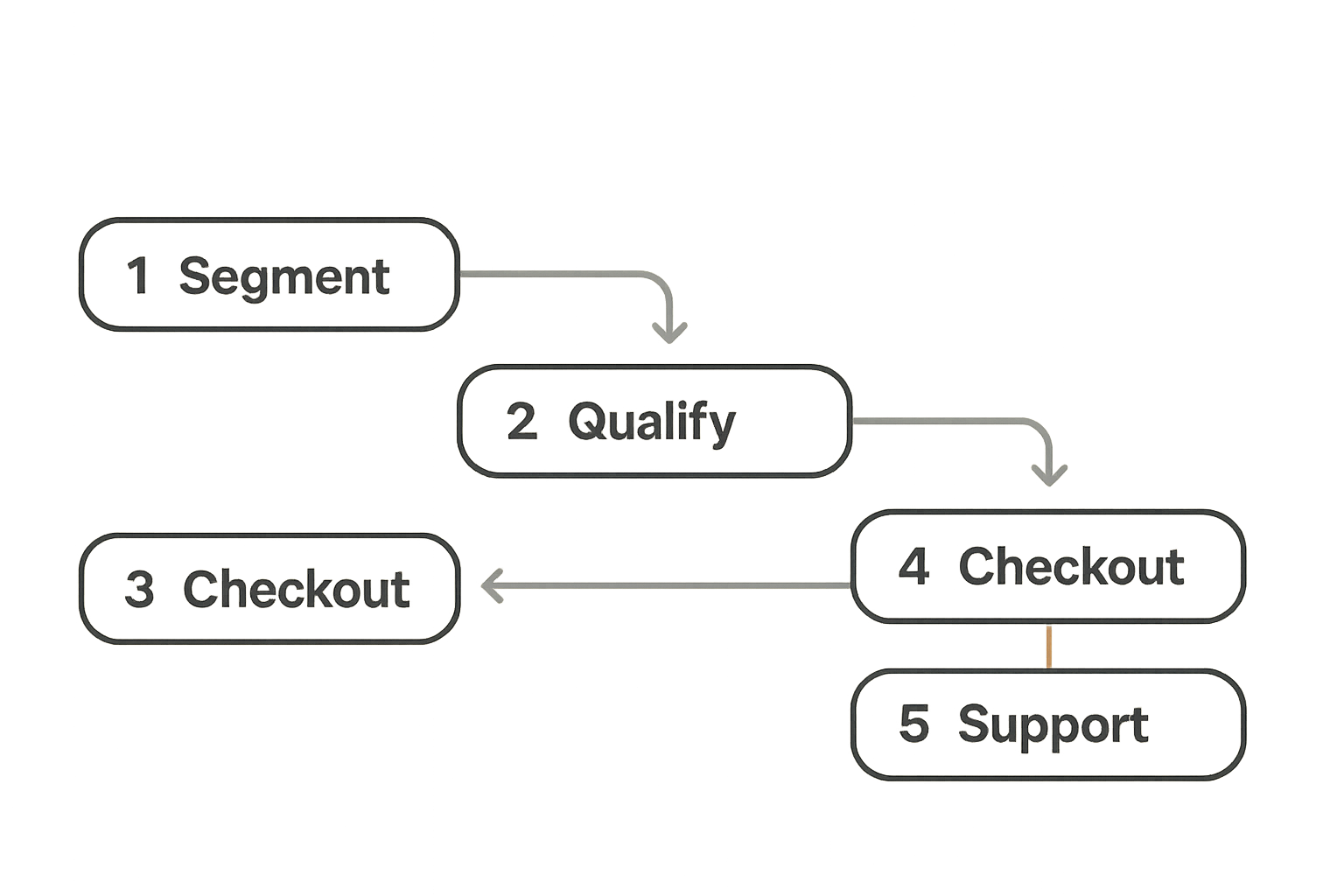
Segment users by intent and risk
A normal ecommerce funnel treats users as traffic, leads, carts, and customers. That is too crude for peptide startup growth.
Segment by intent and risk instead:
- Educational visitors who are learning the category
- Qualified buyers who understand the boundaries
- Practitioners or operators evaluating a workflow
- Partners who need documentation and sales support
- High-risk visitors asking for advice you should not provide
Once you segment this way, the funnel becomes easier to design. Educational visitors get explainers and newsletters. Qualified buyers get documentation and a clear next step. Practitioners get demos or onboarding flows. High-risk questions get routed to safe responses.
That changes the conversation from how do we increase conversion to how do we increase the right conversion.
Capture qualification before checkout
Qualification does not need to feel like bureaucracy. It can be a short workflow that protects the business and improves the buyer experience.
For example, a peptide-related business might use:
- A landing page that states the product category and boundaries.
- A short qualification step that identifies user type or use case.
- Conditional content based on whether the user is a researcher, clinic operator, partner, or general reader.
- A checkout or demo path only after the user has seen the relevant constraints.
- A confirmation email that repeats the operational next steps.
This is basic product design. The page should not pretend all visitors have the same intent.
Hand off edge cases to humans
Automation is useful until it becomes a liability. In sensitive categories, the workflow should know when to stop.
Edge cases may include unusual order patterns, unsupported geographies, medical advice questions, refund disputes, payment flags, documentation requests, or partner inquiries that need a founder-level response.
The practical implementation is simple:
- Tag risky form submissions.
- Pause automated sequences for those users.
- Route them to a human queue.
- Use approved response templates.
- Review recurring edge cases weekly.
The goal is not to make the funnel slower. The goal is to prevent the wrong users from being pushed through the wrong path.
Peptide startup growth channels that actually compound
Search-led education
Search is attractive because peptide buyers research heavily. But search-led growth only compounds when the content architecture matches the funnel.
A useful content map has four layers:
- Category explainers for early research
- Due diligence guides for serious buyers
- Operational pages for policies, shipping, documentation, and support
- Conversion pages for products, demos, or consultations where appropriate
The mistake teams make is writing only bottom-funnel pages. In a trust-heavy category, bottom-funnel pages need the support of educational and operational pages. Otherwise the buyer arrives, sees a product page, and still has unresolved questions.
Search should reduce sales and support burden, not create more of it.
Practitioner and community distribution
Practitioner and community distribution can work, but it requires restraint. Communities are good at detecting opportunistic promotion. Practitioners also protect their reputations and will not refer to a company that creates confusion.
What works is useful participation:
- Answer operational questions without making unsupported claims
- Share launch notes and product decisions
- Build checklists people can reuse
- Invite feedback from people who understand the category
- Document changes publicly when the product improves
What fails is pretending a channel is a shortcut. If the product cannot survive scrutiny, the community will find the weak points faster than paid traffic will.
Partnerships with operational leverage
Partnerships are often stronger than ads in peptide-adjacent markets because trust transfers through existing relationships. A clinic, lab, community operator, or software vendor can introduce you to a concentrated audience.
But partnerships only scale if the handoff is clean. If a partner sends leads and every lead becomes a custom support thread, you have not built distribution. You have created an unpaid services queue.
Partnership readiness usually means:
- A partner-specific landing page
- Clear positioning and boundaries
- Shared qualification criteria
- A support escalation path
- Tracking by source
- A written explanation of what the partner should and should not say
The partner channel should make the workflow more efficient, not more ambiguous.
Payments, checkout, and fulfillment are part of growth
Why payment reliability affects conversion
Founders often treat payments as plumbing. In high-trust or higher-risk categories, payments are part of the customer experience and the growth engine.
If checkout fails, customers do not always tell you. If payment review is slow, support volume rises. If settlement is hard to reconcile, the team loses confidence in fulfillment. If refunds are manual and messy, founders stop experimenting because every launch creates cleanup work.
The UI is not the whole system. State, trust, settlement, and support are the real work.
A checkout system for a peptide-related business should answer:
- Was the customer qualified for this path?
- Did the payment authorize, fail, settle, or require review?
- Is fulfillment allowed to proceed?
- Can support see the order state without asking engineering?
- Are refunds and cancellations traceable?
- Can finance reconcile orders, payouts, fees, and disputes?
Webhooks, retries, and reconciliation mindset
This guest post is written by the team at coinpayportal.com, so we tend to look at growth through the lens of payment state, checkout reliability, webhooks, retries, and reconciliation rather than just landing page conversion.
That mindset is useful even if you are not using crypto payments. A launch creates asynchronous events. A customer submits a form. A payment processor accepts or rejects a payment. An email tool sends a confirmation. A fulfillment system updates inventory. A support tool receives a ticket. Finance later checks settlement.
If those states are disconnected, growth becomes fragile.
A minimum viable payment operations workflow looks like this:
- Create a unique order or lead ID before payment.
- Pass that ID through checkout, email, fulfillment, and support tools.
- Listen for payment events with webhook handling.
- Retry failed webhook processing safely.
- Make fulfillment depend on confirmed payment state.
- Log refunds, disputes, and manual adjustments.
- Reconcile orders against payouts on a fixed cadence.
This is not enterprise overhead. It is how small teams avoid losing orders, shipping incorrectly, or arguing with customers about status.
Keep support close to settlement state
Support needs visibility into payment and fulfillment state. A founder should not have to open five dashboards to answer a simple question.
At minimum, support should be able to see:
- Order ID
- Customer segment or qualification path
- Payment status
- Fulfillment status
- Shipping status
- Refund or dispute status
- Internal notes and escalation history
What breaks in practice is that support gets the emotional version of the problem while finance has the factual version. The customer says they paid. The dashboard says pending. Fulfillment says label created. The payment provider says review. Nobody has a single timeline.
That is not a support problem. It is a systems problem.
Retention is a post-purchase workflow
Onboarding after conversion
The first conversion is not the end of peptide startup growth. It is the start of the retention workflow.
Onboarding should reduce uncertainty. For a software product, that might mean setup steps, demo data, integration docs, and a first successful workflow. For a supply or clinic-adjacent business, it might mean documentation access, handling guidance where appropriate, policy reminders, support paths, and clear expectations.
Good onboarding answers three questions:
- What happens next?
- What should the customer not expect?
- Where should they go if something is unclear?
If the customer has to ask those questions, onboarding is incomplete.
Reorder and follow-up cadence
Retention in this category should not be built on aggressive nudges. It should be built on useful follow-up.
Depending on the model, that could include:
- Reorder reminders based on normal usage cycles where appropriate
- Documentation updates
- Product availability alerts
- Workflow tips for clinic operators
- Integration updates for software buyers
- Educational newsletters with clear boundaries
- Account reviews for higher-value partners
The key is to avoid confusing retention with pressure. Useful follow-up increases confidence. Pressure creates complaints.
Support tickets as product feedback
Support tickets are not just interruptions. They are the best source of product roadmap data during early peptide startup growth.
Tag tickets by root cause:
- Confusing product copy
- Missing documentation
- Shipping uncertainty
- Payment issue
- Refund or cancellation question
- Compliance boundary question
- Partner handoff issue
- Technical integration issue
Review the tags weekly. If the same question appears ten times, do not just improve the macro. Improve the page, checkout step, email, policy, or product behavior that created the question.
Practical rule: A repeated support question is usually a broken product surface, not a customer education problem.
Metrics that matter for peptide startup growth
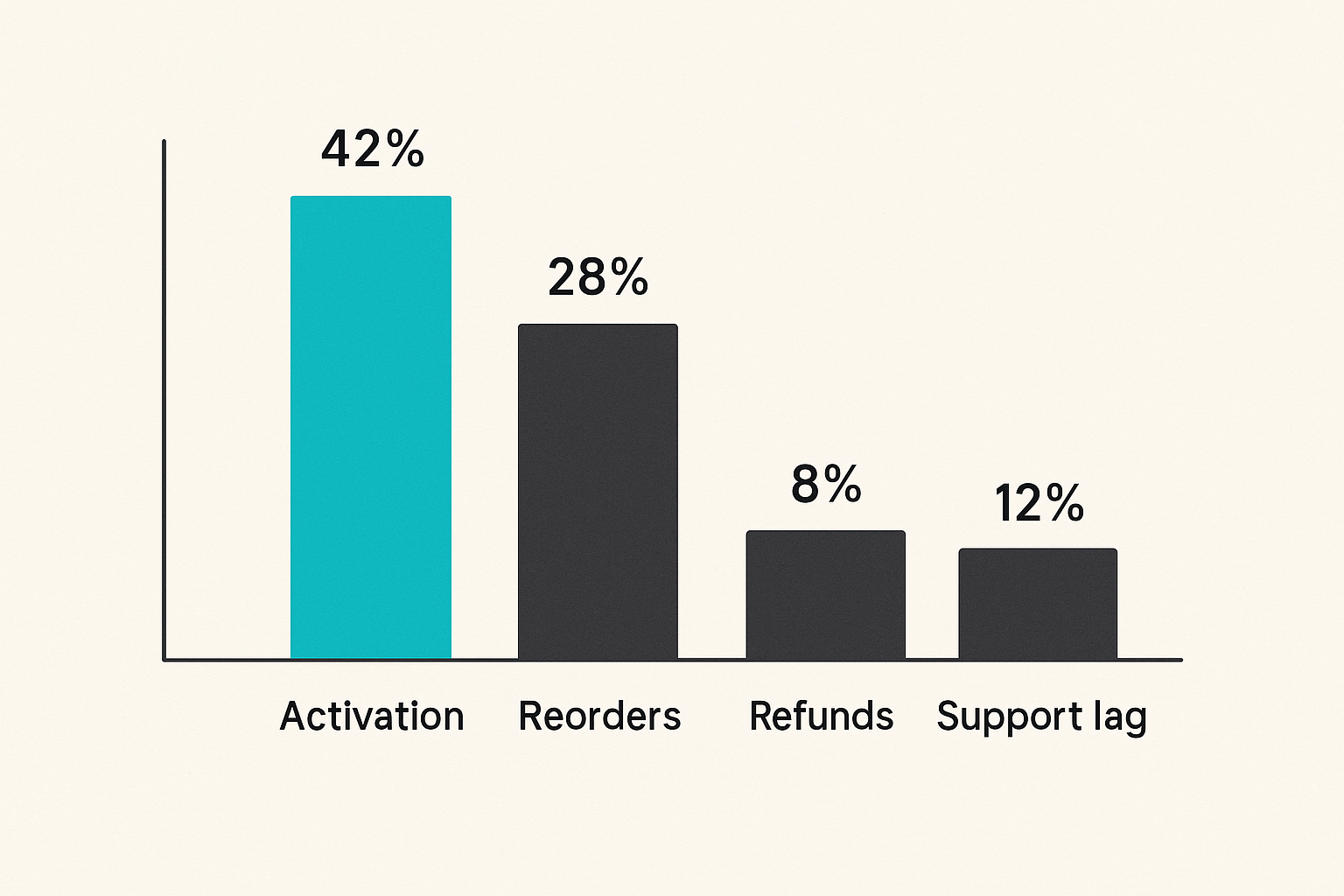
Activation metrics
Peptide startup growth needs metrics that separate curiosity from qualified progress. Vanity traffic is easy to create. Qualified activation is harder.
Useful activation metrics include:
- Visitor-to-qualified-lead rate
- Qualified-lead-to-checkout or demo rate
- Checkout completion rate
- First successful order or workflow completion
- Documentation view rate before purchase
- Email confirmation engagement
- Partner lead acceptance rate
These metrics show whether the system is helping the right people move forward.
Operational metrics
Operational metrics tell you whether growth is sustainable.
Track:
- Payment failure rate
- Manual review rate
- Fulfillment delay rate
- Refund rate
- Dispute rate
- Average support response time
- Support tickets per order or account
- Reconciliation exceptions per payout cycle
A campaign that doubles revenue but triples manual review is not clean growth. It may still be worth doing, but the team should understand the operational cost.
Compliance and trust metrics
Trust can be measured indirectly. You will not get a perfect number, but you can watch for signals.
Useful trust signals include:
- Percentage of traffic reaching policy or documentation pages
- Percentage of buyers who view educational content before checkout
- Number of claims-related support questions
- Number of rejected or redirected inquiries
- Partner content requiring correction
- Affiliate or community posts requiring review
- Chargebacks or complaints tied to misunderstanding
The goal is not to turn compliance into a dashboard theater exercise. The goal is to see whether your messaging is producing informed demand or confused demand.
Common failure modes that kill momentum
Claim-heavy messaging
Claim-heavy messaging is the fastest way to create the wrong kind of attention. It may increase clicks, but it also raises the risk profile of the business.
The practical problem is not only legal exposure. It is operational drag. Every exaggerated claim becomes a support burden. Every ambiguous promise creates refund risk. Every unsupported statement gives partners and platforms a reason to hesitate.
What works:
- Describe the product category accurately
- Explain the workflow and boundaries
- Use qualified experts where interpretation is required
- Keep sales pages narrower than educational pages
- Review content before distribution partners reuse it
What fails:
- Borrowing language from forums
- Letting affiliates invent claims
- Using before-and-after narratives without a review process
- Hiding uncertainty
- Treating disclaimers as a substitute for responsible positioning
Channel dependency
Another common failure mode is relying on one channel too early. A founder gets traction from a community, search cluster, influencer, marketplace, or ad account and mistakes it for a durable growth system.
The channel may still be valuable. The problem is concentration risk.
A resilient peptide startup growth system has at least three motions developing in parallel:
- Owned education that compounds over time
- Direct relationships with practitioners, partners, or operators
- A conversion and retention workflow that can absorb traffic from any source
If one channel disappears and the business cannot still convert existing demand, the team did not build growth. It rented attention.
Operations backlog
The quiet killer is the operations backlog. The company keeps launching while unresolved workflow issues accumulate.
Common backlog items include:
- Unclear refund policy
- Manual payment reconciliation
- Shipping exceptions handled in DMs
- Documentation updates living in a founder notebook
- Support macros not reviewed for accuracy
- Partner pages that do not match current policy
- Old emails with outdated claims
- Analytics events that do not match the funnel
This backlog eventually slows every launch. The founder becomes the router for all ambiguity. That does not scale.
A 90-day implementation plan for peptide startup growth
Days 1-30: foundations
The first 30 days should focus on positioning, workflow, and proof. Do not start by scaling traffic. Start by making the business legible.
Foundational work:
- Choose the operating model and primary buyer.
- Write the category boundaries in plain language.
- Map the funnel from visitor to qualified action.
- Identify which questions support can answer safely.
- Build the first proof assets.
- Create payment, fulfillment, and support status visibility.
- Define the first five metrics that matter.
The deliverable is not a brand refresh. It is a launch-ready operating map.
Days 31-60: demand
The next 30 days should add demand in controlled batches. This is where shippers often get impatient. Resist the urge to push every channel at once.
Run small tests:
- Publish three to five educational pages.
- Launch one partner or practitioner outreach sequence.
- Test one community participation loop.
- Improve one conversion page based on actual questions.
- Run one email onboarding sequence.
- Review payment and support exceptions weekly.
The goal is to learn which demand creates qualified progress, not just which demand creates clicks.
Days 61-90: scale
The final 30 days are where you decide what deserves more resources.
Scale only the loops that meet three conditions:
- They attract the right audience.
- They convert without creating excessive manual review.
- They produce support questions you can safely and repeatedly answer.
At this stage, document the system:
- Channel playbooks
- Partner handoff rules
- Content review workflow
- Payment and fulfillment exception process
- Support macro library
- Weekly metrics review
- Experiment backlog
That documentation is not busywork. It is how a small team launches more without becoming more fragile.
Where sh1pt fits into the launch workflow
Ship smaller proof cycles
For builders reading sh1pt, the core lesson is familiar: shipping is not just releasing. It is learning through controlled exposure to the market.
Peptide startup growth rewards smaller proof cycles because the cost of messy scaling is high. A founder does not need a six-month strategy deck. They need a repeatable cadence:
- Ship a tighter landing page.
- Watch the questions it creates.
- Improve the qualification step.
- Fix the support macro.
- Publish the missing explainer.
- Test the next channel.
The compounding advantage comes from reducing ambiguity every week.
Turn launch work into reusable systems
A launch asset should not be disposable. A good launch page becomes a sales page. A support answer becomes an FAQ. A partner objection becomes a one-pager. A payment exception becomes an automation rule. A founder note becomes onboarding copy.
This is where many startups miss leverage. They treat every launch as a new event instead of turning each launch into reusable infrastructure.
A practical launch repository might include:
- Positioning notes
- Approved claims and banned claims
- Buyer segments
- Landing page templates
- Qualification questions
- Email sequences
- Partner scripts
- Support macros
- Metrics dashboards
- Post-launch reviews
This makes the next launch faster and safer.
Closing the loop on peptide startup growth
Peptide startup growth in 2026 is not about shouting louder than the next brand. The category is too sensitive, too operational, and too trust-dependent for that.
The better approach is to build a growth system that can handle attention responsibly: clear positioning, qualified funnels, reliable checkout, visible fulfillment state, useful education, disciplined support, and metrics that show whether the business is becoming stronger or just busier.
If your team is launching in this market, treat every campaign as a workflow test. The companies that win will not be the ones with the flashiest launch week. They will be the ones that turn launch learning into durable operating leverage.
Try sh1pt.com
Build, launch, and learn faster with sh1pt.com. For founders working on peptide startup growth or any trust-heavy product launch, Try sh1pt.com.