
A saas product launch usually fails before the announcement goes live.
Not because the landing page is ugly. Not because the Product Hunt post went up at the wrong hour. Not because the founder did not write enough social posts.
Teams think the problem is attention. The real problem is launch architecture: the sequence of product readiness, proof, onboarding, instrumentation, support, and follow-up that turns attention into usable learning and revenue.
That changes the conversation. A launch is not a celebration of finished work. It is a controlled market test with operational consequences. If the product cannot onboard users, explain value quickly, capture intent, handle support, and turn feedback into decisions, more traffic just exposes the weak spots faster.
In 2026, the practical question is not whether you should launch. You probably should. The practical question is whether your launch system can survive contact with real users.
Table of contents
- Why a saas product launch is an operating system
- Choose the launch type before choosing the channel
- Build the launch around proof not noise
- The saas product launch stack you need
- The workflow from idea to market
- Instrumentation before announcement
- Pricing packaging and onboarding decisions
- What breaks when teams launch badly
- Post launch operations and feedback loops
- Where sh1pt.com fits in a saas product launch
- Closing the loop on your saas product launch
Why a saas product launch is an operating system
Launch is a state machine not a date
A useful way to think about it is this: a launch moves users through states.
They go from unaware to curious. Curious to signed up. Signed up to activated. Activated to retained. Retained to paid, referred, or expanded. Every state has a trigger, a failure point, and an owner.
The mistake teams make is treating the launch as a content drop. They prepare the announcement but not the system behind the announcement. The tweet is ready. The homepage is ready. The founder story is ready. But the first-run experience is vague, the invite flow is manual, the support inbox is unowned, and the analytics events do not answer the question that matters: did the user reach value?
A saas product launch should be designed like a workflow, not a megaphone. If someone signs up, what happens next? If they do not activate, who notices? If they ask a sales question, where does it go? If a segment converts better than expected, how fast can you change the page, pricing, or onboarding?
Practical rule: If your launch plan ends at publish, you do not have a launch plan. You have an announcement plan.
Why this matters more in 2026
Software buyers and users have less patience for unfinished value. The baseline has moved. Users expect fast setup, clear positioning, visible pricing cues, stable auth, helpful docs, and some evidence that the product solves a real problem.
At the same time, distribution is noisier. Social feeds are fragmented. AI-generated content has lowered the cost of producing launch noise. Communities are more skeptical. Product directories can still help, but they rarely rescue a weak workflow.
That does not mean small teams are disadvantaged. It means small teams need sharper operations. A two-person startup can out-execute a larger team if the launch is built around fewer assumptions, faster feedback, and cleaner ownership.
The team at saasrow.com often frames software growth as a practical operating problem, and that lens is useful here: launch strategy is not separate from product execution. It is how execution meets the market.
Choose the launch type before choosing the channel
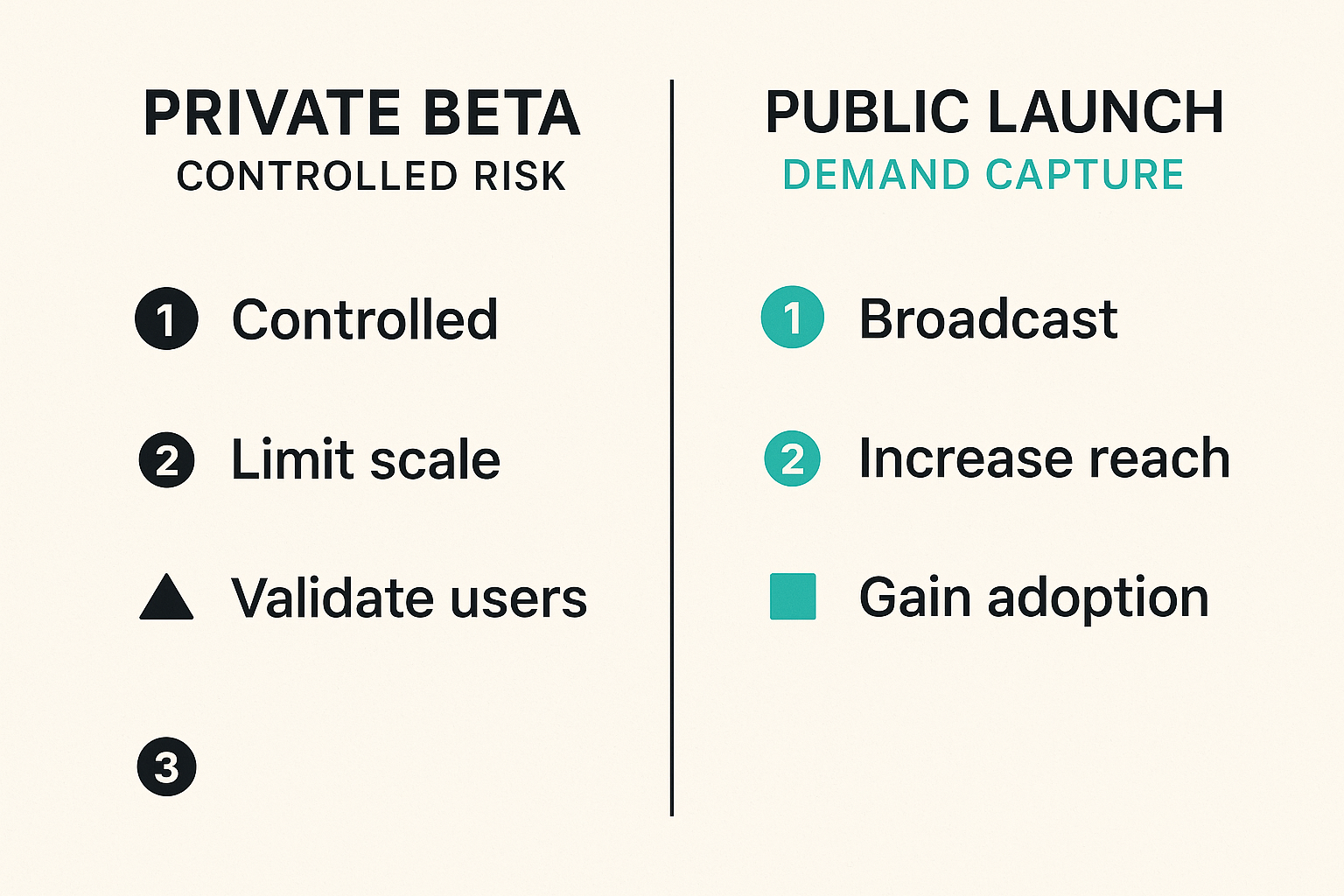
Private beta controlled risk
Before you pick Product Hunt, Hacker News, LinkedIn, Reddit, a partner email, or a founder audience, decide what kind of launch you are running.
A private beta is for controlled learning. You are deliberately limiting scale so you can observe behavior, fix onboarding, and validate the promise with real users. The goal is not maximum traffic. The goal is high-context feedback from users who resemble the market you eventually want.
Private beta works when the product has uncertain workflows, needs setup help, or depends on data quality. It also works when the category is sensitive: finance, security, internal ops, customer data, or anything where users need trust before they give access.
The danger is hiding forever. Many teams call something a private beta because they are avoiding the discomfort of being judged. That is not strategy. That is delay with a nicer label.
Public launch demand capture
A public launch is for demand capture and market signal. You are asking a larger audience to react to the product, positioning, and offer. The product does not need to be perfect, but the path to value must be coherent.
Public launches work when the use case is easy to understand, the first action is low-friction, and the product can produce value quickly. A public launch can also work for waitlists, but only if the waitlist has a credible next step. A bare email form with no timeline, no segmentation, and no follow-up is not demand capture. It is a pile of names that will decay.
Use this comparison before choosing channels:
| Launch type | Primary goal | Best for | What must be ready |
|---|---|---|---|
| Private beta | Learn with control | Complex workflow, high-touch setup, uncertain ICP | Feedback loop, support owner, activation notes |
| Public beta | Validate demand | Usable product with known rough edges | Onboarding, analytics, docs, issue triage |
| General availability | Convert and scale | Product with repeatable value | Pricing, support, reliability, retention tracking |
| Waitlist launch | Segment demand | Early category testing or staged access | Qualification, nurture, invite plan |
Practical rule: Pick the launch type based on the risk you need to reduce, not the channel you want to brag about.
Build the launch around proof not noise
Define the promise users can verify
Every launch needs a promise. Not a tagline. Not a mission statement. A promise.
A promise is the specific improvement the user should be able to verify after using the product. Examples:
- Create a customer-facing changelog in under ten minutes
- Replace a spreadsheet-based approval flow with a tracked workflow
- Generate a clean investor update from existing product metrics
- Find stale permissions across your workspace before they become a security issue
The promise should be narrow enough that a new user can test it. If the promise requires a six-month transformation, it is too broad for launch messaging. You can have a big vision later. At launch, users need a concrete reason to try the product now.
The mistake teams make is positioning around internal effort. We built an AI-powered platform for modern teams. Users do not care yet. They want to know what pain changes if they give you ten minutes, an email address, a credit card, or access to their workspace.
Map claims to evidence
A strong saas product launch connects claims to evidence. Evidence can be product screenshots, workflow demos, customer quotes, before-and-after examples, templates, sample outputs, benchmarks from your own product, or a clear explanation of what happens after signup.
Do not overclaim. Early-stage products lose trust when the launch page sounds more mature than the product. If you are in beta, say what is stable and what is still changing. If integrations are limited, say which ones exist now. If the product is self-serve but setup-heavy, explain the setup path.
A simple evidence map looks like this:
- Claim: Teams can publish product updates faster
- Evidence: Show the update editor, approval flow, and published page
- Claim: Users will not need engineering help
- Evidence: Show settings, templates, and no-code publishing controls
- Claim: Founders can learn from launch feedback
- Evidence: Show comments, reactions, signup sources, or survey capture
That changes the conversation from hype to trust. Users are more willing to try a product when they can see how the promise becomes real.
The saas product launch stack you need
Product readiness
The saas product launch stack is not a stack in the vendor sense. It is the minimum set of product, growth, and support capabilities required to move users through the launch workflow.
Product readiness includes:
- A stable signup and login flow
- A first-run path that leads to one meaningful action
- Clear empty states with examples or templates
- Basic error handling and recovery
- A way to contact support without hunting
- A documented definition of activation
- A known list of bugs you are willing to tolerate
The last point matters. You do not need a bug-free product. You need to know which bugs are acceptable for the launch type. A cosmetic issue is different from a broken integration. A missing admin role is different from failed billing. A slow dashboard is different from lost user data.
What breaks in practice is that teams use launch pressure to skip readiness decisions. They do not decide which bugs block launch, so every issue becomes a debate at the worst possible time.
Growth and support readiness
Growth readiness is not just content. It is routing.
Where does each segment go? What does an indie hacker see versus a product manager? What happens if a visitor is not ready to sign up but wants updates? What happens if an enterprise buyer asks about security? What happens if a free user wants to upgrade but pricing is unclear?
Support readiness is equally important. Launch traffic creates confused users. Confused users are not always bad; they are a source of signal. But only if you capture and classify the confusion.
You need at minimum:
- One support inbox or form, not five scattered channels
- A triage owner for the first 72 hours
- A public known-issues note if the audience is technical
- Short docs for the top three setup questions
- A system for tagging feedback by segment and workflow step
Practical rule: Launch support is part of product discovery. Treat every repeated support question as a broken assumption in positioning, onboarding, or product design.
The workflow from idea to market
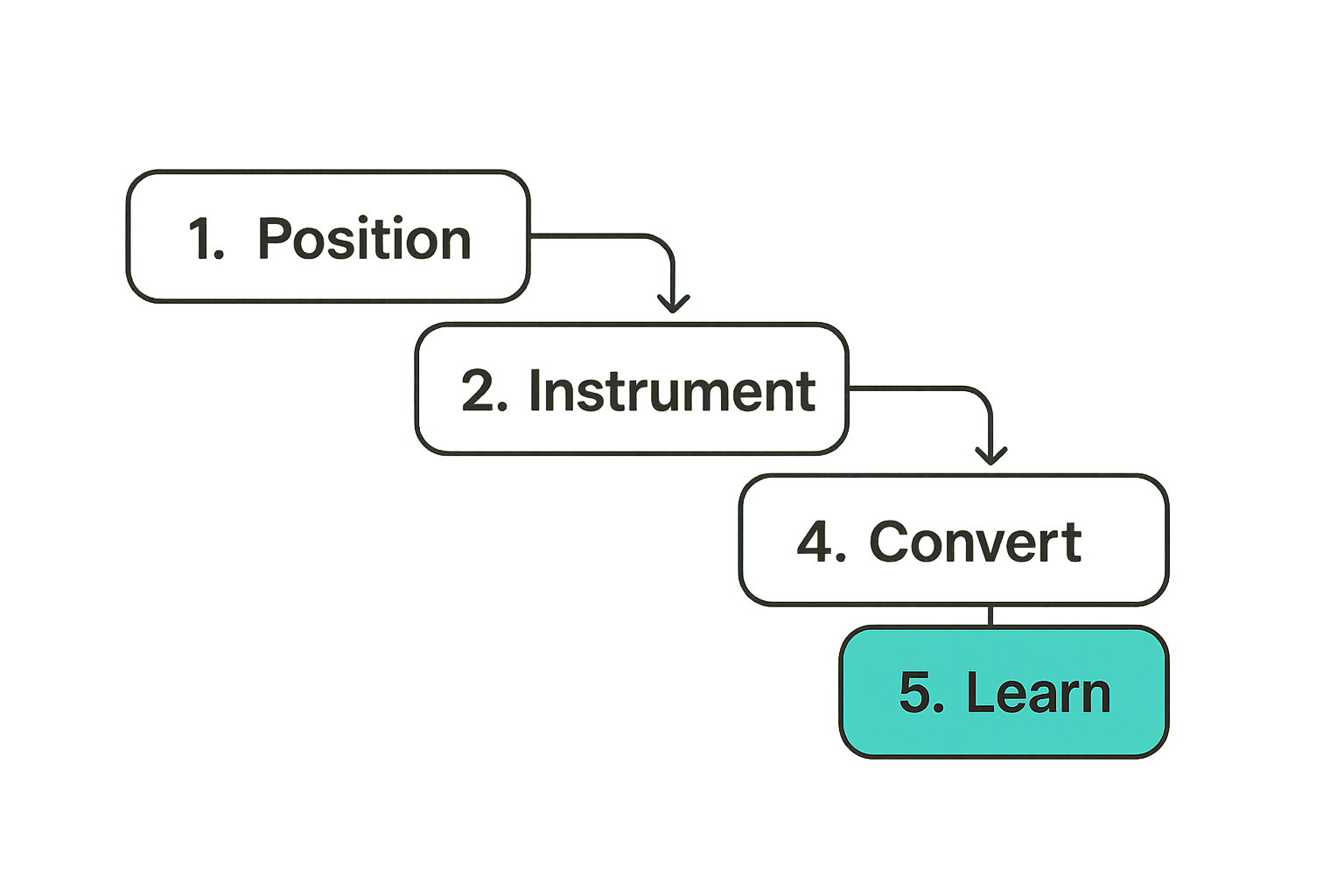
Step by step launch sequence
A clean launch workflow reduces chaos because it creates sequencing. You are not trying to do everything at once. You are moving through gates.
- Define the launch objective. Pick one primary goal: learning, signups, activation, revenue, pipeline, community signal, or investor proof. Secondary goals are allowed, but one goal must win tradeoffs.
- Choose the launch type. Private beta, public beta, waitlist, partner launch, content-led launch, or general availability.
- Define the audience segment. Be specific. First-time founders shipping dev tools is useful. Everyone who builds software is not.
- Write the launch promise. State what the product helps the user accomplish and how quickly they can verify it.
- Build the activation path. Remove steps that do not support the first meaningful outcome.
- Instrument the critical events. Track source, signup, first action, activation, upgrade intent, and feedback.
- Prepare proof assets. Screenshots, short demo, sample project, template, customer quote, or founder walkthrough.
- Set support ownership. Decide who answers, who tags issues, who updates docs, and who fixes blockers.
- Run a small rehearsal. Invite five to twenty users before the public push. Watch where they hesitate.
- Launch and monitor. Publish, respond, measure, and adjust within hours, not weeks.
- Run the post-launch review. Compare expected behavior to actual behavior and decide what changes next.
This is deliberately plain. Fancy launch plans fail when they are too abstract to operate. The best launch plan is the one the team can actually run while tired, distracted, and answering user questions.
Where ownership must be explicit
Ownership is where launch plans either become real or fall apart.
Do not assign ownership by department if you are a small team. Assign ownership by workflow step. One person owns the page. One owns analytics. One owns support. One owns fixes. In a solo launch, those owners may all be you, but the distinction still matters because it forces you to allocate time.
A simple ownership table helps:
| Area | Owner question | Launch-day responsibility |
|---|---|---|
| Positioning | Who can edit the promise fast | Update copy based on confusion |
| Product | Who can fix activation blockers | Ship hotfixes or workarounds |
| Analytics | Who trusts the numbers | Check source and activation events |
| Support | Who replies first | Triage issues and tag feedback |
| Follow-up | Who keeps leads warm | Send updates, invites, or demos |
The mistake teams make is assuming ownership will emerge naturally. It usually does, but too late and under stress.
Instrumentation before announcement
Events that prove activation
Instrumentation should exist before the announcement. Retrofitting analytics after the launch means you are guessing during the most valuable learning window.
You do not need a complicated data warehouse. You need events tied to decisions. For a launch, the baseline event map might look like this:
visitor_arrived
signup_started
signup_completed
project_created
first_value_action_completed
invite_sent
pricing_viewed
upgrade_started
support_requested
feedback_submitted
The important event is usually not signup. It is the first value action. For a writing tool, that might be exporting a draft. For an analytics product, it might be connecting a data source and viewing the first report. For a launch platform, it might be publishing a public page or collecting the first subscriber.
If you do not define activation, the team will default to vanity metrics. Signups feel good, but they can hide a broken product.
Metrics that change decisions
Metrics only matter if they change what you do. A launch dashboard should answer operational questions:
- Which channels produced users who activated, not just clicked?
- Where did users drop during onboarding?
- Which support questions repeated?
- Which segment understood the promise fastest?
- Did pricing interest show up before or after activation?
- Did users invite teammates or share the product?
Avoid building a dashboard that exists to admire traffic. You need a launch control panel, not a trophy case.
For small teams, a daily launch note can be more useful than a complex dashboard:
- Traffic by source
- Signups by source
- Activation rate by source
- Top three support issues
- Top three objections
- Bugs blocking activation
- Copy or onboarding changes made today
The rhythm matters. During launch week, review this daily. After the first wave, review it twice a week until you know what the launch taught you.
Pricing packaging and onboarding decisions
Do not launch a pricing mystery
Pricing does not have to be perfect at launch, but it cannot be mysterious.
Users need to understand the shape of the business relationship. Is there a free plan? Is there a trial? Do they need to talk to you? Is usage limited? Are team features paid? Are integrations gated? What happens after beta?
Many early teams avoid pricing because they fear being wrong. That is understandable, but silence creates worse problems. Users assume the product is either not serious, secretly expensive, or likely to change without warning.
You can launch with directional pricing:
- Free during private beta, paid plans planned later
- Free plan plus paid team features coming soon
- Introductory founder plan for early customers
- Usage-based pricing with published examples
- Contact-based pricing for high-touch workflows
The point is not to lock yourself forever. The point is to reduce uncertainty enough that serious users can evaluate the product.
Onboarding is part of the offer
Onboarding is not a separate UX project. It is part of what you are selling.
If your product promises speed, onboarding must feel fast. If your product promises control, onboarding must explain permissions. If your product promises automation, onboarding must show what is automated and what the user still owns.
For launch, cut onboarding to the minimum path that proves the promise. You can introduce advanced features later. The first run should answer three questions:
- What should I do first?
- Why does this step matter?
- How do I know I got value?
What fails is the feature tour. New users do not need a museum walkthrough of every capability. They need a guided path to a useful outcome.
A good onboarding path is opinionated. It says: do this first, ignore the rest for now, here is the result.
What breaks when teams launch badly
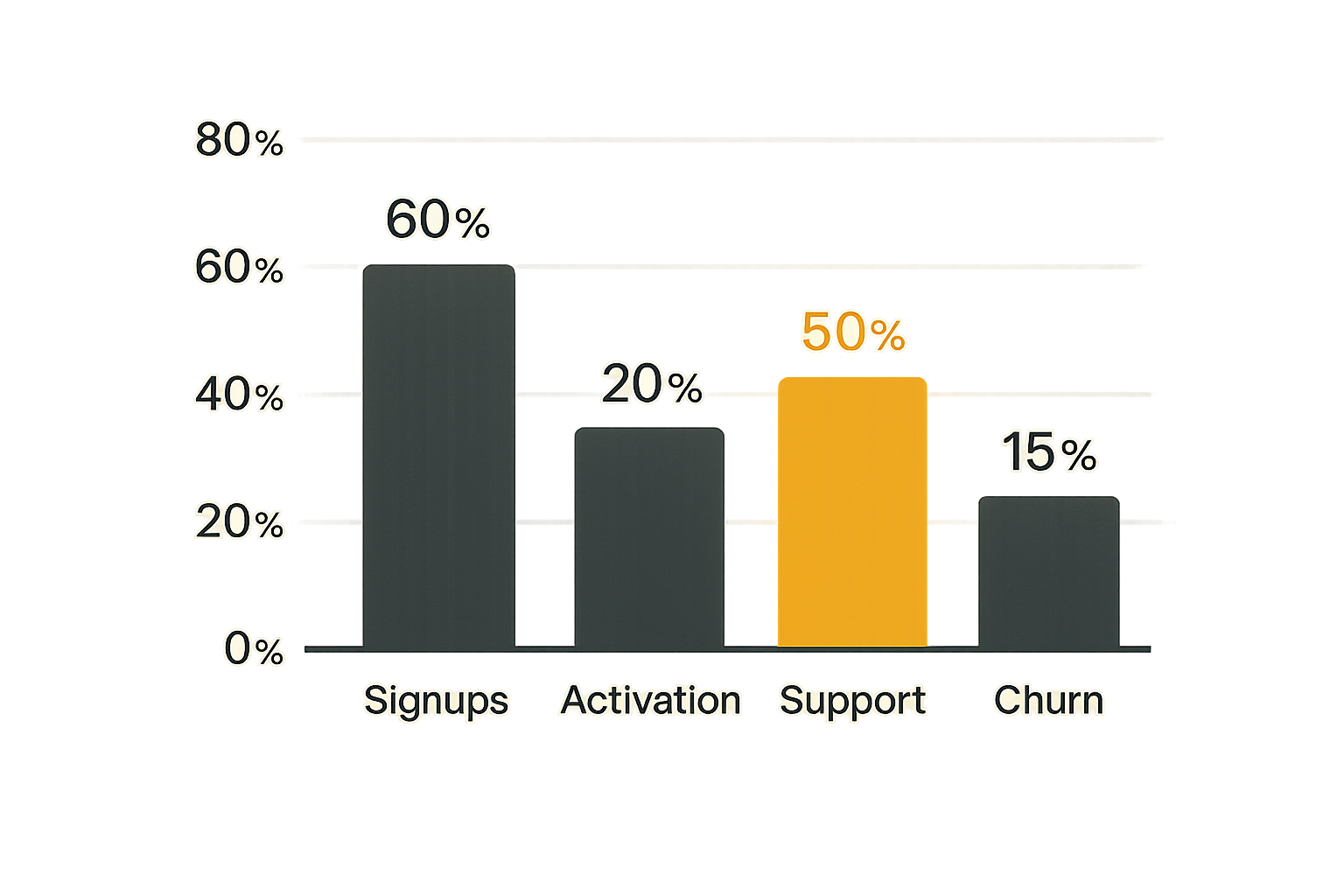
Failure modes operators see
Bad launches often look successful from the outside. The post gets comments. The founder gets congratulations. Traffic spikes. The team takes screenshots.
Then the numbers get quiet.
Common failure modes include:
- High traffic, low signup because the promise is vague
- High signup, low activation because onboarding is confusing
- High activation, low retention because the use case is one-time
- High interest, low revenue because pricing is unclear
- High support volume because docs and empty states are weak
- Positive comments, weak usage because the audience is curious but not the buyer
- Strong early users, no follow-up because the team moved on after launch day
The painful part is not that these happen. They happen to many teams. The painful part is when the team cannot diagnose which one happened because the workflow was not instrumented.
A launch without instrumentation turns every post-launch meeting into opinion theater.
What works and what fails
Here is the practical contrast:
| Area | What fails | What works |
|---|---|---|
| Positioning | Broad category language | One verifiable promise |
| Channel | Chasing the biggest audience | Matching channel to launch risk |
| Product | Shipping every feature | Removing friction to first value |
| Analytics | Tracking page views only | Tracking activation and source quality |
| Support | Responding ad hoc | Triage owner and tagged feedback |
| Follow-up | Thank you posts only | Segmented emails, demos, and roadmap decisions |
The mistake teams make is interpreting launch feedback emotionally. A quiet launch does not always mean the product is bad. A loud launch does not always mean the product is working.
The operator move is to separate signal types. Attention is one signal. Activation is another. Retention is another. Revenue intent is another. Treat them differently.
Post launch operations and feedback loops
Triage the first two weeks
The first two weeks after launch are where you earn the launch.
Most teams underinvest here because they are exhausted. That is exactly why the workflow should be prepared before launch day. You need a triage system that turns raw reactions into decisions.
Use categories like:
- Activation blocker
- Bug but not blocking
- Copy confusion
- Missing integration
- Pricing objection
- Segment mismatch
- Feature request
- High-intent lead
- Testimonial candidate
Then review by severity and frequency. One angry comment may not matter. Five users getting stuck at the same setup step matters. A single high-intent customer asking for a procurement document may matter more than twenty low-intent signups.
The practical question is always: what should change because of this?
Turn feedback into roadmap inputs
Do not dump launch feedback directly into the roadmap. That creates a feature pile.
Translate feedback into problems first. If users ask for Slack integration, the problem may be notification workflow, team visibility, or approval routing. If users ask for export, the problem may be reporting, compliance, sharing, or backup. If users ask for cheaper pricing, the problem may be unclear value, wrong segment, or packaging mismatch.
A useful feedback record includes:
- User segment
- Source channel
- Workflow step
- User words
- Interpreted problem
- Evidence count
- Revenue or retention relevance
- Proposed response
This keeps the launch from hijacking the roadmap. You want the market to inform product direction, not whiplash it.
Practical rule: Feedback becomes roadmap input only after you identify the underlying problem, the affected segment, and the business consequence.
Where sh1pt.com fits in a saas product launch
Use the launch page as a working artifact
A launch page should not be a static brochure you forget after posting. It should be a working artifact that helps the team clarify the promise, capture interest, and keep momentum visible.
For builders, that matters because the launch page is often the first shared surface between product work and market reaction. It forces decisions: what are we shipping, who is it for, what changed, why should anyone care, and what should they do next?
This is where sh1pt.com fits naturally into a saas product launch workflow. Not as magic distribution. No tool can manufacture product-market fit. But a dedicated shipping and launch surface can help indie hackers, founders, and product teams turn scattered updates into a clearer public narrative.
That is useful because shipping is cumulative. One update creates awareness. Several updates create context. A launch with follow-up creates trust.
Keep momentum after ship day
The day after launch is usually less glamorous and more important.
You need to publish fixes, clarify decisions, show progress, and keep early users involved. That does not mean spamming everyone with minor updates. It means maintaining a visible thread of product movement.
For a SaaS team, momentum assets can include:
- Launch announcement
- Changelog update
- Founder note about what you learned
- Public roadmap adjustment
- User story or workflow example
- Follow-up release addressing launch feedback
- Invite to beta cohort or demo session
The launch page becomes a source of continuity. It tells the market that the product is not a one-day stunt. It is being shipped by people who listen and keep moving.
Closing the loop on your saas product launch
The operator checklist
Before your next saas product launch, check the boring things. They are usually the things that decide whether the launch creates useful signal.
- One primary launch objective is written down
- Launch type is chosen based on risk
- Audience segment is specific enough to exclude people
- Promise is verifiable in the product
- Signup and first-run flow have been tested
- Activation event is defined and tracked
- Pricing direction is visible enough to reduce uncertainty
- Support owner is assigned for launch week
- Feedback categories are ready
- Follow-up plan exists before launch day
- Post-launch review is scheduled
If that list feels heavy, shrink the launch. Do not skip the operating system. A smaller launch with clean learning is better than a bigger launch that leaves you guessing.
The decision that matters
The decision that matters is not whether to launch loudly or quietly. It is whether you are launching to learn, convert, or scale.
Those are different jobs. Learning launches need observation. Conversion launches need proof and pricing. Scaling launches need reliability and repeatability. Mixing them without naming the priority creates confusion.
A saas product launch is not a finish line. It is a designed moment where product, market, and operations collide. If you build the workflow before the announcement, the launch becomes more than a spike. It becomes a system for making better product decisions.
Try sh1pt.com
sh1pt.com helps builders turn launches and product updates into visible shipping momentum. Try sh1pt.com