
Most software teams treat promotional products like a late-stage swag errand. Someone orders stickers, shirts, mugs, or notebooks two weeks before launch because the company needs something tangible to send users, investors, partners, or conference leads.
That usually produces boxes in a closet, vague excitement on social media, and no clear idea whether the spend helped the launch. Promotional products become decoration instead of distribution.
Teams think the problem is finding cool merchandise. The real problem is building a promotional products workflow that supports a specific launch motion: activation, retention, referrals, sales acceleration, community building, or partner enablement.
That changes the conversation. The practical question is not which item looks clever. It is where a physical object fits into the software growth system you are already running.
Table of contents
- Promotional products are a launch system, not swag
- Start with the launch job, not the object
- Choose audiences with operational precision
- Design promotional products around the product experience
- Build the fulfillment workflow before you buy inventory
- Measure promotional products without pretending they are ads
- Compare common promotional product plays
- Turn promotional products into a repeatable launch asset
- Common failure modes when teams ship promotional products badly
- How sh1pt.com thinks about promotional products
Promotional products are a launch system, not swag
Why software teams get this wrong
The mistake teams make is treating promotional products as a brand expression first and an operating system second. That leads to subjective debates: Is this hoodie nice enough? Is the sticker funny? Does the tote bag feel premium?
Those questions are not useless, but they are downstream. If you are an indie hacker, startup founder, product manager, or solopreneur, your launch resources are constrained. Every dollar, hour, and operational step should have a job.
Promotional products are physical touchpoints attached to a digital product. They have cost, lead time, storage, shipping, support, and recipient expectations. In other words, they behave more like a mini supply chain than a creative asset.
A useful way to think about it is this: software launches already have a sequence of states. People discover, sign up, activate, invite teammates, hit friction, convert, renew, refer, or churn. A promotional product should move a specific person from one state to the next.
Practical rule: If you cannot name the recipient, trigger, expected action, and follow-up, you are not running a promotional products strategy. You are buying objects.
What promotional products should actually do
Good promotional products create memory, trust, or momentum at a point where digital touch alone is weak. They can make an early user feel seen. They can make a partner kit easier to present. They can give a community member a reason to share. They can make a sales conversation less abstract.
They should not be asked to do everything. A shirt will not fix weak positioning. Stickers will not solve activation. A premium gift will not compensate for a confused onboarding flow.
What works is a tighter connection between the item and the behavior you need. If a developer tool wants more public examples, send contributors a small builder kit after they publish a template. If a B2B SaaS product wants champion expansion, send onboarding materials to the internal champion after the first team milestone. If a consumer app wants referrals, make the physical reward part of a referral loop with clear eligibility.
That changes the conversation from merchandise to mechanism.
Start with the launch job, not the object
Match the item to the business action
Promotional products should map to a launch job. The object is just the interface.
| Launch job | Better promotional product pattern | Weak pattern |
|---|---|---|
| Activate early users | Milestone reward after first meaningful action | Gift everyone who joins the waitlist |
| Enable sales champions | Useful desk kit with product story card | Generic expensive gift with no context |
| Drive referrals | Shareable item tied to referral threshold | Random giveaway with no tracking |
| Support community | Limited contributor item | Unlimited swag store with no status meaning |
| Improve event follow-up | QR card plus useful object tied to demo | Booth pile of low-value items |
| Thank beta testers | Personalized launch note and small gift | Bulk shipment with no segmentation |
The launch job determines the item, budget, timing, quantity, and measurement method. Without that job, teams default to whatever looks good in a supplier catalog.
If you are still defining the broader launch motion, it helps to build the channel and audience decisions first. We covered that operating-system view in Go to Market Strategy in 2026, where the core idea is connecting product, audience, channels, metrics, and founder decisions instead of treating launch as a calendar event.
Separate delight from distribution
Delight matters, but delight is not the same as distribution. A delightful package can make someone smile and still create no growth. A boring object can create growth if it arrives at the exact moment a user is ready to take the next step.
For software teams, the better question is: what does the recipient do after receiving this?
Examples:
- They post a launch photo and tag the product.
- They invite a teammate to unlock a reward.
- They complete onboarding to qualify for a founder note.
- They bring the object to a meeting as a product reminder.
- They join a community call because the kit signals membership.
- They respond to sales because the gift references a specific workflow pain.
The physical product is only one part of the loop. The surrounding copy, landing page, email, QR code, referral rule, CRM note, and follow-up sequence matter more than the item alone.
Practical rule: Promotional products should never be orphaned. Every item needs a digital companion: a page, message, event, referral rule, onboarding milestone, or CRM workflow.
Choose audiences with operational precision
The four recipient groups that matter
Not every user should receive the same thing. For early-stage software businesses, promotional products usually work best for four groups.
First, there are high-intent prospects. These are people already in a sales conversation, on a qualified waitlist, or actively evaluating the product. A physical touch can make the product feel real when trust is still forming.
Second, there are early power users. They have crossed a meaningful usage threshold. They are not just curious; they have felt the product value. Rewarding them can increase retention and advocacy.
Third, there are contributors and community members. They write templates, record demos, report bugs, host meetups, answer questions, or bring new users. Promotional products can signal status and belonging.
Fourth, there are partners and internal champions. For B2B products, the person selling your product inside their company often needs material support. A well-designed kit can help them explain the product when you are not in the room.
Related reading from our network: teams designing operational systems around tools face similar tradeoffs in cloud based productivity and collaboration tools, especially when access, rollout, documentation, and support have to work together instead of living as separate decisions.
Why broad gifting wastes the budget
Broad gifting feels fair. It is also where budgets disappear.
If you send everyone the same object, you lose the ability to use the gift as a signal. The user who joined a waitlist and never opened the product gets the same treatment as the user who recorded a tutorial and brought in ten customers. That weakens the meaning of the item.
The practical question is not who deserves swag. It is which recipient segment can turn a physical touch into a measurable business outcome.
A simple segmentation model works:
- Tier 1: strategic recipients with direct revenue or partnership impact.
- Tier 2: high-signal users who completed a milestone.
- Tier 3: community contributors and launch supporters.
- Tier 4: event or campaign audiences with lower certainty.
Your best items should go to Tier 1 and Tier 2. Your scalable, low-cost items can support Tier 3 and Tier 4. Do not invert this because a supplier offered a bulk discount.
Design promotional products around the product experience
Make the object reinforce the workflow
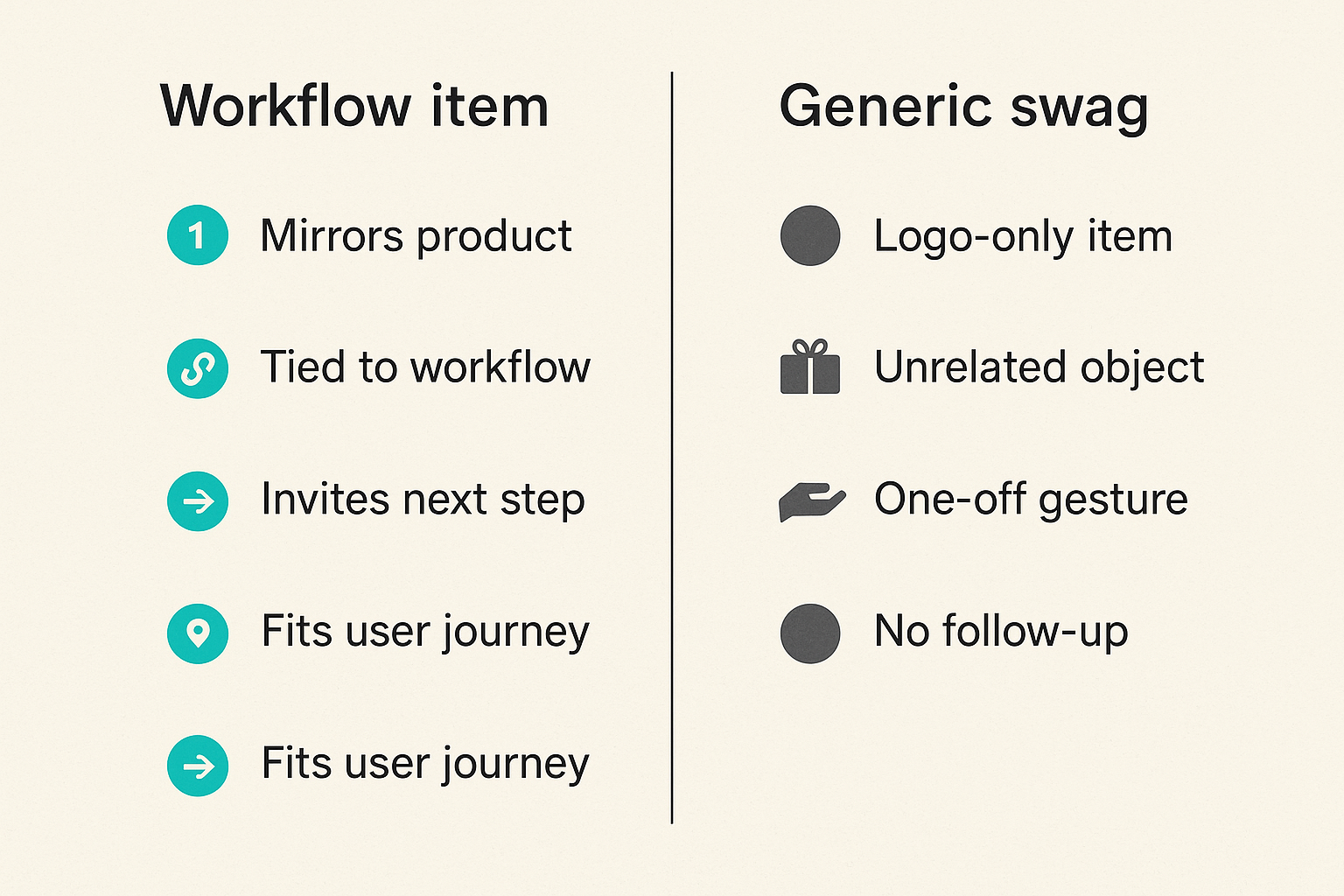
The best promotional products feel like an extension of the product, not a logo slapped on inventory.
A project management tool might send a planning pad that mirrors its workflow. A developer API company might send a command-line reference card, rubber duck, or desk object tied to debugging. A design tool might send color swatches, sketch cards, or a critique checklist. A privacy product might send a camera cover, recovery card, or security checklist.
The key is congruence. The recipient should understand why this object came from your product and what it invites them to do next.
This is where many software teams can borrow from product design. Do not start with the vendor catalog. Start with the user journey:
- What problem did the user come to solve?
- What moment proves they are serious?
- What physical object could make that moment more memorable?
- What message should arrive with it?
- What action should happen after delivery?
A physical artifact can reinforce an onboarding state, a community identity, or a sales narrative. When it does, it earns its place in the launch system.
Avoid clever items that create support debt
What breaks in practice is not usually creativity. It is operational drag.
Fragile items break. Apparel creates size exchanges. International shipping creates customs questions. Food creates allergy and perishability issues. Electronics create battery, warranty, and compliance problems. Premium items create expectations you may not want to maintain.
That does not mean you should only buy stickers. It means you should evaluate promotional products like product features: edge cases, support burden, cost to maintain, and failure states.
Before you buy, ask:
- Can this ship internationally without surprises?
- Does it require sizes, colors, or preferences?
- Will users contact support if something is wrong?
- Does the object age well after the launch?
- Can the item be reordered consistently?
- Does it create a brand promise we can sustain?
Related reading from our network: the same lifecycle thinking shows up in invoicing software workflow decisions, where the visible screen is less important than billing states, controls, integrations, and follow-up.
Build the fulfillment workflow before you buy inventory
A practical fulfillment sequence
Founders often reverse the order. They buy inventory, then figure out who should receive it, how addresses are collected, where tracking lives, who handles failed delivery, and how support responds.
That is backwards. Build the workflow first.
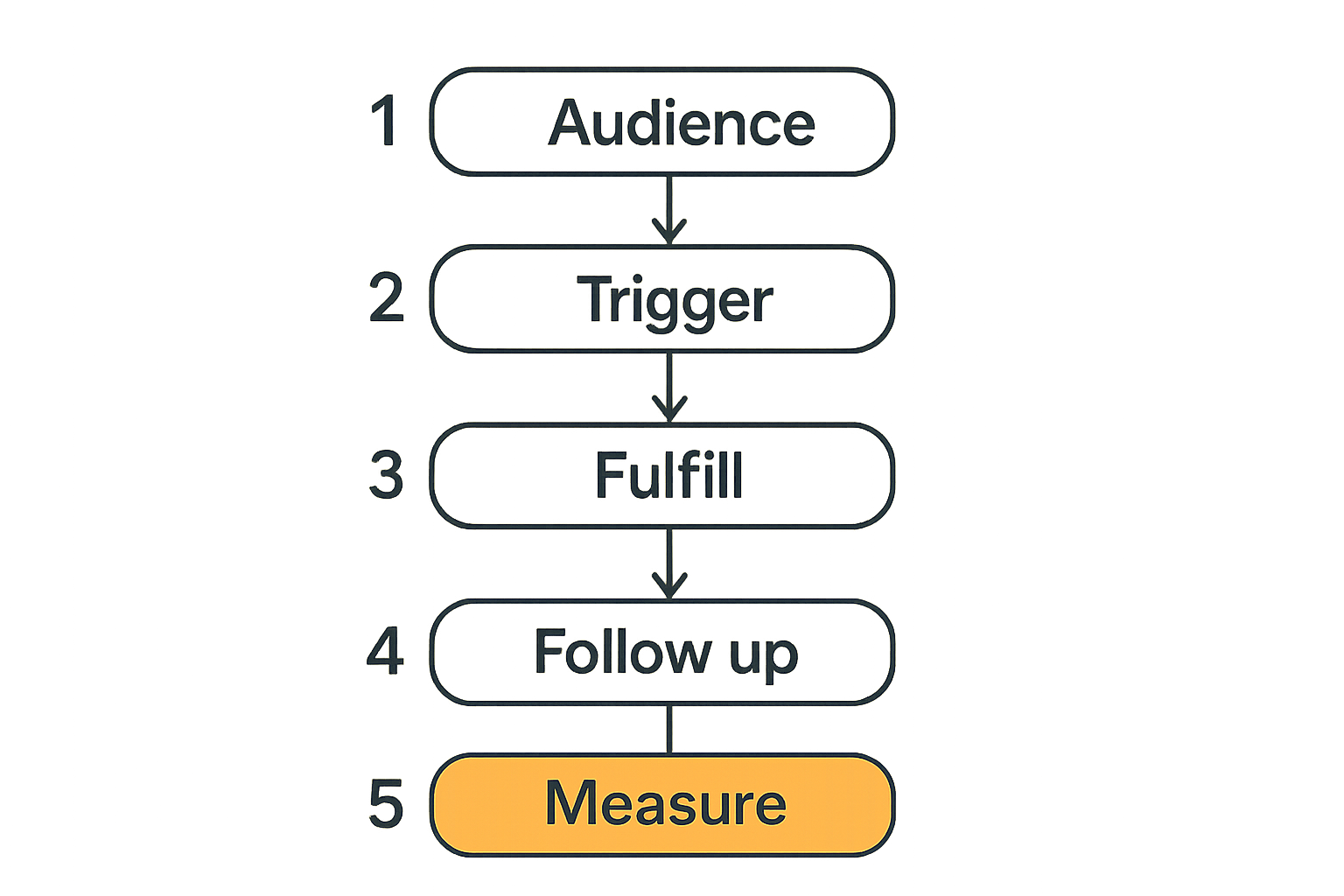
A practical promotional products implementation sequence looks like this:
- Define the launch job and recipient segment.
- Select the trigger that makes someone eligible.
- Decide whether fulfillment is manual, semi-automated, or outsourced.
- Create the address collection flow and consent language.
- Add recipient data to CRM, spreadsheet, or customer database.
- Set inventory thresholds and reorder rules.
- Create shipment status fields and failure handling.
- Write the accompanying email, note, or landing page.
- Track delivery, follow-up, and business outcome.
- Review the campaign after the launch window closes.
This does not require enterprise tooling. A solo founder can run it with a spreadsheet, form, label printer, and calendar reminder. A larger team might use CRM automation, webhook triggers, fulfillment APIs, and warehouse support.
The workflow matters more than the tooling. If the status of a shipment is unknown, the owner is unclear, and the follow-up is missing, the campaign will leak value.
The minimum data model
Even a lightweight promotional products workflow needs structured data. Otherwise you cannot avoid duplicate shipments, missed recipients, or awkward support threads.
A minimum data model might look like this:
recipient_id: user_123
name: Priya Shah
email: priya@example.com
company: Northstar Labs
segment: beta_power_user
eligibility_trigger: activated_3_projects
campaign: launch_contributor_kit_2026
item_sku: founder_notebook_v2
shipping_country: US
address_status: confirmed
fulfillment_status: shipped
tracking_status: delivered
sent_at: 2026-05-18
follow_up_status: emailed
outcome_signal: posted_case_study
owner: growth
You do not need every field on day one. You do need enough structure to answer basic questions: who qualified, who approved, what was sent, when it shipped, whether it arrived, and what happened next.
Practical rule: Treat every promotional product shipment as a stateful workflow. If you only track order quantity, you are blind to the actual launch outcome.
Measure promotional products without pretending they are ads
Metrics that are useful enough
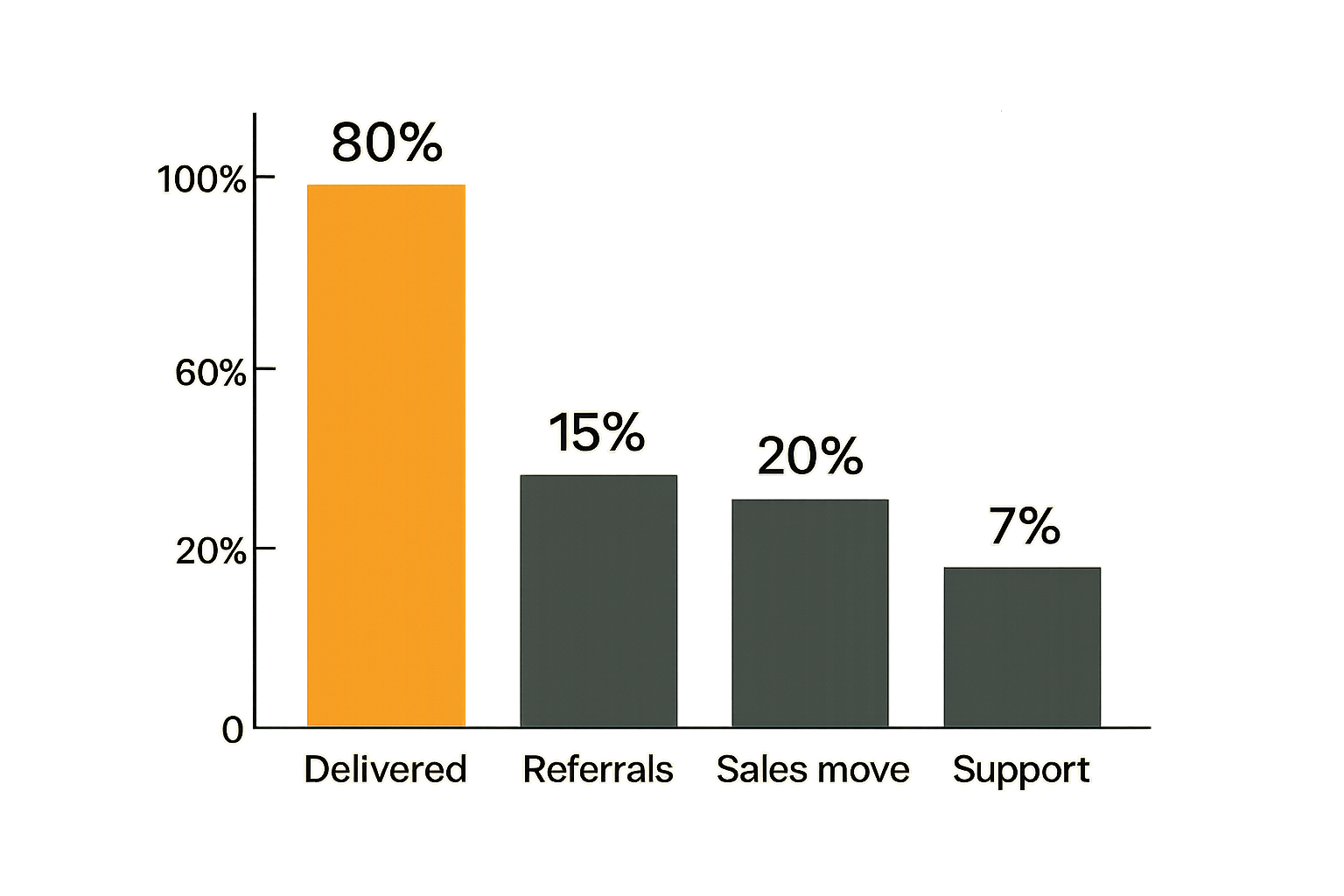
Promotional products are hard to measure with ad-platform precision. That is fine. They are not ads. They are trust, memory, and behavior tools attached to a launch workflow.
Useful measurement is still possible if you choose the right signals.
Track operational metrics:
- Eligible recipients.
- Address completion rate.
- Shipment success rate.
- Delivery time.
- Cost per delivered recipient.
- Failed delivery rate.
- Support issues per campaign.
Track business signals:
- Activation after eligibility.
- Referral completions.
- Sales stage movement.
- Community posts or contributions.
- Renewal or expansion conversations.
- Demo attendance after kit delivery.
- Case study participation.
Do not pretend a hoodie caused an enterprise deal by itself. But if a champion kit consistently improves meeting attendance, stakeholder sharing, or sales cycle engagement, that is useful. If contributor rewards increase high-quality community activity, that is useful. If launch mailers generate social posts from users who already love the product, that is useful.
Attribution traps to avoid
Attribution gets messy when teams want clean answers from messy systems.
The common traps:
- Counting every social mention as incremental growth.
- Treating recipients as a random sample when they were hand-picked.
- Ignoring the cost of staff time, storage, and support.
- Comparing promotional products to paid ads on direct conversion only.
- Forgetting that many campaigns are retention or advocacy plays.
A better approach is to define a counterfactual expectation. What would likely happen without the promotional product? If a top beta user was already going to post, the gift may not deserve full credit. If a quiet but active user becomes a visible advocate after receiving a milestone reward, that signal is more interesting.
Use directional measurement. Promotional products do not need perfect attribution to be valuable. They do need a clear hypothesis and enough data to decide whether to repeat, change, or stop the play.
Compare common promotional product plays
What works by launch stage
Different launch stages call for different promotional products. The item that works for a private beta may be wrong for a public launch or partner push.
| Stage | Strong play | Why it works | Watch out for |
|---|---|---|---|
| Private beta | Small thank-you kit for active testers | Rewards real feedback and strengthens trust | Sending to inactive users |
| Waitlist | Limited item for qualified referrals | Turns demand into a measurable loop | Rewarding low-quality invites |
| Public launch | Shareable creator kit | Gives advocates a reason to post | Making it too expensive to scale |
| Sales-led launch | Champion enablement package | Helps internal buyers explain the product | Generic gifts without product context |
| Community launch | Contributor badge, patch, or useful tool | Signals belonging and status | Overproducing before community exists |
| Event launch | Demo-linked item with QR follow-up | Connects physical booth to digital journey | Booth giveaways with no qualification |
This comparison is deliberately practical. The category matters less than the launch state. A sticker can outperform a premium gift if it reaches the right person at the right moment with the right next step.
What fails in practice
What fails is usually not the object. It is the missing system around the object.
Common failures include:
- No eligibility rule, so the team debates recipients manually.
- No owner, so shipments wait until the launch moment has passed.
- No address flow, so users send sensitive data through random email threads.
- No tracking, so support cannot answer delivery questions.
- No follow-up, so the recipient moment disappears.
- No reorder logic, so a working campaign dies when inventory runs out.
- No stop rule, so the team keeps sending items after the campaign stops working.
The practical fix is to write the operating rules before the campaign starts. If the campaign becomes successful, you will need rules anyway. If it fails, rules make the postmortem easier.
Related reading from our network: security teams use similar ownership and validation models when they think about alerts, response, and supply-chain controls, as described in ADT home security for CI/CD.
Turn promotional products into a repeatable launch asset
Create reusable kits
One-off campaigns are fine, but repeatable kits are better. A kit is not just a box. It is a packaged workflow for a recurring launch situation.
Examples:
- Beta tester kit: thank-you note, small useful item, feedback link, changelog preview.
- Champion kit: product narrative card, stakeholder explainer, desk object, meeting follow-up.
- Contributor kit: limited item, public recognition, community badge, next contribution prompt.
- Event kit: QR card, demo path, useful object, same-day email sequence.
- Referral kit: reward item, referral status page, clear threshold, social copy.
Kits reduce decision fatigue. They also make measurement cleaner because you can compare version one to version two instead of reinventing every campaign.
A useful way to think about it is productizing your physical touchpoints. Your software product has onboarding flows, upgrade paths, lifecycle emails, and release notes. Promotional products should have equivalent patterns: eligibility, packaging, fulfillment, message, tracking, follow-up, and review.
Document the operating rules
Documentation sounds boring until the founder is at a conference, the growth lead is on vacation, and support receives five questions about missing packages.
Document the rules in plain language:
- Who qualifies?
- Who approves exceptions?
- Which item is sent?
- What is the maximum cost per recipient?
- Which countries are supported?
- What happens when inventory is low?
- Who handles returned packages?
- What follow-up message is sent?
- When does the campaign end?
If your team already publishes content or launch assets, promotional products should sit in the same planning layer. For example, an AI-assisted publishing workflow can accelerate launch content, but it still needs approval, scheduling, and control. That is the same operating mindset we described in AI Publishing Shipping Software: speed helps only when the workflow keeps quality and ownership intact.
Practical rule: A promotional product campaign is not done when the item ships. It is done when the recipient state changes or the team decides the play does not work.
Common failure modes when teams ship promotional products badly
Inventory, timing, and ownership problems
Inventory is where hype meets reality. If items arrive after the launch window, the campaign loses context. If you order too much, you store outdated branding. If you order too little, you disappoint the people who qualified. If nobody owns fulfillment, every shipment becomes a favor.
The best teams make boring decisions early:
- Pick a launch window and work backward from supplier lead times.
- Add buffer for proofing, production, shipping, and customs.
- Start with smaller quantities when the audience signal is uncertain.
- Use preorders or interest forms for size-dependent apparel.
- Keep a live inventory count.
- Assign one owner for exceptions.
- Define a reorder threshold.
Do not underestimate address collection. Users may be excited to receive something, but they still need to trust the process. Use a clean form, explain why the address is needed, and avoid collecting more data than required.
This is especially important for privacy-sensitive products. If your software brand is built on trust, a sloppy gifting flow can undermine the message.
Brand risk and customer experience gaps
Promotional products are unusually visible. A bug in your app annoys one user. A bad package can become a public screenshot.
Brand risk appears in small details:
- The item feels cheaper than the product promise.
- The copy sounds generic or automated.
- The packaging creates unnecessary waste.
- The shipment arrives damaged.
- The recipient receives the wrong size or name.
- The product references a joke that does not age well.
- The QR code breaks after the campaign.
What works is consistency. If your software is minimal and fast, do not send a cluttered box full of filler. If your brand is serious and compliance-oriented, do not send novelty items that make the product feel unserious. If your product helps teams ship faster, send something that reinforces execution, planning, or momentum.
The object should feel like your product made physical.
How sh1pt.com thinks about promotional products
Where this fits in a shipping strategy
At sh1pt.com, we write for people building and launching software products who want to understand shipping strategies, product development processes, and growth tactics. Promotional products fit that world only when they support the act of shipping.
They are not a substitute for positioning, onboarding, pricing, support, or a real go-to-market motion. They are a launch layer. Used well, they can strengthen the moments that already matter: first activation, first team invite, first public contribution, first expansion conversation, first referral, first community win.
Used badly, they become expensive clutter.
The founder-friendly approach is simple:
- Start with a launch objective.
- Choose the recipient segment.
- Define the trigger.
- Design the physical touchpoint.
- Attach the digital workflow.
- Measure the operational and business signals.
- Repeat only if the play earns its place.
That is how promotional products become part of the shipping system rather than a separate marketing errand.
Promotional products belong in the launch system
Promotional products should be planned next to release notes, landing pages, lifecycle emails, community posts, launch partners, onboarding milestones, and sales follow-up. They are one more interface between your product and the market.
The mistake teams make is waiting until the end. By then, the launch strategy is already set, the timeline is tight, and the item has to work magically without the workflow around it.
Plan earlier. Keep the scope smaller. Tie every item to a job. Create enough tracking to learn. Then decide whether to scale.
That is the operator answer. Not more swag. Better systems.
Try sh1pt.com
sh1pt.com helps people building and launching software products understand shipping strategies, product development processes, and growth tactics. If you want more practical launch thinking like this, Try sh1pt.com. Promotional products work best when they are part of the system you use to ship.