
Most go to market strategy work fails because it starts too late.
The product is almost ready. The landing page is half-written. Someone opens a spreadsheet called “Launch Plan.” The team debates Product Hunt, LinkedIn, email, influencers, affiliates, SEO, demos, pricing, and whether the headline should say “AI-powered.”
Teams think the problem is distribution. The real problem is that the product, audience, promise, channel, and feedback loop were never designed as one system.
That changes the conversation. A go to market strategy is not a launch announcement. It is the operating model for moving a specific product into a specific market with enough clarity that you can learn, sell, support, and adjust without guessing every week.
In 2026, this matters more because products are easier to build and harder to differentiate. AI has compressed development cycles, content production, and feature parity. The practical question is no longer “Can we ship?” It is “Can we ship into a market with a repeatable path to trust, adoption, revenue, and learning?”
This guide treats go to market strategy as architecture: decisions, workflows, ownership, instrumentation, and failure modes. Not a template. Not a campaign calendar. An operating system.
Table of contents
- What a go to market strategy actually has to operate
- Start with the market event, not the feature
- Choose the narrowest credible beachhead
- Build positioning that sales, content, and product can reuse
- Design the channel workflow before the campaign
- Convert interest into a repeatable launch sequence
- Instrument the funnel without drowning in metrics
- Common go to market strategy failure modes
- What works in practice
- Where sh1pt.com fits in your launch system
What a go to market strategy actually has to operate

A useful way to think about it is this: your go to market strategy is the bridge between product decisions and market behavior.
If it only lives in marketing, it becomes promotion. If it only lives in sales, it becomes outreach. If it only lives in product, it becomes feature justification. The strategy has to coordinate the system that turns a real problem into adoption.
The launch is not the strategy
A launch is an event. A go to market strategy is the workflow that makes the event meaningful.
A launch can create attention. It cannot repair unclear positioning, a weak segment, missing onboarding, bad pricing logic, or a product that does not map to an urgent workflow. The mistake teams make is treating launch day as the moment of truth. In reality, launch day exposes the truth that was already built into the system.
A launch plan asks:
- What do we publish?
- Who posts?
- Which communities do we use?
- When do emails go out?
- What is the offer?
A go to market operating system asks:
- Who has the problem badly enough to change behavior?
- What market event makes the problem urgent now?
- What claim can we prove quickly?
- What channel can repeatedly reach this audience?
- What happens after someone clicks, signs up, replies, or churns?
Practical rule: If your go to market strategy cannot explain what happens after attention arrives, you do not have a strategy. You have a promotion plan.
The system connects product, audience, channel, and revenue
The strongest GTM work starts before the product is finished. It shows up in scope decisions, onboarding design, pricing, proof assets, support scripts, content angles, demo flows, and founder conversations.
For software teams, the core system usually has six connected parts:
| GTM layer | Practical question | What breaks when ignored |
|---|---|---|
| Segment | Who is this first for? | Generic messaging and low conversion |
| Trigger | Why now? | Interest without urgency |
| Promise | What changes for them? | Feature lists instead of outcomes |
| Channel | Where can we reach them repeatedly? | One-off launch spikes |
| Conversion | What action proves intent? | Vanity signups and weak pipeline |
| Learning | What informs the next build cycle? | Roadmap drift and opinion fights |
This is why GTM belongs in the same conversation as product development. If your roadmap and your market motion are disconnected, the company learns slowly. If they are connected, every release becomes a market test.
Start with the market event, not the feature
A feature is rarely enough to make someone switch. Buyers move when something changes in their environment: a new regulation, a workflow bottleneck, a budget shift, a platform change, a team size inflection, a new risk, a new opportunity, or a visible failure.
For indie hackers and early-stage founders, this is uncomfortable because it means “we built something cool” is not enough. The market does not reward effort. It reacts to pressure.
Identify the trigger that makes buyers care now
A market trigger is the thing that turns a problem from background annoyance into active priority.
Examples:
- A solo founder starts publishing daily and can no longer manage content manually.
- A B2B team adds a self-serve plan and needs onboarding that does not require calls.
- A creator launches paid templates and needs licensing, support, and refund workflows.
- A product manager inherits a messy backlog and needs a better release decision process.
- A startup moves upmarket and discovers that proof, security, and procurement matter.
The practical question is: what happened in the buyer’s world that makes your product relevant now?
Without a trigger, your messaging usually becomes abstract: “save time,” “work smarter,” “boost productivity,” “grow faster.” Those claims are not always wrong, but they are too easy to ignore.
Related reading from our network: teams working across freelancer marketplaces face similar trigger and workflow questions in this guide to gig work platforms for AI-assisted freelancers.
Separate curiosity from urgency
Curiosity sounds like:
- “Interesting idea.”
- “I might try this later.”
- “Send me the link.”
- “Cool, congrats on the launch.”
Urgency sounds like:
- “Can this replace what we use now?”
- “Does it work with our workflow?”
- “Can I import existing data?”
- “What happens if my teammate joins?”
- “Can we test this before Friday?”
Many early teams misread curiosity as demand. They collect likes, waitlist emails, and friendly comments, then get confused when activation is weak.
Practical rule: Treat urgency as behavior, not sentiment. A buyer who asks implementation questions is more valuable than a crowd that says the idea is clever.
Choose the narrowest credible beachhead
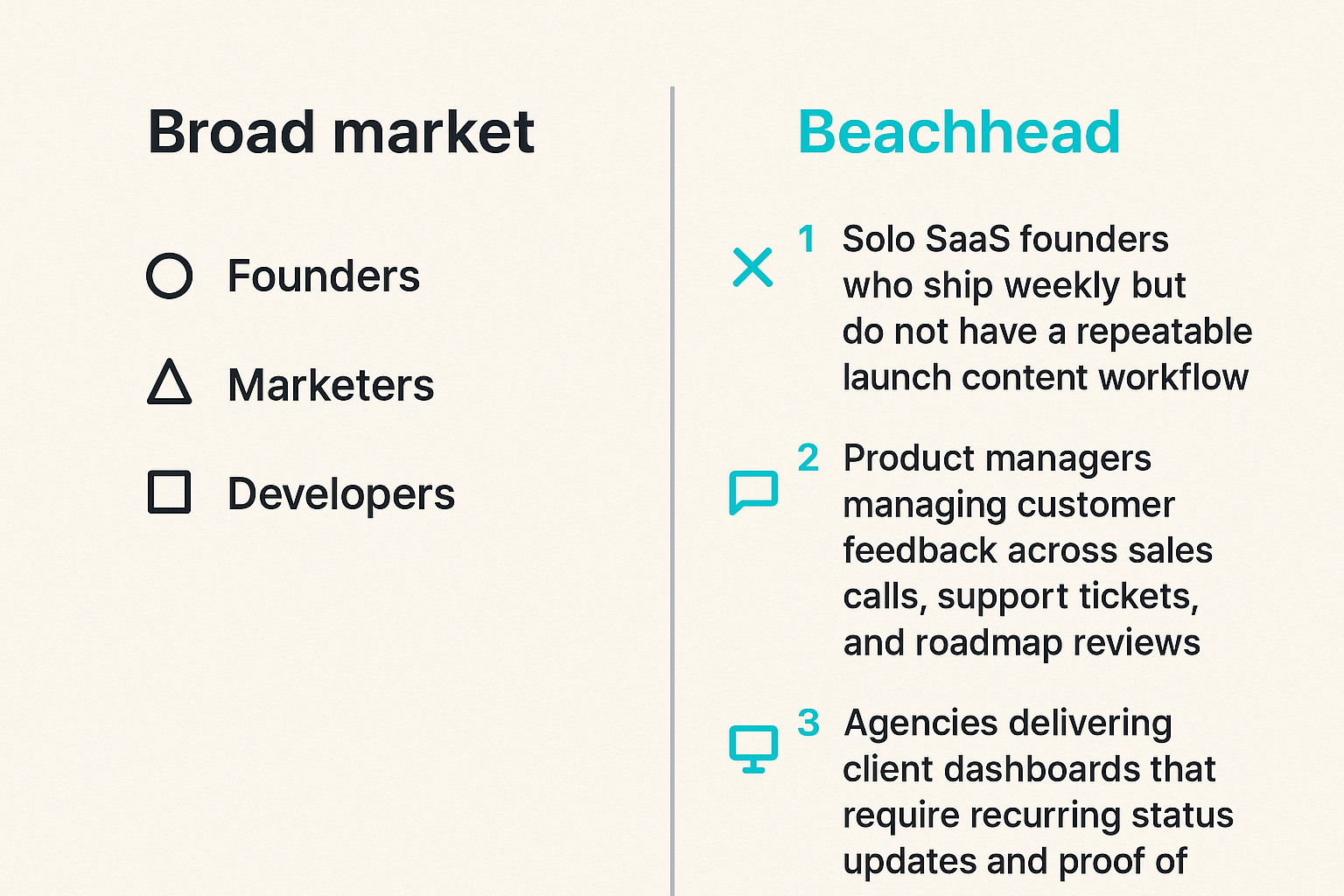
The broad-market version of your product may be real later. It is usually not the right starting point.
A go to market strategy needs a first market where the pain is clear, the language is specific, the proof is reachable, and the channel is practical. The goal is not to make your total addressable market sound impressive. The goal is to create a segment where your product can win conversations.
Define the first segment by workflow pain
Weak segmentation starts with demographics:
- Founders
- Marketers
- Developers
- Agencies
- Small businesses
- Creators
Useful segmentation starts with workflow pain:
- Solo SaaS founders who ship weekly but do not have a repeatable launch content workflow.
- Product managers managing customer feedback across sales calls, support tickets, and roadmap reviews.
- Agencies delivering client dashboards that require recurring status updates and proof of progress.
- AI tool builders who need onboarding that explains where automation stops and human review starts.
The difference is operational. A workflow segment tells you what the buyer is doing, where the pain appears, what systems they already use, what language they understand, and what proof will matter.
If you want a deeper product-side operating model, sh1pt.com has a practical breakdown of how to turn signals into shipped work in this product development workflow guide.
Decide who you are willing to ignore
Positioning gets sharper when you decide who the product is not for yet.
That does not mean insulting other users or blocking future expansion. It means your early system needs focus. Support, onboarding, content, demos, integrations, pricing, and roadmap priorities all become expensive when every possible customer matters equally.
Use a simple exclusion list:
initial_market:
  serve_now:
    - solo founders launching software products
    - small teams shipping frequent updates
    - product operators who own roadmap and launch communication
  ignore_for_now:
    - large enterprises with procurement-heavy buying cycles
    - consumer apps with no clear monetization path
    - teams needing custom implementation before first value
This is not bureaucracy. It is a forcing function. If you cannot say who you are ignoring, your team will quietly build and market for everyone.
Build positioning that sales, content, and product can reuse
Positioning is not the tagline. It is the internal logic that lets every customer-facing surface tell the same truth.
Good positioning reduces translation work. Your homepage, launch post, demo, onboarding, emails, support docs, and founder replies should not feel like they were written by six different companies.
Turn the wedge into a clear category choice
Your wedge is the specific entry point. Your category choice is the mental shelf where buyers place you.
For example:
- “A launch tracker for indie hackers” is a wedge.
- “Product shipping operating system” is a broader category direction.
- “AI content calendar” is a wedge.
- “Publishing workflow infrastructure” is a broader category direction.
The mistake teams make is jumping straight to the big category before they have earned it. Buyers do not care that you want to become a platform. They care whether today’s product solves today’s problem.
A practical positioning statement can be rough but useful:
For [specific segment]
who struggle with [urgent workflow problem],
[product] helps them [specific outcome]
without [painful tradeoff],
unlike [current alternative].
Do not over-polish this too early. Use it as a decision tool.
Write claims your product can prove
A claim is only useful if the product can prove it quickly.
Bad early claims:
- “The ultimate growth platform.”
- “All-in-one launch automation.”
- “10x your product velocity.”
- “The easiest way to scale.”
Better early claims:
- “Turn each release into a reusable launch note, changelog, and audience update.”
- “Keep product feedback, shipping decisions, and launch communication in one workflow.”
- “Publish product updates faster without losing founder review.”
- “See which launches generated replies, signups, and roadmap signals.”
The stronger claim is usually narrower. It is also easier to test.
Related reading from our network: content-heavy GTM teams face the same control problem, and this AI blog publishing software workflow guide is a useful adjacent example of building review gates instead of just generating more output.
Design the channel workflow before the campaign
A channel is not a place where you post. It is a repeatable workflow for reaching, educating, converting, and learning from a market.
This matters because founders often copy channels from other companies without copying the operating conditions that made those channels work. A founder-led LinkedIn motion, SEO motion, outbound motion, affiliate motion, marketplace motion, and community motion all require different assets, cadences, feedback loops, and patience.
Map discovery, education, conversion, and retention
Every channel should be mapped across four jobs:
| Channel job | What it does | Example asset |
|---|---|---|
| Discovery | Helps the right people find you | launch post, search article, community reply |
| Education | Explains the pain and approach | teardown, guide, demo, comparison |
| Conversion | Creates an intent action | trial, waitlist, audit, template, call |
| Retention | Reinforces value after signup | onboarding email, changelog, workflow prompt |
What breaks in practice is that teams over-invest in discovery and under-invest in conversion and retention. They get traffic, then route it into a weak landing page, unclear onboarding, or a signup flow that does not match the promise.
Practical rule: Do not scale a channel until the post-click workflow can capture, qualify, and learn from the attention it creates.
Pick channels by operational fit
The best channel is not always the largest channel. It is the one your team can operate consistently with credible insight.
Use this comparison before committing:
| Channel | Works when | Fails when |
|---|---|---|
| Founder-led social | Founder has strong opinions and can engage daily | Posts become vague updates with no buyer path |
| SEO | Buyers search for workflow, comparison, and problem terms | Team expects instant results or publishes generic content |
| Communities | Team can contribute without drive-by promotion | Product is pushed before trust exists |
| Outbound | Segment and trigger are precise | Lists are broad and messaging is generic |
| Partnerships | Audiences overlap and incentives are clear | Partner is treated as a traffic source only |
| Marketplace/app store | Buyer already searches inside the ecosystem | Listing is not supported by onboarding and reviews |
This is also where project management becomes a GTM issue. Related reading from our network: this project management software workflow guide is a useful parallel for choosing tools by ownership and workflow instead of feature lists.
Convert interest into a repeatable launch sequence
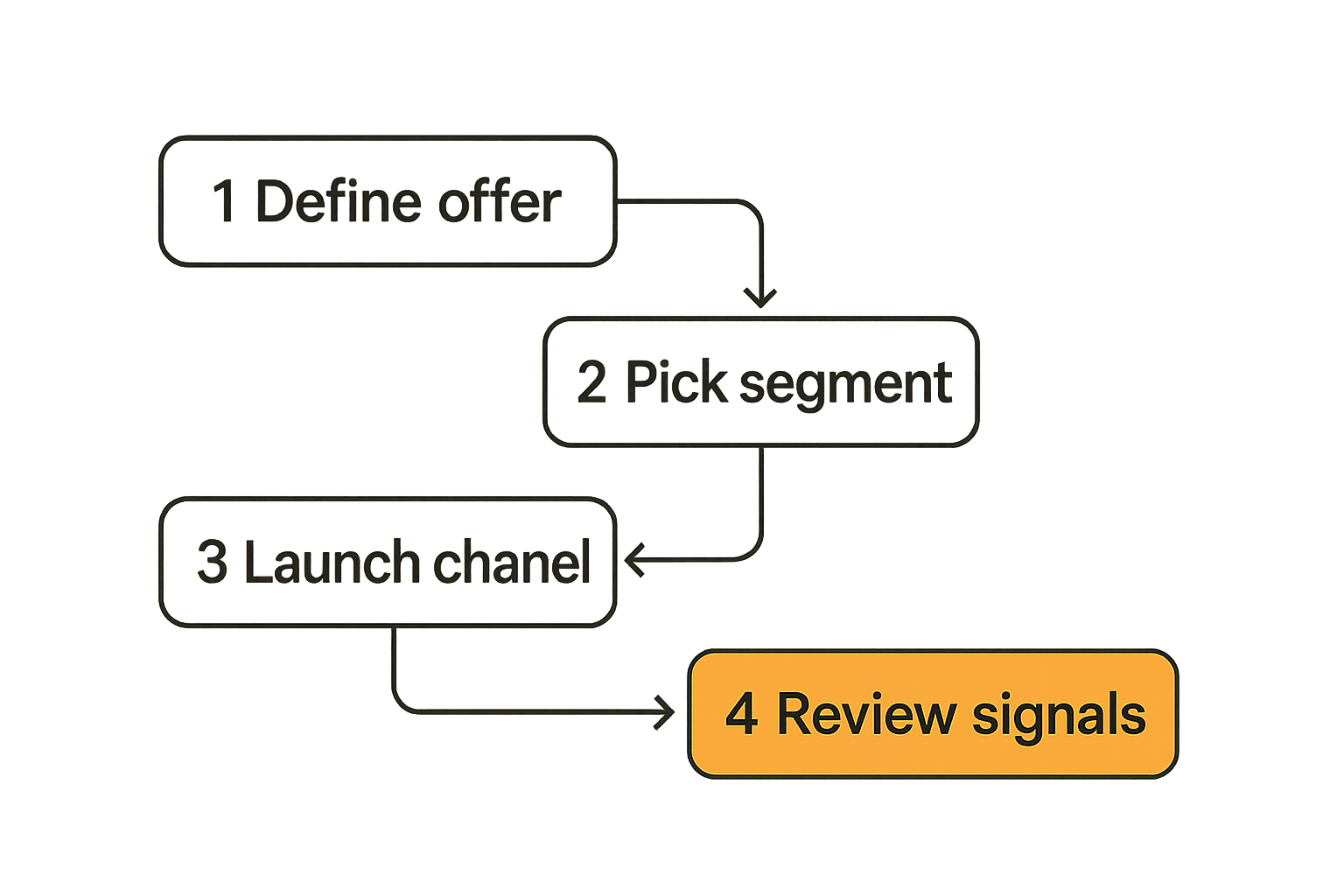
Once the segment, trigger, positioning, and channel are clear, you need a sequence. Not a giant launch checklist. A repeatable workflow that can run for every major release, experiment, or productized offer.
The point is to make launches less heroic. If every launch depends on last-minute effort, the company will avoid launching often enough to learn.
A practical 10 step go to market workflow
Use this sequence as a starting point:
- Define the release or offer. What is shipping, and what customer problem does it address?
- Name the first segment. Who should care first, and why them?
- Write the trigger. What changed that makes this relevant now?
- Draft the core claim. What outcome can the product prove quickly?
- Map the proof. Demo, screenshot, case note, founder story, benchmark, workflow example, or customer quote.
- Choose the primary channel. Do not spread the launch across every possible surface by default.
- Build the conversion path. Landing page, signup, calendar, template, trial, email reply, or in-product action.
- Prepare response handling. Who replies to comments, support questions, objections, and demo requests?
- Log the signals. Capture objections, high-intent replies, activation behavior, and feature requests.
- Run the decision review. Keep, change, expand, narrow, or kill the motion.
This sequence should be small enough to run often. For founders, the discipline is not making it beautiful. The discipline is making it repeatable.
If content is part of your launch system, the adjacent workflow in AI publishing shipping software shows how to use automation without losing review control.
What to automate and what to keep manual
Automation helps when the workflow is understood. It makes bad assumptions worse when the workflow is still unclear.
Automate:
- Draft generation for launch notes, email variants, and social snippets.
- Reformatting one release into multiple distribution assets.
- Routing signups and replies into a CRM or feedback system.
- Sending onboarding reminders based on user actions.
- Tagging feedback by segment, feature, trigger, and objection.
Keep manual:
- Early customer conversations.
- Positioning decisions.
- Objection interpretation.
- Pricing judgment.
- Segment expansion decisions.
- Support replies for confused first users.
The mistake teams make is automating the conversation before they understand it. Early go to market work is full of ambiguity. You need human judgment close to the signal until patterns become obvious.
Instrument the funnel without drowning in metrics
Metrics are useful when they create decisions. They are harmful when they create theater.
A seed-stage startup, indie product, or founder-led software business does not need a 40-metric dashboard to understand whether the go to market strategy is working. It needs enough instrumentation to see where intent is created, where it is lost, and what should change next.
Track signal quality before volume
Volume is seductive. More impressions, more clicks, more subscribers, more waitlist entries. But early GTM work is usually constrained by quality of signal, not quantity.
Track signals like:
- Qualified replies from the target segment.
- Signup-to-activation rate by source.
- Questions that reveal buying intent.
- Objections repeated by multiple prospects.
- Time to first value in onboarding.
- Conversion from launch content to product action.
- Retention by segment or use case.
A small number of high-intent users can teach more than a large audience that never activates.
Here is a simple signal table many teams can maintain manually at first:
| Signal | Source | Segment | Meaning | Decision |
|---|---|---|---|---|
| 5 founders ask for team invites | launch replies | solo-to-small team | collaboration may be pull | test lightweight team feature |
| 20 signups, 2 activations | social post | mixed | message created curiosity | fix onboarding or narrow audience |
| 3 users request export | demo calls | agencies | reporting workflow matters | add export to proof path |
| Many likes, no trials | community | broad | attention is not intent | change CTA or stop channel |
Use feedback loops, not dashboards alone
A dashboard tells you what happened. A feedback loop changes what happens next.
Your GTM review should answer five questions every week during an active launch cycle:
- Which segment showed the strongest intent?
- Which promise created the clearest response?
- Where did users get stuck?
- What objection appeared more than once?
- What product, messaging, or channel decision changes this week?
This is where shipping cadence matters. The faster you can update a page, adjust onboarding, publish a clarification, improve a feature, or respond to objections, the more useful your GTM data becomes. Slow teams collect insights they never operationalize.
For a broader operating model around release cadence and ownership, see sh1pt.com’s guide to shipping software faster without turning the team into chaos.
Common go to market strategy failure modes
A go to market strategy usually fails in predictable ways. The details change by product, but the patterns repeat.
The useful move is not to avoid every mistake. That is impossible. The useful move is to notice the failure mode early enough that you can correct the system before the team invents a false story about the market.
Shipping into vague demand
Vague demand is when people agree with the problem but do not change behavior.
You hear:
- “Everyone needs this.”
- “This could be useful for many teams.”
- “There is definitely a market here.”
- “We just need more awareness.”
But you do not see:
- Fast activation.
- Specific objections.
- Switching questions.
- Repeat usage.
- Budget conversation.
- Users pulling the product into their workflow.
What breaks in practice is that the team keeps adding features to satisfy an undefined customer. The product becomes broader, the messaging becomes safer, and the GTM motion becomes harder to operate.
Fix it by narrowing the segment until you can name the workflow pain in one sentence. If that makes the market feel smaller, good. Early GTM needs traction, not theoretical scale.
Confusing community attention with pipeline
Communities can be valuable. So can social platforms, launch sites, newsletters, and founder networks. But attention from peers is not the same as demand from buyers.
Indie hackers are especially exposed to this because other builders are generous with feedback and encouragement. That is useful, but it can distort the signal. A post can perform well because builders like the story, not because buyers want the product.
Ask:
- Did the audience match the target customer?
- Did attention produce qualified product actions?
- Did comments reveal workflow pain or just support?
- Did the launch create follow-up conversations?
- Did any users return after the first session?
If not, the channel may still be useful for learning or reputation, but it should not be counted as pipeline.
What works in practice
The best go to market teams are usually less dramatic than they look from the outside. They make fewer assumptions at once. They keep product and market learning close together. They write down decisions. They review evidence. They avoid pretending that a launch spike is the same as a working motion.
This is not glamorous work. It is operator work.
Tight scope, fast proof, visible learning
What works:
- A narrow first segment.
- A clear market trigger.
- A product promise that can be proven quickly.
- One or two primary channels operated consistently.
- A conversion path that matches the promise.
- Manual conversations close to the first users.
- Weekly review of signals and decisions.
What fails:
- Launching to everyone.
- Copying another company’s channel without matching their context.
- Publishing content that attracts readers but not buyers.
- Building onboarding after traffic arrives.
- Treating pricing as separate from positioning.
- Tracking metrics that do not change decisions.
- Expanding the roadmap to avoid hard GTM choices.
Practical rule: A small GTM motion that produces clear learning is better than a large launch that produces ambiguous applause.
Weekly decisions beat quarterly theater
A go to market strategy should create decisions every week during active discovery and launch periods.
Good weekly GTM decisions sound like:
- “We are narrowing the homepage to solo SaaS founders for the next two weeks.”
- “We are changing the CTA from waitlist to workflow audit because replies show buyers need diagnosis.”
- “We are moving onboarding proof earlier because users do not understand the value before setup.”
- “We are pausing community posts because high engagement is not converting.”
- “We are writing three comparison pages because search intent is stronger than social intent.”
Bad GTM reviews sound like status theater:
- “Traffic is up.”
- “The launch went well.”
- “People seem excited.”
- “We need more content.”
- “Let’s test everything.”
The difference is ownership. A working GTM system assigns decisions to people, not vibes to dashboards.
Where sh1pt.com fits in your launch system
A site like sh1pt.com is useful when you treat shipping as a market-facing discipline, not just an engineering activity.
Product teams need more than ideas. They need workflows for deciding what to build, how to launch it, how to explain it, how to measure it, and how to turn market response into the next useful release.
Use shipping content as market infrastructure
Shipping content is not only content marketing. It can be infrastructure for your go to market strategy.
A good product update can:
- Explain the problem behind the release.
- Show the workflow the product supports.
- Clarify who the feature is for.
- Give existing users a reason to return.
- Give prospects a concrete proof point.
- Feed sales, support, onboarding, SEO, and community distribution.
This is why launch notes, changelogs, build-in-public posts, teardown essays, product guides, and roadmap updates should not be treated as disconnected assets. They are part of the same learning system.
Connect roadmap, launch notes, and audience learning
For founders and product managers, the practical architecture looks like this:
market signal -> roadmap decision -> shipped release -> launch asset -> user response -> next decision
When that loop works, your go to market strategy gets sharper over time. The product becomes easier to explain because the team understands which pain is real. The launch process becomes faster because the proof assets are produced as part of shipping. The roadmap improves because customer response is not trapped in comments, calls, and scattered notes.
When that loop breaks, teams ship features nobody can position, publish content that does not reflect the product, and collect feedback that never reaches roadmap decisions.
The closing point is simple: go to market strategy is not a document you finish. It is a workflow you operate. The teams that win are not always the teams with the loudest launch. They are the teams that connect shipping, proof, distribution, and learning tightly enough to keep improving.
Try sh1pt.com
sh1pt.com is for people building and launching software products who want practical shipping strategies, product development processes, and growth tactics. Try sh1pt.com.