
Most founders do not struggle because they lack ideas. They struggle because the thing they ship is technically real but commercially vague. The feature works. The landing page exists. The demo records fine. Then real buyers arrive and hesitate.
Buyers products are not products with more features. They are products shaped around how a buyer recognizes pain, evaluates risk, compares alternatives, gets internal permission, reaches value, and keeps using the thing after the first invoice.
Teams think the problem is building the product. The real problem is building the buying system around the product. That changes the conversation.
The practical question is not, can we ship this? It is, can a specific buyer understand, trust, adopt, pay for, and defend this product without the founder manually translating everything?
Table of contents
- Buyers products are an operating system, not a feature list
- Start with buyer pressure, not product inspiration
- Map the buying workflow before you design the product
- Positioning turns software into a purchase decision
- Product packaging is where buyers products become obvious
- Onboarding is part of the sales system
- Launch buyers products with a market workflow
- What breaks when teams build buyers products badly
- What works: the practical rules for buyer-shaped shipping
- Product fit: where sh1pt.com helps founders ship buyers products
Buyers products are an operating system, not a feature list

A useful way to think about it is this: a buyer product is a product where the commercial path is designed as deliberately as the interface. The mistake teams make is treating buyer behavior as a marketing problem that starts after development.
That split creates weak launches. Engineering builds a capable product. Marketing writes general claims. Sales improvises around objections. Support explains missing assumptions. The buyer experiences one messy system, even if the team sees four departments.
The buyer is not always the user
In many software products, the person who feels the pain, the person who uses the tool, and the person who approves payment are different people. Even in indie and prosumer markets, the buyer may be a founder thinking about time, risk, and opportunity cost, while the daily user just wants the workflow to stop being annoying.
If you only design for the user, you may win applause but lose revenue. If you only design for the buyer, you may close deals but create churn. Buyers products connect both.
Practical rule: Build for the user experience, but package for the buyer decision.
The product includes the decision path
The product is not just the app. It includes the landing page, pricing page, onboarding sequence, docs, demo data, support promises, cancellation flow, and the story customers repeat to someone else.
If a buyer cannot answer why this, why now, why you, and what happens after I pay, the product is incomplete. Not technically incomplete. Commercially incomplete.
Why this matters more in 2026
In 2026, buyers are surrounded by competent software. AI-generated prototypes, no-code stacks, design templates, and marketplace distribution have lowered the cost of shipping something plausible. That is good. It also means plausible is no longer enough.
Founders need to ship products that survive comparison. Product managers need to justify roadmap tradeoffs. Solopreneurs need pages and workflows that sell when they are asleep. Buyers products force that discipline.
Related reading from our network: teams thinking about role design and productivity tradeoffs may find the workflow lens in this practical guide to software engineer jobs in 2026 useful, because buying software and staffing software teams often fail for the same reason: unclear ownership.
Start with buyer pressure, not product inspiration
Most product ideas begin with irritation. That is fine. But irritation is not the same as purchase pressure. The practical question is whether the buyer has a moment where the cost of doing nothing becomes visible.
Identify the expensive moment
An expensive moment is the point where the buyer can name the loss. It might be missed revenue, wasted hours, delayed launches, messy handoffs, compliance exposure, bad customer experience, or founder attention burned on low-value work.
For a product launch tool, the expensive moment might be the week before launch when assets, feedback, tasks, metrics, and channel owners are scattered. For a developer tool, it might be the second time a team ships a preventable bug. For a creator product, it might be the first time support requests overwhelm delivery.
Write this moment plainly:
- When does the pain become impossible to ignore?
- Who feels it first?
- Who pays if it continues?
- What workaround are they using now?
- What does that workaround cost?
Separate curiosity from urgency
Curiosity produces signups. Urgency produces buying behavior. A lot of founders confuse waitlist growth with market demand. A buyer may want to inspect a product because it is novel, not because they are ready to replace an existing workflow.
Signals of urgency look different:
- They ask about migration.
- They ask about pricing before the product is polished.
- They describe a deadline.
- They compare you to a current tool or manual process.
- They ask whether their team can use it next week.
Curiosity is still useful. It tells you the topic has attention. But buyers products are built from urgent workflows, not passive interest.
Write the buyer trigger before the roadmap
Before adding features, write the trigger that makes the buyer start looking. Keep it specific.
Weak trigger: Teams need better project management.
Stronger trigger: A remote product team is two weeks from launch and cannot see which launch tasks are blocked, who owns them, or what must be cut.
That stronger trigger tells you what to build, what to ignore, what language to use, and what proof matters. It also prevents the roadmap from becoming a collection of attractive but disconnected capabilities.
Map the buying workflow before you design the product
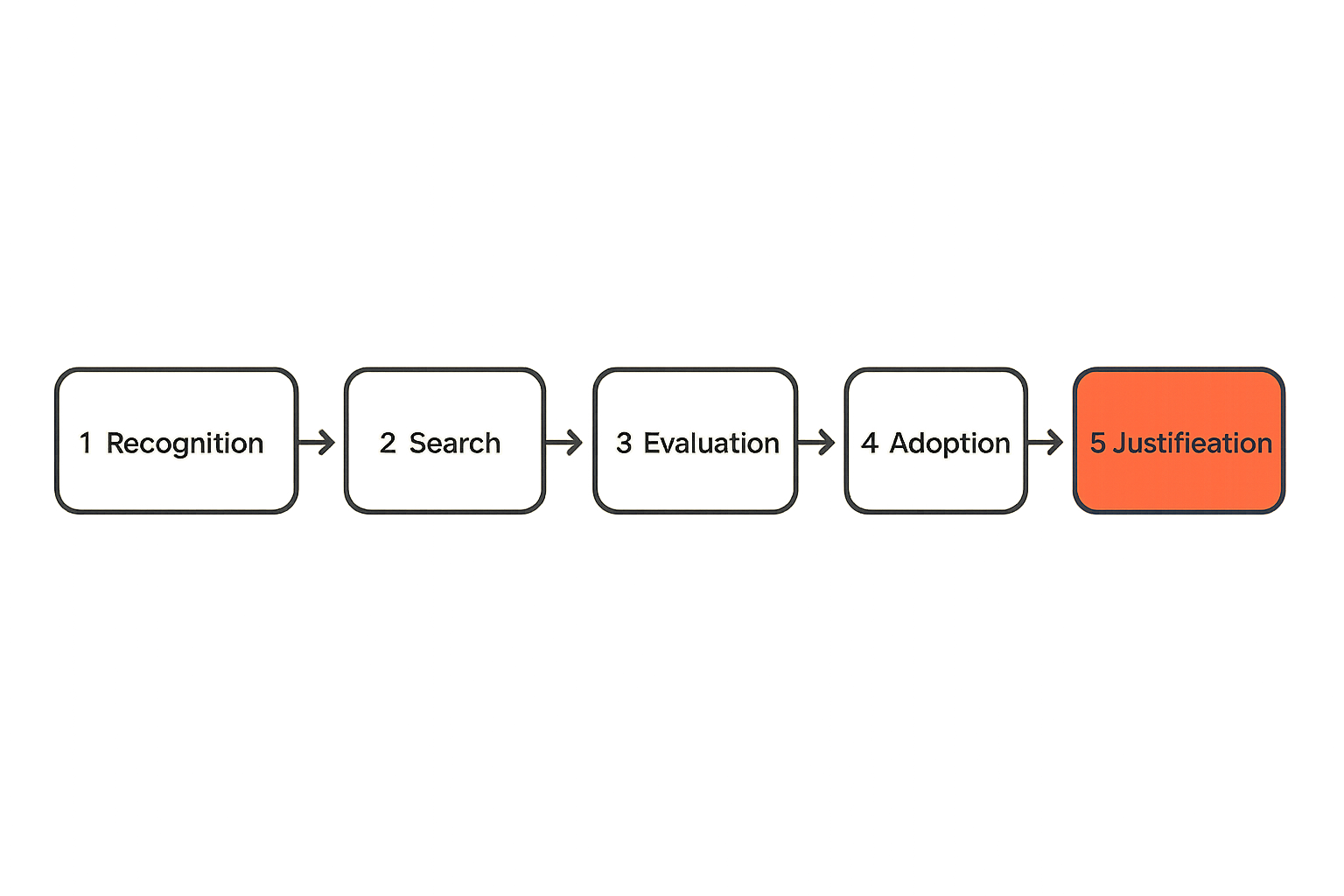
The buying workflow is the path from pain to paid adoption. It deserves the same attention as the product workflow. What breaks in practice is that teams optimize only the middle: the demo or the app screen.
The five-step buyer path
A practical buyer path has five stages:
- Recognition: The buyer realizes the current way is costing too much.
- Search: The buyer looks for categories, recommendations, or examples.
- Evaluation: The buyer compares options, risk, price, and credibility.
- Adoption: The buyer starts using the product or asks a team to use it.
- Justification: The buyer decides whether the purchase was worth defending.
Each stage needs product support. Recognition needs sharp language. Search needs discoverable positioning. Evaluation needs proof. Adoption needs fast time-to-value. Justification needs visible outcomes.
Where founders usually skip steps
Founders often skip recognition because they live inside the problem. They skip evaluation because they believe the product is obviously better. They skip justification because they assume payment is the finish line.
It is not. In buyer-shaped products, payment is the start of the second sale: the sale where the customer decides to keep trusting you.
Practical rule: If your product cannot help a buyer justify the purchase after checkout, you have not finished the product.
A simple implementation sequence
Use this sequence before your next launch or major feature release:
- Write the buyer trigger in one sentence.
- List the current alternatives, including spreadsheets, agencies, interns, and doing nothing.
- Define the first measurable proof the product should deliver.
- Build the shortest onboarding path to that proof.
- Rewrite the landing page around the trigger, alternative, proof, and risk reduction.
- Run five buyer conversations using the page and onboarding flow, not a slide deck.
- Cut features that do not support recognition, evaluation, adoption, or justification.
This is not a branding exercise. It is product architecture. It tells you what the product must make obvious.
For a broader launch system, the operating model in Go to Market Strategy in 2026 pairs well with this buyer workflow because it connects audience, channels, metrics, and founder decisions instead of treating launch as a single announcement.
Positioning turns software into a purchase decision
Positioning is not a tagline. It is the frame that tells buyers what shelf your product belongs on and why they should care now. If buyers have to invent the category for you, most will leave.
Name the category carefully
Category language should reduce cognitive load. Sometimes you should attach to an existing category. Sometimes you should create a narrower subcategory. The decision depends on buyer maturity.
If buyers already search for the category, use their language. If they do not, anchor your product to a known workflow and introduce the distinction after they understand the pain.
For example, launching as an AI workspace for founders may sound broad and modern, but a launch readiness dashboard for indie software launches gives the buyer a clearer decision path.
Make the alternative explicit
Every buyer compares you to something. The alternative might be a competitor, but early products usually compete with messy internal workflows.
Name the alternative:
- Instead of tracking launch work across Notion, Slack, email, and memory...
- Instead of hiring an agency before you know the channel...
- Instead of building custom internal tooling for a temporary process...
This makes the value concrete. It also helps buyers explain the purchase to themselves.
Use proof that reduces risk
Proof does not need to be a famous logo. Early proof can be a walkthrough, teardown, before-and-after example, public build log, migration checklist, demo workspace, or founder-led case note.
The key is that proof must reduce a specific risk. If the buyer worries setup will take too long, show setup. If they worry the product is too lightweight, show a serious workflow. If they worry the product will vanish, show your cadence and support posture.
Related reading from our network: if your product touches secure development or DevSecOps buyers, this architecture guide to cyber security certifications is a useful adjacent example of how trust signals influence technical buying decisions.
Product packaging is where buyers products become obvious
Packaging is the bridge between capability and purchase. It decides what the buyer thinks they are buying. The mistake teams make is packaging around internal architecture instead of buyer jobs.
Package around jobs, not modules
A module-based package says: dashboards, exports, integrations, team roles. A job-based package says: launch planning, customer feedback review, release coordination, investor update workflow.
Buyers do not wake up wanting modules. They want progress against a job. The same feature can feel optional or necessary depending on how it is packaged.
A useful test: remove your feature names from the pricing page and replace them with outcomes. If the page gets clearer, you were selling the implementation instead of the job.
Pricing should explain the value model
Pricing is communication. Per-seat pricing says the value grows with team adoption. Usage pricing says the value follows volume. Flat pricing says simplicity matters. Tiered pricing says different maturity levels exist.
None of these are universally right. The practical question is which model matches the buyer's mental accounting.
If your product saves founder time, a simple monthly price may work. If it processes launch campaigns or transactions, usage may be logical. If it supports a whole team, seats may fit. But do not copy a pricing model because another SaaS uses it. Copy the buyer logic, not the surface.
Comparison table: builder product vs buyer product
| Area | Builder-centered product | Buyer-shaped product |
|---|---|---|
| Homepage | Explains features | Names the painful situation |
| Pricing | Mirrors database limits | Mirrors buyer value and maturity |
| Onboarding | Shows everything possible | Drives to first proof quickly |
| Roadmap | Adds requested features | Removes friction from buying and adoption |
| Metrics | Tracks signups and usage | Tracks activation, conversion, retention, and objections |
| Support | Answers confusion repeatedly | Feeds confusion back into product and positioning |
Practical rule: If packaging does not make the buyer's next decision easier, it is decoration.
Onboarding is part of the sales system
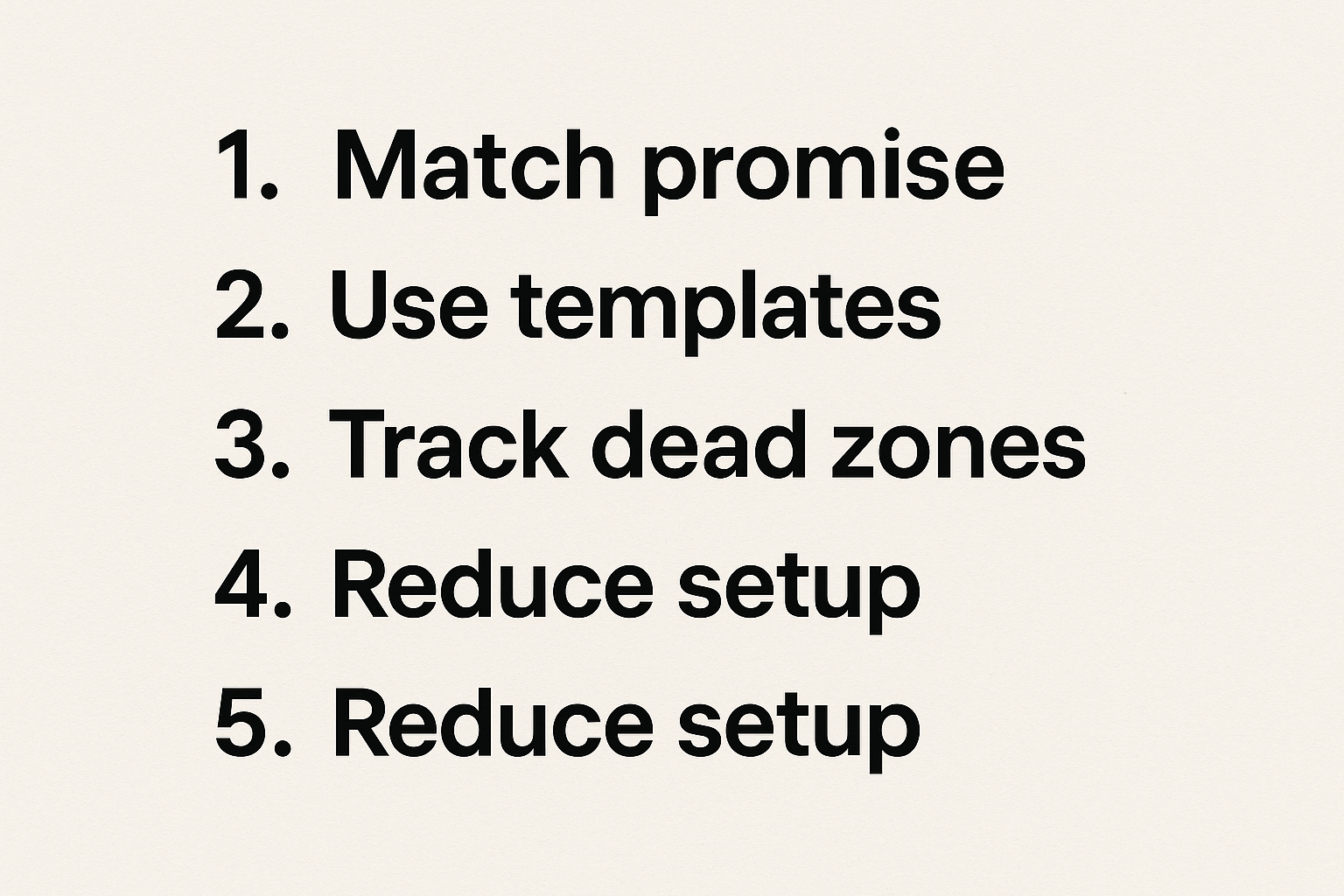
Onboarding is where the product proves the promise. Many teams treat it as a user education layer. That is too narrow. For buyers products, onboarding is a conversion, retention, and trust system.
Activation must match the promise
If your landing page promises a cleaner launch workflow, activation is not account creation. It is the moment the buyer sees their launch workflow become clearer. If your product promises faster customer research, activation is not importing contacts. It is the first useful insight.
Define activation in buyer language:
- First launch plan created with owners and deadlines.
- First customer interview tagged into a useful theme.
- First payment reconciliation completed without manual spreadsheet work.
- First security issue routed to the right owner.
The more precise the activation event, the easier it is to improve onboarding.
Design for first proof, not full setup
Full setup is often the enemy of first proof. Buyers will tolerate configuration after they believe the product works. They will not tolerate configuration before they understand the payoff.
Give them a small but real win. Use templates, sample data, guided imports, default workflows, and opinionated empty states. Do not make a new buyer design your system from scratch.
For software launches, even offline or physical touchpoints can support onboarding when they reinforce the campaign. The workflow in Promotional Products for Software Launches is useful because it treats swag and fulfillment as part of attribution and post-launch learning, not as random merch.
Instrument the dead zones
Dead zones are places where buyers stop but the dashboard still looks fine. Common dead zones include invite flows, integration setup, empty dashboards, approval steps, and pricing upgrades.
Track events that reveal hesitation:
- Started onboarding but did not create the first project.
- Created a project but did not invite anyone.
- Connected an integration but did not use imported data.
- Viewed pricing three times but did not upgrade.
- Exported data before canceling.
These signals tell you where the buyer system is leaking.
Launch buyers products with a market workflow
A launch is not a megaphone. It is a structured test of whether the buyer system works under real attention. The announcement is only one artifact.
Pre-launch is buyer discovery under pressure
Before launch, you should know the trigger, alternative, first proof, primary objection, and buyer segment. If you do not, the launch will become expensive research.
Pre-launch work should produce assets, not just opinions:
- A landing page that names the painful moment.
- A short demo that reaches proof fast.
- A pricing page that explains who each plan is for.
- A customer conversation script.
- A launch issue tracker for objections and bugs.
- A follow-up sequence for interested but not-ready buyers.
Launch assets should answer objections
Do not ship a launch post that only says what the product does. Answer what the buyer is already thinking:
- Why should I switch from my current workaround?
- How long does setup take?
- What happens if my team ignores it?
- Is this for solo founders, teams, agencies, or enterprises?
- Can I cancel, export, or migrate?
The best launch assets reduce uncertainty. A clear demo, checklist, template, or comparison page often does more work than a clever announcement.
Post-launch is where positioning gets corrected
After launch, sort feedback by buyer-stage failure. Did people fail to understand the pain? Did they understand but not trust the product? Did they try it but fail to reach proof? Did they pay but not return?
Each failure points to a different fix. Do not respond to every launch disappointment by adding features. Sometimes the feature is fine and the category is wrong. Sometimes the page is clear but onboarding is too slow. Sometimes the product works but the wrong buyers showed up.
Related reading from our network: remote teams face similar coordination problems when tooling, ownership, and workflows drift apart; this guide to cloud based productivity and collaboration tools is a useful adjacent reference for thinking about collaboration architecture.
What breaks when teams build buyers products badly
Bad buyer architecture creates predictable failure modes. They often look like marketing problems at first, but the root is usually a product and workflow problem.
The product sells only when the founder is present
Founder-led sales are useful early. But if every sale requires a custom explanation, the product has not learned how to sell itself. The founder is acting as the missing positioning, demo, objection handling, and onboarding layer.
This does not mean you should remove humans from the process. It means the product should become more self-explanatory after every founder conversation.
Capture the phrases buyers use. Convert repeated objections into page sections. Turn setup explanations into onboarding steps. Turn custom demos into reusable templates.
Support becomes the missing strategy department
Support tickets are often symptoms of unclear product decisions. If customers keep asking what plan they need, packaging is unclear. If they keep asking what to do first, onboarding is unclear. If they keep asking whether the product supports their use case, positioning is unclear.
Support should not absorb the cost of strategic ambiguity forever. Build a weekly loop where support themes become product, docs, pricing, or positioning changes.
This is especially important for technical products where trust is part of adoption. If you are shipping secure communication, developer infrastructure, or privacy-sensitive workflows, the architectural choices must be explained as product value. The framing in Encrypted Messaging Software Development is a useful example of turning technical architecture into buyer-relevant shipping decisions.
Metrics look busy but do not explain revenue
Page views, signups, email opens, trial starts, and feature clicks are useful only if they connect to the buyer journey. Otherwise they create activity without diagnosis.
A better dashboard connects stages:
- Recognition: qualified traffic by pain or segment.
- Evaluation: demo views, pricing depth, comparison page visits.
- Adoption: activation rate and time to first proof.
- Justification: retained accounts, repeated use, expansion, referrals.
- Objections: support themes, sales notes, cancellation reasons.
The point is not to create a complex analytics stack. The point is to see where buying breaks.
What works: the practical rules for buyer-shaped shipping
Buyer-shaped shipping is not slower. Done well, it prevents wasted work. The team stops building features that do not change purchase behavior or adoption outcomes.
Keep the promise narrow
A narrow promise is easier to believe, build, prove, and sell. It does not mean the product stays small forever. It means the first buying motion is clear.
Weak promise: Manage your startup better.
Sharper promise: Plan and track a software launch from idea to first customer feedback without losing tasks across tools.
The sharper promise tells the buyer when to care and what success looks like.
Make adoption politically safe
Even small products have politics. A buyer may worry about looking foolish, annoying teammates, wasting budget, or choosing a tool that disappears. Reduce those risks.
Useful safety mechanisms include:
- Free trial with real export.
- Clear cancellation policy.
- Templates that make the buyer look prepared.
- Team invite flows that explain why someone is being invited.
- Short internal summary the buyer can forward.
- Migration path from the current workaround.
Practical rule: Buyers products do not just create value; they reduce the social and operational risk of trying something new.
Review the buyer system every sprint
Add buyer-system review to your product rhythm. Every sprint or shipping cycle, ask:
- Did we learn a sharper buyer trigger?
- Which objection repeated?
- Where did activated users get stuck?
- Which feature changed buying behavior?
- Which feature created complexity without conversion?
- What page, email, demo, or onboarding step needs to change?
This keeps product, marketing, and support from drifting apart. It also makes launch learning cumulative instead of anecdotal.
Product fit: where sh1pt.com helps founders ship buyers products
sh1pt.com is for people building and launching software products who want practical shipping strategies, product development processes, and growth tactics. That makes buyers products a natural fit: the goal is not to admire product theory, but to move from idea to market with fewer avoidable mistakes.
Use shipping strategy as a product constraint
Shipping strategy should shape what you build. If the target buyer needs proof in five minutes, your onboarding cannot require a blank workspace and twelve configuration choices. If the buyer needs to convince a team, your product needs shareable artifacts. If the buyer is comparing alternatives, your positioning needs to name the tradeoff.
This is the operator lens: every launch decision creates product requirements.
Connect launch learning back into the roadmap
The launch is not over when traffic drops. The useful work starts when you turn buyer behavior into product decisions. Which segment understood fastest? Which objection blocked payment? Which activation path created retained use? Which promise attracted the wrong users?
Founders who build buyers products do not separate roadmap, launch, onboarding, and growth. They treat them as one operating system.
The closing point is simple: buyers products are not created by adding persuasion on top of software. They are created by designing the product, packaging, onboarding, pricing, proof, and launch workflow around how real buyers decide.
Try sh1pt.com
sh1pt.com is for people building and launching software products who want to understand shipping strategies, product development processes, and growth tactics. Try sh1pt.com.