
Most teams asking for digital products to sell are not short on ideas. They are drowning in them: templates, courses, prompt packs, calculators, starter kits, paid communities, micro-SaaS add-ons, research reports, swipe files, and niche workflow tools.
The mistake teams make is treating this as an idea-picking exercise. They open a spreadsheet, list formats, guess what people might buy, and then build the thing that feels easiest to ship.
Teams think the problem is finding digital products to sell. The real problem is designing a small product system that converts trust, workflow pain, distribution, delivery, and support into revenue without turning the founder into a help desk.
That changes the conversation. The practical question is not, What digital product is hot in 2026? It is, Which customer workflow can you improve, package, deliver, update, and sell repeatedly with a clear support boundary?
Table of contents
- Digital products to sell are portfolio decisions
- Choose customers before formats
- Build the offer around a painful workflow
- Digital products to sell in 2026: practical categories
- Score ideas before you build
- Design delivery, fulfillment, and support
- Price digital products like systems
- Launch with a repeatable operating system
- Common failure modes
- The implementation workflow
- Where sh1pt.com fits
Digital products to sell are portfolio decisions
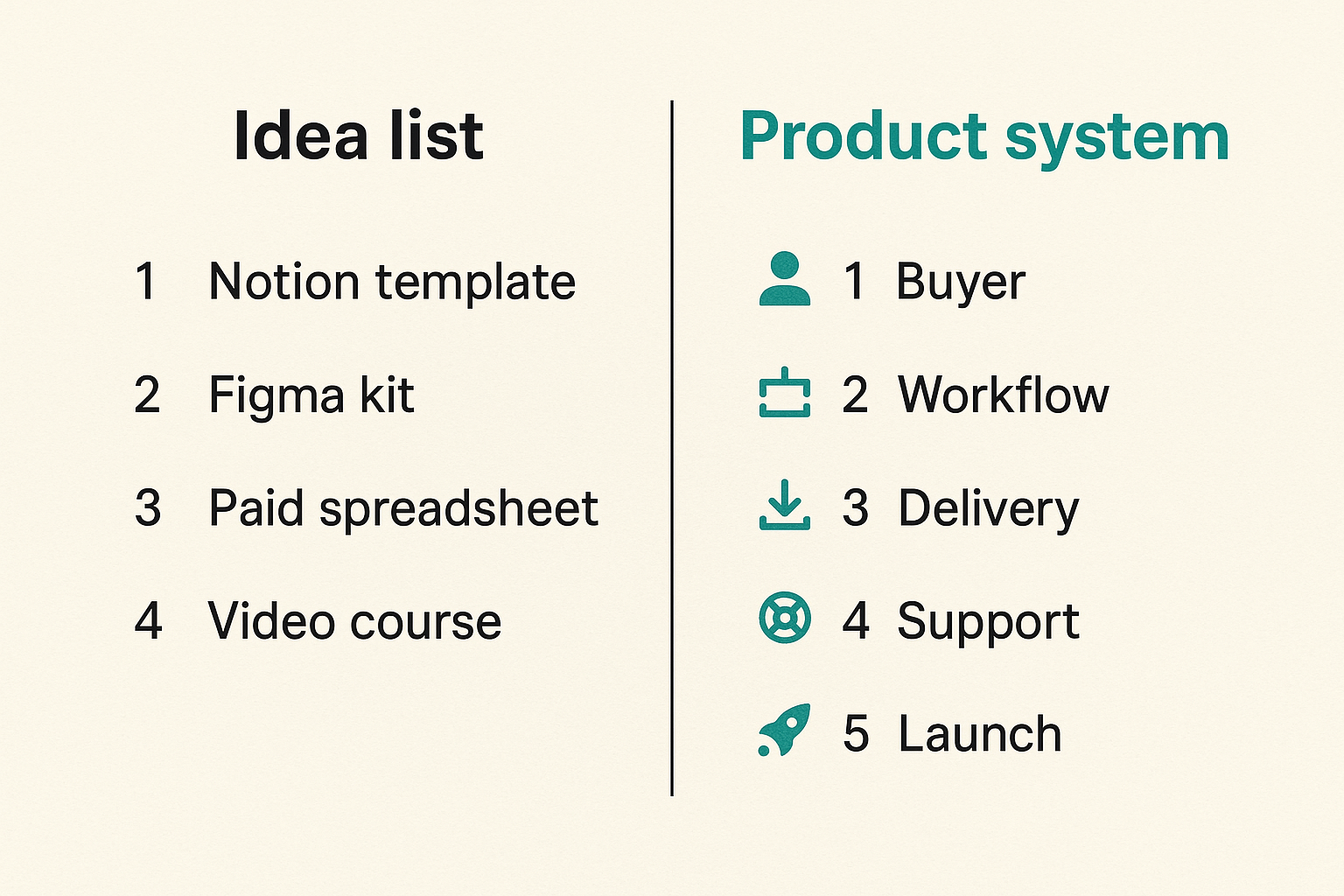
The catalog is not the strategy
A list of digital products is useful for brainstorming. It is not a strategy. A Notion template, a Figma kit, a paid spreadsheet, and a video course can all work. They can also all fail for the same reason: the buyer cannot see the path from purchase to outcome.
A useful way to think about it is this: the format is just the delivery container. The product is the workflow improvement inside the container.
If you sell a hiring scorecard, the buyer is not buying a PDF. They are buying a way to make better hiring decisions with less internal debate. If you sell a SaaS onboarding checklist, the buyer is not buying checkboxes. They are buying a lower-risk launch process.
Practical rule: Do not start with the file type. Start with the repeated decision, task, or bottleneck the buyer already feels.
Why 2026 rewards sharper products
In 2026, buyers have more free information than they can process. AI can summarize, draft, generate, and remix. That does not make digital products worthless. It makes vague digital products weaker.
A generic ebook is competing with search, AI answers, social threads, and old blog posts. A specific implementation kit for a specific buyer in a specific moment is competing against confusion, delay, and internal risk. That is a much better market.
The practical question is whether your product helps a buyer move from stuck to shipped. This is why shipping strategy matters. If your product sits inside a launch workflow, it can be small and still valuable.
For adjacent context, the same operating-system framing shows up in go to market strategy for shipping products, where the hard part is not making a launch checklist but connecting audience, channels, product, and decisions.
The minimum useful product portfolio
You do not need ten offers. Most indie hackers and solopreneurs need three layers:
- A low-friction entry product that proves the buyer has the problem.
- A higher-value implementation product that saves time or reduces risk.
- A relationship product that creates repeat exposure, feedback, or upgrades.
That portfolio might be a $29 template, a $199 operating system, and a $49/month update feed. Or a free diagnostic, a $99 research database, and a paid workshop. The numbers matter less than the ladder.
What breaks in practice is building disconnected products. A prompt pack for marketers, then a budgeting spreadsheet for freelancers, then a community for AI founders. Each may be fine alone, but together they do not compound trust, support, or distribution.
Choose customers before formats
Pick a buyer with urgent context
The best digital products to sell usually attach to a moment of pressure. Someone is launching, hiring, fundraising, migrating, auditing, onboarding, planning, reporting, or trying to avoid a visible mistake.
Urgency matters because digital products are easy to postpone. Buyers save links. They bookmark pages. They tell themselves they will come back later. A strong product fits a moment when delay has a cost.
Examples of urgent contexts:
- A founder preparing a Product Hunt launch.
- A PM writing a positioning brief before sales enablement.
- An agency owner trying to standardize client onboarding.
- A creator deciding which sponsorships to accept.
- A developer shipping a boilerplate faster than a client deadline.
Map buying power and trust
Not every audience with pain has budget. Not every buyer with budget trusts you. Your job is to map both before building.
Ask three questions:
- Does this buyer already spend money to solve this problem?
- Do they believe a digital product can solve enough of it?
- Do you have a credible reason to be trusted here?
If the answer to all three is yes, you have a market worth testing. If only one is yes, you have content, not necessarily a product.
Related reading from our network: teams evaluating tools face a similar workflow-first decision in this guide to pivotal software rollout risk and integrations, where the buying question is less about features and more about adoption, ownership, and operational fit.
Avoid generic creator markets
The phrase creator economy hides too much. Selling to creators is not a market. Selling a sponsorship negotiation tracker to mid-sized YouTubers is closer. Selling a launch teardown database to bootstrapped SaaS founders is closer.
The mistake teams make is chasing broad categories because they feel bigger. Broad categories usually require more audience, more brand, and more explanation. Narrow categories let you use sharper promises and simpler proof.
A narrow product can say: Use this to plan your first B2B SaaS launch in seven days. A broad product says: Grow your business faster. One gets evaluated. The other gets ignored.
Build the offer around a painful workflow
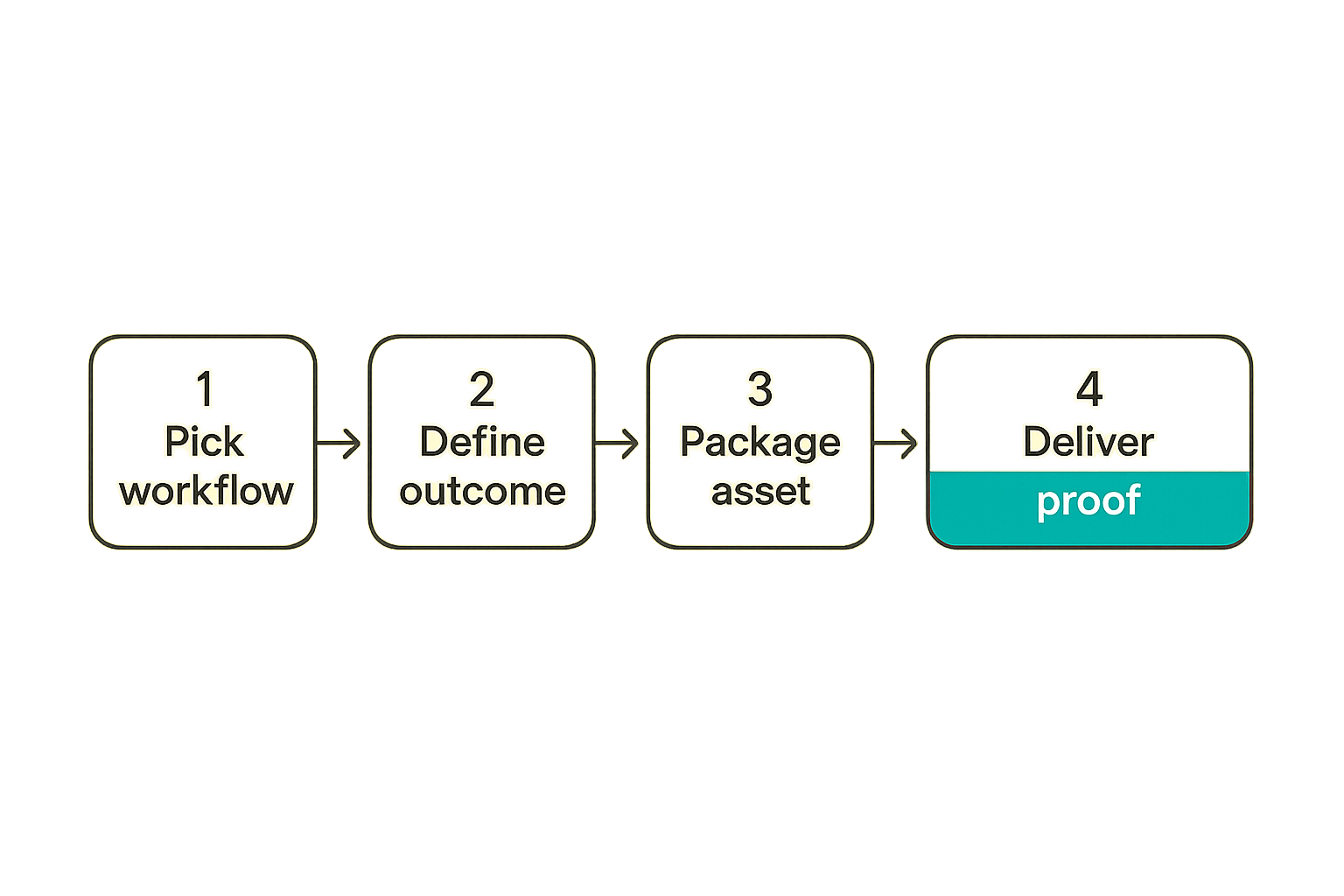
Turn recurring work into a product
The strongest digital products are often extracted from work you already do repeatedly. If you consult, advise, build, manage, analyze, design, or launch, you probably have internal assets that buyers would pay for if packaged correctly.
Look for repeated artifacts:
- Briefs you write for every project.
- Spreadsheets you rebuild for every client.
- QA checklists you use before shipping.
- Scripts you run during onboarding.
- Decision frameworks you explain on calls.
- Dashboards you create to remove ambiguity.
The product opportunity is not the artifact alone. It is the artifact plus instructions, examples, defaults, and a clear success path.
Practical rule: If the buyer still needs a private call to understand what to do next, the product is not packaged yet.
Separate information from implementation
Information explains. Implementation changes the buyer's next action. Most low-performing digital products over-index on explanation.
A 40-page guide may be less useful than a one-page launch sequence with examples, default copy, and decision rules. A video course may be less useful than a working repo with comments, setup notes, and deployment caveats.
This does not mean courses are dead. It means teaching must be tied to execution. Each lesson should produce an artifact, decision, or shipped step.
For product teams, this is close to product marketing. The work is not just saying what the product is; it is making the buyer understand why it matters and how to act. The operator version is covered in product marketing as a shipping system, which is directly relevant when your digital product needs a clear promise and launch narrative.
Package the outcome, not the file
Weak packaging says: 120 pages, 18 templates, 9 videos. Strong packaging says: plan your pricing page, write your launch emails, evaluate your idea, onboard your first contractor, or audit your churn risk.
Features still matter. Buyers want to know what they get. But features should support the outcome, not replace it.
A good product page answers:
- Who is this for?
- What job will it help them complete?
- What is included?
- What does the buyer need before starting?
- How long should implementation take?
- What is not included?
That last question is underrated. A clear exclusion can reduce refunds, support load, and mismatched buyers.
Digital products to sell in 2026: practical categories
Software templates and starter kits
Templates and starter kits work when the buyer needs speed and quality control. This includes code boilerplates, design systems, onboarding flows, analytics setups, no-code dashboards, and automation recipes.
Good starter kits have strong defaults. Bad starter kits are just folders full of options. The buyer should not need to become an expert in your structure before getting value.
Use this category when you can provide:
- A working baseline.
- Setup instructions.
- Opinionated defaults.
- Examples for common use cases.
- A versioning plan.
Playbooks, systems, and operating docs
Playbooks sell when buyers face repeated ambiguity. They need a way to decide, sequence, and delegate.
Good examples include launch operating systems, customer interview scripts, investor update templates, sales call review systems, customer success handoff docs, and product discovery workflows.
This category is useful for founders and PMs because many product problems are coordination problems. The file is valuable only if it creates shared language and reduces meeting load.
Data, research, and decision tools
Some buyers do not need another course. They need better inputs. Research databases, benchmark libraries, vendor comparison sheets, market maps, pricing teardown collections, and niche calculators can work well when the data is hard to gather or normalize.
The hard part is maintenance. A stale database becomes a liability. If you sell data, define update frequency, sources, and confidence levels. You do not need academic precision, but you do need operational honesty.
| Category | Best buyer moment | What creates value | Main risk |
|---|---|---|---|
| Templates | Buyer needs speed | Strong defaults | Too generic |
| Playbooks | Buyer needs decisions | Sequencing and examples | Too theoretical |
| Research | Buyer needs inputs | Curated data | Staleness |
| Tools | Buyer needs calculation | Faster judgment | Edge cases |
| Community-backed products | Buyer needs feedback | Access and context | Moderation load |
Community-backed digital products
Community can increase retention, but it can also create operational drag. Do not add a community because it sounds valuable. Add it when buyers benefit from feedback, accountability, examples, or updated context.
A private Slack group attached to a $29 template is usually a support trap. A small paid cohort attached to a launch system may work because everyone is moving through the same workflow at the same time.
Related reading from our network: remote teams run into similar coordination issues when the tool is simple but the workflow is not, as shown in this piece on screen sharing workflows for remote teams.
Score ideas before you build
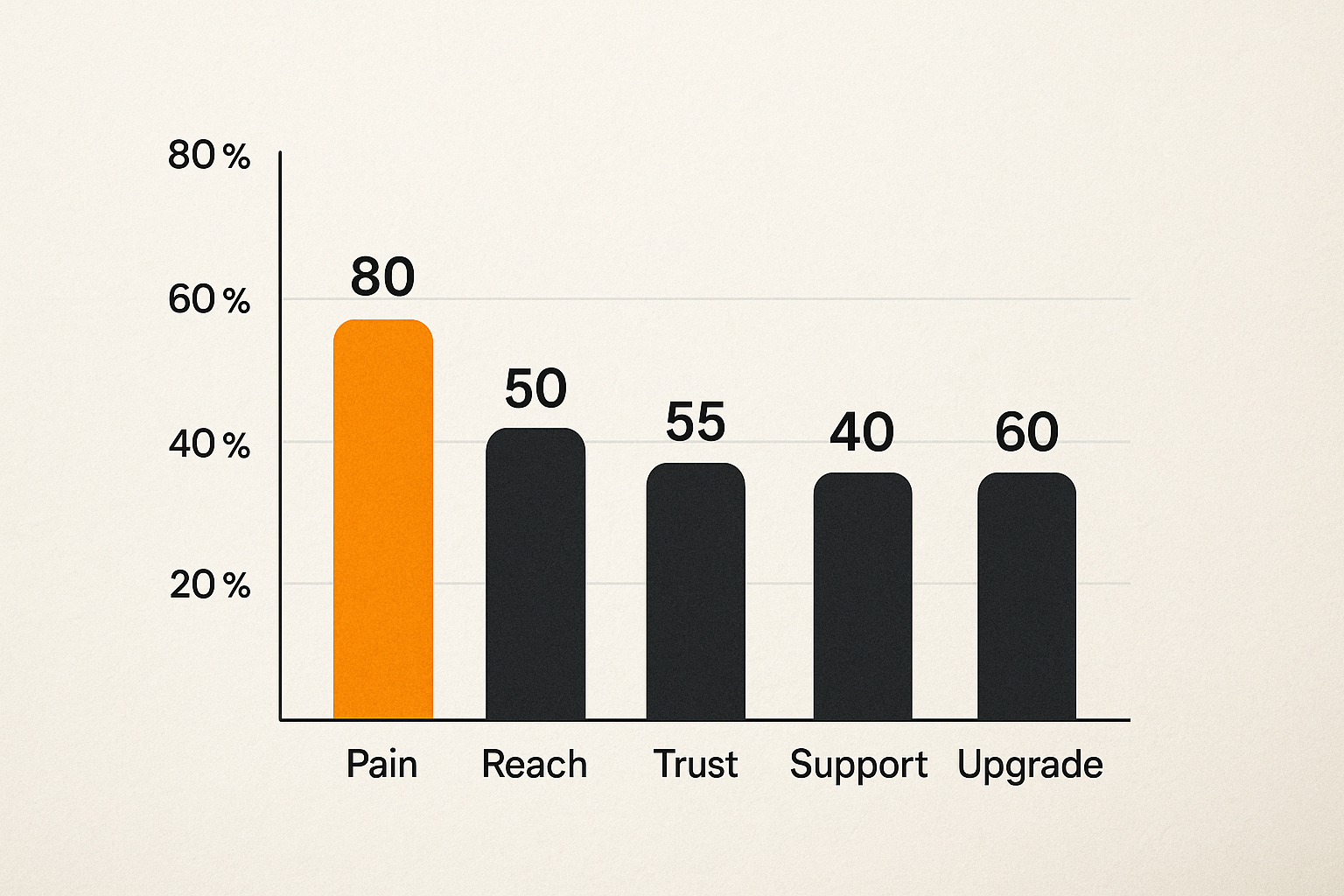
The idea scoring table
Before you build, score each product idea against operational criteria. This is not meant to be perfect. It is meant to prevent you from falling in love with easy-to-create products that are hard to sell.
| Criterion | Score 1 | Score 3 | Score 5 |
|---|---|---|---|
| Pain intensity | Nice to have | Recurring annoyance | Blocks revenue, launch, hiring, or delivery |
| Buyer specificity | Broad audience | Clear segment | Clear segment in a high-pressure moment |
| Proof access | No proof | Some anecdotes | Direct examples, calls, or prior work |
| Build effort | Heavy custom work | Manageable scope | Can ship useful v1 fast |
| Support load | Many edge cases | Some guidance needed | Mostly self-serve |
| Distribution fit | No clear channel | One possible channel | Existing audience, partners, or search intent |
| Upgrade path | One-off only | Possible add-ons | Natural ladder to higher-value offers |
A product scoring above 25 is worth testing. A product below 20 may still work, but you should know what risk you are accepting.
What works
What works is building from evidence. Evidence can be small: five calls, ten replies, three paid preorders, a service process you have repeated, or a free artifact that got unusually specific feedback.
You are looking for buyer language. The exact phrases buyers use become product positioning, landing page copy, onboarding notes, and support docs.
Practical rule: If you cannot write the product page using the buyer's own words, do more discovery before building.
What fails
What fails is building from personal excitement alone. Founder energy matters, but buyers do not pay for your enthusiasm. They pay when they believe the product helps them make progress.
Common weak signals:
- People liked your tweet.
- A friend said they would buy it.
- A competitor exists, so the market must be validated.
- You want the product to exist for yourself.
- The format is trending.
These can start an investigation. They should not end it.
Design delivery, fulfillment, and support
Your product needs a service boundary
The UI is not the whole system. A Gumroad page, Lemon Squeezy checkout, Stripe link, or Webflow landing page can sell the product. But delivery, access, updates, refunds, onboarding, and support are where the business either stays clean or gets messy.
Define the service boundary before launch:
- What exactly is included?
- What implementation help is excluded?
- Where do buyers ask questions?
- How quickly do you respond?
- How are updates delivered?
- What happens if a buyer loses access?
This is not bureaucracy. It is margin protection.
Access, updates, and versioning
Digital products change. Links break. APIs change. Design tools update. Platforms rename features. If your product depends on external systems, you need a versioning plan.
A simple versioning model is enough:
- v1.0: initial release.
- v1.1: minor corrections and examples.
- v2.0: structural update or new platform assumptions.
Tell buyers what updates they receive. Lifetime updates sound attractive, but they create undefined obligations. A better promise may be: includes all updates for 12 months, plus discounted upgrades afterward.
Refunds, onboarding, and buyer success
Refund policy is part of product design. If the product is self-serve and instantly accessible, you need clear refund conditions. If the product includes a cohort, workshop, or review, you need deadlines and attendance rules.
Onboarding should be short. A welcome email should tell the buyer where to start, how to know if the product is right for them, and what to do in the first 20 minutes.
What breaks in practice is silent delivery. The buyer purchases, receives a link, opens a folder, and leaves. You need a path.
Price digital products like systems
Match price to buyer risk
Pricing is not about file size. It is about buyer value, risk, urgency, and trust. A five-tab spreadsheet that helps a founder avoid a bad hire can be worth more than a 200-page ebook about productivity.
Use low prices when the product is simple, broad, and low-risk. Use higher prices when the product is specific, implementation-heavy, and tied to business outcomes.
A practical pricing ladder:
- $9 to $49: entry templates, swipe files, small calculators.
- $50 to $199: operating systems, toolkits, research packs, niche playbooks.
- $200 to $1,000: implementation kits, cohorts, workshops, advanced databases.
- $1,000+: productized advisory, done-with-you systems, high-value B2B assets.
Use tiers without creating chaos
Tiers can increase revenue, but they also create complexity. A clean three-tier model might be:
| Tier | Includes | Best for | Risk |
|---|---|---|---|
| Basic | Core asset | Self-serve buyers | Lower revenue |
| Pro | Asset plus examples and updates | Operators implementing soon | More maintenance |
| Team | Multi-seat license plus workshop | Companies and agencies | Scheduling and support |
The mistake teams make is stuffing tiers with random bonuses. Bonuses should reduce implementation friction, not inflate the product page.
When subscriptions make sense
Subscriptions work when value refreshes. They fail when the buyer only needed one outcome.
Good subscription candidates include market databases, trend briefings, teardown libraries, prompt libraries with tested updates, legal or compliance trackers, and community-backed accountability systems.
Bad subscription candidates include static PDFs, one-time templates, and courses with no ongoing reason to return.
Related reading from our network: if you are building in technical markets, the tradeoffs around routing, validation, and infrastructure in decentralized compute architecture are a useful reminder that product value often comes from operational reliability, not the buzzword on the label.
Launch with a repeatable operating system
Build the pre-launch proof loop
A launch should not be the first time buyers see the product. Before launch, build a proof loop:
- Publish the problem in public.
- Ask for examples from the target buyer.
- Share a draft artifact or partial framework.
- Invite five to twenty people to test it.
- Capture objections, use cases, and buyer language.
- Turn the strongest proof into the product page.
This loop does two jobs. It improves the product and creates early distribution.
Use channels as learning instruments
Channels are not just traffic sources. They are feedback systems. Search tells you what buyers already know they want. Social tells you which pain has emotional charge. Communities reveal objections. Email shows whether people trust you enough to click.
Do not try every channel at once. Choose one primary channel and one support channel. For example:
- SEO plus email capture.
- LinkedIn posts plus founder DMs.
- YouTube demos plus newsletter.
- Partner webinars plus retargeting.
The launch plan should define what you expect to learn from each channel, not just how many impressions you hope to get.
Post-launch is where the product improves
The first launch is a diagnostic. Watch where buyers hesitate, refund, ask questions, request examples, or fail to implement.
Track:
- Landing page conversion objections.
- Checkout abandonment questions.
- First-week activation behavior.
- Support themes.
- Refund reasons.
- Testimonial language.
This is where many founders quit too early. They treat a quiet launch as a verdict. Often it is just unclear positioning, weak proof, or the wrong buyer moment.
If you are tying a digital product to a broader campaign, promotional assets can help when they are part of the system rather than random swag; sh1pt covered that in promotional products for software launches.
Common failure modes
Shipping a bundle instead of a result
Bundles feel valuable to the maker because they contain a lot. Buyers often experience them as homework.
A bundle fails when it has no default path. The buyer opens it and asks: where do I start? If your product includes many assets, add a recommended sequence, examples by use case, and a quick-start path.
A smaller product with a clear path will usually beat a larger product with vague abundance.
Overbuilding before demand is visible
Digital products are easy to overbuild because the marginal cost of adding more pages, videos, and templates feels low. But every extra piece increases maintenance and explanation.
Ship a v1 that proves the core promise. If buyers ask for more examples, add examples. If they ask for integrations, add integrations. If they ask for team licenses, build team support. Let demand choose the roadmap.
Practical rule: Build the smallest product that can create a real outcome for a real buyer, then use support data to decide what v2 deserves.
Ignoring support cost
Support cost hides inside every digital product. A $49 product that generates ten long support emails per buyer is not a product. It is underpriced consulting.
Reduce support load with:
- Better prerequisites.
- Clear exclusions.
- Setup videos.
- Troubleshooting sections.
- Example outputs.
- Office hours only for higher tiers.
Support is not bad. Unpriced support is bad.
The implementation workflow
A 14-day validation sequence
Here is a simple sequence for choosing and testing digital products to sell without disappearing for two months.
- Day 1: Choose one buyer segment and one urgent workflow.
- Day 2: Write ten painful moments that happen inside that workflow.
- Day 3: Interview or message five buyers.
- Day 4: Pull exact buyer language into a positioning draft.
- Day 5: Sketch the smallest useful artifact.
- Day 6: Share a public teardown or mini-guide.
- Day 7: Collect replies and objections.
- Day 8: Build the v1 asset.
- Day 9: Add examples, quick start, and exclusions.
- Day 10: Create the landing page and checkout.
- Day 11: Invite early buyers or testers.
- Day 12: Fix activation problems.
- Day 13: Publish launch content.
- Day 14: Review sales, objections, and support data.
This is not magic. It is a forcing function. You are trying to keep the loop between market signal and product decision short.
The operating dashboard
Your dashboard can be simple. Track the metrics that tell you whether the product is understandable, wanted, and usable.
| Metric | What it tells you | Operator response |
|---|---|---|
| Visitor to email signup | Problem interest | Improve lead magnet or traffic quality |
| Email to checkout click | Offer clarity | Rewrite promise and proof |
| Checkout conversion | Price and trust | Add examples, guarantees, or better fit language |
| Refund rate | Expectation mismatch | Clarify exclusions and prerequisites |
| Support tickets per buyer | Implementation friction | Improve onboarding and docs |
| Repeat purchase rate | Portfolio strength | Build upgrade path |
Do not optimize too early. If you have twenty visitors, you do not have a conversion problem yet. You have a distribution problem.
Decision rules after launch
After launch, decide with rules instead of mood.
Keep building if buyers purchase, implement, and ask for adjacent help. Reposition if people understand the problem but not the offer. Narrow if the audience is too broad. Stop if buyers do not feel urgency after direct conversations and repeated positioning tests.
The practical question is not whether the launch made you feel good. It is whether the product created enough evidence to justify the next iteration.
Where sh1pt.com fits
Use shipping strategy as infrastructure
sh1pt.com is for people building and launching software products who want practical shipping strategies, product development processes, and growth tactics. That matters here because digital products are not side quests from product work. They are small products with positioning, delivery, support, and launch constraints.
If you are an indie hacker, founder, PM, or solopreneur, the useful move is to treat your digital product like a product system from day one. Define the buyer, workflow, promise, delivery path, support boundary, launch loop, and decision rules.
That does not make the work heavier. It makes it less random.
Try sh1pt.com
For more practical guides on shipping software products, launch workflows, and growth systems, Try sh1pt.com. If you are evaluating digital products to sell, start with the workflow your buyer already wants to finish.