
Most software teams do not fail at product marketing because they cannot write a landing page. They fail because the landing page is the first time anyone forces the product, buyer, use case, pricing, proof, and channel into the same sentence.
That is why launch week feels messy. The product is nearly ready, the roadmap is still moving, the founder is rewriting the homepage at midnight, and nobody agrees whether the product is for agencies, developers, founders, or teams that vaguely need productivity.
Teams think the problem is messaging. The real problem is decision architecture.
Product marketing is the operating system that turns product work into market-facing decisions. It connects what you built, who it is for, why they should care now, what objections will block the sale, and how the team will learn after shipping. That changes the conversation from slogans to workflow.
Table of contents
- Product marketing is an operating system, not a launch checklist
- The product marketing architecture for small teams
- Positioning before copy
- Messaging that survives real conversations
- Channels are workflow constraints
- Product marketing metrics that operators can use
- Launch workflow from private beta to public release
- Common product marketing failure modes
- What works and what fails in product marketing execution
- Product marketing tools and AI without losing control
- How sh1pt.com fits product marketing work
- Closing checklist for product marketing in 2026
Product marketing is an operating system, not a launch checklist

The mistake teams make is treating product marketing as the last mile. Engineering ships. Design polishes. Then someone asks for copy, screenshots, social posts, and a launch email.
That model creates predictable problems. The product may be useful, but the story is late. The pricing page may exist, but the buyer does not understand the tradeoff. The roadmap may be rational internally, but the outside world sees another tool asking for attention.
A useful way to think about it is this: product marketing is not the paint on the product. It is the translation layer between product decisions and market behavior.
Why launch day exposes weak positioning
Launch day compresses every unresolved decision. If you never chose a primary audience, every channel sounds generic. If you never named the switching trigger, your call to action becomes soft. If you never captured proof, the launch depends on adjectives.
Weak positioning usually hides during build because internal teams share context. A founder can explain the product on calls. A PM can walk through edge cases. A developer can show the workflow. The market does not have that context.
What breaks in practice is not grammar. It is routing. The wrong people click, the right people bounce, early users ask basic questions, and support becomes the first real messaging test.
The job is demand translation
Product marketing translates product capability into buyer relevance. That means answering practical questions:
- What job does this product help someone complete?
- What painful workaround does it replace?
- What event makes the problem urgent?
- What proof reduces risk for a skeptical buyer?
- What should a user do next after they understand the value?
This is especially important for indie hackers and small startup teams because there is no large sales organization to repair unclear messaging manually. Your homepage, docs, onboarding, demos, emails, and founder posts need to carry more of the load.
What product marketing owns
In a lean team, product marketing should own the market-facing decision record. Not every decision must be made by a marketer, but someone must keep the system coherent.
Typical ownership includes:
- Positioning and category choice
- Ideal customer profile and use cases
- Messaging hierarchy
- Launch plan and announcement sequence
- Sales or self-serve enablement assets
- Objection handling
- Feedback routing into product decisions
- Channel-specific packaging
Practical rule: If a product decision changes who the product is for, why it matters, what it costs, or how it is adopted, it is also a product marketing decision.
The product marketing architecture for small teams
Product marketing becomes easier when you stop asking for assets and start designing an architecture. The practical question is: what inputs, decisions, and outputs must exist so the team can ship without re-litigating the story every week?
Inputs that should exist before copy
Before writing copy, collect the raw material. Most teams skip this and then wonder why every message sounds like a feature list.
Useful inputs include:
- Five to ten customer conversations or founder-led sales calls
- Support tickets or beta feedback grouped by pain theme
- Competitor pages and pricing notes
- Product usage events from early users
- Churn reasons, if the product already has customers
- Roadmap notes that explain why the team built this now
- Screenshots of the old workaround the product replaces
For teams building an overall launch machine, the product marketing layer should sit inside the broader go-to-market workflow. We covered that operating-system view in Go to Market Strategy in 2026, especially the parts about connecting audience, channels, metrics, and founder decisions.
Decisions that cannot stay implicit
The problem with implicit decisions is that they appear cheap until launch. Then they create drift.
Make these calls explicit:
| Decision | Bad default | Better operating choice |
|---|---|---|
| Primary audience | Everyone who could use it | One audience for the next launch cycle |
| Category | Whatever sounds trendy | The mental shelf the buyer already understands |
| Main pain | List all problems | Lead with the urgent switching trigger |
| Proof | Use broad claims | Show workflow evidence, examples, or customer language |
| CTA | Ask for everything | Match CTA to buyer readiness |
| Channel | Post everywhere | Pick channels where the audience already evaluates tools |
This does not mean the product can never serve multiple audiences. It means the launch cannot speak clearly to all of them at once.
Outputs the team can reuse
Good product marketing produces reusable operating assets, not one-off copy.
At minimum, create:
- A positioning memo
- A messaging hierarchy
- A launch brief
- A channel plan
- A customer objection sheet
- A proof library
- A demo narrative
- A post-launch learning document
These assets reduce founder bottlenecks. They also prevent the common problem where every social post, email, sales call, and landing page explains the product differently.
Positioning before copy
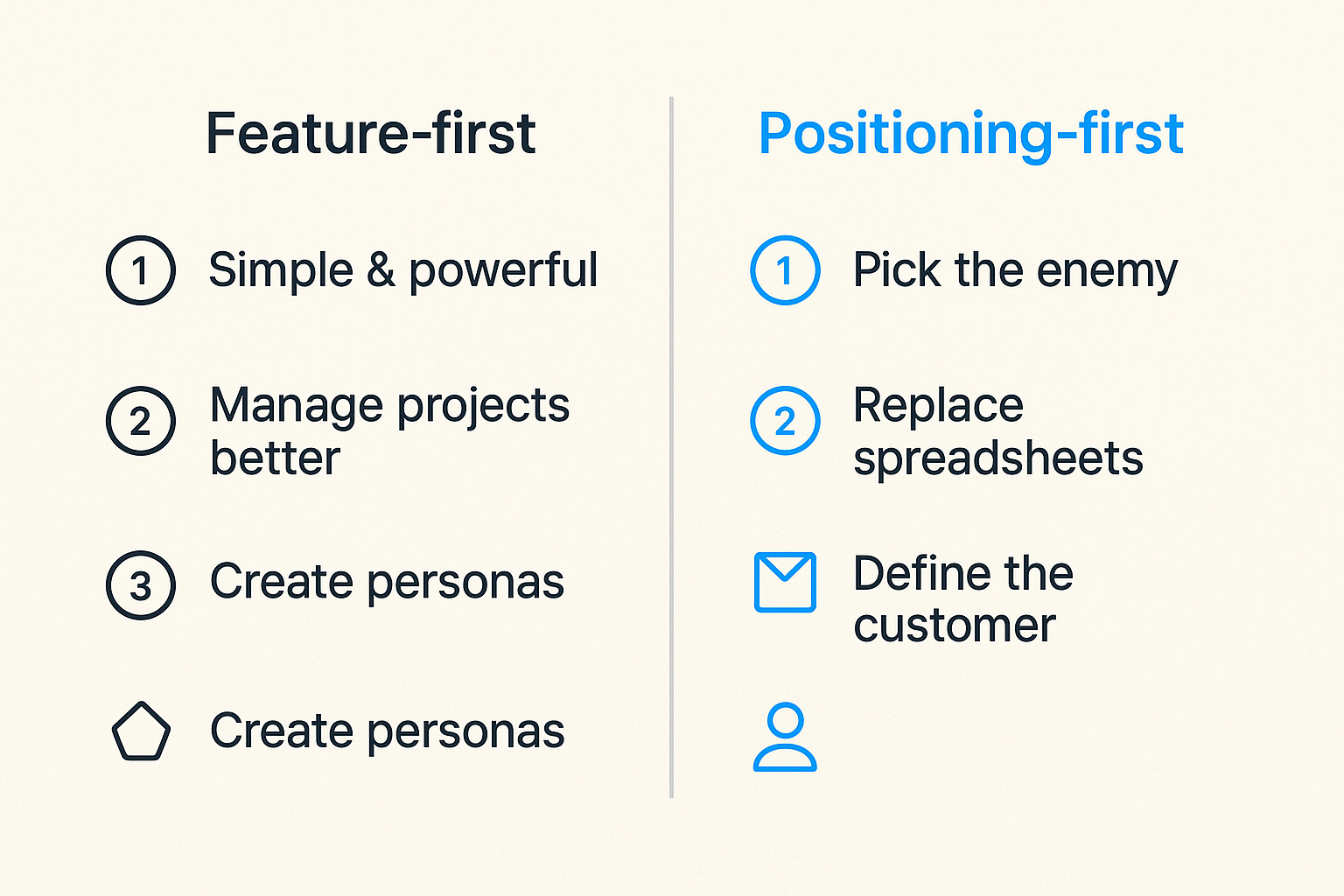
Positioning is the set of choices that makes copy possible. Without it, copywriting becomes word decoration.
The mistake teams make is starting with phrases like simple, powerful, AI-powered, modern, or all-in-one. Those words rarely help a buyer decide. The buyer is trying to answer a harder question: is this for my situation, and is switching worth it?
Pick the enemy
Every strong product has an enemy. Not necessarily a competitor. Often the enemy is a broken workflow.
Examples:
- Manual spreadsheet reconciliation
- Endless meeting notes nobody acts on
- Developer handoffs stuck in Slack
- Launch plans scattered across docs, tickets, and calendars
- Content drafts with no approval path
Picking the enemy gives the product a point of view. It also gives your audience a reason to care.
Bad positioning says: We help teams manage projects better.
Better positioning says: We replace launch spreadsheets with a shipping workflow that keeps product, marketing, and founder decisions in sync.
The second version is narrower. That is why it works.
Define the customer without persona theater
Many teams create fake personas because they think it is what marketing requires. Product marketing does not need a fictional profile named Growth Gary. It needs a usable customer definition.
Define the customer with operational traits:
- What are they responsible for?
- What workflow breaks for them?
- What tools do they already use?
- What budget or authority do they control?
- What trigger makes them search for a solution?
- What would stop them from adopting?
For indie products, a tight customer definition is more valuable than a large theoretical market. You are not trying to win a category analyst report. You are trying to create enough clarity for the right early users to self-identify.
Turn features into reasons to switch
Features are internal facts. Reasons to switch are market arguments.
A feature might be: automated launch checklist generation.
A reason to switch might be: your team can turn a roadmap item into a channel-ready launch plan without rebuilding the same checklist each release.
That difference matters because buyers do not pay for feature inventory. They pay to remove friction, risk, delay, or cost from a workflow.
Practical rule: For every feature you mention publicly, attach the workflow pain it removes and the decision it helps the user make.
Messaging that survives real conversations
Messaging has to work outside the clean room. It needs to survive a founder demo, a skeptical Reddit comment, a pricing objection, a quick investor explanation, and a distracted buyer scanning the homepage.
Write the one-liner like a routing rule
A useful one-liner routes the right person forward and lets the wrong person leave quickly.
Use this pattern:
- For whom
- With what painful workflow
- We provide what product
- So they can achieve what outcome
Example:
For small software teams launching new products, sh1pt.com helps turn product decisions, launch content, and shipping lessons into practical workflows so teams can move from idea to market with less chaos.
That is not a slogan. It is a routing rule. It tells the reader whether to keep going.
Build proof into the message
Proof should not be an afterthought at the bottom of the page. It should appear wherever a claim creates risk.
Types of proof that work for early products:
- Screenshots of real workflows
- Before-and-after process examples
- Founder notes explaining tradeoffs
- Customer quotes from beta users
- Short demo clips
- Public changelogs
- Templates or examples the reader can inspect
If you do not have logos, do not fake authority. Show operational proof. Let the buyer see how the product behaves.
Pre-answer the objections
Most product pages underperform because they avoid the buyer's real objections.
Common objections include:
- Will this fit my current workflow?
- How long does setup take?
- What happens if my team does not adopt it?
- Is this replacing a tool or adding another one?
- How does pricing scale?
- Can I export my data?
- Does this work for my specific use case?
Pre-answering objections is not defensive. It is respectful. It also shortens sales and support cycles because fewer users need to ask the same questions manually.
Channels are workflow constraints
Distribution is not just where you post. Each channel changes the shape of the message, the proof required, the CTA, and the feedback loop.
Owned channels give you control
Owned channels include your website, email list, documentation, changelog, blog, and in-product surfaces. They are slower to build, but they give you control over sequence.
For product marketing, owned channels are where you can explain the complete argument:
- The problem
- The current broken workflow
- The product's point of view
- The feature path
- The proof
- The CTA
- The follow-up sequence
Owned channels also help you compound learning. A good launch post becomes onboarding material. A support answer becomes a docs page. A customer objection becomes a pricing FAQ.
Community channels punish vague claims
Community channels can work well for founders, but they punish lazy messaging. Product Hunt, Hacker News, Reddit, Discord groups, Slack communities, niche newsletters, and founder networks all have different norms.
The practical question is not: where can we promote this?
The better question is: where do people already discuss the workflow pain we solve?
If your product improves launch planning, you should be near conversations about shipping, founder bottlenecks, product updates, and marketing execution. If your product improves developer workflow, you need proof that developers recognize quickly.
Related reading from our network: teams building local activation loops face similar coordination issues when offers, attribution, and redemption rules collide, as shown in this piece on coupon codes for local networks.
Partner and paid channels need clean handoffs
Partner and paid channels amplify whatever system already exists. If positioning is weak, paid spend scales confusion. If onboarding is unclear, partner traffic becomes support load.
Before using paid or partner channels, define:
- Landing page matched to the audience
- Source-specific CTA
- Tracking parameters
- Qualification rules
- Follow-up email sequence
- Owner for replies and demos
- Post-campaign review date
For launch moments that include physical campaigns, events, or giveaways, the same architecture applies. The useful question is not whether swag is fun; it is whether fulfillment, timing, audience, and attribution connect to the release. That is the lens in our guide to promotional products for software launches.
Product marketing metrics that operators can use
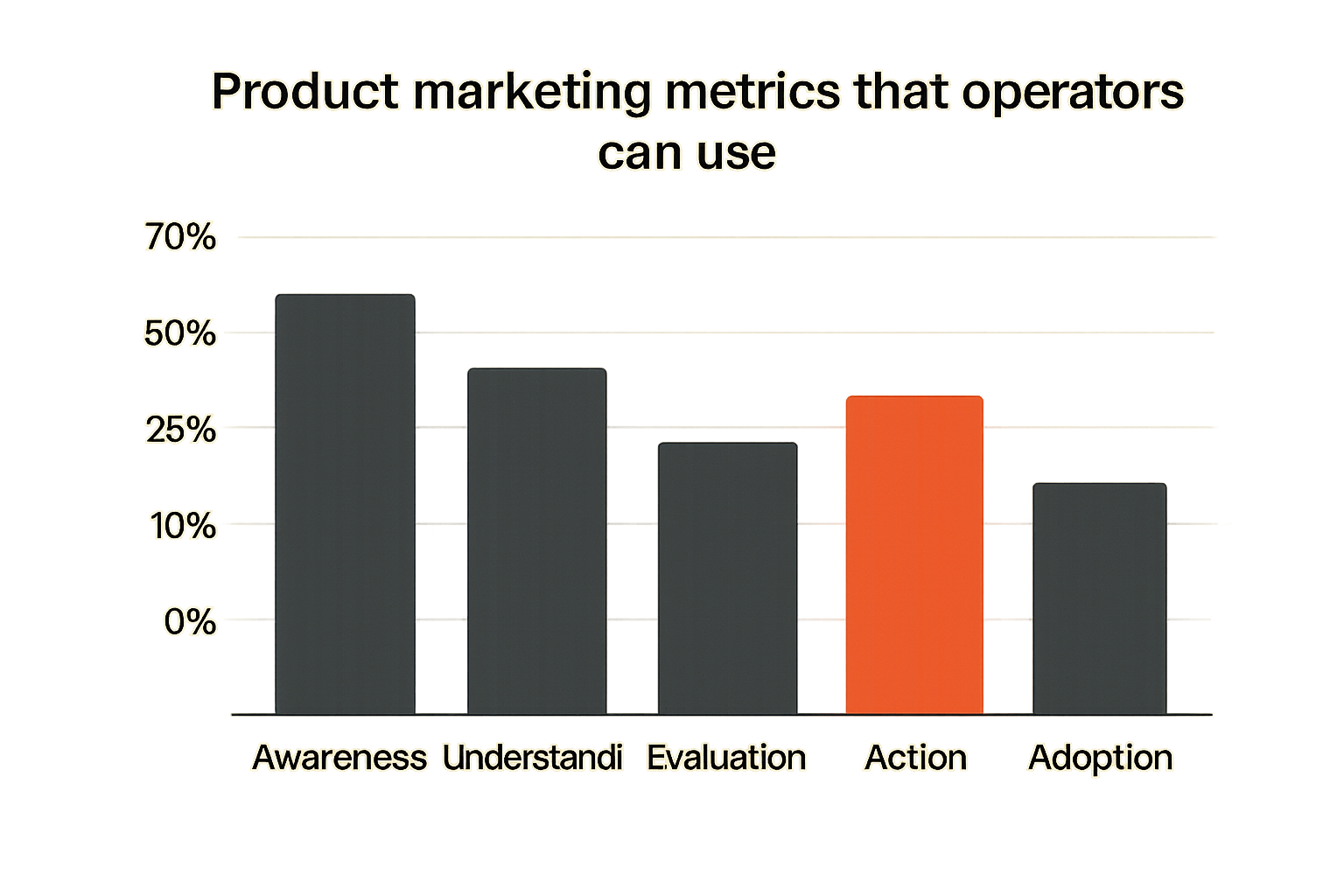
Metrics should tell you whether the market understood the product, whether the right audience moved forward, and where the handoff broke. Vanity traffic alone does not do that.
Leading signals before revenue
Early product marketing metrics are often directional. That is fine if you treat them as signals, not proof.
Useful leading signals include:
- Qualified waitlist signups
- Demo requests from the target segment
- Replies to launch emails
- Activation from source-specific landing pages
- Time on key explanation sections
- Repeat visits from target accounts
- Click-through from problem statement to pricing
- Objections repeated in calls or comments
The goal is not to celebrate numbers in isolation. The goal is to detect message-market friction.
Lagging signals that still matter
Revenue, retention, expansion, and referrals matter because they show whether the promise survives usage.
Lagging indicators include:
- Trial-to-paid conversion
- Activation-to-retention conversion
- Churn reasons by segment
- Expansion by use case
- Referral source quality
- Sales cycle length
- Support tickets per new customer
If a channel creates many signups but low activation, the message may be attracting curiosity instead of intent. If demos convert but self-serve does not, the product may need better proof, onboarding, or pricing explanation.
Instrumentation without analytics theater
Many small teams install analytics and still cannot answer basic questions. The mistake is tracking events without a decision model.
Instrument around the buyer journey:
| Stage | Question | Example signal |
|---|---|---|
| Awareness | Did the right person arrive? | Source, segment, landing page |
| Understanding | Did they grasp the problem? | Scroll depth on problem section, explainer clicks |
| Evaluation | Did they inspect proof? | Demo views, pricing clicks, comparison page visits |
| Action | Did they take the right next step? | Signup, demo request, invite, install |
| Adoption | Did the promise become behavior? | Activation event, repeat usage, team invite |
| Learning | What blocked them? | Exit survey, support tags, churn reason |
Practical rule: Track fewer events, but make every tracked event answer a decision you are willing to act on.
Launch workflow from private beta to public release
A launch is not a single announcement. It is a sequence of belief-building, proof-gathering, risk-reducing, and feedback-routing steps.
The sequence that keeps teams honest
Here is a practical workflow for a small software team:
- Write the positioning memo before final launch copy.
- Select one primary audience for the launch cycle.
- Interview or review feedback from at least five target users.
- Define the main switching trigger and top three objections.
- Map the product demo around the buyer's workflow, not your navigation.
- Build the landing page, email, social, docs, and onboarding from the same messaging hierarchy.
- Run a small private beta or preview with people who match the audience.
- Capture objections, confusing language, and proof points.
- Update the launch assets before public release.
- Ship publicly with owners assigned for replies, support, analytics, and follow-up.
- Review the launch within one week and decide what changes.
This sequence prevents the common situation where public launch becomes the first serious test of the message.
The asset map
A launch asset map keeps the team from creating random content.
Core assets usually include:
- Positioning memo
- Homepage or launch landing page
- Product screenshots and short demo
- Announcement post
- Email sequence
- Founder social posts
- FAQ or objection page
- Pricing explanation
- Onboarding checklist
- Support macros
- Post-launch survey
Each asset should map back to the same core argument. If the homepage says the product is for founders, the email says product managers, and the demo says marketing teams, you do not have multiple campaigns. You have confusion.
Feedback loops after launch
The post-launch review is where product marketing becomes valuable. Do not only ask whether the launch was successful. Ask what the market taught you.
Review:
- Which audience segments responded?
- Which channels created qualified intent?
- Which claim got challenged?
- Which objection appeared repeatedly?
- Which feature created the strongest pull?
- Where did users drop off?
- What should change in product, pricing, onboarding, or messaging?
This review should feed roadmap and messaging decisions. Otherwise, the team repeats the same launch with new copy.
Common product marketing failure modes
Product marketing breaks in predictable ways. The failure is rarely a single bad headline. It is usually an operating gap that shows up as bad copy, weak conversion, noisy feedback, or confused customers.
Copy after code complete
When copy starts after code complete, the team loses the chance to notice market-facing problems early.
Examples:
- The feature is useful, but the buyer cannot understand it without a long demo.
- The product solves a real problem, but not one urgent enough to switch.
- The pricing model does not match how the customer measures value.
- The onboarding asks for too much setup before showing value.
Product marketing should pressure-test these issues during build, not after release.
Persona soup
Persona soup happens when the team lists every possible customer and tries to serve all of them in one launch.
The symptoms are obvious:
- Homepage copy with too many audiences
- CTA language that avoids commitment
- Feature sections grouped by internal modules instead of customer jobs
- Sales calls that require heavy explanation
- Roadmap debates driven by hypothetical users
Narrow does not mean small forever. Narrow means useful now.
Launch theater
Launch theater is activity that looks like momentum but does not improve understanding or adoption.
Examples:
- Posting the same announcement across every channel
- Celebrating traffic with no qualification
- Publishing a press-style announcement nobody asked for
- Creating a launch video before clarifying the audience
- Chasing a big spike without a follow-up workflow
What breaks in practice is the handoff. Attention arrives, but the system cannot turn it into learning, activation, revenue, or better product decisions.
What works and what fails in product marketing execution
Execution is where product marketing either becomes a habit or collapses into sporadic launch panic. The difference is cadence.
What works
What works is boring but effective:
- One positioning owner, even if many people contribute
- A shared decision document
- Customer language captured continuously
- Launch assets built from one message hierarchy
- Product demos written around workflows
- Clear handoffs between channels and onboarding
- Post-launch reviews that create product and messaging changes
The best teams do not reinvent the story every release. They evolve it based on evidence.
What fails
What fails is usually more theatrical:
- Rewriting the homepage by committee
- Measuring only impressions
- Treating AI output as strategy
- Creating separate messages for every channel without a core narrative
- Ignoring support and sales feedback
- Shipping features with no adoption plan
- Waiting for perfect positioning before talking to customers
The practical question is not whether your first message is perfect. It is whether your system improves it quickly.
The weekly operating cadence
Use a lightweight weekly cadence:
- Review new customer conversations, support tickets, and channel feedback.
- Identify repeated objections or misunderstood claims.
- Decide whether the issue is product, onboarding, pricing, or messaging.
- Update one shared source of truth.
- Assign changes to launch assets, docs, onboarding, or roadmap.
- Review metrics tied to the current product marketing goal.
This keeps product marketing close to the product instead of trapping it in campaign mode.
Product marketing tools and AI without losing control
Tools can speed up product marketing, but they cannot make the core decisions for you. In 2026, many teams use AI to draft launch content, summarize calls, generate variants, and repurpose founder notes. That is useful. It is not a strategy.
Use AI for range, not judgment
AI is good for expanding options:
- Rewrite a positioning line for different audiences
- Summarize customer interviews
- Extract objections from transcripts
- Draft FAQ candidates
- Generate channel-specific post variants
- Turn a launch memo into email, docs, and social drafts
But AI does not know which audience you should prioritize, which competitor matters, what claim you can prove, or what risk your buyer feels. Those are operator decisions.
Related reading from our network: if your team uses AI heavily in marketing workflows, this guide to AI writing software for marketing teams is a useful adjacent look at review lanes, approvals, and measurement.
Approval gates matter more than prompts
The mistake teams make is obsessing over prompts while ignoring approval gates. Prompt quality matters, but workflow control matters more.
Every AI-assisted product marketing workflow should define:
- Source material allowed
- Claims that require proof
- Tone and positioning constraints
- Review owner
- Legal or compliance checks, if relevant
- Final publishing approval
- Version history
Related reading from our network: remote teams face the same coordination issue in a different context, where screen control, permissions, and recovery rules determine whether a workflow works; see this guide to remote team screen sharing workflows.
Content operations for launches
Content operations are where product marketing becomes repeatable. A founder note can become a launch post, onboarding email, FAQ, sales script, and short social thread if the system is designed for reuse.
The workflow should look like this:
- Capture the raw product decision.
- Attach audience, pain, proof, and objection notes.
- Draft channel assets from the same source.
- Review for accuracy and positioning.
- Publish in the right sequence.
- Measure response.
- Feed learning back into the source document.
If you are building with AI support, the risk is not just bad writing. The risk is uncontrolled publishing drift. We covered a related launch-content workflow in AI Publishing Shipping Software, focused on turning content into a controlled shipping system instead of a pile of drafts.
How sh1pt.com fits product marketing work
sh1pt.com is built for people who are trying to ship software products, not admire abstract frameworks. That matters because product marketing is most useful when it stays close to real launch decisions.
Shipping lessons over marketing folklore
Founders and product teams do not need more vague advice about building a brand. They need clearer ways to decide:
- What should we launch first?
- Who is this release really for?
- What proof do we have?
- Which channels fit the product and audience?
- What should change after the launch?
sh1pt.com focuses on practical shipping strategies, product development processes, and growth tactics. The point is to help creators move from idea to market with a stronger operating system.
From launch notes to repeatable systems
A good product marketing system turns messy launch notes into repeatable assets. That is where product teams often need the most help.
Instead of treating every launch as a custom emergency, teams can build repeatable patterns:
- Product decision memo
- Audience and positioning brief
- Launch asset checklist
- Channel-specific publishing plan
- Feedback review workflow
- Post-launch learning archive
Over time, this becomes a company memory. New launches get faster because the team is not starting from a blank page.
Where to start
Start with the next release, not a full rebrand.
Pick one product update and document:
- Who it is for
- What changed
- Why it matters now
- What old workflow it replaces
- What proof you can show
- What objection you expect
- What action the user should take
That single exercise will expose most of the gaps in your current product marketing system.
Closing checklist for product marketing in 2026
Product marketing in 2026 is not about making more noise. It is about helping the right users understand the product faster, evaluate it with less risk, and adopt it with fewer handoff failures.
The minimum viable system
Before the next launch, make sure you have:
- One primary audience
- One clear switching trigger
- One positioning memo
- One messaging hierarchy
- One proof library
- One launch asset map
- One owner for feedback synthesis
- One post-launch review date
If those pieces are missing, more channels will not fix the launch. They will only distribute the confusion.
The next two weeks
Use the next two weeks to build the system around one release:
- Pull real customer language from calls, tickets, comments, and emails.
- Write the positioning memo in plain language.
- Convert the memo into homepage, email, demo, and social assets.
- Test the message with a small set of target users.
- Capture what confused them.
- Update the product, onboarding, pricing, or copy based on the evidence.
- Launch with a follow-up plan already assigned.
This is not glamorous. It works because it connects product marketing to actual shipping behavior.
Final check
The final check is simple: can a target customer understand what you built, why it matters, why now, why you, and what to do next without a founder personally explaining it?
If the answer is no, the product marketing system is not ready. If the answer is yes, you have something more useful than a launch campaign. You have a workflow that can keep improving every time you ship.
Try sh1pt.com
sh1pt.com is for people building and launching software products who want practical shipping strategies, product development processes, and growth tactics. Build a better product marketing workflow and move from idea to market with less chaos: Try sh1pt.com.