
Most founders asking how to sell digital products are not stuck because they lack a checkout page. They are stuck because the business has no operating system.
The file exists. The Gumroad page exists. The Stripe link exists. Maybe the Notion template, course, paid community, codebase, swipe file, or research report even solves a real problem. Then launch day happens and everything becomes manual: access requests, refund questions, discount chaos, abandoned buyers, unclear analytics, and a vague sense that the product either worked or did not.
Teams think the problem is distribution. The real problem is workflow design.
That changes the conversation. Selling a digital product in 2026 is less about uploading an asset and more about connecting the offer, checkout, fulfillment, trust, support, analytics, and iteration loop. The practical question is not, which platform should I use? The practical question is, what has to happen reliably after someone believes the promise enough to pay?
Table of contents
- How to sell digital products as an operating system
- Pick the product model before you pick the platform
- Validate demand with a sales workflow, not a survey
- Build the minimum delivery architecture
- Price digital products like systems, not files
- Choose channels and write the launch loop
- Automate the boring parts without hiding ownership
- Measure the right things after launch
- Common failure modes when selling digital products
- What works in 2026
- Where sh1pt.com fits in the workflow
How to sell digital products as an operating system
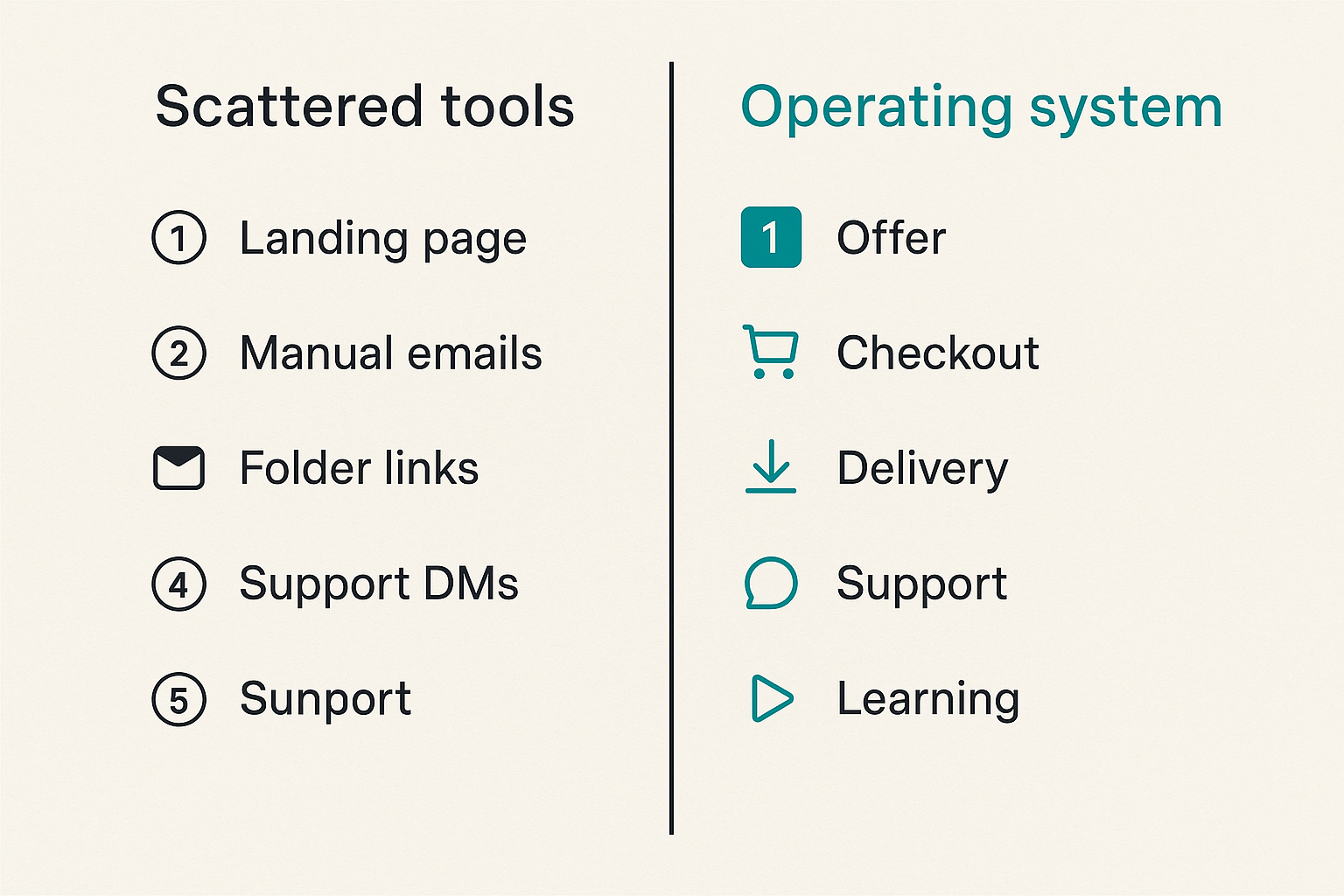
If you want to know how to sell digital products, start by treating the product as a system of states, not a static asset. A buyer moves from unaware, to interested, to trusting, to paying, to receiving, to using, to deciding whether the purchase was worth it.
Most launches only design the first half of that path. They obsess over the landing page and launch post. Then the actual customer experience is stitched together with manual emails, folder links, unclear instructions, and support DMs.
A useful way to think about it is this: the digital product is the thing being purchased, but the selling system is what makes the purchase feel safe, useful, and repeatable.
The offer is the control plane
The offer decides almost everything downstream. If the promise is vague, every later workflow gets noisy. Support tickets become clarification requests. Refunds become expectation mismatches. Testimonials become weak because buyers cannot explain what changed.
A strong offer has five pieces:
- A specific buyer
- A painful current state
- A believable better state
- A defined mechanism
- A clear boundary around what is not included
For example, sell less like this: a productivity template for founders. Sell more like this: a weekly operating dashboard for solo founders who need to track launches, revenue experiments, and customer follow-up in one place.
Practical rule: If your buyer cannot tell what changed within seven days of purchase, your offer is probably too broad or your delivery workflow is too weak.
Checkout is not the business
Checkout matters. Payment reliability matters. Tax handling, card failures, receipts, and fraud controls matter. But checkout is not the business.
The mistake teams make is using checkout completion as the finish line. In reality, payment is a state transition. The buyer has moved from prospect to customer. Now the system must deliver access, confirm expectations, reduce anxiety, and start activation.
Your checkout should answer operational questions:
- What exactly did the buyer purchase?
- What state is the payment in?
- What happens if payment succeeds but fulfillment fails?
- How does the buyer get help?
- Where is the purchase recorded for analytics and support?
If the answer is, I will check Stripe and send them a link manually, that may work for the first ten buyers. It becomes a liability once you launch to a list, a community, or paid traffic.
Delivery is part of the product
For digital products, delivery is not shipping a box. It is creating confidence that the buyer can use what they bought.
That means your delivery layer should include:
- Immediate confirmation
- Access instructions
- A short start-here path
- License or usage boundaries
- A support route
- A follow-up touchpoint
If you sell a template, include installation steps and common mistakes. If you sell a course, show the fastest useful path through the material. If you sell software access, make the first successful action obvious.
Delivery is where many good products lose trust. The buyer pays, receives a pile of links, and has to reverse-engineer the intended workflow. That creates buyer's remorse even when the underlying product is good.
Pick the product model before you pick the platform
A platform decision is easier after you understand the product model. A PDF guide, paid dataset, template pack, video course, paid API, membership, and micro-SaaS all have different operational needs.
The practical question is: what are you really selling: a file, a transformation, access, or an ongoing workflow?
| Product model | Best for | Operational risk | What buyers expect |
|---|---|---|---|
| File or template | Fast utility, low support | Piracy, low perceived value | Instant access and clear instructions |
| Course or cohort | Skill development | Completion drop-off, support load | Structure, examples, progress path |
| Membership | Ongoing updates and community | Churn, content treadmill | Fresh value and active facilitation |
| Software access | Repeated workflow value | Bugs, onboarding, uptime | Reliability, support, roadmap |
| Paid research/data | Decision support | Freshness, trust, sourcing | Accuracy, updates, methodology |
Templates and files
Templates, swipe files, design assets, calculators, prompt libraries, and Notion systems are good first products because they are simple to deliver. The trap is assuming simple delivery means simple selling.
Buyers do not want a file. They want a shortcut. Your sales page should make the before-and-after concrete:
- What task becomes faster?
- What decision becomes easier?
- What error is avoided?
- What existing tool does this plug into?
What works: a narrow template with examples, instructions, and use cases.
What fails: a generic bundle with 400 assets and no point of view.
If you are still deciding what to build, the operator guide to digital products to sell in 2026 is useful because it frames product selection around buyer pain and fulfillment complexity, not creator preference.
Courses and knowledge products
Courses are not just videos behind a paywall. They are structured behavior change. That means the course architecture matters as much as the content.
A practical course product needs:
- A diagnostic for where the buyer is starting
- A sequence of lessons that maps to real execution
- Assignments or outputs
- Examples from realistic contexts
- A reason to finish
Many founders overbuild courses before proving demand. A smaller workshop, teardown, paid email sequence, or recorded implementation sprint can validate the same promise with less production risk.
Software and access products
Software-based digital products include paid tools, plugins, AI workflows, API access, private dashboards, and micro-SaaS. Here, selling is tightly coupled to reliability.
What breaks in practice is not the landing page. It is access provisioning, billing state, entitlement checks, onboarding, and support. If payment succeeds but the account is not upgraded, the buyer does not care that your checkout provider worked. They experience your product as broken.
For software access, define:
- User identity
- Billing account
- Entitlement state
- Usage limits
- Upgrade and downgrade behavior
- Cancellation and data retention rules
This is where digital product selling starts to look like product operations rather than creator marketing.
Validate demand with a sales workflow, not a survey
Surveys are easy to misread. People say they would buy things they will not buy. They praise ideas they would ignore in a real checkout. Validation gets cleaner when the workflow includes a buying action, even if the first version is small.
The mistake teams make is validating opinions instead of validating urgency.
Find the expensive problem
A digital product sells more easily when it attaches to an expensive problem. Expensive does not always mean enterprise budget. It can mean time, stress, status, risk, missed revenue, or repeated frustration.
Look for phrases like:
- I keep rebuilding this every time
- I know this is important but never get to it
- I tried three tools and still do it manually
- I would pay someone to just set this up
- I do not know if I am doing this right
Those sentences are better signals than likes on a concept post.
A good validation process starts with problem collection, not product pitching. Talk to buyers, read communities, inspect support threads, and watch what people already pay for.
Pre-sell without pretending
Pre-selling is useful when done honestly. It becomes a trust problem when founders disguise an idea as a finished product.
A clean pre-sale says:
- What will be delivered
- When it will be delivered
- What buyers get if scope changes
- What refund terms apply
- Why early buyers should trust you
You can sell a founding version, beta cohort, early-access toolkit, or live workshop. Just do not fake completeness.
Practical rule: Pre-sell the outcome and the delivery commitment, not a fantasy screenshot of a product you have no operational plan to finish.
Use small launches as research
A small launch is not a failed big launch. It is a controlled test of message, buyer segment, price, and delivery.
Run small launches to learn:
- Which promise gets attention?
- Which objections repeat?
- Which buyers convert without heavy persuasion?
- Which parts of delivery cause confusion?
- Which testimonials describe the value clearly?
The goal is not only revenue. The goal is to reduce uncertainty before scaling distribution.
Related reading from our network: teams thinking about discoverability in AI-driven search will recognize similar constraints in constrained optimization for AEO, where the work is less about chasing every possible prompt and more about making the system easier to understand and cite.
Build the minimum delivery architecture
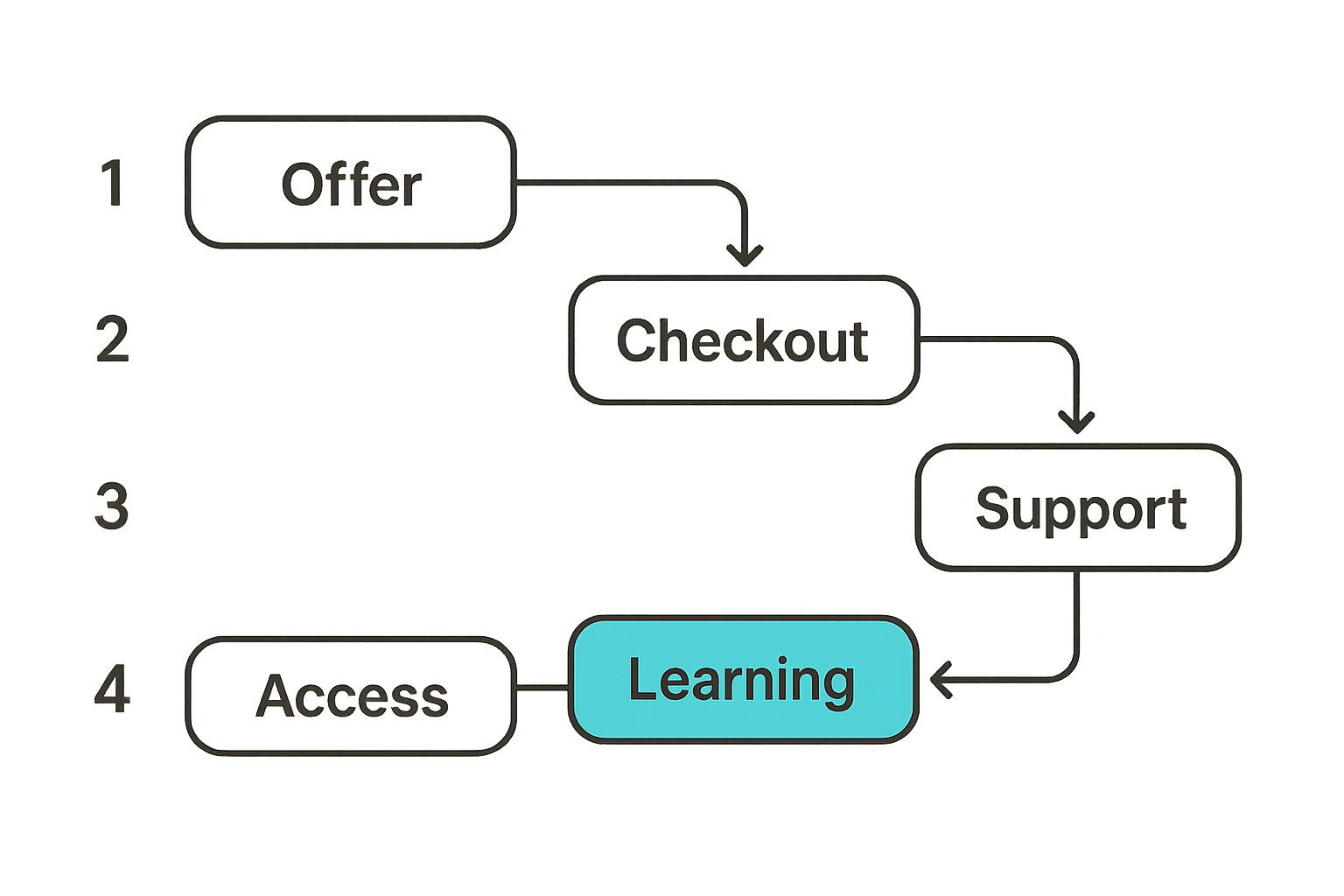
The minimum delivery architecture is the smallest reliable system that takes a buyer from paid to activated. It does not need to be fancy. It does need to be explicit.
Here is a practical implementation sequence:
- Define the product SKU, version, price, and included access.
- Build the checkout path and success page.
- Capture buyer identity and payment state.
- Trigger fulfillment automatically after confirmed payment.
- Send a delivery email with start-here instructions.
- Record the order in a customer system or spreadsheet.
- Add a support route and refund process.
- Follow up after activation to collect friction and proof.
This is enough for many early products. The important part is that every step has an owner and a failure path.
Checkout and payment state
Payment state is not binary. A buyer can be pending, paid, failed, refunded, disputed, upgraded, canceled, or partially comped. Your workflow should know which state matters for access.
For simple products, a payment link may be enough. For more complex products, use checkout sessions, webhooks, and a customer database.
At minimum, store:
- Customer email
- Product purchased
- Amount paid
- Payment status
- Purchase timestamp
- Fulfillment status
- Refund status
A common failure mode: payment succeeds, but the delivery email lands in spam or the file permission is wrong. If you have no fulfillment status, you will not know until the buyer complains.
Access control and fulfillment
Access control should match product risk. A $19 PDF does not need enterprise-grade licensing. A $999 research database, paid API, or private software workflow probably needs stronger entitlements.
Possible fulfillment patterns:
- Static download link
- Expiring signed link
- Invite to a workspace
- Account upgrade in your app
- License key
- Email sequence
- Private repository access
The mistake teams make is either under-controlling high-value assets or over-engineering low-risk ones. Both are expensive in different ways.
Practical rule: Match access controls to the refund, piracy, and support risk of the product. Do not build a licensing system for a $9 checklist unless the checklist is the start of a larger product line.
Receipts support and refunds
Support is part of the sales system because it protects trust after payment. Your refund policy, receipt email, and support path should be visible before purchase and easy after purchase.
A useful receipt email includes:
- What was purchased
- How to access it
- What to do first
- How to get help
- Refund or guarantee terms
- Invoice link if relevant
Refunds should be tracked as learning, not only lost revenue. Was the buyer wrong? Was the product unclear? Was onboarding weak? Did the promise overreach?
For a deeper operating-system view of checkout, delivery, and growth, this prior sh1pt.com guide on how to sell digital products in 2026 goes further into the post-payment machinery that many first launches ignore.
Price digital products like systems, not files
Digital product pricing gets weird because marginal delivery cost is low. Founders then underprice because it feels cheap to send another copy. Buyers do not price based on your file transfer cost. They price based on perceived outcome, risk, alternatives, and urgency.
Anchor on outcome, not effort
Do not price based only on how long it took you to make the product. A simple spreadsheet that saves a finance operator five hours every month may be worth more than a beautiful 90-page ebook nobody finishes.
Ask:
- What does the buyer avoid?
- What does the buyer gain?
- How often does the problem recur?
- What would they pay a contractor, consultant, or employee to do this?
- What does inaction cost?
A useful pricing sentence is: this helps a specific buyer produce a specific result faster, cheaper, or with less risk than the alternative.
Use tiers to separate buyers
Tiers are useful when buyers have different needs. They are harmful when they create confusion.
Good tiering separates by:
- Usage rights
- Support level
- Templates plus implementation
- Individual versus team access
- Basic product versus product plus review
- One-time purchase versus updates
Bad tiering hides the real product behind arbitrary feature gates.
Example:
| Tier | Buyer | Includes | Risk |
|---|---|---|---|
| Starter | DIY buyer | Core template and guide | Low support, lower price |
| Pro | Busy operator | Template, examples, update pack | Better value, moderate support |
| Done-with-you | High-intent buyer | Product plus review call | Higher price, calendar dependency |
This structure lets you capture different willingness to pay without forcing everyone into the same support model.
Discount carefully
Discounts can help a launch. They can also train buyers to wait.
Use discounts when they have a reason:
- Early buyer risk
- Launch window
- Partner campaign
- Student or nonprofit access
- Upgrade from a previous product
Avoid permanent fake urgency. Buyers notice. More importantly, it corrupts your own data. If every sale happens at 60% off, you have not validated the full-price offer.
Practical rule: A discount should explain why the price is temporarily lower. If you cannot explain the reason, you are probably using price to compensate for weak positioning.
Choose channels and write the launch loop
Selling digital products is not a one-time announcement. It is a loop: publish, capture attention, convert, deliver, learn, improve, and relaunch.
Most founders under-document this loop. They post on launch day, watch the numbers, and then improvise. The next launch starts from memory instead of a system.
Audience-channel fit
Different products fit different channels. A developer tool may work through GitHub, Hacker News, technical SEO, and founder communities. A design template may sell through visual platforms, creator newsletters, and marketplace search. A B2B playbook may sell through LinkedIn, webinars, and direct founder relationships.
Match the channel to the buyer's existing behavior:
- Where do they already look for solutions?
- Who do they already trust?
- What proof format do they respond to?
- Is the purchase impulse immediate or research-heavy?
- Does the product need education before purchase?
The practical question is not, where can I post? It is, where is the buyer already trying to solve this problem?
Content as a distribution asset
Content works when it reduces buyer uncertainty. That could mean tutorials, teardown posts, benchmark comparisons, build-in-public notes, demos, case studies, or implementation checklists.
For digital products, content should do at least one job:
- Clarify the problem
- Show the mechanism
- Demonstrate expertise
- Prove the product works
- Handle objections
- Create search demand capture
Do not publish random thought leadership and hope it sells. Tie content to the product workflow.
For founders building a broader launch motion, the sh1pt.com guide to go to market strategy in 2026 is adjacent because it connects audience, channel, launch workflow, metrics, and decision-making into one operating system.
Partner and affiliate loops
Partners can work well for digital products because delivery cost is low and margins can support revenue share. But affiliate programs are not magic distribution. They need assets, tracking, rules, and trust.
A partner-ready product includes:
- Clear audience definition
- Partner landing page
- Approved messaging
- Tracking links or coupon codes
- Commission terms
- Refund handling rules
- Payout schedule
What fails is asking partners to promote a vague product with no proof, no creative assets, and no reason their audience should care.
Automate the boring parts without hiding ownership
Automation is useful when it makes the system more reliable. It is dangerous when it hides broken ownership behind a chain of tools nobody understands.
The mistake teams make is automating before defining states. Then a buyer gets three emails, two different access links, and no clear support path.
What to automate first
Automate the work that is repetitive, state-based, and easy to verify.
Good early automation targets:
- Payment success to fulfillment
- Welcome email
- Course or onboarding sequence
- License key generation
- CRM tagging
- Refund status update
- Review request after activation
- Failed payment notification
Keep the automation map simple. Write down trigger, action, owner, and failure path.
Example:
Trigger: checkout.session.completed
Condition: product_id = launch_playbook_pro
Actions:
  - create customer record
  - grant product access
  - send delivery email
  - tag buyer as pro_customer
Failure path:
  - alert founder in support inbox
  - mark fulfillment_status = failed
Where automation fails
Automation fails when tools disagree about the buyer state. Stripe says paid. Email tool says delivered. Course platform says invited. Workspace says no access. The founder has to inspect four dashboards to understand one order.
What breaks in practice:
- Duplicate fulfillment from retrying webhooks
- No idempotency on order creation
- Refund issued but access remains active
- Email changed in one system but not another
- Coupon use not recorded in analytics
- Support cannot see purchase history
If your digital product starts to grow, idempotency and source-of-truth decisions matter. Even simple businesses need to know which system decides whether a buyer has access.
Related reading from our network: the same architecture-first thinking shows up in best workflow automation software in 2026, where the buying decision is less about demo polish and more about integrations, controls, and rollout ownership.
Human checkpoints
Do not automate judgment too early. Keep humans in the loop for high-value refunds, enterprise access, suspicious orders, partner disputes, and VIP onboarding.
A practical split:
- Automate repeatable fulfillment
- Alert humans on exceptions
- Review refund reasons weekly
- Manually inspect failed activation
- Personally follow up with early customers
Automation should free attention for learning, not remove you from the customer relationship.
Measure the right things after launch
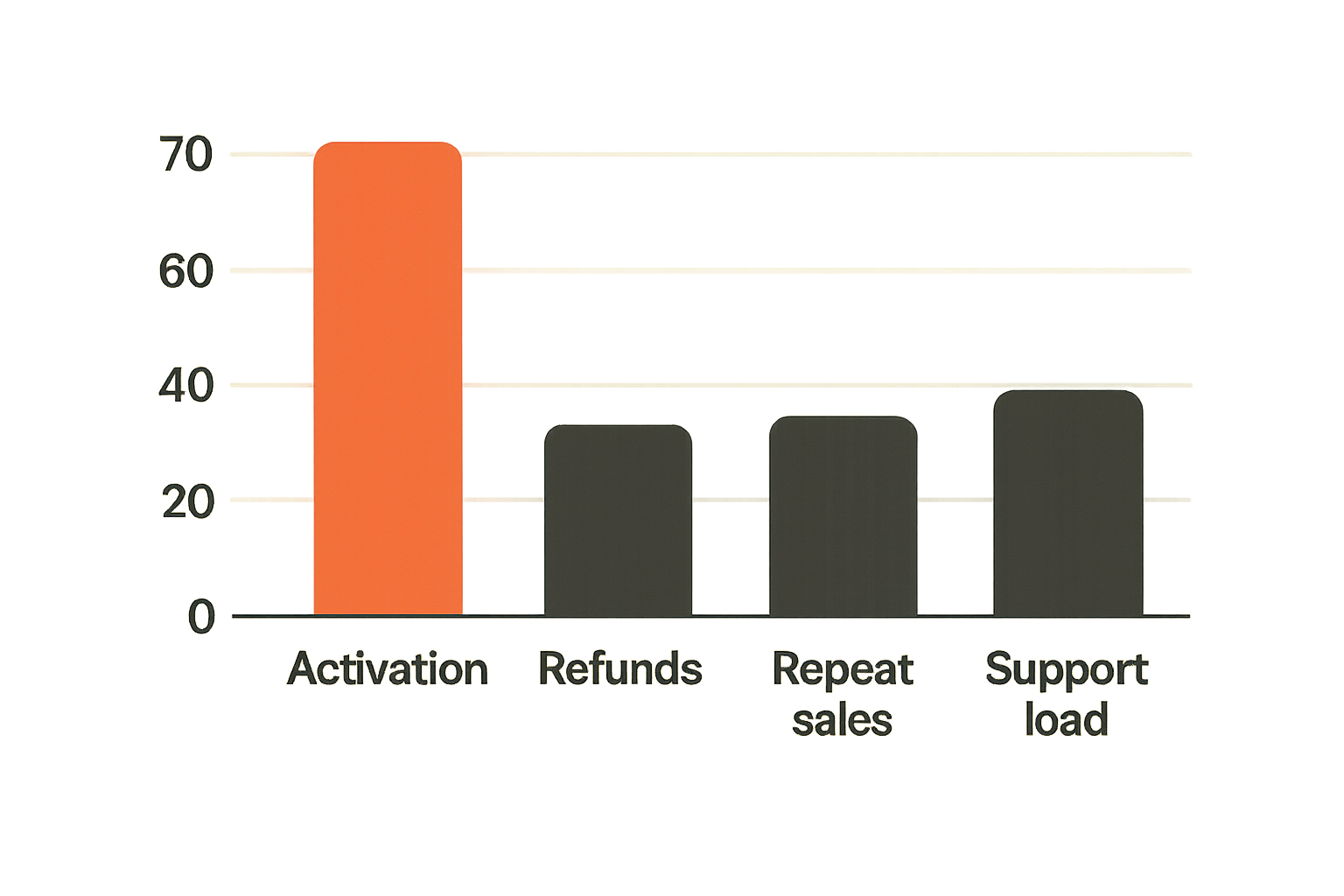
Launch revenue is useful, but it is not enough. A product can produce a good launch day and still fail as a business because buyers do not activate, refunds are high, or no channel repeats.
The practical question is: which signals tell you whether the product is getting easier to sell and more useful to buyers?
Metrics that matter
Track metrics by stage:
| Stage | Metric | Why it matters |
|---|---|---|
| Attention | Qualified visits, email signups | Shows whether the message reaches the right people |
| Conversion | Checkout starts, purchases, conversion rate | Shows offer and trust strength |
| Delivery | Fulfillment success, email open, access completion | Shows operational reliability |
| Activation | First use, lesson completion, template duplication | Shows whether buyers start getting value |
| Satisfaction | Refunds, support themes, testimonials | Shows expectation fit |
| Growth | Repeat purchases, referrals, partner sales | Shows whether the loop compounds |
Do not over-instrument before you have buyers. But do not run blind either. A simple spreadsheet updated after every launch is better than a beautiful analytics stack nobody checks.
Cohorts and refund signals
Refunds are not all the same. Segment them by cohort, source, price, and product version.
A few examples:
- Buyers from paid ads refund more than newsletter buyers
- Discount buyers ask more support questions
- Version 1 buyers complain about setup time
- A specific partner campaign brings poor-fit customers
- Buyers who do not open the delivery email refund within 48 hours
That changes the conversation. Instead of saying the product does not work, you can ask which promise, source, or delivery step is causing the mismatch.
Post-purchase activation
Activation is the first meaningful success after purchase. Define it clearly.
For different products, activation might be:
- Template duplicated
- First report generated
- First lesson completed
- API key created
- First client proposal sent
- First dashboard configured
- First workflow shipped
Measure activation because it connects product value to support and retention. If buyers pay but never activate, you do not have a checkout problem. You have a delivery, onboarding, or promise problem.
Common failure modes when selling digital products
Most failed digital product launches are not mysterious. The same patterns repeat.
The product is too broad
Broad products feel safer to build because they can theoretically appeal to more people. In practice, broad products are harder to sell because nobody sees themselves clearly in the promise.
Weak: marketing templates for startups.
Stronger: launch email templates for B2B SaaS founders announcing a product update to existing users.
The narrower version is easier to write, price, demo, support, and improve.
The funnel has invisible states
Invisible states create operational drag. A buyer is interested but not captured. A checkout fails but nobody follows up. A customer pays but does not activate. A refund happens but access stays open. A partner sends traffic but attribution disappears.
Make the key states visible:
- Visitor
- Lead
- Checkout started
- Paid
- Fulfilled
- Activated
- Refunded
- Repeat buyer
- Referred buyer
You do not need an enterprise data warehouse. You need enough visibility to know where the workflow leaks.
Support is treated as an afterthought
Support is where positioning gets stress-tested. If buyers repeatedly ask what is included, the sales page is unclear. If they cannot install the template, delivery is weak. If they want a refund because the product is not for them, targeting is off.
Related reading from our network: even in a different context, Vizio remote control thinking for remote team screen sharing workflows is a useful reminder that handoffs, permissions, and support paths need design before something goes wrong.
Treat support themes as product input. Tag issues. Review them. Turn repeated answers into onboarding improvements, docs, demos, or offer changes.
What works in 2026
The digital product market is more mature now. Buyers have seen low-effort bundles, AI-generated filler, recycled courses, and fake scarcity. That does not mean digital products are dead. It means trust and usefulness matter more.
Clear promise, compact scope
Compact products often outperform bloated ones because buyers can understand and use them quickly.
What works:
- Narrow buyer
- Specific job
- Fast first win
- Clear examples
- Honest boundaries
- Useful updates
What fails:
- Giant bundles
- Vague transformation language
- No implementation path
- Overpromised AI wrappers
- Lifetime access with no update plan
A compact product can always expand later. A bloated product is harder to explain from day one.
Proof assets and trust
Trust does not only come from testimonials. It comes from showing your work.
Useful proof assets include:
- Before-and-after examples
- Screenshots of outputs
- Short demo videos
- Buyer implementation notes
- Public changelog
- Transparent refund policy
- Sample module or preview
- Founder teardown of the problem
Proof reduces perceived risk. It also attracts better-fit buyers because they can inspect whether the product matches their situation.
Iteration cadence
A digital product should have an iteration cadence. That does not mean endless updates for every purchase. It means you know when and why the product changes.
Possible cadence:
- Weekly support review
- Monthly sales page update
- Quarterly product version update
- Launch retrospective after every campaign
- Annual repositioning review
The mistake teams make is treating launch as the end of product development. In reality, launch is when the market starts giving you usable data.
Where sh1pt.com fits in the workflow
sh1pt.com is for people building and launching software products who want to understand shipping strategies, product development processes, and growth tactics. That includes founders selling digital products, but the lens is broader than creator monetization.
The useful angle is operational: how do you move from idea to market without confusing motion for progress?
Shipping decisions need context
Most advice about how to sell digital products is either platform-first or tactic-first. Use this marketplace. Post on this channel. Run this discount. Add this AI feature.
Sometimes that advice is fine. Often it skips the architecture: product model, buyer state, fulfillment path, activation signal, and launch loop.
sh1pt.com focuses on the decisions underneath the launch surface. The goal is not to make shipping feel glamorous. The goal is to make it less fragile.
Use launch notes as operating memory
Every launch should leave behind operating memory:
- What promise was tested?
- Which audience responded?
- Which channel worked?
- What broke after checkout?
- What objections repeated?
- What support issues appeared?
- What should change before the next launch?
Without this record, founders repeat the same launch with a new headline. With it, each campaign improves the system.
Closing the loop from idea to market
If you are learning how to sell digital products, do not start with the tool stack. Start with the buyer workflow. Define the promise, build the minimum delivery architecture, price around outcomes, launch through a repeatable channel loop, and measure activation after purchase.
That is the difference between a product that sells once because the launch was loud and a product that keeps improving because the system can learn.
Try sh1pt.com
sh1pt.com is for people building and launching software products who want practical guidance on shipping strategies, product development processes, and growth tactics. If you are figuring out how to sell digital products without building a fragile launch machine, start here: Try sh1pt.com.