
You can sell digital products with a landing page, a payment link, and a download button. That is the easy version. It works until customers ask where their purchase went, affiliates need tracking, refunds create accounting noise, and your launch traffic exposes every manual step you forgot existed.
Teams think the problem is creating the product. The real problem is operating the sale after the first transaction.
That changes the conversation. If you want to sell digital products in 2026, you are not only choosing an ebook topic, course format, template pack, or paid community. You are designing a lightweight commerce system: offer, checkout, fulfillment, customer access, support, lifecycle messaging, metrics, and iteration.
The practical question is not: what platform should I use? The practical question is: what workflow lets me ship, sell, learn, and improve without turning a small product into a support-heavy mess?
Table of contents
- Sell digital products as an operating system, not a checkout link
- Choose the product format around delivery risk
- Design the offer before you build the asset
- Build the checkout and fulfillment workflow
- Price digital products with support cost in mind
- Launch channels are distribution infrastructure
- Instrument the metrics that expose bottlenecks
- What breaks when teams sell digital products badly
- A practical implementation sequence
- Where sh1pt.com fits in the digital product workflow
Sell digital products as an operating system, not a checkout link

Most first-time founders treat a digital product sale as a page plus payment. That is understandable. The tools make checkout look finished. But the buyer does not experience your stack as separate tools. They experience one promise: I paid, I got access, I understand how to use it, and I trust you if something breaks.
The mistake teams make is optimizing the visible layer while ignoring the states behind it. A button can be beautiful and still fail the business.
The checkout is only one state transition
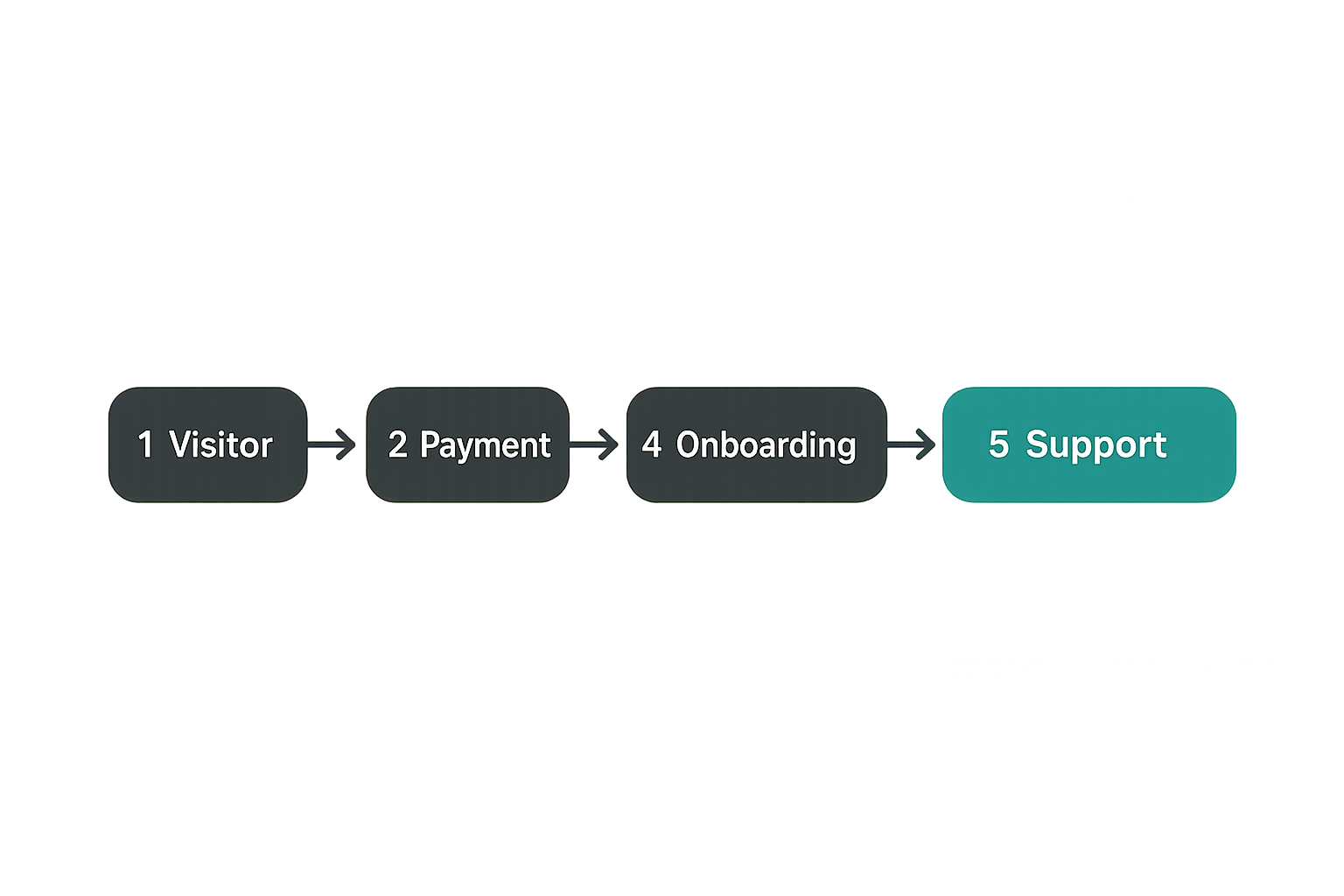
A sale moves through states:
- visitor sees the offer
- prospect understands the promise
- buyer completes payment
- system confirms purchase
- customer receives access
- customer consumes the product
- customer asks for help, upgrade, refund, or more
Checkout handles one transition: unpaid to paid. Everything after that is fulfillment and trust.
Practical rule: If you cannot describe what happens in the five minutes after payment, you are not ready to scale the launch.
This matters for founders because digital products have low marginal cost but not zero operational cost. Access issues, confused buyers, broken links, tax receipts, license questions, and missing onboarding all become drag.
The product promise creates the workflow
A template pack has a different operating model than a cohort course. A paid database has a different support surface than a PDF guide. A software starter kit has versioning, compatibility, and update expectations.
A useful way to think about it is this: the more transformation you promise, the more workflow you owe.
If you sell a Notion template, the workflow can be simple: purchase, duplicate link, usage notes, email follow-up. If you sell a founder operating system with implementation calls, you need scheduling, reminders, recordings, access control, and customer success boundaries.
For adjacent thinking on product selection, the operator guide to digital products to sell in 2026 is useful because it separates product ideas from the operating load behind them.
The minimum viable system
The minimum viable system to sell digital products is not complicated, but it must be explicit:
| System part | Minimum version | Failure if ignored |
|---|---|---|
| Offer | Clear promise, buyer, outcome | Traffic arrives but does not convert |
| Checkout | Payment, receipt, confirmation | Buyers pay but feel uncertain |
| Delivery | Reliable access path | Support tickets spike |
| Onboarding | First-use instructions | Customers do not get value |
| Support | Contact path and policy | Refunds and public complaints rise |
| Metrics | Funnel and revenue tracking | You cannot diagnose the launch |
The system can be no-code. It can be scrappy. It cannot be vague.
Choose the product format around delivery risk
Many founders choose the format that sounds valuable. Course. Toolkit. Membership. Bundle. Certification. The better question is what delivery risk you can support.
What breaks in practice is not the file. It is the gap between what buyers expect and what your operations can consistently deliver.
Low-touch products scale differently
Low-touch products include ebooks, guides, templates, swipe files, checklists, design kits, code snippets, and recorded workshops. They are attractive because delivery can be automated and support can be contained.
They work best when the promise is specific:
- launch checklist for a SaaS beta
- pricing calculator for freelance productized services
- email sequence for waitlist conversion
- Figma kit for onboarding screens
- prompt library for customer interviews
Low-touch does not mean low value. It means the customer can reach the outcome without your direct involvement.
High-touch products need operating capacity
High-touch products include cohorts, memberships, paid communities, office hours, implementation programs, audits, and coaching-backed products. They can command higher prices, but they add calendar risk and expectation risk.
If you sell access to yourself, your calendar becomes part of the product. If you sell a community, moderation becomes part of the product. If you sell updates, maintenance becomes part of the product.
Related reading from our network: teams designing community-heavy offers face similar follow-up and trust problems, which is why this piece on community building software for local groups is relevant even outside local organizations.
Bundle only when the workflow can support it
Bundles are tempting because they increase perceived value. The mistake teams make is using bundles to hide a weak core offer.
A bundle is operationally safe when:
- every component serves the same buyer job
- access is delivered through one clean path
- updates are easy to communicate
- the buyer knows what to use first
- support questions do not scatter across unrelated assets
A bundle fails when it becomes a junk drawer. More files do not equal more value. More clarity usually does.
Design the offer before you build the asset
Before building another 80-page guide, write the offer. Not the sales page. The offer.
The offer is the agreement between buyer pain, promised outcome, proof, price, risk reversal, and delivery method. When that is unclear, founders compensate by adding more content. That rarely fixes the problem.
Who has the painful job
The buyer must be specific enough that you can predict their day.
Weak: founders who want to grow.
Stronger: solo SaaS founders with a working product and fewer than 500 waitlist subscribers who need a launch plan for their first paid users.
Specificity helps because it determines examples, language, pricing, objections, and distribution. If your buyer is vague, your product becomes vague.
What outcome are they buying
Customers do not buy digital products because they want files. They buy reduced effort, reduced uncertainty, better taste, faster execution, or access to a pattern they trust.
Examples:
- avoid spending 20 hours designing onboarding emails
- ship a landing page without hiring a copywriter
- validate pricing before building a feature
- prepare a launch plan investors and teammates can understand
- implement a repeatable customer interview system
Practical rule: Name the before-and-after state in one sentence before you write the product outline.
If you cannot do that, the asset is likely premature.
What proof lowers risk
Proof does not always mean a giant audience or revenue screenshot. For productized knowledge, proof can be:
- a working artifact you used yourself
- customer examples
- teardown clips
- before-and-after samples
- transparent process notes
- a small free diagnostic tool
Proof should answer the buyer's hidden question: why should I believe this will work for someone like me?
Build the checkout and fulfillment workflow
This is where digital product businesses become real. A launch is not a tweetstorm. A launch is a workflow under load.
When you sell digital products, your system should handle success, failure, and ambiguity. Payment succeeded. Payment failed. Payment succeeded but email bounced. Buyer used the wrong email. Customer wants an invoice. Customer bought twice. Customer wants team access.
Map every purchase state
Start with a state map. It can be a spreadsheet, whiteboard, or simple YAML-style spec:
purchase_states:
  - visitor
  - checkout_started
  - payment_failed
  - payment_succeeded
  - access_granted
  - onboarding_sent
  - refund_requested
  - refunded
  - upgraded
  - support_opened
Then define the owner and system action for each state.
| State | System action | Owner |
|---|---|---|
| Payment succeeded | Send receipt and access | Checkout tool |
| Access failed | Create support task | Founder or support inbox |
| Refund requested | Check policy and usage | Founder |
| Upgrade requested | Apply credit or coupon | Founder or automation |
| Product updated | Notify eligible buyers | Email system |
This looks boring. It is also where launches stop being chaotic.
Use automation where failure is predictable
Automate the predictable paths:
- payment confirmation
- receipt and tax invoice
- access email
- onboarding email
- license or download link
- post-purchase check-in
- refund confirmation
- update notification
Do not automate judgment too early. Refund edge cases, enterprise invoices, partner payouts, and angry support messages often need human review until patterns emerge.
Related reading from our network: software teams face a similar workflow problem when remote access tools are bought as isolated utilities instead of support infrastructure; the same pattern is covered in this guide to remote access software workflow.
Keep manual override paths
Every sales system needs manual controls. You need to grant access manually, revoke access, resend receipts, change an email, apply a discount, refund an order, and see the customer history.
Practical rule: If a non-technical founder cannot fix the top five customer access problems in under ten minutes, the selling system is too brittle.
This is especially important for indie hackers and solopreneurs. You may not have support staff. Your tooling must give you operational leverage, not create a second job.
Price digital products with support cost in mind
Pricing is not only positioning. It is capacity planning.
The wrong price attracts the wrong support load. A very cheap product can bring high-volume, low-context buyers who ask questions answered on the sales page. A premium product can attract fewer buyers but more demanding expectations. Neither is automatically better. The question is whether the price matches the delivery model.
Cheap can become expensive
A $19 product with 1,000 buyers sounds clean until 8% need help, 3% request refunds, and 40 people email about access on launch day. Again, do not invent precision in your planning. Just assume some percentage of buyers will need assistance.
Common low-price failure modes:
- unclear scope because the product tries to appeal to everyone
- buyers purchase casually and never use it
- refund requests rise because perceived commitment is low
- support cost consumes the margin
- paid acquisition becomes difficult
Cheap works when delivery is extremely clear and the product solves a narrow job.
Tier by transformation, not file size
Bad tiers are based on volume:
- Basic: 20 pages
- Pro: 80 pages
- Premium: 200 pages
Better tiers are based on transformation and support:
| Tier | Buyer need | Included value |
|---|---|---|
| Self-serve | I need the artifact | Template, guide, examples |
| Guided | I need implementation help | Walkthrough, checklist, office hours |
| Team | I need rollout support | Seats, async review, team license |
This lets different buyers choose the amount of help they need. It also keeps the core product clean.
Protect the refund boundary
Refund policies should be visible before purchase and operationally easy to apply. Avoid clever policies. They create support arguments.
A sane refund boundary includes:
- time window
- product access rules
- exceptions for duplicate purchases
- how refunds are requested
- expected response time
If the product includes files that can be downloaded instantly, say how refunds work. If it includes live access, say what happens after attendance. Clarity reduces conflict.
Launch channels are distribution infrastructure
Founders often treat distribution as promotion. Post on X. Send an email. Launch on Product Hunt. Share in communities. Maybe run ads.
That is activity. Distribution infrastructure is different. It is the repeatable path by which the right buyers encounter the right offer at the right time with enough trust to act.
Owned channels reduce launch fragility
Owned channels are email lists, customer lists, blogs, communities you operate, and direct relationships. They are slower to build but reduce dependency on platform algorithms.
If you intend to sell digital products repeatedly, your owned channel is not a nice-to-have. It is the compounding asset.
A simple owned-channel loop:
- publish useful public artifact
- capture interested readers with a specific lead magnet
- segment by buyer job
- invite the right segment to the paid offer
- follow up based on behavior
- learn from replies and support questions
For broader launch architecture, the sh1pt guide to building a go to market strategy operating system covers how product, channel, audience, and metrics need to connect instead of living in separate documents.
Marketplaces trade reach for control
Marketplaces can help with discovery. They can also constrain pricing, customer data, email access, customization, and support flows.
Use marketplaces when:
- the category already has demand
- buyer intent is strong
- your product is easy to compare
- platform fees still leave margin
- you can tolerate limited customer ownership
Use your own checkout when:
- you need buyer segmentation
- you want lifecycle emails
- you have bundles or upgrades
- you need clean analytics
- your brand and trust matter
There is no universal answer. The mistake teams make is choosing a channel based on convenience instead of control requirements.
Partner channels need tracking discipline
Affiliates, newsletter swaps, creator bundles, agencies, and community partnerships can work well. They also introduce attribution and expectation problems.
Before running partner campaigns, decide:
- what counts as a referred sale
- how long attribution lasts
- whether coupons stack
- when partners get paid
- how refunds affect commissions
- who handles customer support
If you do not define these rules upfront, the first successful campaign will create arguments.
Instrument the metrics that expose bottlenecks
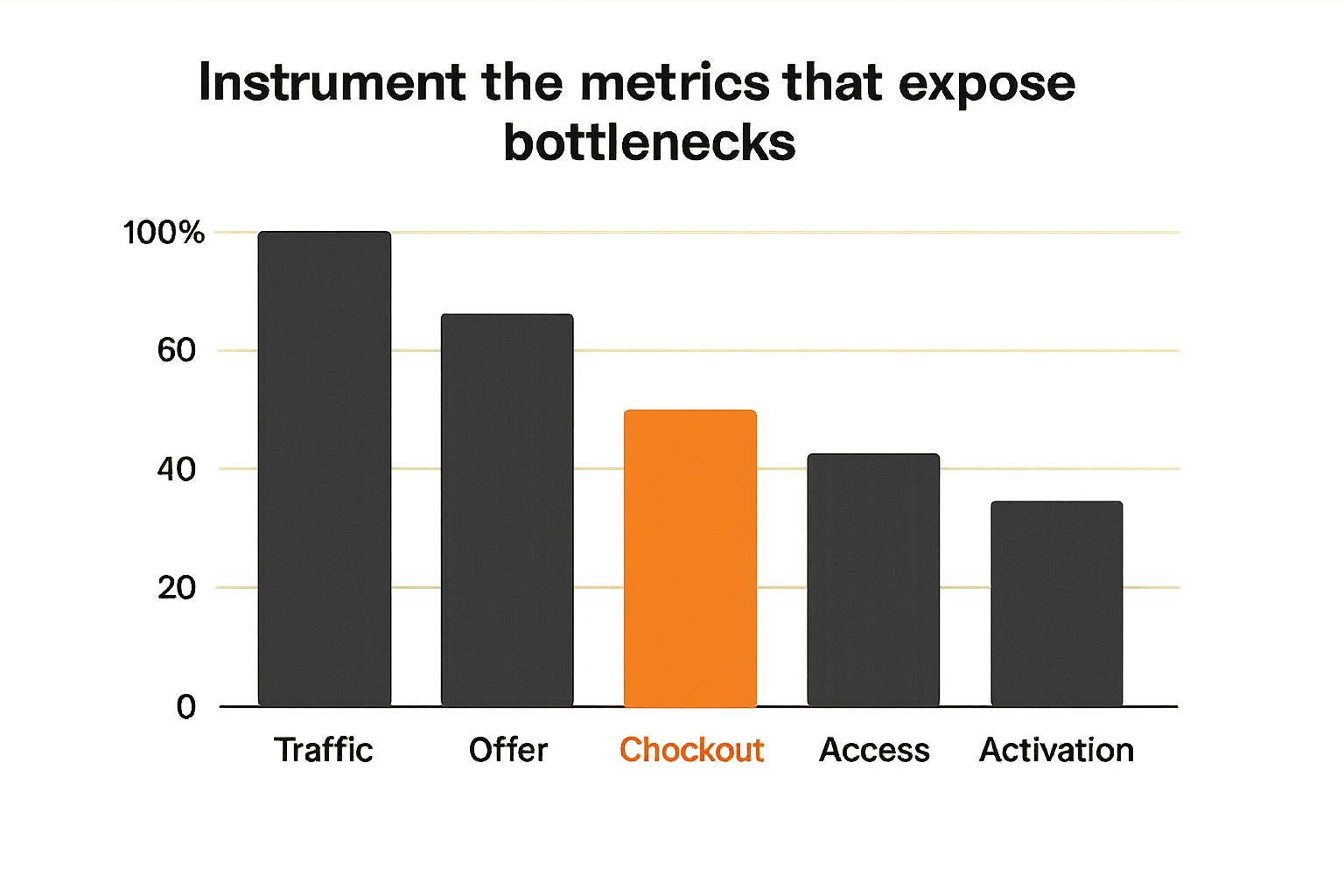
Analytics should not be a dashboard graveyard. Metrics exist to answer operational questions.
The practical question is: where is the system leaking? Traffic, offer comprehension, checkout, fulfillment, activation, retention, or support?
Track the funnel as states
Track the sales funnel as state transitions, not vanity numbers.
Useful metrics include:
- landing page visitors
- sales page conversion rate
- checkout starts
- checkout completion rate
- payment failures
- access delivery failures
- refund rate
- support contacts per 100 orders
- activation or first-use rate
- repeat purchase rate
Do not overbuild analytics before you have volume. But do define the events early so launch data is not lost.
Separate traffic problems from offer problems
A low number of sales can come from different causes:
| Symptom | Likely issue | Fix |
|---|---|---|
| Low traffic, high conversion | Distribution problem | More channel work |
| High traffic, low conversion | Offer or audience mismatch | Rewrite promise, proof, targeting |
| Checkout starts, few payments | Price, trust, checkout friction | Improve pricing page and payment flow |
| Many purchases, many refunds | Expectation mismatch | Fix sales page and onboarding |
| Many buyers, low usage | Activation problem | Improve first-use workflow |
This is why one metric is dangerous. Revenue alone does not explain what to fix.
Use support signals as product data
Support tickets are not just interruptions. They are structured evidence if you label them.
Use simple categories:
- access issue
- billing question
- expectation mismatch
- implementation confusion
- missing example
- refund request
- bug or broken link
- upgrade interest
After each launch, review the top categories. If 30 people ask the same question, the product or sales page is unclear. If buyers ask for the same adjacent artifact, you may have your next product.
Related reading from our network: teams shipping software products also need to treat operational signals as workflow inputs, not afterthoughts, which is the same lesson in this guide to security systems for CI/CD and software supply chains.
What breaks when teams sell digital products badly
Bad digital product operations rarely fail all at once. They leak trust in small ways.
The customer pays and waits. The login link fails. The download is outdated. The refund policy is vague. The support inbox is a personal email with no labels. The founder cannot tell who bought what. The next launch starts from scratch.
Access failures create trust debt
Access is the first proof of competence. If someone pays and cannot immediately use the product, the relationship starts with doubt.
Common access failures:
- confirmation email lands in spam
- download link expires too aggressively
- account creation requires manual approval
- buyer uses Apple Pay email and cannot find access
- community invite is sent to the wrong address
- files are hosted in a tool with permission issues
What works: redundant access paths. Put access on the thank-you page and in the email. Give customers a support link. Keep a manual resend process.
What fails: assuming email delivery is enough.
No source of truth causes operational drift
As sales grow, founders often end up with customer data split across checkout, email, spreadsheet, community platform, course tool, and support inbox.
At small scale, memory covers the gaps. At launch scale, memory fails.
You need one practical source of truth for:
- who bought
- what they bought
- when they bought
- payment status
- refund status
- access status
- license or seat count
- support history
This does not require enterprise software. It requires discipline. A spreadsheet can be the source of truth early if it is consistently updated. A database or CRM can come later.
One-off launches hide weak retention
One-off launches feel good because they create spikes. But spikes can hide weak product-market fit if buyers do not use the product, recommend it, or buy again.
If every launch needs the same amount of effort to produce the same revenue, you do not have an asset. You have a campaign habit.
Retention for digital products can show up as:
- repeat purchases
- upgrades
- referrals
- testimonials
- ongoing community activity
- low refund rate
- high completion or usage
- customers asking for the next version
The goal is not to force subscriptions onto every product. The goal is to understand whether the value compounds.
A practical implementation sequence
This is the workflow I would use if starting from zero with a digital product idea and a small audience.
It assumes you are an indie hacker, founder, product manager, or solopreneur who needs revenue and learning without building a giant backend.
Step one define the customer job
Do this before platform selection.
- Write the buyer segment in one sentence.
- Write the painful job they are trying to complete.
- Write the before-and-after outcome.
- List the objections that would stop purchase.
- List the proof you can provide honestly.
- Choose the smallest product format that can deliver the outcome.
Example:
buyer: solo founder launching first paid beta
job: convert waitlist into first 25 paying users
outcome: launch sequence, pricing test, follow-up system
format: playbook plus email templates plus metrics sheet
support: one async Q&A form for first 14 days
This prevents you from building a course when a playbook would do.
Step two wire the selling system
Build the workflow in this order:
- sales page with clear promise and scope
- checkout with tax, receipts, and payment methods
- thank-you page with immediate access
- access email with backup instructions
- onboarding email focused on first use
- support form or inbox label
- customer source of truth
- refund and duplicate-purchase process
- analytics events for each state
- post-purchase feedback request
Test it with a real payment, not only preview mode. Buy your own product. Refund yourself. Change your email. Open the download link on mobile. Forward the receipt. Try the path like a tired customer would.
Practical rule: A launch checklist is not complete until you have tested the unhappy paths.
For a deeper workflow view, sh1pt has a companion piece on selling digital products as a practical system, which is useful if you are moving from idea validation into repeatable revenue operations.
Step three run a controlled launch
Do not make your first launch a maximum-blast event if the workflow is untested. Start with a controlled batch.
A practical launch sequence:
- invite 10 to 25 warm prospects
- watch checkout and delivery manually
- collect objections and support questions
- fix sales page confusion
- improve onboarding
- open to a larger owned audience segment
- add partner or marketplace distribution only after fulfillment is stable
- review metrics within 72 hours
- ship an update based on actual buyer behavior
The purpose of the first launch is not only revenue. It is workflow validation.
Where sh1pt.com fits in the digital product workflow
sh1pt.com is built for people building and launching software products who want to understand shipping strategies, product development processes, and growth tactics. That makes the digital product conversation practical rather than inspirational.
The point is not to become a creator by accident. The point is to ship assets that support your product strategy, revenue model, audience learning, and market position.
Use shipping discipline to avoid creator chaos
Software teams already understand versioning, release notes, QA, incident response, and customer feedback. Apply that same discipline to digital products.
For example:
- version your product updates
- keep a changelog for buyers
- tag support issues by root cause
- separate draft assets from production assets
- test purchase flows before launch
- retire outdated offers cleanly
This turns selling into an operating loop instead of a personality-driven hustle.
Turn each launch into reusable infrastructure
Every launch should leave behind assets you can reuse:
- refined positioning
- tested checkout flow
- email segments
- objection database
- support macros
- customer testimonials
- analytics baseline
- partner terms
- update process
That changes the conversation. You are not asking whether one digital product will change the business. You are building the capability to create, sell, deliver, and improve useful products repeatedly.
Sell digital products with a repeatable cadence
The founders who do this well usually avoid extremes. They do not spend a year building in private. They also do not throw unfinished PDFs at an audience every week.
A sane cadence might be:
- one small diagnostic or free artifact per month
- one paid product or major update per quarter
- one customer feedback review after every launch
- one systems cleanup before the next launch
The closing point is simple: if you want to sell digital products in 2026, build the operating system around the sale. Checkout matters, but delivery, trust, support, metrics, and iteration are what make the revenue durable.
Try sh1pt.com
sh1pt.com is for people building and launching software products who want practical shipping strategies, product development processes, and growth tactics. Try sh1pt.com.