
An indie hacker product launch usually fails before launch day.
Not because the founder chose the wrong emoji, posted at the wrong hour, or missed the perfect Product Hunt comment format. Those things can matter at the margin. They do not save a weak system.
Teams think the problem is attention. The real problem is conversion infrastructure: who the product is for, what promise is being tested, how intent is captured, how feedback is routed, and what happens after the spike disappears.
That changes the conversation. A launch is not a one-day marketing event. It is a workflow for turning a burst of attention into product signal, revenue, relationships, and a better shipping loop.
Table of contents
- Launches fail because the system is underbuilt
- Define the indie hacker product launch architecture before you post
- Choose a launch surface instead of chasing every channel
- Build the pre-launch pipeline
- Ship a launch-ready product, not a perfect product
- Run launch day like an operations workflow
- Measure what changes behavior
- Common failure modes in indie hacker launches
- Turn launch traffic into a product loop
- Where sh1pt.com fits in your shipping system
Launches fail because the system is underbuilt
The mistake teams make is treating an indie hacker product launch as a visibility problem. They ask where to post, when to post, and how to get upvotes. Useful questions, but late questions.
The practical question is: if 1,000 relevant people arrive tomorrow, what will the product, website, analytics, support, and follow-up system do with them?
If the answer is vague, the launch is not ready. You may still get traffic. You may even get praise. But praise without capture, activation, and learning is a very expensive dopamine event.
The launch is not the event
The visible launch is a checkpoint. The actual launch includes:
- The positioning work before anyone sees the product.
- The pre-launch audience and waitlist.
- The landing page and conversion path.
- The first-use workflow.
- The founder response loop.
- The post-launch follow-up.
- The product changes made from real signal.
A useful way to think about it is a release train. Launch day is when the train hits a station. If the tracks are broken, a bigger crowd at the station only makes the failure more obvious.
Practical rule: do not launch to a broad audience until you can explain what a qualified visitor should do in the first three minutes.
Many indie hackers reverse the order. They ship a landing page, post a big announcement, and then discover the onboarding is unclear, the pricing is under-specified, the demo breaks on mobile, and the contact form routes nowhere. What breaks in practice is not the idea. It is the handoff between attention and action.
The queue before launch matters more than the spike
A launch spike is useful because it compresses learning. But compressed learning only helps if you have a queue for it.
That queue might be a waitlist, a beta cohort, a list of founder DMs, a spreadsheet of early users, or a private community. The form matters less than the discipline. You need a place where potential users can express intent before the product asks them for full commitment.
This is especially important for solo founders. You will not process every comment, bug, objection, and support request in real time unless you prepare the routing. Without a queue, the launch becomes a stream of disconnected signals.
Related reading from our network: teams outside software face the same operations problem when attention turns into work, and this guide on AI-assisted construction jobs workflows is a useful adjacent example of turning field signals into repeatable execution.
Define the indie hacker product launch architecture before you post
An indie hacker product launch needs architecture, not ceremony. Architecture means the parts are connected: promise, product, proof, channel, onboarding, measurement, support, and follow-up.
This is the same lens used in broader launch planning. If you want the startup version of the pattern, the sh1pt.com guide to product launch strategy for startups breaks down why launches work better when treated as systems instead of checklists.
Map the promise, product, proof, and path
Before you post anywhere, write four lines:
- Promise: what painful outcome does this product improve?
- Product: what workflow does the user actually complete?
- Proof: why should a skeptical visitor believe it works?
- Path: what is the next step after they understand the promise?
This sounds basic. It is where many launches fail.
A vague promise creates vague feedback. A product without a clear workflow produces shallow signups. Proof without specificity becomes marketing noise. A path with too many choices creates hesitation.
For example, compare these two launch messages:
| Weak launch message | Stronger launch message |
|---|---|
| I built an AI tool for productivity | I built a tool that turns messy meeting notes into assigned engineering follow-ups |
| Sign up to learn more | Paste one meeting note and get the first action list free |
| Built with the latest models | Tested on weekly product and engineering meetings |
| Great for teams | Useful for founders, PMs, and tech leads who lose tasks after calls |
The stronger version is not just better copy. It defines the product workflow and the audience. That makes the launch measurable.
Assign ownership even if you are solo
Solo does not mean unowned. It means you hold every role unless you deliberately create constraints.
For launch planning, split the work into operating roles:
- Product owner: fixes broken flows and ships patches.
- Support owner: answers users, documents issues, and triages confusion.
- Analytics owner: watches events, sources, conversion, and activation.
- Distribution owner: posts, replies, and maintains channel context.
- Sales owner: follows up with high-intent users.
If you are one person, time-block these roles. Do not try to do all of them continuously. That is how founders spend launch day refreshing dashboards while important replies go unanswered.
Practical rule: on launch day, decide in advance when you are building, replying, measuring, and selling. Context switching is a hidden launch tax.
Related reading from our network: for a different market, this piece on threat intelligence asks and offers shows a similar exchange model: define what signal you need, what you can offer back, and how the workflow avoids becoming a noisy channel.
Choose a launch surface instead of chasing every channel
Distribution is not a moral contest. Product Hunt, Hacker News, X, Reddit, LinkedIn, indie communities, Slack groups, newsletters, and private founder circles all work for different products.
The mistake teams make is posting everywhere with the same message. That creates surface area without context. Each channel has a different trust model, tolerance for promotion, and expected proof.
Product Hunt, Hacker News, X, Reddit, and communities
A useful comparison:
| Channel | Works when | Fails when | Best launch asset |
|---|---|---|---|
| Product Hunt | The product is easy to understand visually | You need deep domain context before value is clear | Demo, screenshots, clear offer |
| Hacker News | The technical insight is interesting | The post is pure promotion | Build story, architecture, lesson learned |
| X | You have founder network or strong narrative | You rely on one generic announcement | Thread, demo clip, direct replies |
| You respect the subreddit norms | You drop a sales link and leave | Problem-first post, transparent build notes | |
| Private communities | You have earned trust before asking | You show up only to extract attention | Specific ask, early access, feedback loop |
This is where community matters. If you are building with a community motion, sh1pt.com's piece on community building software development is worth reading because it frames community as a shipping workflow, not a chat room.
Owned audience beats rented attention over time
Launch platforms are rented attention. Useful, but rented. You do not control the algorithm, ranking system, moderation tone, or timing.
Owned audience means email, user accounts, customer conversations, community membership, and direct relationships. This does not mean you avoid public launch platforms. It means you use them to pull qualified people into a system you can operate after the day ends.
The practical question is not, where can we get the biggest spike? It is, which launch surface gives us the most useful users for the next product decision?
For a developer tool, 300 technical readers from a niche newsletter may beat 20,000 unqualified visitors from a broad social post. For a consumer utility, a visual demo on X or TikTok may beat a long technical essay. For a B2B workflow product, ten founder calls can outperform a noisy leaderboard.
Build the pre-launch pipeline
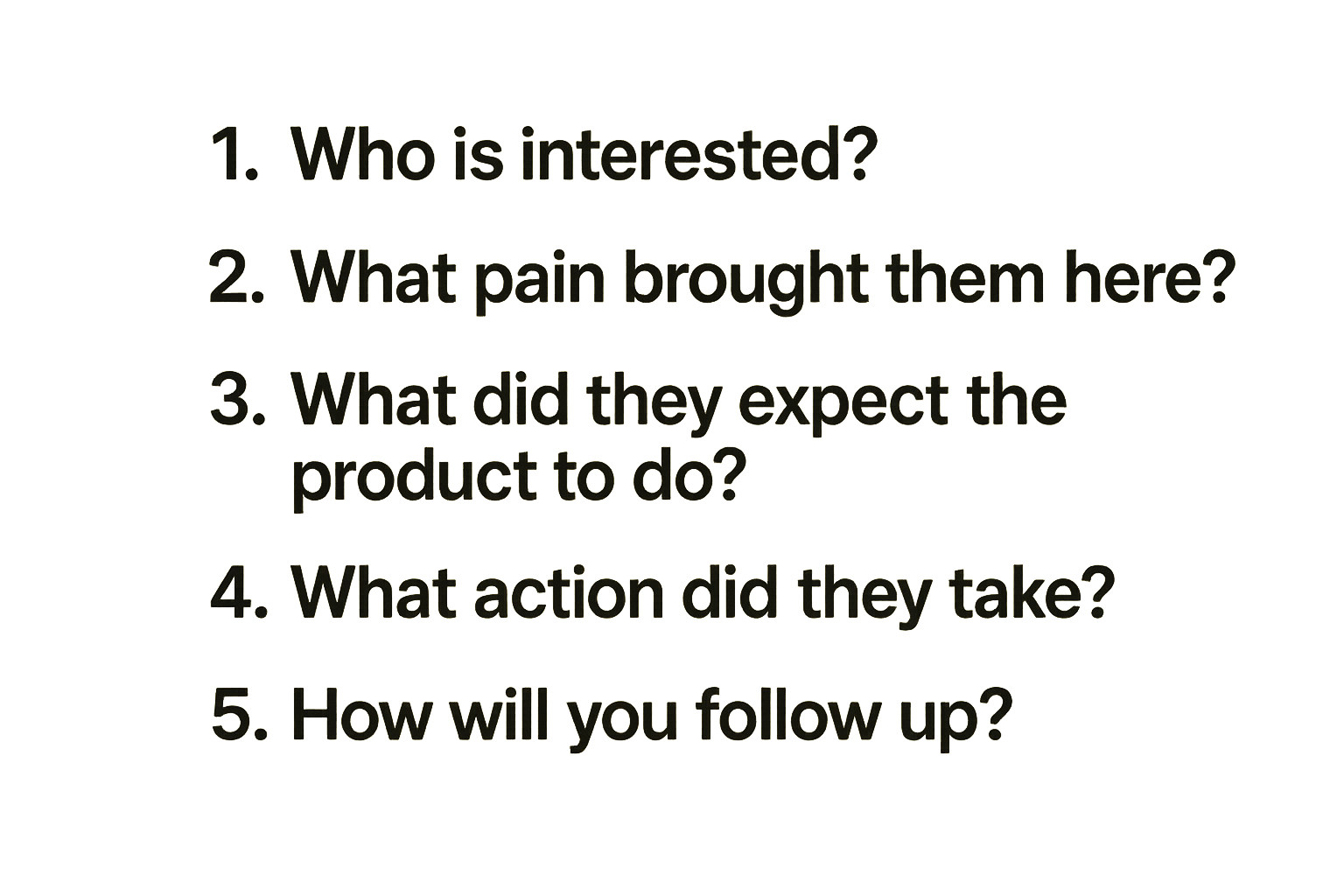
A pre-launch pipeline is how you turn curiosity into structured demand. It does not need to be complicated. It does need to exist before you announce.
The pipeline answers five questions:
- Who is interested?
- What pain brought them here?
- What did they expect the product to do?
- What action did they take?
- How will you follow up?
Capture intent before you ask for conversion
A full signup is not always the right first ask. Depending on the product, better pre-launch asks may include:
- Join the beta.
- Request early access.
- Upload a sample file.
- Book a 15-minute workflow review.
- Vote for the integration you need.
- Reply with your current workaround.
- Join a small pilot cohort.
The ask should match the user's trust level. A stranger who found you through a launch post may not be ready to pay. But they may be willing to describe their pain, try a demo, or join a waitlist for a specific use case.
Practical rule: ask for the smallest action that proves real intent, then earn the next action through product experience.
This is also where founders overbuild. You do not need a complex CRM on day one. A form, tagged email list, lightweight analytics, and disciplined notes can be enough. The failure mode is not simplicity. The failure mode is losing the signal.
Segment by pain, not by vanity source
Source tracking matters, but it is not segmentation. Knowing a visitor came from Product Hunt is less useful than knowing they are a freelance designer trying to invoice clients faster, or a SaaS founder trying to reduce churn calls.
Segment around jobs-to-be-done:
- User type: founder, PM, engineer, marketer, agency owner.
- Pain: time lost, revenue leakage, compliance risk, support load, manual work.
- Urgency: curious, evaluating, needs this now.
- Current workaround: spreadsheet, custom script, VA, competitor, internal tool.
- Conversion path: self-serve, demo, waitlist, paid pilot.
This makes follow-up specific. Instead of sending one generic thanks for joining email, you can say: you told us the hard part is turning customer calls into tickets; here is the workflow we built for that.
Ship a launch-ready product, not a perfect product
Launch-ready does not mean complete. It means coherent. A launch-ready product lets the target user experience the core promise without founder hand-holding at every step.
This is where many indie hackers hide behind perfection. They delay because settings, edge cases, and secondary features are not finished. Sometimes that is discipline. Often it is avoidance.
Minimum lovable workflow
A minimum lovable workflow is different from a minimum viable product. MVP asks whether something can work. Minimum lovable workflow asks whether the first useful path feels worth continuing.
For a launch, define one primary workflow:
- User understands the promise.
- User starts without confusion.
- User reaches a meaningful result.
- User sees why the result matters.
- User knows what to do next.
If that path works, you can launch with rough edges. If that path does not work, more features will not help.
Examples:
- A writing tool should produce one useful draft or edit.
- A finance tool should show one clear account insight.
- A developer tool should complete one integration path.
- A scheduling tool should successfully create one meeting workflow.
- A research tool should save one real investigation step.
The product does not need every advanced setting. It needs one complete story.
The support surface is part of the product
Support is not something you bolt on after launch. For early products, support is part of the user experience and the learning system.
Your support surface should include:
- A visible way to contact the founder or team.
- A known response window.
- A short FAQ for predictable confusion.
- A bug intake path with browser, device, and account context.
- A way to identify high-intent users.
- A simple escalation process for payment or data issues.
If your product touches payments, identity, or sensitive workflows, support and trust are even more important. Related reading from our network: crypto payment teams face a sharper version of this problem, where threat intelligence blockchain architecture connects risk signals, holds, webhooks, and merchant operations.
The broader lesson applies to indie products: if the user is blocked, confused, or worried, the support path becomes the product.
Run launch day like an operations workflow
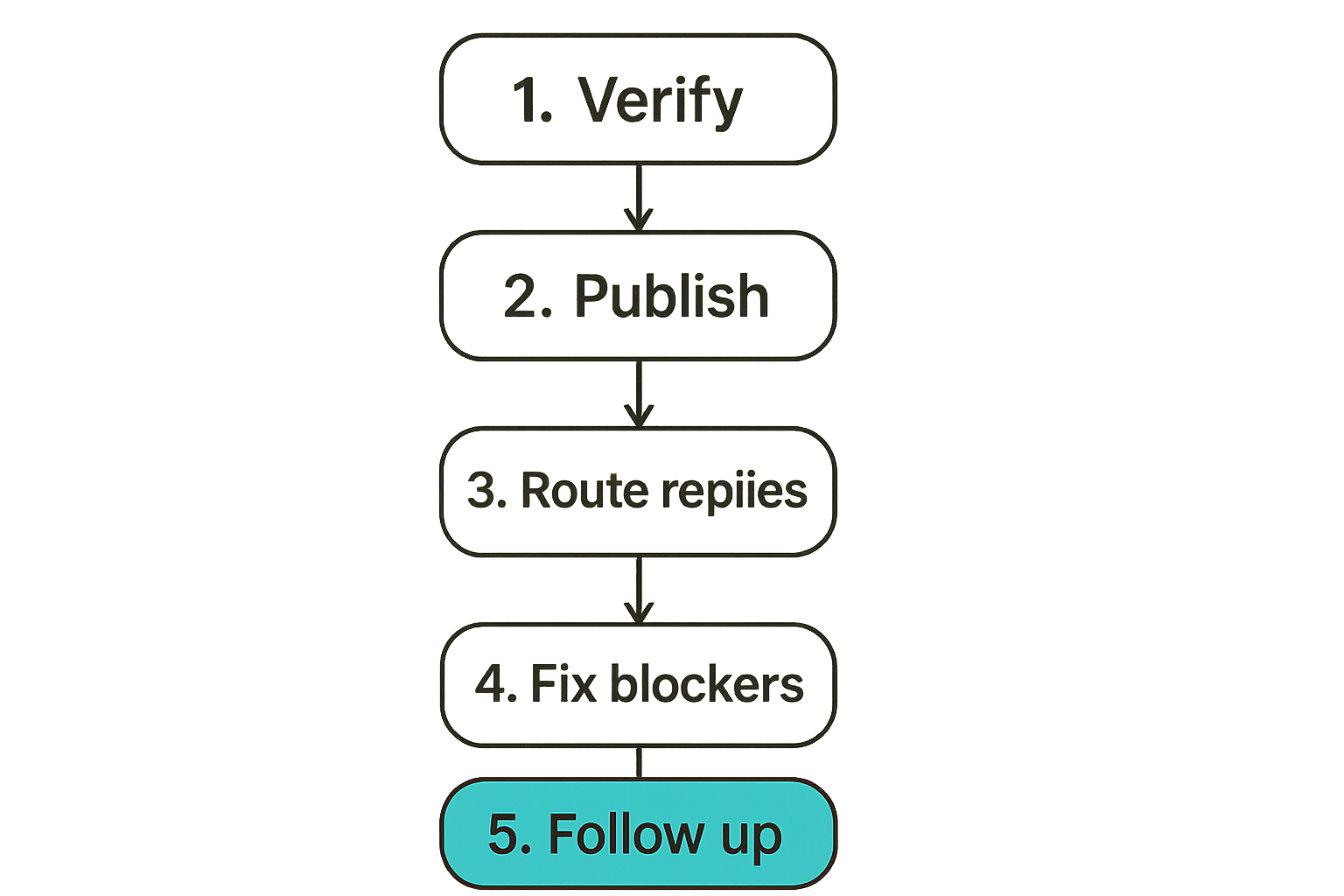
Launch day should not be improvised. You can still be human, responsive, and flexible. But the workflow should already be defined.
A simple launch-day sequence works better than an overdesigned plan:
- Verify the product path, analytics, payments, forms, and email delivery.
- Publish the launch post on the primary channel.
- Route replies into buckets: praise, confusion, bug, objection, opportunity.
- Fix critical blockers only; defer non-critical polish.
- Follow up with high-intent users while the context is fresh.
- Capture the post-launch decision log before memory decays.
The first hour is instrumentation
The first hour is not for celebrating. It is for checking whether the machine is working.
Watch:
- Landing page loads.
- Signup completion.
- Auth errors.
- Payment failures.
- Demo failures.
- Email confirmation delivery.
- Analytics events.
- Mobile rendering.
- Broken links.
- Support messages.
If something breaks, prioritize by user impact. A typo in the footer can wait. A broken OAuth redirect cannot.
What breaks in practice is often boring: missing environment variables, rate limits, failed email DNS, test payment keys left in production, empty states that were never tested, or a demo video that does not load under traffic.
Use responses to route work
Every launch reply is not equal. Treat replies as inputs into an operating system.
Use a simple routing model:
- Praise: thank, ask what resonated, invite sharing if natural.
- Confusion: clarify copy, update FAQ, improve onboarding.
- Bug: reproduce, tag severity, patch or acknowledge.
- Objection: identify missing proof, pricing issue, trust gap, or wrong audience.
- Feature request: map to user pain, not requested UI.
- High intent: start a direct conversation quickly.
This keeps you from treating the loudest comment as the highest priority. A clever feature request from an unqualified user should not outrank payment failure from someone trying to buy.
Practical rule: during launch, optimize for removing blockers in the core workflow, not satisfying every visible request.
Measure what changes behavior
A launch dashboard should be boring enough to use under pressure. If it requires interpretation theatre, you will ignore it when things get busy.
The goal is not to collect every metric. The goal is to know what changed behavior and what decision you should make next.
Metrics that matter for indie launches
Useful launch metrics include:
- Qualified visitors: not just total traffic, but relevant traffic.
- Landing page conversion: visitor to waitlist, signup, trial, or demo.
- Activation: user reaches the first meaningful result.
- Time to value: how long until the user gets the promised outcome.
- Reply quality: specific pain, objection, or use case.
- Retention signal: user returns, continues, invites, pays, or asks for more.
- Revenue signal: payment, pre-order, pilot, upgrade, or serious procurement motion.
Vanity metrics are not useless, but they are incomplete. Upvotes, impressions, likes, and comments can create reach. They do not prove product pull.
A simple scorecard might look like this:
| Metric | Good signal | Weak signal | Decision |
|---|---|---|---|
| Traffic | Relevant users arrive from chosen channel | Broad visitors bounce quickly | Refine channel or message |
| Conversion | Users take the intended next step | Visitors praise but do not act | Improve offer or path |
| Activation | Users complete core workflow | Users sign up and stall | Fix onboarding |
| Feedback | Specific pains repeat | Random feature requests dominate | Narrow audience |
| Revenue | Users pay or request pilot | Users say nice idea only | Rework urgency or pricing |
The post-launch decision table
After the launch, do not ask whether it was successful in the abstract. Ask what decision the launch enables.
| Launch outcome | Likely meaning | Next move |
|---|---|---|
| High traffic, low conversion | Message attracted curiosity but not intent | Tighten positioning and call to action |
| Low traffic, high conversion | Channel was small but audience fit was strong | Find more of that audience |
| High signup, low activation | Promise worked, product path failed | Fix onboarding and first result |
| Low signup, high reply quality | Trust or timing issue, but pain is real | Run conversations and pilots |
| High activation, low retention | First use works, habit or ongoing value is weak | Improve repeat use loop |
| Early revenue from few users | Strong signal in narrow segment | Focus on that segment before broadening |
This table prevents the common founder mistake of declaring failure too early. A small launch can be extremely valuable if it identifies the right user segment or exposes the exact onboarding break.
Common failure modes in indie hacker launches
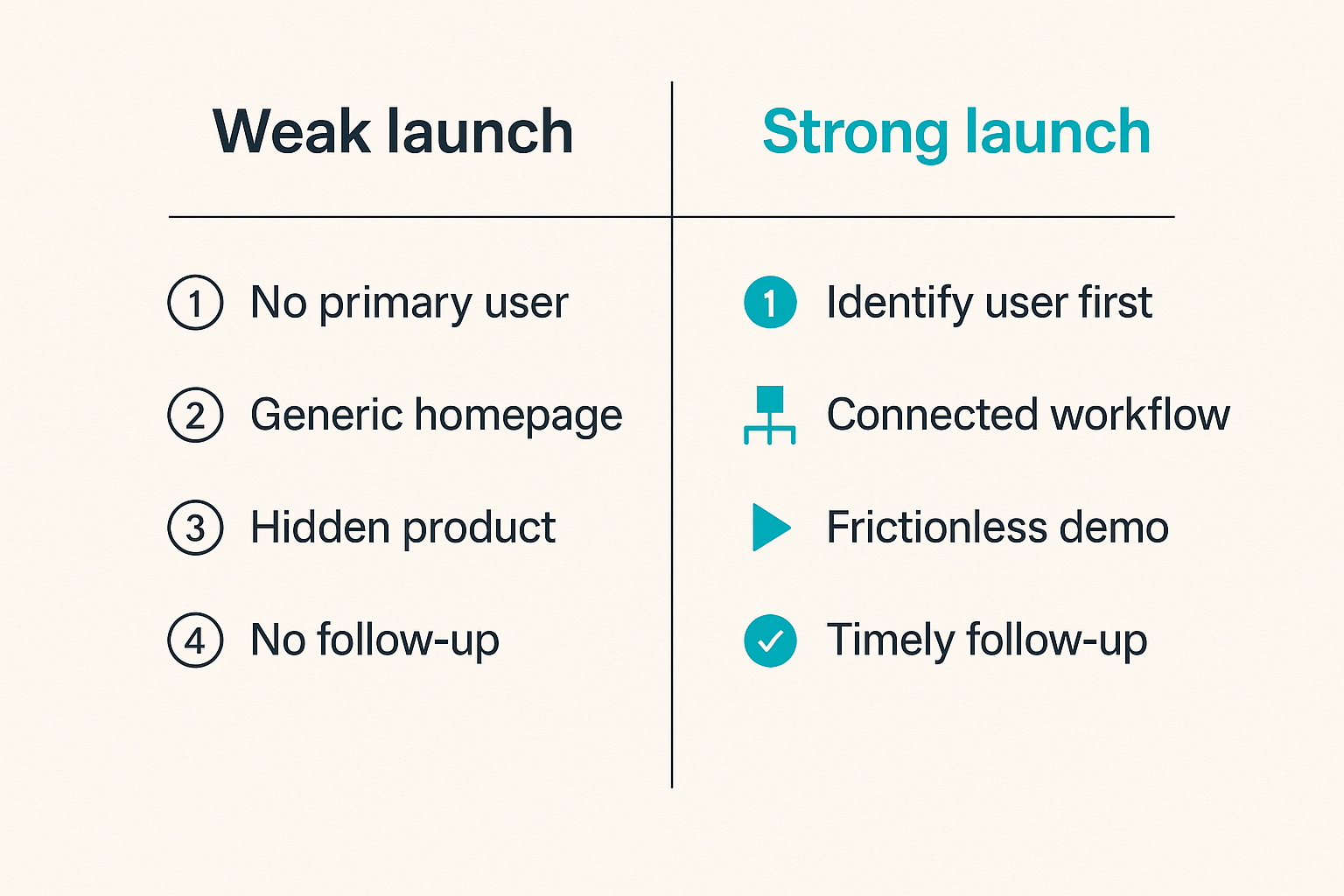
Most launch failures are not dramatic. They are small disconnects repeated across the system. The copy promises one thing, the product does another, the pricing page introduces doubt, and the founder follows up too late.
What fails
Common failure modes:
- Launching with no primary user.
- Writing copy for peers instead of buyers.
- Over-optimizing for Product Hunt rank.
- Sending all traffic to a generic homepage.
- Hiding the actual product behind too many steps.
- Treating waitlist count as demand.
- Ignoring onboarding analytics.
- Offering lifetime deals without understanding support cost.
- Responding defensively to criticism.
- Shipping too many launch-day changes without testing.
- Forgetting timezone coverage for support.
- Not following up after the announcement.
The mistake teams make is assuming the launch will reveal the market magically. It will not. It will reveal how well your current system handles the market.
Another failure mode is copying launches from products with different trust dynamics. A fun consumer tool can launch with a lightweight demo and playful copy. A B2B data product may need security answers, integrations, and proof. A founder selling to developers may need transparency about architecture. A founder selling to operators may need workflow screenshots and ROI clarity.
What works instead
What works is narrower and less glamorous:
- One clear target user.
- One painful job.
- One primary launch surface.
- One conversion path.
- One activation workflow.
- One support intake.
- One post-launch decision log.
This does not mean you only build one thing forever. It means you reduce launch ambiguity enough to learn.
A useful pre-launch review:
- Can a qualified visitor understand the product in ten seconds?
- Can they try or express intent in one obvious path?
- Can they reach value without a call, unless the product requires sales?
- Can you identify where they came from and what they did?
- Can they contact you if blocked?
- Can you follow up based on their use case?
- Can you decide what to change after the launch?
If the answer is no, postpone the public push or narrow it to a beta cohort.
The same architecture thinking applies in non-obvious categories. A niche or regulated launch can look like a marketing problem from the outside, but the shipping challenge is often the underlying operating model; sh1pt.com's prior article on peptide product launch architecture makes that point in a different market.
Turn launch traffic into a product loop
The launch is not finished when traffic drops. It is finished when the learning has been converted into product, positioning, and distribution changes.
This is where indie hackers can outperform larger teams. You can move faster, talk directly to users, and change the product without waiting for five internal meetings. But only if you keep the loop tight.
Onboarding should explain the job
Onboarding is not a tour of your interface. It is the bridge between the user's pain and the product's first useful outcome.
Bad onboarding says:
- Here are all the features.
- Complete your profile.
- Watch this long video.
- Invite your team before value is clear.
Better onboarding says:
- What are you trying to get done?
- Connect or enter the minimum context.
- Here is the first result.
- Here is how to improve it.
- Here is the next useful step.
For an indie hacker product launch, onboarding should also help you learn. Ask one or two questions that improve segmentation. Do not interrogate the user. Just collect enough context to route them properly.
Examples:
- What do you use today?
- What are you trying to replace?
- How often do you do this workflow?
- Are you using this solo or with a team?
- What would make this worth paying for?
Follow-up converts ambiguity into signal
Most users will not send perfect feedback unprompted. You need structured follow-up.
A useful follow-up sequence:
- Immediate: thanks, restate the promise, point to the first action.
- After first use: ask whether they reached the expected result.
- After inactivity: ask what blocked them.
- After success: ask what they would use it for next.
- After payment or high intent: offer a direct conversation.
Keep these messages short. The goal is not nurturing for its own sake. The goal is to identify friction, urgency, and language you can reuse.
Good follow-up often reveals that the user understood the value but did not trust the implementation, pricing, data handling, or long-term viability. That is not a copy tweak. That is a product trust issue.
Where sh1pt.com fits in your shipping system
sh1pt.com is for people building and launching software products who want practical shipping strategies, product development processes, and growth tactics. The editorial bias is simple: launching is an operating problem before it is a promotion problem.
For indie hackers, that matters because the cost of confusion is high. You do not have a large team to absorb messy processes. The system has to be lightweight enough to run alone and explicit enough to survive real users.
Use the launch as a repeatable operating model
Treat each launch as a versioned operating model:
- Launch 0.1: validate pain with conversations and a waitlist.
- Launch 0.2: test the first product workflow with a small cohort.
- Launch 0.3: publish to one public channel and measure activation.
- Launch 0.4: improve onboarding and follow-up.
- Launch 1.0: expand distribution once the loop works.
That changes the conversation. You are not asking whether one post made the company. You are asking whether each release improved the product-market learning system.
For a solo founder, this is the difference between random shipping and compounding shipping. Random shipping produces scattered posts and forgotten experiments. Compounding shipping produces reusable assets: positioning, demos, onboarding, support notes, user segments, proof, and channel knowledge.
The best indie hacker product launch is not the loudest one. It is the one that leaves you with more users, sharper positioning, clearer product priorities, and a stronger next launch.
Try sh1pt.com
sh1pt.com helps people building and launching software products understand shipping strategies, product development processes, and growth tactics. If you are planning an indie hacker product launch, use it to think through the system before you post.