
You've spent three months building. The product works. You post to Product Hunt at 8am, blast your email list, and... silence. A handful of upvotes, a few trial signups who never convert, and a Slack channel that's suspiciously quiet. Two weeks later you're back to building, telling yourself the timing was off or the market isn't ready.
The problem wasn't timing. The problem was that what you called a "launch strategy" was actually a loose collection of one-day tactics with no underlying system. Teams think the problem is marketing reach. The real problem is that they've built a product but not a launch architecture — the set of states, triggers, feedback loops, and decision rules that turn a release into a business.
This happens at every stage. First-time indie hackers ship a side project with a Product Hunt post and a tweet thread. Series A teams run a "big bang" launch without a feedback pipeline. The surface area of the mistake changes; the underlying shape stays the same.
This post is about reframing your product launch strategy as an architecture and workflow decision — not a marketing execution problem. If you get the architecture right, the tactics largely sort themselves out.
Table of contents
- Why most launch strategies are just tactics in a trench coat
- Define your launch model before you write a single tweet
- The state machine underneath every product launch
- Pre-launch infrastructure that most teams skip
- Positioning and the ICP problem
- Distribution channels as architecture decisions
- The launch sequence: a practical workflow
- Common failure modes and what breaks
- What works vs. what fails: a comparison
- Metrics that matter for a product launch strategy
- The ongoing launch model: shipping as a system
- Where sh1pt.com fits in this architecture
Why most launch strategies are just tactics in a trench coat
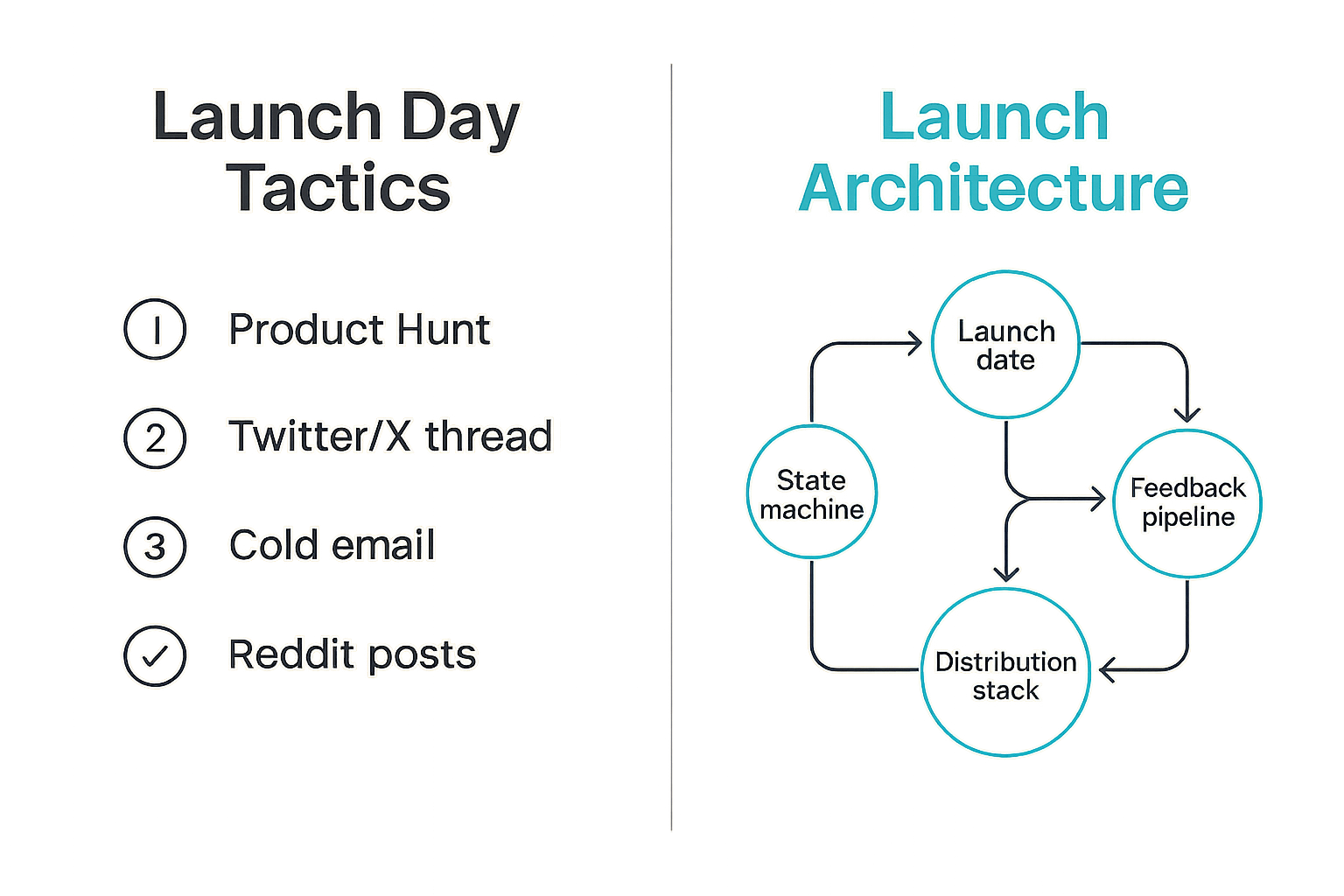
Ask a founder what their launch strategy is and you'll get a list: Product Hunt, Twitter/X thread, cold email to a list of journalists, a few Reddit posts, maybe a LinkedIn post if they're feeling bold. That's not a strategy. That's a to-do list for a single afternoon.
A real product launch strategy for startups is a system — one that runs before, during, and after a public release date, with defined inputs, defined states, and defined decision points. The launch date is just one event inside that system, not the system itself.
The one-day launch fallacy
The one-day launch fallacy goes like this: if you get the launch day right, the product takes off. Get enough upvotes, enough shares, enough press pickups, and you've "made it." The reality is that most successful products didn't blow up on day one. They built compounding distribution over weeks and months by having a system that kept pulling users in, activating them, and learning from the ones who churned.
The mistake teams make is optimizing for a spike instead of a slope. A spike on Product Hunt is a vanity win if there's no activation flow on the other side. The traffic arrives, bounces because onboarding is broken or the value proposition is unclear, and the moment evaporates.
What a launch architecture actually contains
A launch architecture has roughly six components:
- A clear launch model — what kind of release this is (soft launch, beta, public, press-led, community-led)
- A user state machine — defined stages from awareness to activation to retention, with explicit transition logic
- A distribution stack — owned, earned, and paid channels, each with an explicit role
- A feedback pipeline — structured collection of signal from early users, feeding back into product and positioning
- An instrumentation layer — the events you're measuring and the decisions they unlock
- A post-launch iteration plan — what you do in the 30 days after, not just on the day
Most teams have 1 and 3, partially. They skip 2, 4, 5, and 6 entirely, then wonder why nothing stuck.
Define your launch model before you write a single tweet
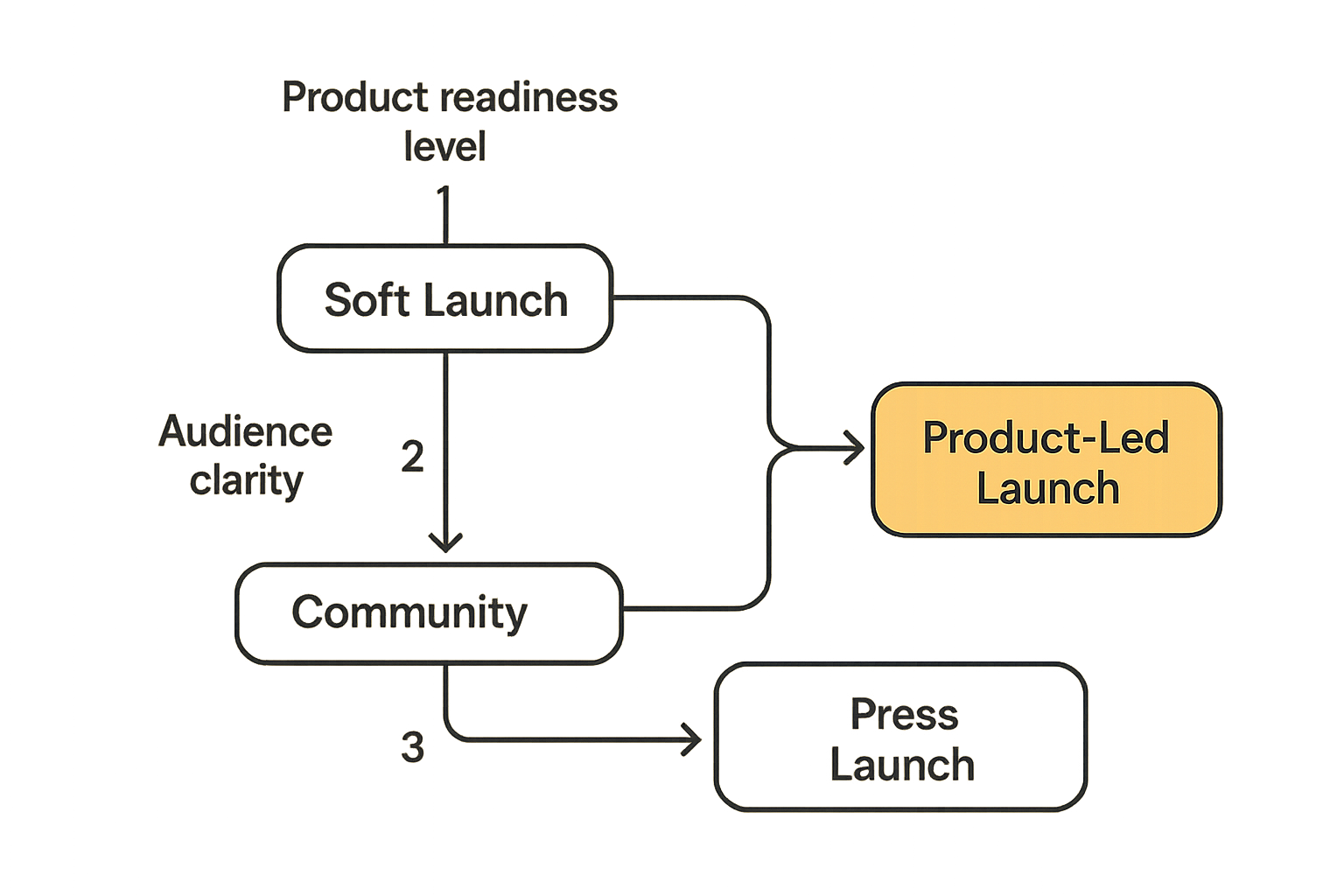
The practical question is: what kind of launch is this? Not every product release is the same event, and the mistake of conflating them leads to misaligned expectations and wrong tactics.
The four launch model archetypes
1. The soft launch (learning launch) You open access to a small, hand-picked cohort. Goal: learn, not grow. Measure activation rates, support volume, and feature confusion. No press, minimal social noise. This is the right model when your product is genuinely early.
2. The community launch You go deep in one specific community — an IndieHackers thread, a Slack group, a subreddit, a niche Discord. Goal: get signal from the exact audience you're building for, build early advocates. Requires genuine participation, not drop-and-run.
3. The press/influencer launch You coordinate with journalists, newsletters, and creators to get coverage on a specific date. Goal: wide awareness spike. This only works if your product can handle sudden load, your onboarding converts, and the product is genuinely interesting to their audience.
4. The product-led launch You ship a free tier, a freemium model, or a viral mechanic that makes the product itself the distribution. Think tools with shareable outputs, embeds that carry your brand, or referral loops baked into the core flow. Goal: build compounding acquisition without paid spend.
Matching the model to your product stage
Practical rule: If you can't articulate your retention mechanism before launch day, you're not ready for a press launch. Run a community launch first.
The right model isn't about ambition — it's about honest stage assessment. A pre-revenue product with no activation data should not do a press launch. The traffic will arrive to a broken experience, and you'll have burned the press opportunity on a bad first impression.
Match the launch model to where you actually are, not where you want to be.
The state machine underneath every product launch
A useful way to think about a product launch is as a state machine. Users enter the system in an initial state (unaware, or aware-but-not-signed-up) and need to move through defined states toward the outcome you want (activated, retained, paying, referring). Your launch architecture's job is to design and maintain those transitions.
Mapping your user states
For most B2B SaaS or developer tools, the states look something like:
- Unaware → triggered by a tweet, article, or Product Hunt listing
- Aware → lands on homepage, reads positioning
- Curious → signs up for waitlist or free trial
- Onboarding → goes through activation flow
- Activated → hits the aha moment; has extracted real value
- Retained → returns without being nudged
- Advocate → refers others or creates UGC
The launch day primarily moves people from Unaware to Aware to Curious. Everything after that is product and onboarding work, not marketing work. Teams that treat the launch as a marketing problem skip the product work that makes the marketing matter.
This is the same principle that underlies good software architecture more broadly — as covered in writing about inventory management software as an architecture decision, the system's state and the transitions between states are more important than any individual feature.
Why state transitions break in practice
What breaks in practice is the Aware → Activated transition. A user lands on your site, is genuinely interested, signs up — and then hits an onboarding flow that's either too long, unclear, or doesn't deliver value fast enough. They churn before reaching the aha moment. Your launch metrics look fine (signups are up) but your product metrics look terrible (no one is coming back).
Practical rule: Measure time-to-first-value, not just signup count. If time-to-first-value is above 5 minutes, fix that before you spend a dollar on acquisition.
The other common break is between Activated and Retained. A user gets value once, but there's no hook that brings them back — no email sequence, no habit trigger, no sticky workflow. They leave happy and never return. That's an architecture failure, not a marketing failure.
Pre-launch infrastructure that most teams skip
Pre-launch work is where most of the real leverage is. The 30 days before your public launch date should be more work-intensive than launch day itself.
The waitlist is not just a list
Most founders treat the waitlist as a holding pen. People sign up, get a "thanks, we'll let you know" email, and then wait. A well-designed waitlist is actually a qualification and activation tool.
Useful waitlist mechanics:
- Segmentation question at signup — one question that tells you which use case brought them there. This immediately segments your list for personalized outreach.
- Referral mechanic — a simple "move up the queue" or "get early access" incentive that turns waitlist members into distributors before you've even launched.
- Drip sequence — 3–5 emails during the wait period that educate users on the problem you're solving, so they arrive at the product already bought-in on the category.
- Manual outreach to the first 50 — personal emails to your first 50 signups asking one question: what made you sign up? The qualitative signal here is irreplaceable.
The waitlist architecture mirrors a broader principle we explored in the peptide product launch architecture problem — the pre-launch system often determines whether the launch itself sticks.
Instrumentation before acquisition
Before you run any acquisition, you need instrumentation. Specifically:
- Signup funnel tracked — every step from landing page to signed-up state, with dropoff rates visible
- Activation event defined — what specific action constitutes "activated"? Not a guess; a defined event in your analytics
- First-session depth tracked — how far do users get in session one? Where do they bounce?
- Email open/click rates on onboarding sequence — if your onboarding emails aren't opening, users are not coming back
Instrumentation before acquisition means you won't be flying blind during the launch spike. When traffic arrives, you'll know within hours whether the onboarding is converting or collapsing.
Positioning and the ICP problem
Positioning is the most under-invested part of a product launch strategy for startups. It's treated as a copywriting task when it's actually a targeting decision.
Writing positioning that survives contact with real users
The mistake teams make is writing positioning for the product they've built rather than the problem their ICP already knows they have. Positioning that starts with "we built a tool that does X" is product-first. Positioning that starts with "if you're struggling with Y, here's what changes" is problem-first. Problem-first positioning converts.
A useful framework:
- Name the known pain in the first line (not the solution)
- Name who it's for, specifically (not "teams" or "businesses")
- Name what changes for them after they use it (the outcome, not the feature)
- Handle the obvious objection in the subheading ("unlike {alternative}, we...")
The single-sentence test
Practical rule: If you can't explain your product in one sentence that someone in your ICP would text to a colleague, your positioning isn't ready.
The test is social transmission. Positioning that converts is positioning that spreads. If you can't summarize it in a sentence a user would naturally share, you're making their job of spreading the word harder. Run the sentence by 5 people in your target audience before finalizing it — not 5 founders, 5 actual ICP members.
Teams in adjacent spaces — like organizers building peer networks, where community definition shapes the whole product strategy (related reading from our network: what it actually means to build a community that works) — face the same positioning problem: you're not just describing features, you're naming an identity your users want to adopt.
Distribution channels as architecture decisions
Choosing distribution channels is not a tactics conversation. It's an architecture decision with long-term compounding effects. The channels you build first become structural advantages or structural liabilities.
Owned vs. rented channels
| Channel type | Examples | Control | Cost at scale | Compounding? |
|---|---|---|---|---|
| Owned | Email list, blog, podcast | High | Low | Yes |
| Earned | Press, SEO, UGC | Medium | Low | Yes |
| Rented | Twitter, Reddit, Product Hunt, LinkedIn | Low | Medium | No |
| Paid | Ads, sponsorships | High | High | No |
The mistake teams make is over-investing in rented channels during launch and then having nothing to show for it six months later. A tweet spike is not a distribution asset. An email list of 3,000 activated users is.
For a product launch strategy at a startup, the rule of thumb is: use rented channels to feed owned channels. Run the Product Hunt launch to build your email list, not to live or die by the day-one upvote count.
Community as infrastructure
Building a community around your product is one of the highest-leverage distribution decisions you can make — but only if you treat it as infrastructure, not a marketing campaign. A community that's alive before you launch means you have an audience that already cares, already trusts you, and already talks to each other. That's a structural advantage that no ad budget replicates.
Note that this requires genuine participation and value creation in the community long before you mention your product. Drop-and-run community "launches" backfire; they read as spam and damage the relationship with the exact audience you need.
The launch sequence: a practical workflow
Phase 1: Foundation
(T-minus 8 to 4 weeks)
- Lock the launch model (which archetype fits your stage?)
- Define user states and activation event
- Instrument the signup and onboarding funnel
- Write and test the positioning (single-sentence test with 5 ICP members)
- Build the waitlist with segmentation question and referral mechanic
- Draft the 5-email drip sequence for waitlist members
Phase 2: Pre-launch activation
(T-minus 4 to 1 weeks)
- Open early access to your first cohort of 20–50 users
- Run personal onboarding calls with the first 10 (yes, manual)
- Measure time-to-first-value; iterate if above 5 minutes
- Collect qualitative feedback via a 3-question in-app prompt
- Identify your most enthusiastic early users — these are your launch amplifiers
- Prepare your distribution assets: tweet thread, Product Hunt listing, email blast, community post
Phase 3: Launch day operations
(T-minus 0 to T+24 hours)
- Post at the right time for your primary channel (9am ET for Product Hunt, peak hours for your community)
- Activate your launch amplifiers simultaneously — DM them with a direct link and ask for support
- Monitor the signup funnel in real time; if conversion drops below threshold, check for breaks immediately
- Respond to every comment, question, and DM during the first 12 hours
- Track activation rate, not just signup count
- Send a personal thank-you email to every signup in the first 24 hours
Phase 4: Post-launch feedback loop
(T+1 to T+30 days)
- Tag and segment signups by source and use case
- Run a 15-minute call with at least 5 users in the first two weeks
- Identify the aha moment: which feature or flow correlates with users who retained?
- Instrument that moment as your new activation metric
- Ship one meaningful improvement based on launch week feedback before day 14
- Publish a "what we learned" post — this generates earned distribution and signals iteration velocity
Common failure modes and what breaks
Acquisition without retention infrastructure
This is the most common failure mode. Teams spend all their pre-launch energy on getting traffic and none on what happens after signup. The launch spike arrives, the onboarding breaks under load (literally or figuratively), and the acquired users churn before experiencing value.
What breaks: activation rate craters. Support volume spikes. The founder spends launch week answering the same three questions over and over instead of watching the funnel convert.
The fix is obvious in retrospect: instrument and repair the activation flow during the pre-launch cohort phase, not during the spike.
Skipping the feedback pipeline
Teams that don't build a feedback pipeline during launch are flying blind. They don't know why users churned, don't know which use cases are resonating, and can't distinguish between "the product is broken" and "the positioning is wrong."
In practice, skipping the feedback pipeline means you run the same broken launch six months later with a slightly different set of tactics and get the same result.
Minimum viable feedback pipeline: one in-app prompt asking "what brought you here?", a 3-question email survey to churned users, and five user calls in the first two weeks. That's it. Not complicated, just consistently skipped.
Launching to everyone, converting no one
Broad positioning attracts a broad, unqualified audience. Unqualified traffic has low activation rates because the product isn't solving their specific problem. Teams see the traffic and feel good; they look at the activation rate and get confused.
Narrowing your ICP for the launch — even if your product can theoretically serve many segments — dramatically improves activation rates. Launch to the segment where the problem is sharpest and your solution is most precise. Broaden later from a position of proven traction.
What works vs. what fails: a comparison
| Dimension | What works | What fails |
|---|---|---|
| Launch scope | Narrow ICP, deep problem fit | "For everyone" positioning |
| Pre-launch | Manual user calls, instrumented funnel | Wait until launch day to see what happens |
| Distribution mix | Owned channel first, rented to feed it | All-in on rented channels |
| Feedback | Structured pipeline from day one | Ad hoc Slack messages from friends |
| Post-launch | Ship improvement in 14 days | Return to building in isolation |
| Success metric | Activation rate, D7 retention | Total signups, upvote count |
| Launch model | Matches actual product stage | Press launch for a pre-product MVP |
| Positioning | Problem-first, single-sentence shareable | Feature-list homepage hero |
Metrics that matter for a product launch strategy
Vanity metrics vs. signal metrics
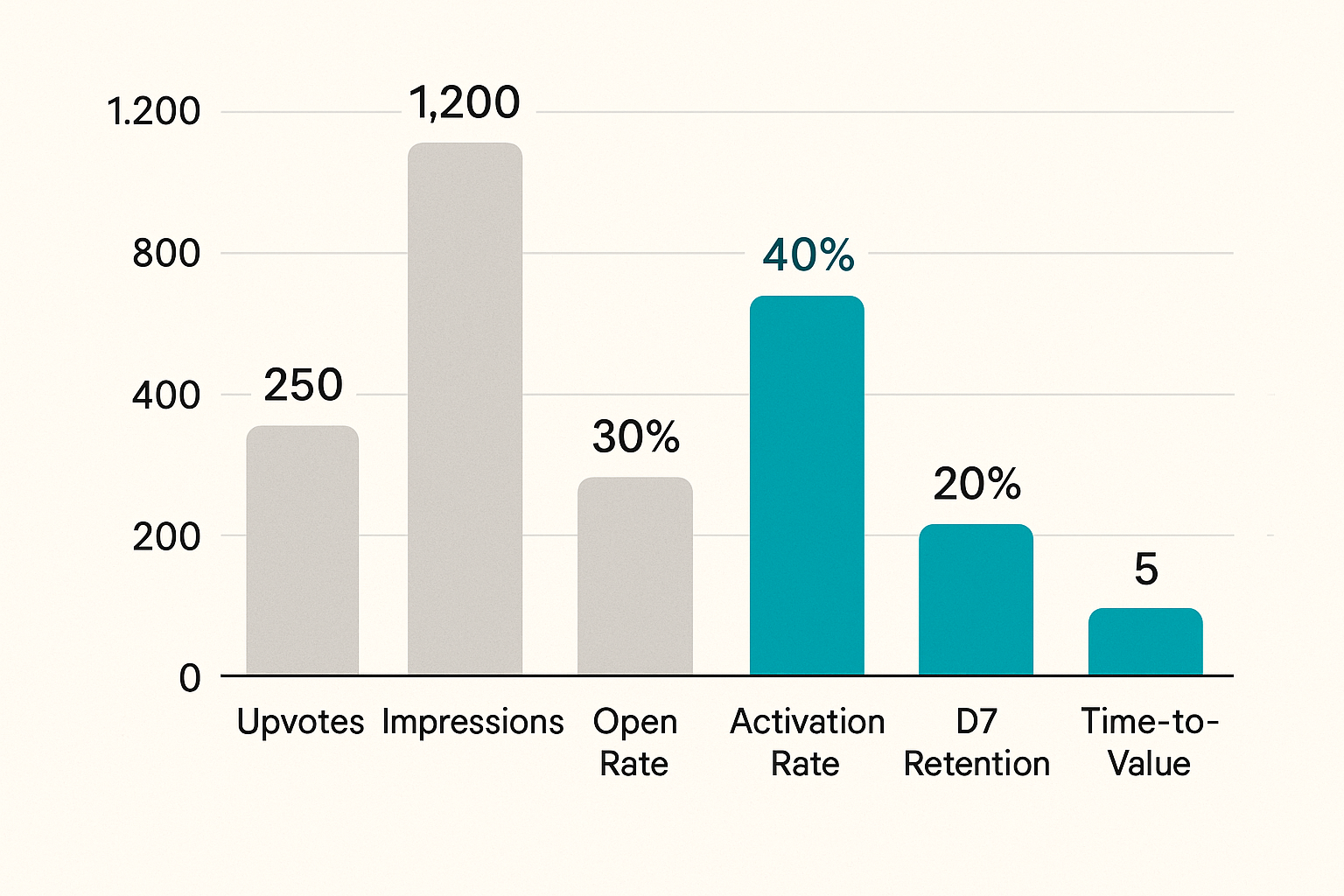
Product Hunt upvotes, Twitter impressions, and email open rates are vanity metrics in the context of a launch strategy. They feel good and they're easy to measure. They tell you almost nothing about whether the launch worked.
Signal metrics for a startup launch:
- Activation rate — what % of signups hit your defined activation event within 7 days?
- Time-to-first-value — median time from signup to activation event
- D7 retention — what % of users from launch week are still using the product 7 days later?
- Qualitative signal density — how many users gave you unsolicited feedback in the first 48 hours? (A proxy for intensity of resonance)
- Referral rate — what % of signups mentioned how they found you when asked? (Tracks organic spread)
- Support contact rate — what % of users contacted support? (Above ~10% signals onboarding friction)
Setting honest launch targets
Before you launch, write down specific numbers: "We expect X signups, Y% activation rate, Z% D7 retention." Then actually measure them. Most teams set no targets and therefore can't tell whether the launch worked. Honest targets force honest post-mortems.
For early-stage products in production, realistic benchmarks are roughly: 20–30% activation rate (of signups who complete the core flow), 30–40% D7 retention for users who activated. These are hard to hit and worth targeting.
Discoverability increasingly runs through AI-driven channels, and building content that gets cited matters more each quarter — related reading from our network: how specialized content gets cited (or ignored) by AI answer engines is a useful lens for teams thinking about earned distribution beyond traditional SEO.
The ongoing launch model: shipping as a system
Treating every release as a mini-launch
The mindset shift that separates high-velocity shipping teams from everyone else is treating every meaningful release as a mini-launch, not just the initial public launch. Every new feature, every significant fix, every tier addition is an opportunity to re-engage existing users, attract new ones, and reinforce the narrative around your product.
This doesn't mean posting to Product Hunt every two weeks. It means: write the changelog post with real context (not "bug fixes and performance improvements"), email your list with the one thing that changed and why it matters, and engage the users who requested that feature personally.
For teams thinking about how content discoverability connects to answer engines and structured distribution, the same underlying principle applies — related reading from our network: answer engine optimization for crypto payment infrastructure illustrates how structured, findable content compounds over time, a parallel worth noting for SaaS launch content strategies.
Building a launch muscle
Launch muscle is the organizational capacity to ship publicly, learn fast, and iterate. It doesn't come from a playbook — it comes from repetition. Teams that ship and launch frequently get better at all of it: the positioning, the timing, the feedback loops, the instrumentation. Teams that treat every launch as a one-time event stay permanently anxious about it.
A useful way to think about it is: the first launch teaches you almost nothing about your product, but a lot about your system. The third launch reveals your actual distribution leverage. The tenth launch is where compounding begins.
Practical rule: Run a written post-mortem within 7 days of every launch. One page. What you targeted, what happened, what you're changing. Without this, you're not building launch muscle — you're just repeating the same experiment.
This also applies to how you think about HR management software as a product decision — the same systems-thinking discipline that makes your people operations intentional is what makes your product launches repeatable. Workflow decisions compound; ad hoc decisions don't.
Where sh1pt.com fits in this architecture
Building this launch architecture from scratch — state machines, feedback pipelines, instrumentation, positioning frameworks — is genuinely hard, and most founders are doing it alone while also building the product. The articles, ship-it stories, and platform deep-dives on sh1pt.com are written for exactly this context: founders and PMs who need to move fast but want to make the right structural decisions, not just the most obvious tactical ones.
A product launch strategy for startups isn't a checklist you execute once. It's a system you build, test, and improve across every release. The teams that understand this ship more, learn faster, and compound their distribution in ways that eventually look like "luck" from the outside.
The practical work is building the system before you need it — before launch day, before the spike, before the post-mortem where you realize what you didn't instrument.
Try sh1pt.com
sh1pt.com is built for founders, PMs, and indie hackers who want to ship better products and launch smarter. Platform deep-dives, ship-it stories, and real-world launch architecture — practical and operator-focused.