
Product differentiation gets treated like a naming exercise too often. A founder ships a product, opens a positioning doc, and tries to find a sharper phrase for why it is different.
That usually fails because the market does not buy phrases. Buyers compare workflows, risk, switching cost, trust, support, and the shape of the outcome. If the only difference is the words on the landing page, the product will be compared on price, speed, or brand awareness.
Teams think the problem is standing out. The real problem is giving a specific buyer a rational reason to switch, stay, and tell someone else why your product is the obvious choice.
That changes the conversation. Product differentiation is not a marketing layer added after the roadmap. It is an architecture problem across product decisions, launch strategy, onboarding, pricing, support, and proof. The practical question is not what sounds unique. It is where the product behaves differently in a way the customer can feel.
Table of contents
- Product differentiation is an operating system, not a tagline
- Start with the buyers switching math
- Choose a differentiation lane before you build
- Build proof into the product differentiation loop
- What works when the market looks crowded
- What fails in product differentiation
- Turn differentiation into a shipping workflow
- Pricing, onboarding, and retention are differentiation surfaces
- Launch product differentiation through your go-to-market system
- Product differentiation metrics that operators can use
- How sh1pt.com thinks about product differentiation
Product differentiation is an operating system, not a tagline

Most product differentiation work starts too late. The team has already built the thing, chosen the features, created the pricing, and recorded the demo. Then someone asks what makes it different.
That sequence creates weak positioning because every meaningful decision has already been made. You are left describing the product instead of designing contrast into it.
A useful way to think about it is this: differentiation is the set of decisions that make your product meaningfully non-interchangeable for a specific buyer in a specific situation.
Why feature lists collapse
Feature-based differentiation decays quickly. If your wedge is only a dashboard, integration, AI summary, template library, or faster editor, competitors can copy the visible layer. Bigger teams can copy it with distribution. Smaller teams can copy it with focus.
The mistake teams make is confusing implementation effort with market contrast. A feature may be hard to build and still not matter to the buyer. Another feature may be simple but deeply valuable because it removes a recurring operational pain.
Feature lists also make customers do the translation work. They have to infer which feature maps to their workflow, which workflow maps to their cost, and which cost justifies switching. Most buyers will not do that work unless the pain is already severe.
Practical rule: If your differentiation requires the buyer to study a feature matrix for ten minutes, it is probably not differentiation yet. It is raw material.
Where differentiation actually lives
Real differentiation usually lives in one of five places:
- The workflow you make easier, safer, or faster.
- The audience you serve with unusual specificity.
- The trust boundary you handle better than alternatives.
- The business model or pricing logic that aligns with the customer outcome.
- The operational system around the product, including onboarding, support, education, and migration.
For example, two products can both offer task management. One is differentiated because it supports compliance-heavy approval flows. Another is differentiated because it is built for solo creators who need a daily shipping ritual. The feature category is the same. The operating model is different.
Related reading from our network: teams making software workflow choices face similar sequencing issues in Asana project management software workflow architecture, where the board matters less than the process it represents.
Start with the buyers switching math
Product differentiation starts with the buyer's current reality. Not your roadmap. Not your competitor spreadsheet. Not the clever phrase you want to own.
The buyer already has a system. It may be a spreadsheet, a hacked-together set of tools, an agency, a junior employee, a marketplace, a manual process, or doing nothing. Your product has to beat that system after switching cost, risk, learning curve, internal politics, and budget are included.
Map the current workaround
Before you decide what to build, map the workaround in plain operational language:
- What triggers the need?
- Who notices the problem?
- What tool, person, or process handles it today?
- Where does the workaround create delay, error, embarrassment, or cost?
- What would make the buyer trust a new approach?
For indie hackers and solopreneurs, this is especially important because you do not have the budget to educate a market from zero. You need to find places where people already spend time, money, or attention trying to solve the problem.
A product for customer interview analysis is not competing only with other interview tools. It competes with Notion tables, Google Docs, founder memory, Slack threads, and the decision to ignore research altogether.
Find the cost of staying put
Switching happens when the cost of staying put becomes clearer than the cost of moving. Your differentiation has to make that cost visible.
Common costs include:
- Time lost to repeated manual work.
- Mistakes caused by context switching.
- Revenue lost because follow-up is slow.
- Team confusion from unclear ownership.
- Customer churn caused by poor handoffs.
- Opportunity cost from not launching faster.
The practical question is: which cost do you make impossible to ignore?
If your landing page says everything is easier, the buyer hears nothing. If it says your product cuts the weekly founder reporting workflow from scattered notes to one reviewed update, the buyer can evaluate the claim.
Practical rule: Do not position against competitors first. Position against the customer's current workaround. Competitors become relevant after the buyer admits the workaround is broken.
Choose a differentiation lane before you build
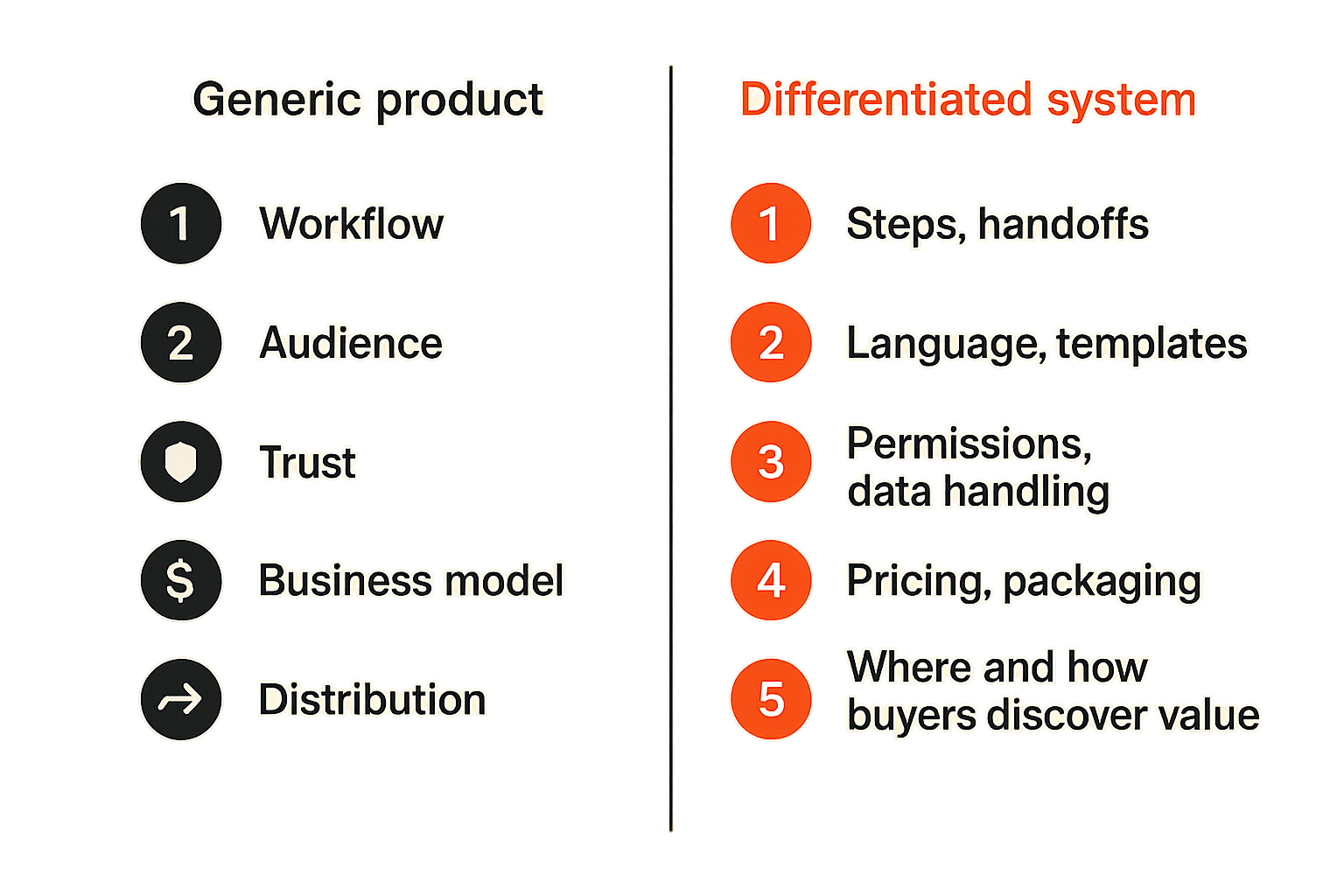
You do not need to be different in every dimension. In fact, trying to be different everywhere usually creates a confusing product.
Pick a lane. Then let that lane constrain roadmap decisions.
| Differentiation lane | What it changes | Good fit | Common failure |
|---|---|---|---|
| Workflow | Steps, handoffs, speed, defaults | Operational products, B2B tools, creator utilities | Building features without removing work |
| Audience | Language, templates, integrations, support | Vertical SaaS, niche tools, founder-led products | Persona theater without product specificity |
| Trust | Permissions, data handling, reliability, review | Security, finance, health, team systems | Vague claims without visible controls |
| Business model | Pricing, packaging, contract shape | Tools with measurable outcomes | Cheap pricing that attracts bad-fit users |
| Distribution | Where and how buyers discover value | Community-led, content-led, partner-led products | Channel hacks disconnected from product use |
Workflow differentiation
Workflow differentiation means your product changes how work gets done, not just where it gets displayed.
This is often the strongest lane for small teams because it does not require a massive brand. You can win by understanding a painful sequence better than broad competitors do.
A useful workflow differentiation statement looks like this:
- Before: user exports data, cleans it manually, sends it to a teammate, waits for approval, then updates the customer.
- After: user reviews exceptions, approves the recommended action, and the product updates the customer with an audit trail.
That is not a slogan. It is a product architecture.
Audience differentiation
Audience differentiation is not choosing a broad persona like marketers, founders, or developers. It is designing for a group whose constraints force different product decisions.
Examples:
- Not project management for teams, but launch planning for solo technical founders.
- Not analytics for SaaS, but activation tracking for template marketplaces.
- Not CRM for everyone, but follow-up workflows for high-ticket design studios.
Audience specificity should show up in default fields, sample data, integrations, onboarding questions, empty states, templates, and support docs. If it only appears in the headline, it is not real yet.
Trust differentiation
Trust differentiation matters when the buyer is worried about risk: data, money, team permissions, public reputation, legal exposure, or operational failure.
For software teams, trust is not just a security page. It is how the product behaves when something goes wrong. Can users see what happened? Can they reverse a change? Can they assign ownership? Can they export data? Can they understand permissions?
Related reading from our network: the same operating-system mindset appears in CI/CD supply-chain defense, where trust comes from controls, visibility, and response workflows rather than vague safety language.
Build proof into the product differentiation loop
Product differentiation has to be proven inside the product and around the product. Otherwise, it remains a claim.
Many teams treat proof as a later-stage marketing asset: testimonials, case studies, logos, review quotes. Those help, but they are not the foundation. The foundation is whether the product creates a repeated moment where the buyer can say: this is why we chose it.
Convert claims into observable behavior
Take every differentiation claim and convert it into something observable.
| Claim | Observable proof |
|---|---|
| Faster setup | Time from signup to first completed job |
| Built for agencies | Client workspace, approval flow, reusable templates |
| Safer collaboration | Permissions, activity log, rollback, review step |
| Better insights | Decision made from the insight, not chart views |
| Less manual work | Number of steps removed from the old process |
This forces better product decisions. If you cannot observe the claim, you probably cannot improve it.
Instrument the moment of contrast
Every differentiated product should have at least one contrast moment: the point where the user experiences the difference.
Examples:
- The first time a founder turns scattered launch notes into a concrete shipping plan.
- The first time a product manager sees customer feedback grouped by roadmap risk.
- The first time a solo creator publishes a product update without rebuilding the same checklist.
- The first time a team avoids a coordination mistake because ownership is explicit.
Instrument that moment. Track whether users reach it, how long it takes, what they do next, and what support questions appear around it.
Practical rule: Your core activation event should be tied to your differentiation, not just generic account setup.
What works when the market looks crowded
Crowded markets are not automatically bad. They usually mean buyers already understand the category and already spend attention there.
What breaks in practice is entering a crowded category with a generic product and hoping better design or founder energy will carry the launch. Better design helps. It is rarely enough by itself.
Narrow the job, not just the persona
A narrow job is more useful than a narrow demographic.
Weak: a tool for startup founders.
Stronger: a tool for founders preparing a public beta launch who need to coordinate product updates, waitlist messaging, and feedback triage in one week.
The second version creates product decisions. It tells you what the user is doing, when they are doing it, what pressure they feel, and what outcome matters.
For builders studying the market, product examples are useful only when they become inputs to decisions. A practical way to do that is covered in Product Examples Are Not Inspiration, which treats examples as a system for roadmap, UX, and launch choices rather than mood-board material.
Package the tradeoff
Strong differentiation usually involves a tradeoff. You are choosing to be better for someone by being less ideal for someone else.
That tradeoff should be visible.
Examples:
- Fewer integrations, but deeper support for one workflow.
- Less customization, but faster setup and stronger defaults.
- Higher price, but included migration support.
- Smaller feature surface, but clearer ownership and fewer errors.
If you hide the tradeoff, buyers will compare you to tools you are not trying to replace. If you name the tradeoff, the right buyers self-select faster.
Use examples without copying
Competitor analysis should not become product cloning. The goal is to identify assumptions.
When reviewing product examples, ask:
- Who is the product clearly for?
- What workflow does it assume?
- What does it make easy by default?
- What does it make hard or impossible?
- What buyer anxiety does it reduce?
- What tradeoff does it avoid naming?
Then decide where you disagree. Differentiation often comes from a strong disagreement about the workflow, not from a new feature category.
What fails in product differentiation
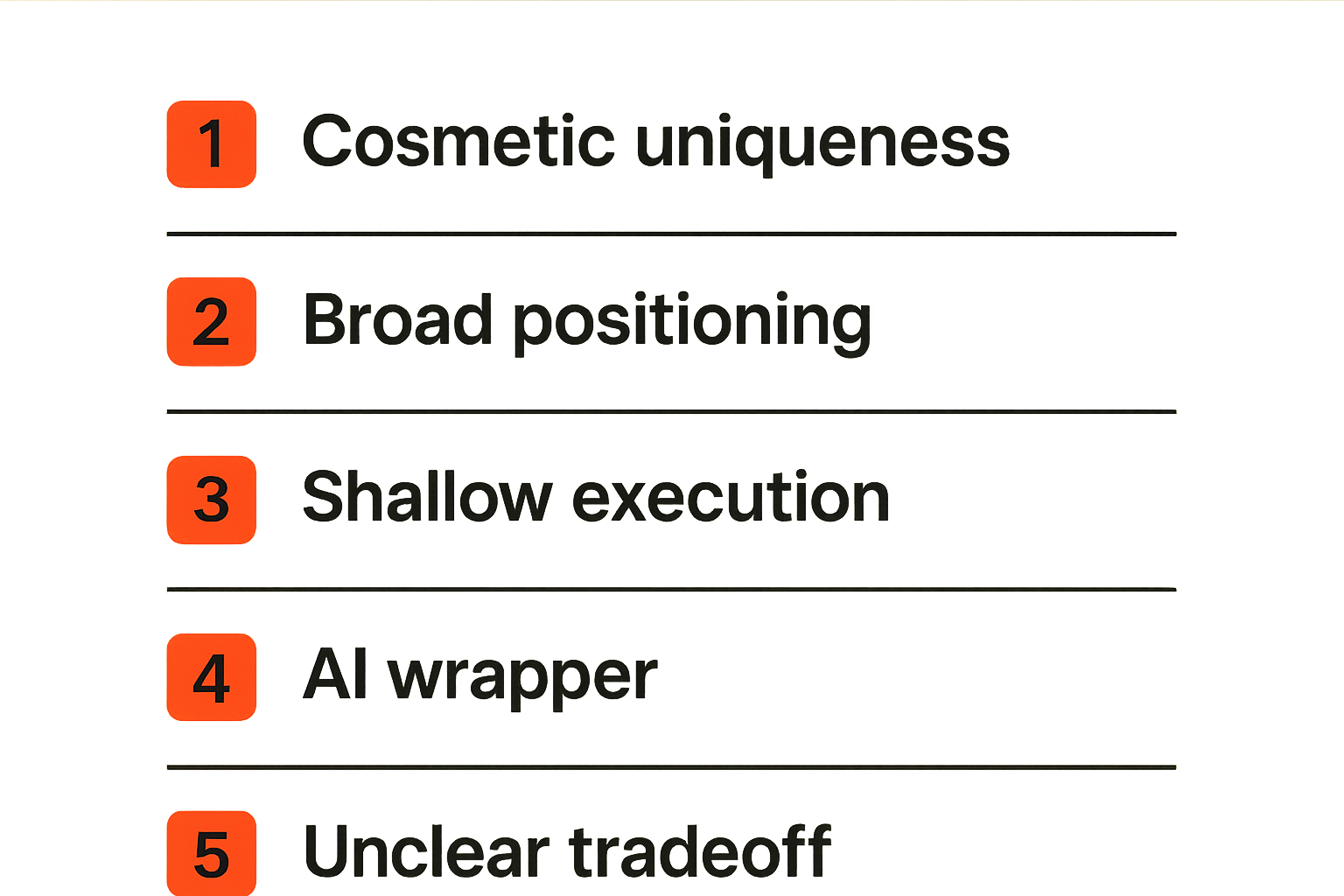
Bad product differentiation is expensive because it creates false confidence. The landing page sounds sharp, but sales calls stay vague. The roadmap expands, but activation does not improve. Launches produce attention, but not durable demand.
The mistake teams make is treating differentiation as language cleanup instead of decision cleanup.
Cosmetic uniqueness
Cosmetic uniqueness is the easiest trap. It includes new terminology, unusual UI patterns, clever plan names, playful branding, and category labels that buyers do not use.
Some of that can help if the underlying product is strong. But cosmetics cannot carry weak contrast.
Signals you are relying on cosmetics:
- Users ask what the product actually does after reading the homepage.
- Sales calls require a long category explanation.
- Competitor comparisons feel defensive.
- The product demo looks similar after the first two minutes.
- Users remember the brand tone but not the reason to switch.
Broad positioning with shallow execution
Broad positioning feels safe because it avoids excluding anyone. In reality, it gives no one a reason to care.
A product for teams to collaborate better is not differentiated. A product that helps remote product teams resolve launch blockers without adding another status meeting is at least testable.
Related reading from our network: remote teams face similar control and ownership problems, and Vizio remote control thinking for collaboration workflows is an adjacent example of designing around who controls what, when, and with which safeguards.
AI wrappers without workflow ownership
In 2026, AI features are common enough that AI by itself is rarely a durable differentiator. The question is what workflow the AI owns, what state it manages, and what decision it improves.
An AI summary is easy to copy. An AI-assisted launch workflow that preserves approvals, source context, publishing cadence, and feedback loops is harder because it owns more of the operating system.
If content is part of your launch motion, the useful version is not generating more drafts. It is connecting content to shipping control. That is the point of an AI publishing shipping software workflow: speed matters only if the system keeps quality, ownership, and launch intent intact.
Turn differentiation into a shipping workflow
Differentiation should show up in the weekly cadence of the team. If it is not part of the shipping workflow, it will be overridden by urgent feature requests, competitor anxiety, and founder taste.
Here is a practical implementation sequence:
- Write the current workaround in one paragraph.
- Name the switching trigger that makes the buyer look for a new option.
- Choose one differentiation lane for the next 90 days.
- Define the contrast moment users should experience.
- Instrument that moment in the product.
- Review support tickets and churn through that lens.
- Rewrite onboarding, pricing, and launch content around the same contrast.
- Kill or defer roadmap items that do not strengthen the chosen lane.
This is not glamorous. It is how you avoid drifting into a generic product.
The weekly differentiation review
Once a week, review shipped work against the differentiation lane.
Ask:
- Did this release make our chosen workflow easier, safer, or more valuable?
- Did it strengthen the reason our target buyer chooses us?
- Did it introduce complexity that weakens the contrast?
- Did users reach the contrast moment faster?
- Did support questions confirm or challenge our assumptions?
This review can be short. The point is consistency. Differentiation erodes when no one owns the tradeoff.
The release note test
Before shipping a feature, write the release note. If the note sounds generic, the feature may be generic.
Weak release note: We added custom labels and improved the dashboard.
Stronger release note: Launch teams can now tag feedback by blocker type and see which issues prevent beta users from activating before the next release window.
The stronger version explains the workflow, the user, and the decision the feature supports.
The support feedback loop
Support is where weak differentiation becomes obvious. Users ask confused questions when the product's promise and behavior do not match.
Track support by differentiation theme:
- Setup friction around the promised workflow.
- Confusion about who the product is for.
- Requests that pull the product toward generic competitors.
- Repeated questions about trust, ownership, exports, or permissions.
- Moments where users describe the product in their own words.
Those user words are valuable. They often reveal the clearest version of your differentiation.
Pricing, onboarding, and retention are differentiation surfaces
Many teams design the product and then attach pricing and onboarding later. That creates a mismatch. If your product is differentiated but your pricing and onboarding look generic, buyers receive conflicting signals.
The UI is not the whole system. State, trust, progress, ownership, and support are where the product becomes real.
Pricing should reveal your bet
Pricing tells the buyer what you believe value is tied to.
If your product saves operational time, pricing by seat may punish adoption. If your product coordinates client work, pricing by workspace or client may make more sense. If your product helps ship launches, pricing around active products, campaigns, or workflows may be clearer than charging for arbitrary feature gates.
Bad pricing hides differentiation. Good pricing reinforces it.
A few checks:
- Does the free plan let users experience the contrast moment?
- Does the paid plan map to the value metric?
- Are limits tied to meaningful usage or internal cost?
- Does the plan structure attract the buyer you are built for?
- Does the price create enough margin to support the differentiated workflow?
Onboarding should remove the old workflow
Onboarding is not a tour. It is migration from the old way to the new way.
If your differentiation is workflow-based, onboarding should ask about the current workflow and help replace it. If your differentiation is audience-based, onboarding should use the user's language and defaults. If your differentiation is trust-based, onboarding should expose controls, permissions, and recovery options early.
A practical onboarding structure:
- Identify the user's situation.
- Import or recreate the current state.
- Guide the user to the contrast moment.
- Ask for the first real decision or output.
- Reinforce what changed compared with the old workflow.
Retention should measure adopted difference
Retention is not only logins. A user can log in repeatedly and still fail to adopt the differentiated behavior.
Measure whether the user keeps using the part of the product that makes you different.
For example:
- If you differentiate on launch planning, do users return before each release?
- If you differentiate on feedback triage, do users classify feedback before roadmap reviews?
- If you differentiate on safer collaboration, do teams use approval flows and activity logs?
- If you differentiate on faster publishing, do users ship through the workflow rather than exporting drafts elsewhere?
Retention should answer whether your difference became part of the customer's operating rhythm.
Launch product differentiation through your go-to-market system
Product differentiation does not matter if your launch motion teaches the wrong lesson. A launch should not just announce availability. It should create the market's first clean understanding of why the product exists and who should care.
The practical question is how to make the launch demonstrate the difference rather than describe it.
Align channels with the wedge
Different differentiation lanes need different channels.
Workflow differentiation often performs well through demos, teardown content, founder videos, templates, and before-after walkthroughs. Audience differentiation can work through niche communities, expert partnerships, and specific examples. Trust differentiation may need documentation, comparison pages, migration guides, and transparent operational practices.
Do not choose channels only because they are popular. Choose channels that can show the wedge clearly.
If you are building the broader launch system, Go to Market Strategy in 2026 is a useful companion because it treats GTM as an operating system connecting audience, channels, metrics, and founder decisions.
Make content show the before and after
Content that supports differentiation should make the old way and new way obvious.
Useful formats:
- Workflow teardown: how teams do it today, where it breaks, and how your product changes the sequence.
- Decision guide: when your product is a fit and when it is not.
- Migration guide: how to move from the current workaround.
- Build-in-public note: why you chose one tradeoff over another.
- Customer story: the operational change, not just the quote.
The best content makes the buyer feel understood before it asks them to convert.
Keep campaign scope small enough to learn
A broad launch can hide weak differentiation. You get traffic, comments, and signups, but you cannot tell which message or audience worked.
Small campaigns create cleaner learning loops.
Example launch test:
- Audience: solo technical founders preparing beta launches.
- Wedge: turn scattered product notes into a one-week launch workflow.
- Channel: founder communities and practical teardown posts.
- Offer: beta launch checklist plus product workspace template.
- Success signal: users complete the launch workflow, not just sign up.
That scope is narrow enough to inspect. You can see whether the differentiation is pulling or whether people only wanted the free asset.
Product differentiation metrics that operators can use
Metrics should not become theater. You need a small set of numbers that tell you whether the market understands, adopts, and repeats the differentiated behavior.
The goal is not to build a dashboard for every possible event. The goal is to reduce guessing.
Signal metrics
Signal metrics tell you whether the market is reacting to the wedge.
Track:
- Conversion rate by message or audience segment.
- Reply quality from outreach or launch posts.
- Percentage of demos where buyers repeat the core problem in their own words.
- Waitlist source by differentiation angle.
- Search queries and support questions that match the target job.
Signal metrics are early and imperfect. Use them to decide what to investigate, not to declare victory.
Adoption metrics
Adoption metrics tell you whether users experience the contrast.
Track:
- Time to first contrast moment.
- Completion rate of the differentiated workflow.
- Percentage of active users using the key behavior.
- Frequency of repeated use around the target job.
- Drop-off step before the contrast moment.
This is where many products expose the truth. People may like the idea but avoid the actual workflow. That means either the workflow is too hard, the pain is not urgent, or the differentiation is not strong enough.
Decision metrics
Decision metrics connect differentiation to business choices.
Track:
- Win reasons from sales calls or founder conversations.
- Churn reasons tied to missing or misunderstood differentiation.
- Expansion behavior from users who adopt the key workflow.
- Requests that align with or dilute the chosen lane.
- Pricing objections by segment.
These metrics help you decide what to build, what to explain, and what to ignore.
Practical rule: If a metric cannot change a roadmap, pricing, onboarding, or launch decision, it is probably not an operating metric.
How sh1pt.com thinks about product differentiation
Product differentiation is not a one-time workshop. For builders, it is part of the shipping system: what you choose, what you cut, what you launch, what you measure, and what you refuse to become.
At sh1pt.com, the useful lens is operator-first. Differentiation should help you ship better decisions, not just prettier messaging.
Product-fit for builders who ship
sh1pt.com is for people building and launching software products who want to understand shipping strategies, product development processes, and growth tactics.
That means product differentiation is treated as a practical workflow:
- Use examples to sharpen decisions.
- Connect positioning to roadmap tradeoffs.
- Turn launch content into proof.
- Measure whether users adopt the differentiated behavior.
- Keep the product focused enough that the market can explain it back.
For indie hackers, startup founders, product managers, and solopreneurs, this matters because limited resources punish vague strategy. You cannot outspend broad competitors. You can out-focus them.
When sh1pt.com is not the answer
sh1pt.com is not trying to be a generic motivation feed or a library of abstract startup theory. If you want only inspirational launch stories, this is probably too operational. If you want a universal framework that avoids tradeoffs, this will feel too narrow.
The bias here is practical: shipping strategy, product development process, and growth tactics that help creators move from idea to market with more control.
That is also the right mindset for product differentiation. The best version is not louder. It is clearer, more specific, and embedded in how the product works.
Try sh1pt.com
sh1pt.com is for people building and launching software products who want to understand shipping strategies, product development processes, and growth tactics. If you want a practical way to think through product differentiation and ship with sharper focus, Try sh1pt.com.