
A Product Hunt launch strategy usually fails before launch day.
Not because the tagline was weak. Not because the team posted at the wrong hour. Not because the founder did not ask enough people to upvote.
Teams think the problem is visibility. The real problem is launch architecture: who is being activated, what promise is being tested, how the spike is handled, and how the team converts attention into learning, users, and momentum.
That changes the conversation. A Product Hunt launch is not a magic distribution channel. It is a compressed market test with public feedback, social proof, support load, onboarding friction, and conversion pressure all arriving at once. If the system behind it is weak, the launch exposes that weakness faster.
The practical question is not how do we win Product Hunt. The practical question is how do we use Product Hunt to ship cleaner, learn faster, and create a launch asset that still matters after the leaderboard resets.
Table of contents
- Product Hunt launch strategy is a workflow, not a launch day trick
- When a Product Hunt launch strategy is actually worth doing
- Build the offer before you build the noise
- Audience seeding for a Product Hunt launch strategy
- Prepare the page, assets, and launch narrative
- Launch day operating system
- Metrics that matter after the spike
- Common failure modes that break Product Hunt launches
- Product Hunt launch strategy checklist for 2026
- Turn Product Hunt into a repeatable shipping system
Product Hunt launch strategy is a workflow, not a launch day trick
What Product Hunt actually tests
A useful way to think about Product Hunt is this: it tests whether a cold but curious audience can understand why your product exists quickly enough to act.
That includes several smaller tests:
- Can people understand the category without a demo call?
- Can they identify themselves as the target user?
- Can they see what is new, different, or timely?
- Can they try the product without friction?
- Can your team respond in public without sounding scripted?
- Can you turn comments, signups, and objections into useful next steps?
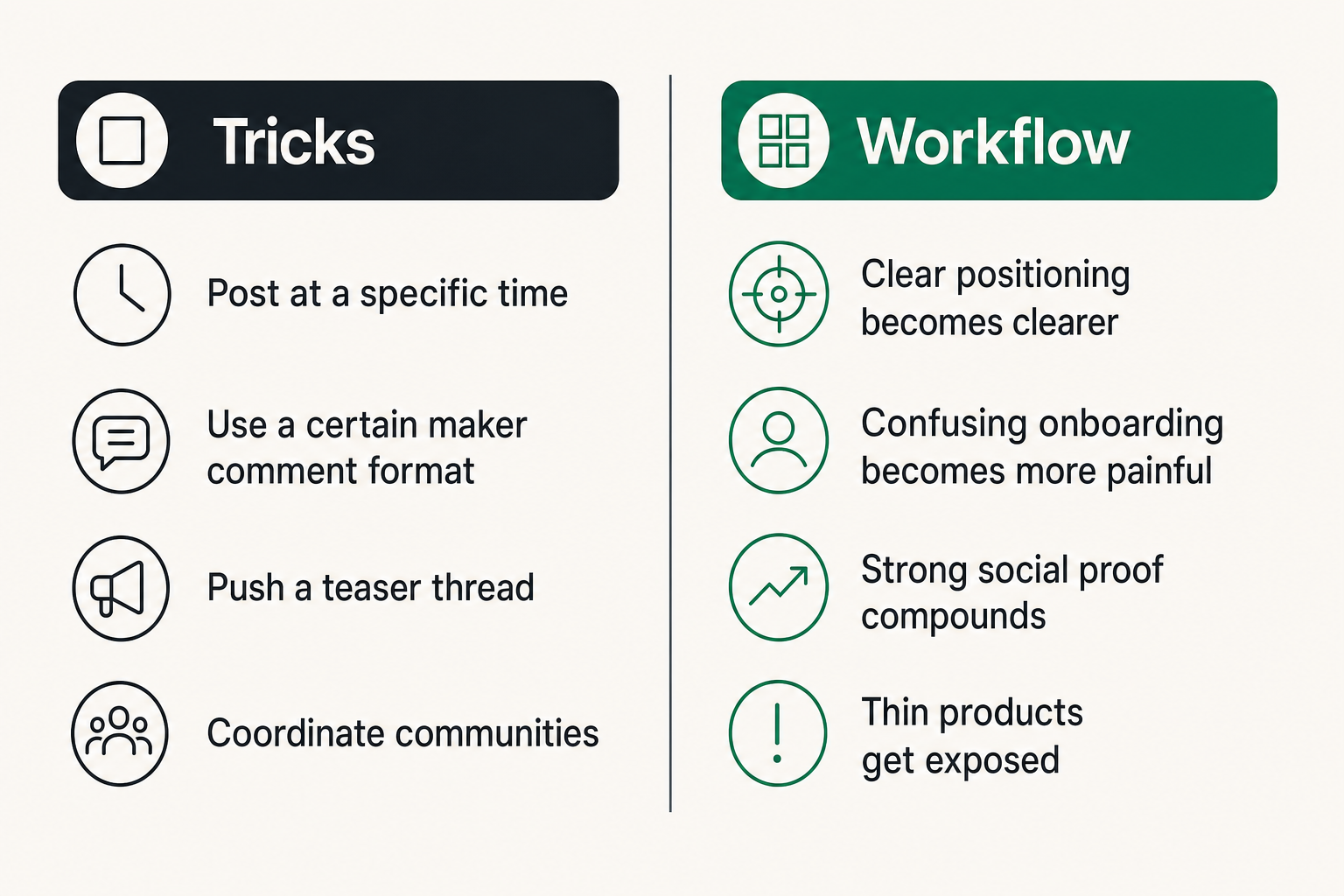
The mistake teams make is treating Product Hunt as a popularity contest detached from the product system. In practice, Product Hunt amplifies whatever already exists. Clear positioning becomes clearer. Confusing onboarding becomes more painful. Strong social proof compounds. Thin products get exposed.
Practical rule: Do not launch on Product Hunt to create clarity. Launch when you have enough clarity to test it under pressure.
Why launch day hacks age badly
There is always a new tactic: post at a specific time, use a certain maker comment format, ask a hunter, push a teaser thread, coordinate communities. Some of those details matter. None of them compensate for a weak launch system.
What breaks in practice is that teams optimize for the leaderboard and forget the business workflow. They get attention, then lose it because the landing page is generic, the signup flow asks too much, the trial has no activation moment, or nobody follows up with high-intent users.
A hack can improve distribution at the margin. It cannot repair unclear positioning, weak onboarding, missing analytics, slow support, or a product that does not match the promise.
The operating model that holds up
A Product Hunt launch strategy needs four layers:
| Layer | Practical question | Output |
|---|---|---|
| Positioning | Why should this audience care today? | Launch promise, tagline, maker comment |
| Audience | Who already has context before launch day? | Supporter map, pre-launch conversations |
| Operations | Who handles traffic, support, comments, bugs, and updates? | Launch day runbook |
| Learning | What decisions will we make from the data? | Metrics review, roadmap changes, follow-up plan |
This is why product operations matter even for tiny teams. If you want the broader operating-system view, the sh1pt guide to product operations as the shipping system behind cleaner launches is directly relevant here.
When a Product Hunt launch strategy is actually worth doing
Good candidates for Product Hunt
Product Hunt is useful when your product is easy to understand, easy to try, and interesting to a builder, founder, operator, designer, marketer, developer, or tech-curious audience.
Good candidates usually have at least one of these traits:
- A self-serve onboarding path
- A clear before-and-after workflow
- A visual or interactive product surface
- A new take on a known category
- A generous free tier or launch offer
- A community-friendly founder story
- A product that benefits from early feedback
This does not mean you need a tiny AI widget or developer tool. But Product Hunt rewards products that can be evaluated quickly. If the buyer needs procurement, legal review, stakeholder alignment, and a security questionnaire before understanding the value, launch expectations need to be different.
Bad candidates for Product Hunt
A Product Hunt launch is usually a bad primary strategy when the product requires deep enterprise context, has no usable public demo, targets a narrow non-tech persona, or cannot support a sudden spike in low-context users.
It can still be useful for awareness, recruiting, investor visibility, or category education. But those are different goals.
The mistake teams make is copying launch plans from products with different buying motions. A consumer productivity tool, a developer API, and a compliance platform do not need the same launch mechanics.
The readiness test
Before committing, answer these questions honestly:
- Can a qualified user reach value in under ten minutes?
- Can an unqualified visitor understand who the product is not for?
- Can support handle repetitive questions without founder panic?
- Can analytics separate Product Hunt traffic from other channels?
- Can the team follow up within 24 to 72 hours?
- Can the product survive public feedback without defensive messaging?
If the answer is no to most of these, delay the launch. Not forever. Long enough to fix the workflow.
Practical rule: A delayed Product Hunt launch is cheaper than a public spike that produces no learning, no activation, and no follow-up.
Build the offer before you build the noise
Define the launch promise
The launch promise is the short, testable claim behind the entire campaign. It is not the feature list. It is not the mission statement. It is the reason someone stops scrolling.
Weak promise: An all-in-one platform for product teams.
Stronger promise: Turn messy user feedback into prioritized roadmap decisions in one workflow.
The stronger version tells the reader who it is for, what pain it addresses, and what outcome to expect. That matters because Product Hunt users are scanning. They are not studying your positioning deck.
A good launch promise has three parts:
- User: who this is for
- Problem: what workflow is painful
- Outcome: what becomes easier, faster, or safer
For example:
launch_promise:
  user: indie founders shipping SaaS products
  problem: scattered launch tasks and unclear follow-up
  outcome: a repeatable launch workflow from pre-seeding to post-launch review
Segment the first users
Not all upvotes are equal. Not all signups are equal either.
You need to know which visitors you care about most before the traffic arrives. Otherwise every comment feels important and every feature request looks urgent.
Create a simple segmentation model:
| Segment | Example | Desired action |
|---|---|---|
| Primary users | Founders actively preparing a launch | Signup, activate, book feedback call |
| Adjacent users | PMs, marketers, builders researching launches | Subscribe, save, share |
| Influencers | Newsletter writers, community leads, operators | Comment, amplify, request demo |
| Curious visitors | General Product Hunt audience | Try free tool, leave feedback |
This is where research beats guessing. If you are still unclear on target segments, use lightweight customer discovery before launch. The sh1pt article on product research surveys as a shipping workflow is useful because it treats research as a decision process, not a form collecting vanity answers.
Prepare the activation path
A Product Hunt launch strategy fails when traffic lands on a beautiful page and then hits a dead zone.
Activation needs to be explicit. Decide the one action that proves the visitor understood the product enough to continue. It might be creating a project, importing data, generating a report, connecting an integration, inviting a teammate, or publishing the first artifact.
Reduce every unnecessary step before that moment.
Practical rule: Launch traffic should not enter your full product complexity. It should enter the shortest credible path to the first useful outcome.
Audience seeding for a Product Hunt launch strategy
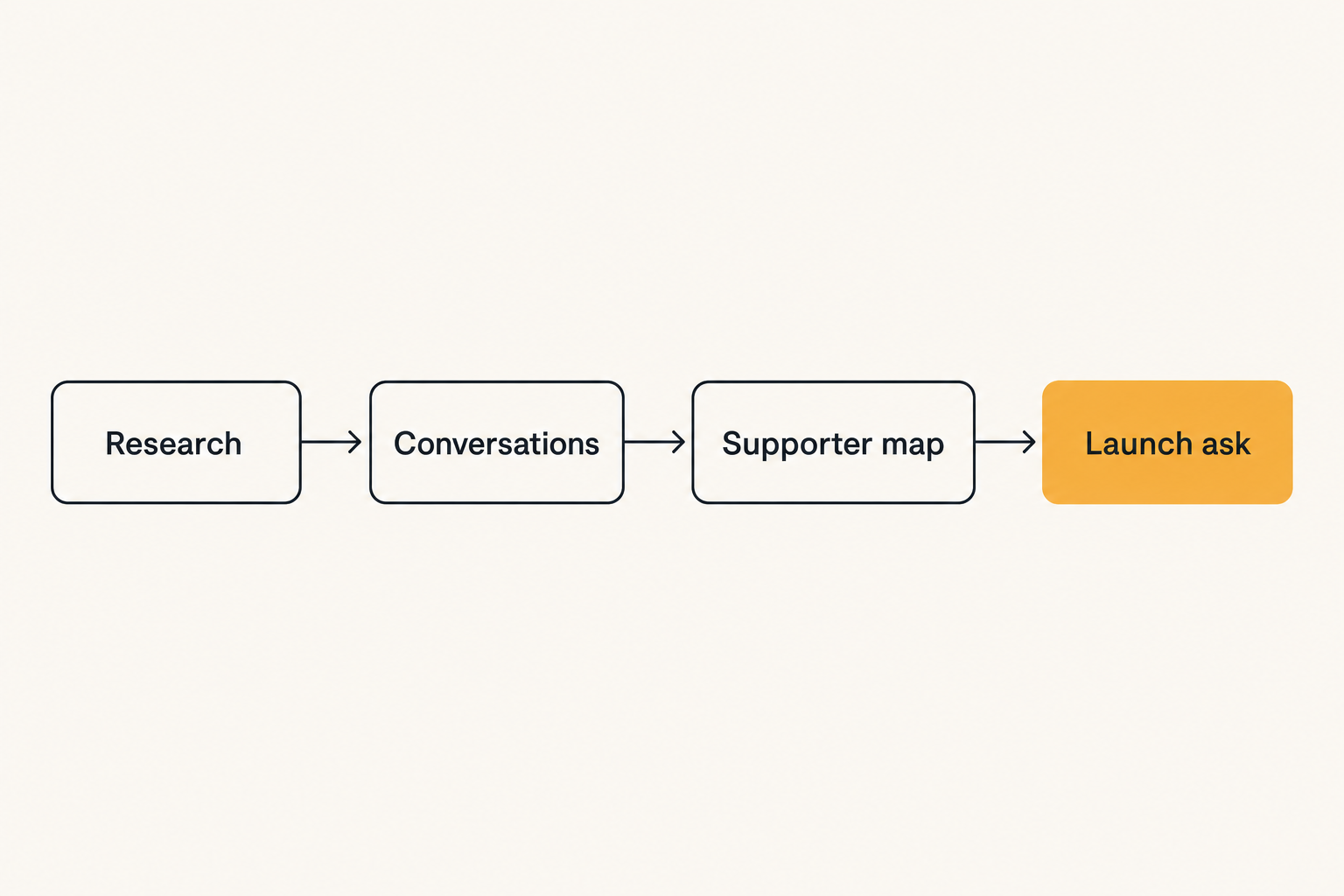
Seed conversations, not upvote requests
The worst pre-launch message is a cold request for support from someone who has never heard of the product.
The better workflow starts earlier. You seed context by asking for feedback, sharing a build-in-public update, inviting people to a beta, posting a teardown, or explaining the problem you are solving. By launch day, the ask should feel like a continuation, not a transaction.
This is not moral advice. It is operational advice. People are more likely to support a launch when they already understand why it exists.
A simple pre-launch message can be:
Hey, I am launching a tool next month for solo founders planning Product Hunt and beta launches. You gave useful feedback on our onboarding earlier. If the final version looks relevant, I would appreciate your comment on launch day. No pressure, and I can send the page when it is live.
Notice what it does not do. It does not demand an upvote. It does not hide the ask. It gives context and makes the support optional.
Build your supporter map
Your supporter map is not a spam list. It is a list of people and communities with context, relevance, and an appropriate way to reach them.
Use columns like:
- Name or community
- Relationship strength
- Segment fit
- Best channel
- Last interaction
- Launch day ask
- Follow-up owner
For founders, this often includes beta users, newsletter readers, friends building in public, community peers, advisors, customers, previous users, and people who commented on earlier content.
Related reading from our network: teams preparing a launch can create a mess of disconnected tools quickly, and the workflow discipline in avoiding software tool sprawl applies surprisingly well to launch stacks.
Use content as pre-launch infrastructure
Pre-launch content is not only for awareness. It is infrastructure for the launch conversation.
Good pre-launch content answers questions Product Hunt users will ask later:
- Why build this now?
- What failed in existing tools?
- Who is it designed for?
- What did beta users teach you?
- What tradeoffs did you make?
- What does the roadmap look like?
This content can become launch day replies, newsletter sections, founder comments, social posts, and onboarding copy. The mistake teams make is writing fresh copy under pressure on launch morning. That is when vague language wins because nobody has time to think.
Prepare the page, assets, and launch narrative
The Product Hunt page is a routing layer
The Product Hunt page is not the destination. It is a routing layer that sends different users into the right next step.
Your tagline needs to route attention. Your gallery needs to route understanding. Your maker comment needs to route trust. Your links need to route intent.
A strong launch page usually includes:
- A specific tagline
- Screenshots that show the workflow, not just the dashboard
- A short demo or walkthrough
- A maker comment explaining the origin, tradeoffs, and ask
- A launch offer if it makes business sense
- A clear link to the product
- A clear path for feedback
The Product Hunt audience is skeptical of generic SaaS language. Say what the product does. Say who should care. Say what is different.
Asset checklist for launch week
Your asset pack should be done before the final week. Otherwise launch week becomes a design sprint, a copy sprint, a QA sprint, and a support sprint at the same time.
Minimum useful assets:
- Product Hunt tagline variants
- Gallery images with captions
- Short demo video or GIF
- Maker comment draft
- Landing page hero variant for Product Hunt traffic
- FAQ for comments and support
- Social posts for founder and team accounts
- Email to beta users or waitlist
- Short replies for common objections
- Screenshots for communities and newsletters
Product examples help here, but only if you use them operationally. The sh1pt post on using product examples as a practical system explains how to convert examples into launch and roadmap decisions instead of collecting inspiration screenshots.
Comments are part of the product
Product Hunt comments are not a side channel. They are part of the product experience during launch.
The founder comment should do real work:
- Explain the problem in plain language.
- Share why the team built this version now.
- Name the ideal user.
- Mention one or two important tradeoffs.
- Invite specific feedback.
- Thank early users without sounding like a press release.
Do not outsource your voice to generic launch copy. A founder comment should sound like the person who has lived with the problem.
Launch day operating system
Roles, shifts, and ownership
Launch day feels chaotic when nobody owns the state of the launch.
Even a solo founder needs roles. They may all belong to one person, but the functions should be explicit:
| Role | Owns | Failure if missing |
|---|---|---|
| Comment lead | Product Hunt replies and maker updates | Slow public response |
| Support lead | Emails, chat, bug reports | Users feel ignored |
| Analytics lead | Traffic, signup, activation, source tags | No learning after spike |
| Social lead | Posts, community updates, supporter follow-up | Weak amplification |
| Product lead | Hotfix decisions and incident triage | Panic changes in production |
If the team is remote, the handoffs matter even more. Related reading from our network: remote launch teams face similar control and permission issues to the ones described in remote team control workflows.
The launch day workflow
Run launch day like an incident plus a campaign.
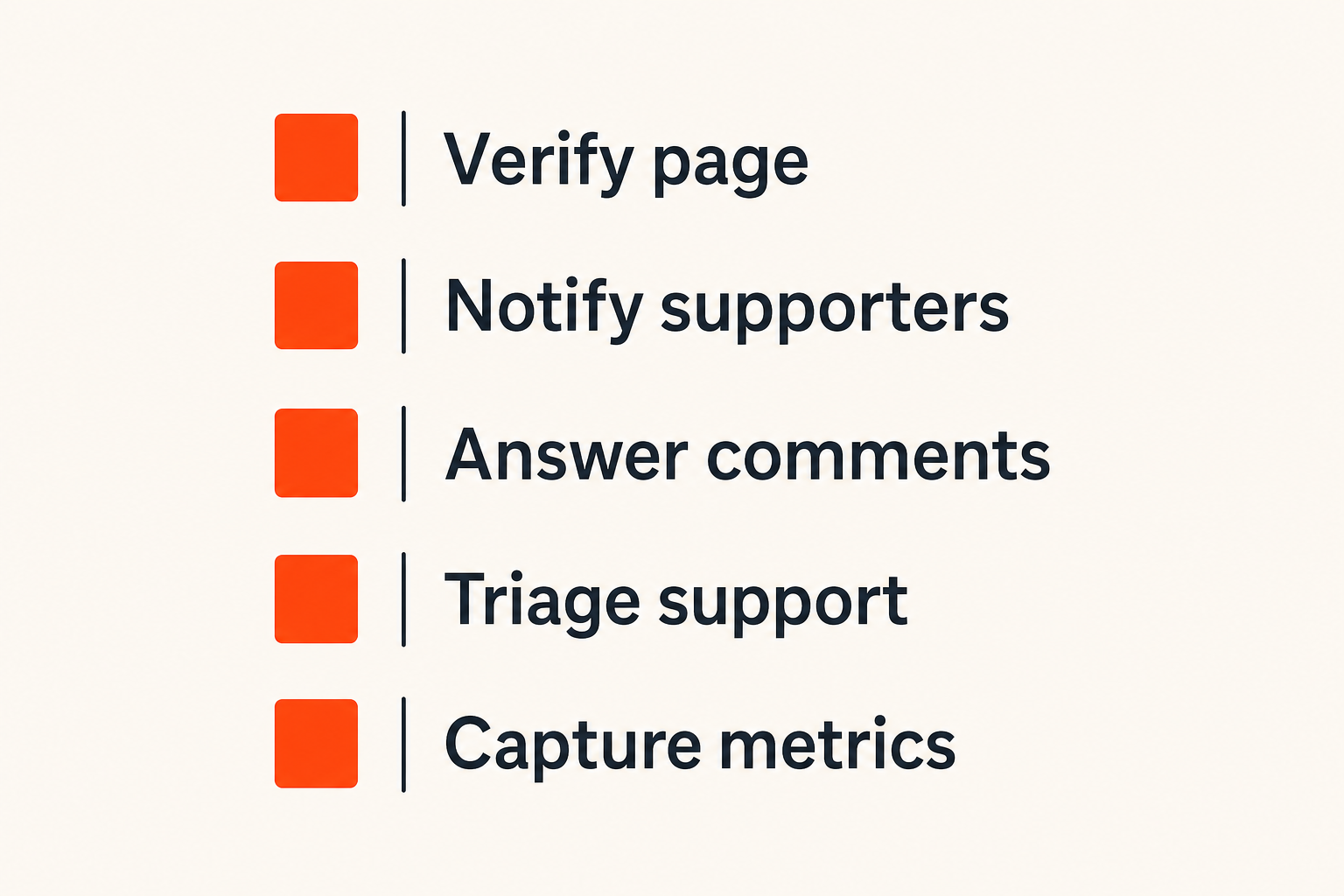
A practical sequence:
- Confirm page is live and all links route correctly.
- Post the maker comment and verify formatting.
- Notify the first circle of high-context supporters.
- Publish founder social posts and community updates.
- Monitor comments, support, analytics, and errors in one shared channel.
- Tag feedback by theme as it arrives.
- Update supporters only when there is something useful to say.
- Capture screenshots, quotes, objections, and bugs.
- Send a late-day update if momentum or feedback warrants it.
- Export metrics and notes before the team logs off.
The practical question is not whether every minute is optimized. It is whether the team can see what is happening and make calm decisions.
Support and incident handling
Product Hunt traffic can be weird. You may get unqualified signups, aggressive feedback, demo requests, pricing objections, bug reports, and integration questions in the same hour.
Prepare triage rules:
- Critical bug: fix or disable path immediately
- Payment issue: acknowledge fast and handle manually if needed
- Confusing onboarding: record sessions, avoid rewriting the product live
- Repeated objection: turn into public FAQ or comment reply
- Feature request: tag by segment before prioritizing
Related reading from our network: content-heavy launch teams can borrow the review-lane thinking in AI content workflow architecture, especially when multiple posts, emails, replies, and approvals are moving at once.
Practical rule: Do not ship large product changes during launch day unless the current path is blocking activation or damaging trust.
Metrics that matter after the spike
Separate attention from progress
Upvotes are useful, but they are not the business result. Ranking is useful, but it is not retention. Comments are useful, but not all comments come from target users.
Track the launch in layers:
| Metric layer | Examples | What it tells you |
|---|---|---|
| Attention | Upvotes, visits, comments, social mentions | Did people notice? |
| Intent | Signup rate, waitlist joins, demo requests | Did the promise resonate? |
| Activation | First project, first export, first integration | Did users reach value? |
| Quality | Target segment fit, feedback depth, referral source | Did the right people arrive? |
| Retention | Return visits, week-one usage, paid conversion | Did launch interest survive? |
The mistake teams make is celebrating attention without checking whether the right users moved forward.
Track cohorts by source and intent
Tag Product Hunt traffic separately. Also tag traffic from your own email, founder social posts, communities, newsletters, and direct shares. Otherwise the team will attribute every result to Product Hunt and learn the wrong lesson.
At minimum, capture:
- Source
- Landing page variant
- Signup timestamp
- Segment selection or inferred persona
- Activation event
- First support interaction
- First paid action, if relevant
A simple event plan might look like:
events:
  - ph_visit
  - signup_started
  - signup_completed
  - first_project_created
  - first_output_shared
  - feedback_submitted
  - upgrade_clicked
segments:
  - founder
  - product_manager
  - marketer
  - developer
  - curious_visitor
This does not require a giant analytics stack. It requires discipline before launch day.
Use feedback to update the roadmap
A Product Hunt launch produces noisy feedback. Some of it is gold. Some of it is drive-by opinion. Treat it as input, not instruction.
Sort feedback into four buckets:
| Feedback type | Example | Action |
|---|---|---|
| Clarity issue | I do not understand who this is for | Fix positioning or onboarding |
| Activation blocker | I cannot import my data | Fix immediately or prioritize |
| Segment-specific request | Can this support agencies? | Evaluate by strategy |
| Interesting but off-roadmap | Add a mobile app | Park unless repeated by target users |
The best launches create roadmap pressure. The worst launches create roadmap chaos.
Common failure modes that break Product Hunt launches
What fails before launch
Most failures are baked in early.
Common pre-launch failures include:
- No clear target user
- Generic tagline
- Weak supporter list
- Unfinished onboarding
- No analytics tagging
- No support plan
- No post-launch follow-up owner
- Launching because the calendar says so, not because the product is ready
What breaks in practice is confidence. The team enters launch day hoping attention will solve uncertainty. Instead, attention multiplies uncertainty.
What fails during launch day
During launch day, the failure mode is usually unmanaged state.
Nobody knows which comments were answered. Nobody knows if the signup bug is affecting all users or just one browser. Nobody knows whether the email list has been notified. Someone rewrites copy at noon. Someone else posts a different promise on social. Support messages sit unanswered because everyone is watching the leaderboard.
This is avoidable. Use one launch command center, one owner per workstream, one bug triage rule, and one live notes document.
What fails after launch
Post-launch failure is quieter and more expensive.
The team gets tired, celebrates or sulks, and then moves on. High-intent users do not receive follow-up. Commenters who gave thoughtful feedback never hear back. Trial users hit onboarding friction. The team never writes the launch retro. Two weeks later, nobody can explain what the launch taught them.
That is the real waste. Not a bad ranking. A launch that creates data but no decisions.
Practical rule: The value of a Product Hunt launch is captured in the week after launch, not only on launch day.
Product Hunt launch strategy checklist for 2026
Four weeks before launch
Four weeks out, focus on clarity and audience.
- Define the launch promise
- Pick the primary target segment
- Audit onboarding to the first value moment
- Start supporter conversations
- Draft the Product Hunt tagline and maker comment
- Prepare analytics events and source tags
- Identify communities where you have permission to participate
- Ask beta users for objections and confusing moments
This is not the time to add five major features. It is the time to make the product easier to understand and easier to try.
One week before launch
One week out, freeze the core message and operationalize the launch.
- Finalize Product Hunt page assets
- QA links, signup, payments, emails, and onboarding
- Create the launch command center
- Assign owners and shifts
- Prepare support macros and FAQ answers
- Schedule or draft social posts
- Confirm supporter outreach messages
- Set up dashboard views for launch traffic
- Decide what qualifies as an incident
The mistake teams make is leaving narrative work until the final week. The final week should be assembly and QA, not existential positioning debate.
The week after launch
The week after launch is where the strategy pays off.
- Follow up with activated users
- Follow up with high-intent non-activated users
- Reply to thoughtful comments with updates
- Review conversion and activation by source
- Tag feedback by segment
- Fix obvious clarity and onboarding problems
- Decide which roadmap items changed
- Write a launch retro
- Turn useful launch assets into evergreen content
Your post-launch review should answer three questions:
- What did the market understand?
- Where did users get stuck?
- What are we changing because of what we learned?
Turn Product Hunt into a repeatable shipping system
Product Hunt as one launch channel
A mature Product Hunt launch strategy treats Product Hunt as one channel inside a broader shipping system.
That means the work should be reusable. The launch promise can become homepage copy. The demo can become onboarding content. The comments can become FAQ entries. The feedback can shape roadmap decisions. The supporter map can become the beginning of a community or advisory loop.
If everything dies when the leaderboard resets, the launch was too isolated.
The better model is:
| Launch asset | Reuse after Product Hunt |
|---|---|
| Maker comment | Founder story, about page, investor update |
| Demo video | Landing page, onboarding, sales follow-up |
| FAQ replies | Help docs, email sequences, support macros |
| User objections | Positioning updates, roadmap review |
| Social proof | Website proof points, newsletter recap |
| Feedback themes | Product planning inputs |
That changes the conversation from how do we get votes to how do we build a launch asset library.
Where sh1pt.com fits
sh1pt.com is for people building and launching software products who want practical shipping strategies, product development processes, and growth tactics.
A Product Hunt launch strategy belongs here because it is not just marketing. It touches product readiness, positioning, user research, support design, launch operations, analytics, and roadmap discipline. Those are shipping problems.
If you are an indie hacker, startup founder, product manager, or solopreneur, the goal is not to copy someone else’s launch thread. The goal is to build a repeatable system that helps you move from idea to market with less chaos and better feedback.
A good launch creates attention. A better launch creates a reusable workflow. The best launch improves the product.
Try sh1pt.com
sh1pt.com is for people building and launching software products who want to understand shipping strategies, product development processes, and growth tactics.
Use it to sharpen your next Product Hunt launch strategy and build a cleaner path from product idea to market: Try sh1pt.com.