
Product operations is usually introduced too late.
A founder starts with a roadmap, a backlog, a few customer calls, and a launch date. Then the product grows. Feedback lands in five places. Bugs compete with feature requests. Marketing wants dates. Support wants answers. Engineering wants clearer priorities. Nobody can tell whether the last release moved the business or just created more follow-up work.
Teams think the problem is speed. The real problem is operating design.
In 2026, product operations is less about adding process and more about making shipping observable, repeatable, and owned. The practical question is not whether you need a product ops person. It is whether your product system can turn signal into decisions, decisions into shipped work, and shipped work into learning without depending on heroics.
Table of contents
- Product operations is a shipping system, not a team label
- The product operations control loop
- What product operations owns, and what it should not own
- Design the workflow before buying tools
- Build product operations around launch readiness
- Feedback systems are the center of product operations
- Metrics that make product operations useful
- Common product operations failure modes
- Implementation sequence for small teams
- Product operations for indie hackers and solopreneurs
- Where sh1pt.com fits in the product operations stack
Product operations is a shipping system, not a team label
The useful definition for operators
Product operations is the set of workflows, ownership rules, artifacts, and feedback loops that help a product team ship the right work with less confusion.
That is the useful definition because it avoids the common trap. Product operations is not a meeting scheduler, a Jira cleaner, or a documentation role with a better title. It is the operating layer between strategy and execution.
A useful way to think about it is this: product management decides what should matter, engineering builds the system, go-to-market brings it to market, and product operations keeps the machine from losing context between those steps.
Practical rule: if a product operations activity does not improve decision quality, launch quality, or learning speed, it is probably administrative drag.
Why founders feel the pain before they name it
Small teams often resist product operations because they associate it with large-company process. That is understandable. A two-person SaaS project does not need a product ops department.
But it still needs product operations.
The founder has customer notes in email, roadmap items in a project board, activation metrics in analytics, churn reasons in Stripe or a CRM, and launch copy in a doc. Each system contains part of the truth. None of them owns the workflow.
What breaks in practice is not ambition. It is continuity. You forget why a feature mattered. You ship without support context. You launch before analytics are instrumented. You treat every new request as equally urgent because there is no intake model.
Where product operations sits in the company
Product operations sits wherever the product system currently leaks.
In a startup, that might be the founder. In a growing team, it might be a product manager who also owns rituals, roadmap hygiene, launch readiness, and feedback routing. Later, it may become a dedicated role.
The mistake teams make is hiring for product operations before defining the operating gaps. If the problem is unclear strategy, product ops will not fix it. If the problem is weak engineering throughput, product ops will expose it but not magically repair it. If the problem is that customer learning never reaches planning, product ops can help immediately.
The product operations control loop
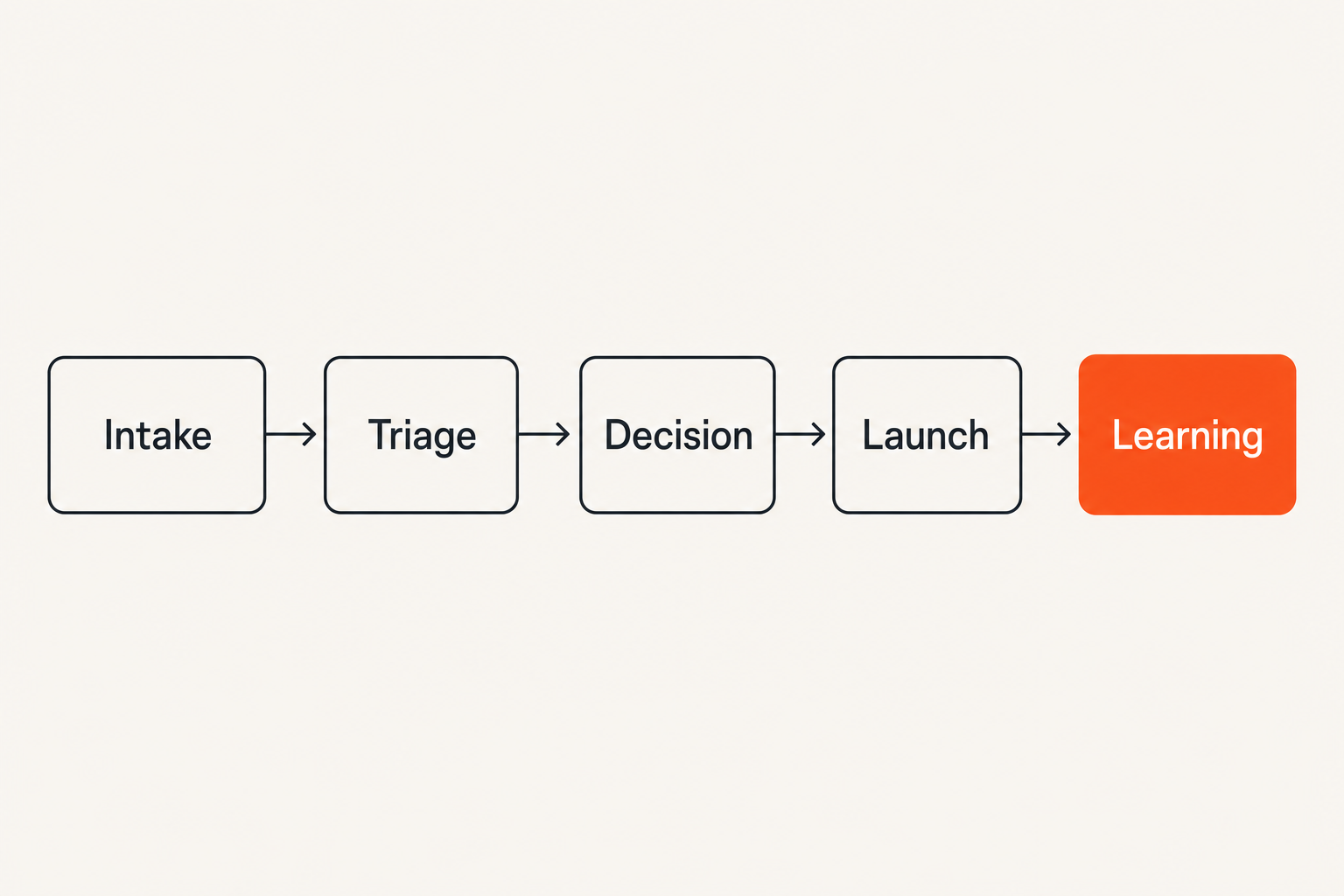
Signal intake
The product operations control loop starts with signal intake. This is where customer feedback, support tickets, sales objections, usage data, bug reports, competitor notes, and founder intuition enter the system.
Without intake rules, everything becomes a request. A customer says they need a dashboard export. Sales says the deal depends on SSO. Support says onboarding is confusing. Analytics says users are dropping before activation. These are not all the same type of input.
Good intake labels the signal before it becomes a roadmap item:
- Bug or defect
- Usability issue
- Feature request
- Expansion opportunity
- Churn risk
- Activation blocker
- Positioning confusion
- Internal operations problem
That changes the conversation. Instead of asking, should we build this, the team first asks, what kind of signal is this and what decision does it inform?
Decision routing
Product operations should make decision routing explicit. Not every signal deserves the same path.
A production bug needs triage. A repeated onboarding complaint needs discovery. A strategic enterprise request needs commercial context. A confusing feature request may need better messaging, not new code.
Here is a lightweight routing model:
signal_type:
  bug:
    owner: engineering lead
    response_time: same day
    artifact: issue with reproduction steps
  activation_blocker:
    owner: product manager
    response_time: weekly review
    artifact: experiment or UX fix
  sales_request:
    owner: founder or product lead
    response_time: pipeline review
    artifact: opportunity brief
  positioning_confusion:
    owner: product marketing
    response_time: launch review
    artifact: messaging update
The exact tool does not matter. The routing contract does.
Launch execution and learning
The loop closes when shipped work produces learning. This is where many teams fail.
They ship the feature, publish the announcement, and move on. A month later nobody knows whether adoption improved, which customer segment used it, or whether the support burden changed.
Product operations creates the habit of asking before launch:
- What are we trying to change?
- How will we know if it changed?
- Who needs to be ready internally?
- What customer communication is required?
- When will we review the result?
Practical rule: every meaningful launch needs a learning date, not just a release date.
Related reading from our network: security teams face a similar workflow problem when response actions lack ownership, and the fleet-response framing in Fleet Response in 2026 is a useful adjacent model for thinking about triggers, routing, and accountable action.
What product operations owns, and what it should not own
Core ownership areas
Product operations usually owns or coordinates five areas:
| Area | Product operations role | Why it matters |
|---|---|---|
| Feedback intake | Normalize and route signals | Prevents chaos from becoming roadmap noise |
| Roadmap hygiene | Keep priorities, status, and rationale visible | Reduces repetitive alignment meetings |
| Launch readiness | Coordinate internal and external readiness | Avoids shipping into confusion |
| Product analytics | Ensure key events and metrics exist | Makes learning measurable |
| Operating rituals | Maintain planning, review, and decision cadence | Keeps the team from reinventing process every cycle |
This does not mean product operations makes every product decision. It means product operations makes sure decisions have the right inputs, owners, and follow-through.
Boundaries with product management
Product management owns judgment. Product operations owns the system that helps judgment scale.
A PM should decide whether a customer segment matters, whether a feature fits strategy, and how to trade off scope against urgency. Product operations should make sure the PM has the relevant signal, the decision is recorded, and the downstream teams know what changed.
If product ops starts making priority calls without strategy context, it becomes a shadow product function. If PMs ignore the operating system, every launch becomes bespoke.
The healthy boundary is simple: PMs own product bets. Product operations owns the repeatability of how bets are evaluated, shipped, and reviewed.
Boundaries with marketing, sales, and support
Product operations is also where cross-functional tension becomes manageable.
Marketing wants clearer launch dates. Sales wants roadmap commitments. Support wants details before customers ask. Product wants discovery time. Engineering wants fewer interruptions.
The product ops answer is not to make everyone happy. It is to create shared artifacts that reduce ambiguity:
- A launch brief
- A roadmap view with confidence levels
- A feedback taxonomy
- A release readiness checklist
- A post-launch review template
For teams building a structured source of truth around what is being shipped, a product catalog can become part of the operating layer; the deeper architecture is covered in Product Catalog Architecture for Software Teams.
Design the workflow before buying tools
The mistake teams make with tooling
The mistake teams make is treating product operations as a software purchase.
They buy a customer feedback tool, a roadmap tool, a session replay tool, and a project tracker. Then they still do prioritization in a meeting with stale notes and unclear criteria.
Tools amplify workflow design. They do not replace it.
Before buying anything, answer these questions:
- Where does feedback enter?
- Who labels it?
- What gets escalated?
- How does it connect to roadmap decisions?
- Where is launch readiness tracked?
- How do support, marketing, and sales know what changed?
- When do we review outcomes?
If these answers are vague, adding software will create more places to lose context.
A minimal product operations stack
For many small teams, the first product operations stack can be boring:
| Function | Lightweight option | Scaling option |
|---|---|---|
| Feedback intake | Form plus spreadsheet | Dedicated feedback platform |
| Roadmap | Linear, Jira, Notion, or GitHub Projects | Roadmap tool with stakeholder views |
| Docs | Notion, Google Docs, GitBook | Structured knowledge base |
| Analytics | Plausible, PostHog, Amplitude, Mixpanel | Warehouse-backed product analytics |
| Launch tracking | Checklist template | Release management workflow |
| Customer comms | Email tool and changelog | Lifecycle messaging platform |
The point is not to worship simple tools. The point is to avoid tool sprawl before the workflow is real.
A practical workflow map
Start by mapping a single path from signal to learning:
- Customer feedback arrives through support, email, sales, or in-app prompt.
- Feedback is tagged by type, segment, account, and severity.
- Weekly review turns repeated signals into product questions.
- Product decision is recorded with rationale and confidence.
- Work is scoped and connected to launch requirements.
- Release ships with analytics, documentation, and internal notes.
- Outcome is reviewed after a defined learning window.
This workflow is simple enough for an indie hacker and still useful for a 30-person team.
Related reading from our network: teams evaluating operational software run into the same workflow-first buying problem, which is why this time tracking software workflow guide is relevant even outside time tracking.
Build product operations around launch readiness
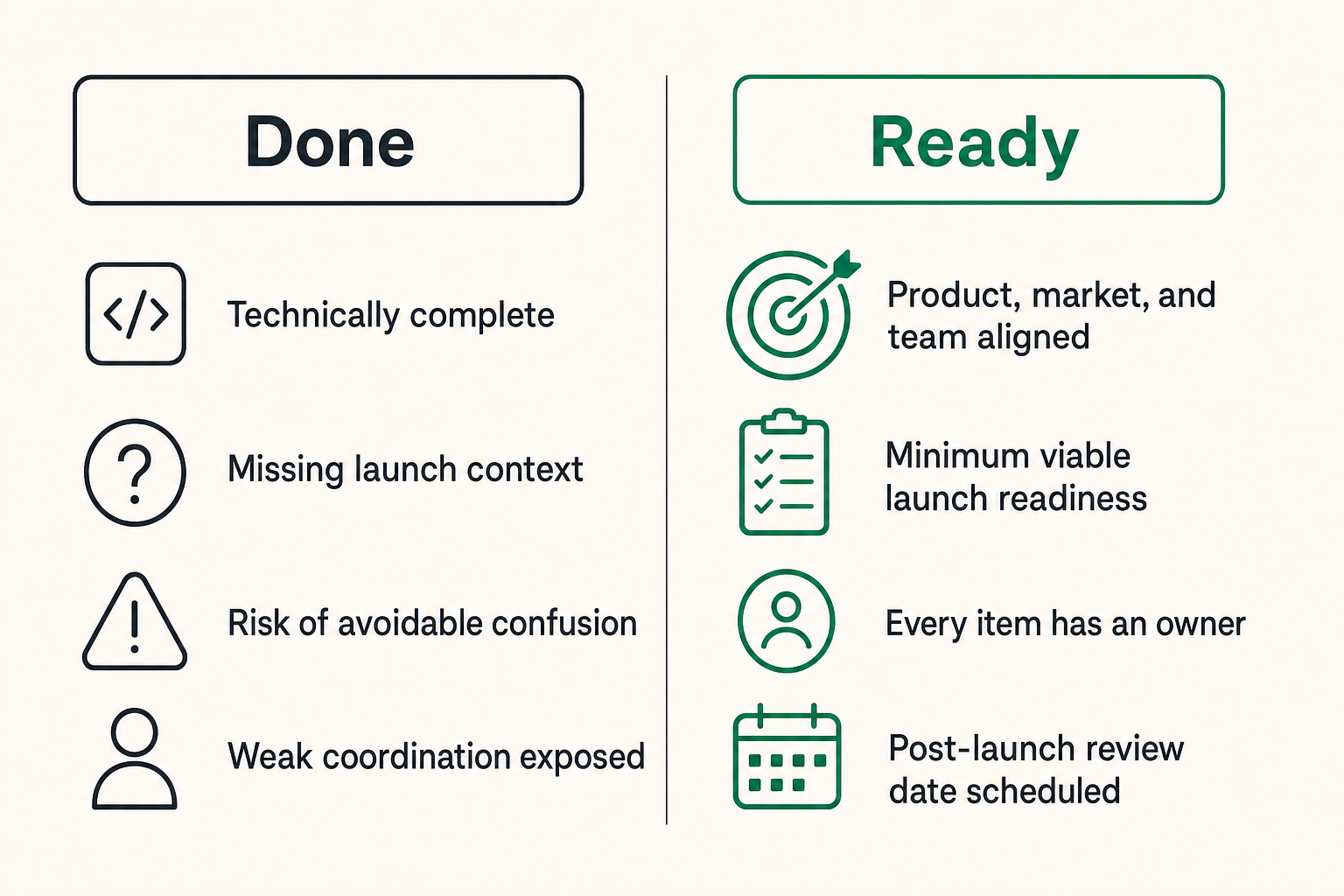
Readiness is more than a ship date
Product operations becomes visible during launches because launches expose weak coordination.
A release can be technically complete and operationally unready. Analytics may be missing. Support may not know the edge cases. Marketing may have the wrong positioning. Sales may be promising functionality that did not make the cut. The founder may announce a feature before onboarding can absorb the traffic.
Readiness means the product, the market, and the internal team are aligned enough to ship without avoidable confusion.
Practical rule: done is not the same as ready. Done is an engineering state. Ready is an operating state.
The launch checklist that actually matters
A useful launch checklist is not a 90-line document nobody trusts. It is a short set of gates that catch expensive misses.
Minimum viable launch readiness:
- Problem and target user are clear
- Scope and exclusions are written down
- Analytics events are implemented
- Support has known issues and response notes
- Marketing has the positioning and screenshots
- Sales or founder has approved customer-facing claims
- Billing, permissions, and onboarding changes are tested
- Rollback or mitigation path exists
- Post-launch review date is scheduled
The best checklist item is not a checkbox. It is an owner. Every readiness item should have a person who can say yes, no, or not yet.
Release notes, support notes, and internal context
Release notes tell customers what changed. Support notes tell the team what will break, confuse, or require explanation. Internal context tells everyone why the launch matters.
Do not collapse these into one generic announcement.
A practical launch packet can include:
- Customer-facing summary
- Internal rationale
- Segment or persona fit
- Screenshots or demo video
- Pricing or packaging impact
- Known limitations
- Support macros
- Success metric
- Review date
If your team uses AI to draft launch content, keep product operations in charge of the workflow rather than letting drafts scatter across tools. The controlled approach in AI Publishing Shipping Software maps well to release notes, changelogs, and launch narratives.
Feedback systems are the center of product operations
Separate raw feedback from product signal
Raw feedback is what someone said. Product signal is what the team can act on.
A customer saying, add CSV export, is raw feedback. The product signal might be that finance users need offline reporting, admins need auditability, or power users are blocked by integration gaps.
If you skip this translation step, your roadmap becomes a transcript of requests. That is not customer-centric. It is operationally lazy.
Good product operations preserves the original quote but adds interpretation:
raw_feedback: Need CSV export for invoices
customer_segment: finance admin
context: monthly reconciliation
signal: reporting workflow incomplete
possible_paths:
  - CSV export
  - accounting integration
  - scheduled report email
  - better invoice API
confidence: medium
linked_accounts: 7
This keeps the team from overfitting to the first requested solution.
Close the loop with customers and internal teams
Feedback without closure trains customers and teammates to stop contributing.
Closure does not mean building everything. It means acknowledging the input, explaining the status when appropriate, and updating the people who need to know.
For support, closure might mean: this is now linked to the onboarding improvement project. For sales, it might mean: not committed this quarter, but we are researching enterprise permissioning. For customers, it might mean: we shipped a related improvement; here is how to try it.
The practical question is, who needs to be notified when this changes state?
Avoid the loudest-customer roadmap
The loudest-customer roadmap happens when feedback volume is confused with strategic importance.
Enterprise prospects can distort priorities. Power users can demand complexity that hurts new users. Founders can overweight recent conversations. Support teams can understandably push for fixes that reduce ticket pain but do not always move the product forward.
Product operations should add context to feedback:
- Customer segment
- Revenue or strategic fit
- Frequency
- Severity
- Workflow affected
- Current workaround
- Churn or expansion risk
- Alignment with product strategy
That does not remove judgment. It gives judgment better raw material.
Related reading from our network: community builders face a similar problem with routing asks, offers, and follow-up, which makes Words for Community a useful adjacent read on operating vocabulary.
Metrics that make product operations useful
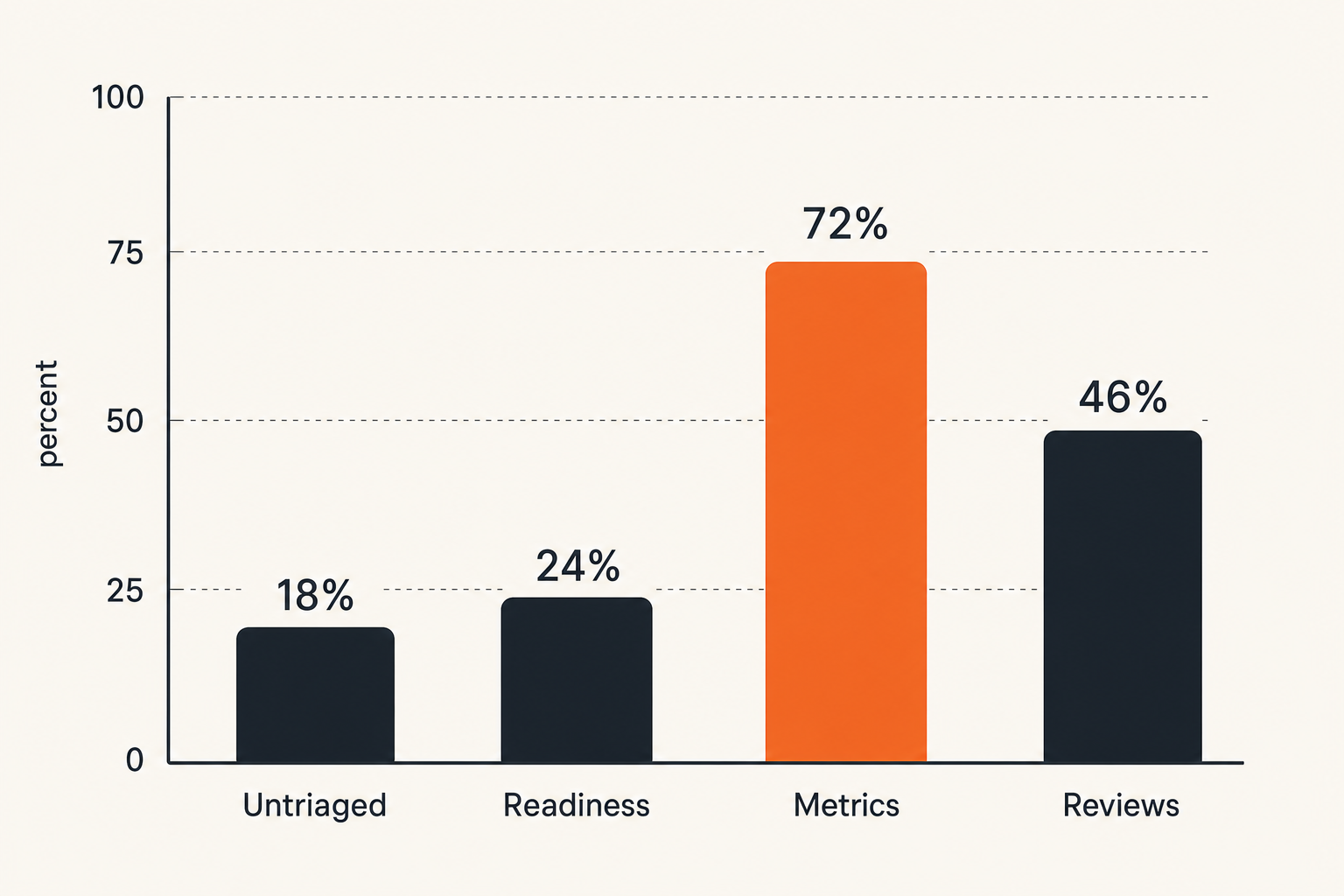
Measure flow, not vanity
Product operations metrics should show whether the product system is getting healthier.
Vanity metrics make the team feel productive. Flow metrics show where work slows down or loses context.
Useful product operations metrics include:
| Metric | What it reveals | Bad interpretation to avoid |
|---|---|---|
| Time from signal to triage | Intake responsiveness | Faster is not always better if triage is shallow |
| Percent of launches with success metric | Learning discipline | Do not fake metrics just to hit 100% |
| Launch readiness misses | Coordination quality | Use misses to improve system, not blame people |
| Feedback items linked to decisions | Traceability | Not every comment needs roadmap linkage |
| Post-launch review completion | Learning closure | Reviews must change future decisions |
| Support ticket change after launch | Operational impact | More tickets may be fine if adoption rose sharply |
The goal is not a perfect dashboard. It is to make operational friction visible.
Use launch metrics before and after release
Many teams instrument after launch. That is backwards.
Before release, define the expected behavior change. Are you trying to increase activation, reduce setup time, improve paid conversion, reduce support tickets, or expand usage in a segment?
After release, review the delta. Not every launch needs a statistically perfect experiment. But every meaningful launch should have a point of view.
A simple post-launch review can ask:
- What shipped?
- What changed in user behavior?
- What surprised us?
- What did support or sales hear?
- What should we do next?
- What should we change about the launch process?
A small dashboard beats a giant report
The best product operations dashboard for a small team may have only eight numbers:
- Open high-severity feedback themes
- Untriaged feedback count
- Current launch readiness status
- Upcoming launch dates
- Launches missing success metrics
- Post-launch reviews due
- Activation or adoption for recent launches
- Support ticket trend for changed areas
If the dashboard cannot drive a weekly decision, it is probably a report, not an operating tool.
Common product operations failure modes
Process theater
Process theater is when the team performs operating maturity without improving outcomes.
Common signs:
- Meetings exist because the calendar says so
- Roadmap status is updated but decisions remain unclear
- Launch checklists are completed after the launch
- Feedback is tagged but never reviewed
- Post-launch reports are written and ignored
The fix is to connect every ritual to a decision. If a meeting does not change priority, unblock execution, improve readiness, or produce learning, remove it.
Practical rule: product operations should reduce coordination cost, not create a second product to manage.
Disconnected systems
Disconnected systems are the most common failure mode in production.
Feedback lives in support. Roadmap lives in Jira. Launch copy lives in docs. Customer segments live in a CRM. Analytics lives in a dashboard. The team tries to align by memory.
You do not need one tool to rule everything. You do need stable references between systems.
For example:
- Feedback theme links to roadmap item
- Roadmap item links to launch brief
- Launch brief links to analytics dashboard
- Support note links to known issue
- Post-launch review links back to original decision
This creates traceability without forcing every team into one interface.
No decision rights
Product operations fails when it is responsible for coordination but has no authority to enforce the workflow.
If nobody can require launch readiness, readiness becomes optional. If nobody can close stale feedback, the backlog becomes a landfill. If nobody can challenge missing metrics, learning becomes folklore.
Decision rights do not need to be heavy. They just need to be explicit:
| Decision | Owner | Product ops role |
|---|---|---|
| Feature priority | Product lead or founder | Provide signal and rationale trail |
| Launch go or no-go | Product plus engineering plus GTM owner | Maintain readiness view |
| Feedback taxonomy | Product operations owner | Define and update labels |
| Success metric | Product owner | Ensure metric exists before release |
| Post-launch action | Product lead | Schedule review and capture decision |
Without authority, product operations becomes note-taking with better templates.
Implementation sequence for small teams
Week one: map the current operating reality
Do not start with a reorg. Start with a map.
Write down the last three meaningful product changes and trace them backward:
- Where did the idea come from?
- Who decided to build it?
- Where was the rationale recorded?
- Who knew it was launching?
- What broke during launch?
- What metric was expected to move?
- Did anyone review the outcome?
This exercise usually exposes the real problem quickly. Maybe intake is messy. Maybe launch readiness is weak. Maybe strategy is unclear. Maybe analytics are missing. Each problem needs a different fix.
Weeks two to four: install the first control loop
Pick one control loop and make it reliable. For most small teams, choose either feedback-to-roadmap or launch-readiness-to-learning.
A practical first-month sequence:
- Create one feedback intake table with source, segment, type, severity, and linked customer.
- Define five to eight signal labels and stop there.
- Hold a weekly 30-minute triage review.
- Create one launch brief template.
- Require a success metric for every meaningful launch.
- Schedule post-launch reviews at the time the release is approved.
- Archive stale items monthly.
This is enough to create operating leverage without slowing the team down.
After month one: standardize without freezing
Once the first loop works, standardize the artifacts:
- Feedback taxonomy
- Launch brief
- Roadmap status definitions
- Readiness checklist
- Post-launch review
- Decision log
But keep the system editable. Early product operations should be treated like product development. Ship the workflow, observe usage, remove friction, and improve the next version.
What works is a small set of trusted operating artifacts. What fails is a beautiful internal wiki nobody uses.
Product operations for indie hackers and solopreneurs
Keep it lightweight
Indie hackers do not need enterprise product operations. They need memory, discipline, and fewer dropped balls.
Your version might be one Notion database, one GitHub project, one analytics dashboard, and one weekly review. That is fine.
The key is to stop keeping the product system entirely in your head. Your brain is good for judgment. It is bad for preserving every customer quote, edge case, launch promise, and follow-up date while you are coding, selling, and supporting the product.
Automate the handoffs you keep forgetting
Solopreneurs still have handoffs. They are just handoffs between modes of work.
Builder-you needs to leave context for marketer-you. Support-you needs to inform product-you. Founder-you needs to revisit metrics after launch instead of chasing the next idea.
Automate lightweight reminders:
- When a feature is marked ready, create a launch note task
- When a customer requests something twice, tag it for triage
- When a release ships, schedule a review in two weeks
- When support tickets spike, link them to the recent change
- When pricing changes, update onboarding and help docs
This is product operations without bureaucracy.
Use product operations to protect focus
The biggest benefit for small teams is focus protection.
A clear intake process lets you say, captured, not now. A launch checklist prevents last-minute scrambling. A decision log stops you from re-litigating old calls. A post-launch review keeps learning from disappearing.
The practical question is not how much process can you tolerate. It is which lightweight operating habits buy back the most attention.
For teams where one person wears product and marketing hats, the operator-style breakdown of the product marketing manager role is a useful companion because shipping only creates leverage when the market understands what changed.
Where sh1pt.com fits in the product operations stack
A shipping knowledge base for operators
sh1pt.com is not a product operations platform. It is a practical resource for people building and launching software products who want sharper shipping strategies, better product development processes, and clearer growth tactics.
That matters because product operations is partly internal architecture and partly operator judgment. Templates help, but judgment improves when you see how other builders think through launch timing, positioning, tooling, and workflow design.
Use sh1pt.com as a reference layer around your operating system: when you are refining launch checklists, evaluating platform choices, writing product narratives, or tightening the path from idea to market.
Use it to sharpen launch judgment
The best product operations system will not remove hard calls. It will make those calls less random.
You still need to decide what not to build. You still need to choose between launching early and waiting for readiness. You still need to know when a customer request is a strategic wedge and when it is a distraction.
That is the closing point: product operations is not about slowing builders down. It is about making the shipping system strong enough that speed does not destroy context. In 2026, teams that treat product operations as architecture will launch cleaner, learn faster, and waste less motion than teams that treat it as admin work.
Try sh1pt.com
You are writing for people building and launching software products who want to understand shipping strategies, product development processes, and growth tactics. Try sh1pt.com.