
Product research surveys usually fail quietly. The form gets sent, responses pile up, the team exports a spreadsheet, and then everyone argues about what the answers mean.
Teams think the problem is getting more responses. The real problem is that the survey was never connected to a product decision.
That matters more in 2026 because small teams are shipping faster, using AI to prototype faster, and launching into noisier markets. You can build the wrong thing faster than ever. Product research surveys are one of the cheapest ways to reduce that risk, but only if they are treated like part of the shipping system.
The practical question is not: Which survey tool should we use? The practical question is: What decision will this survey change, who will trust the result, and how will the answer move through the roadmap, launch plan, and customer conversation?
Table of contents
- Product research surveys are not a form problem
- Product research surveys need decision architecture
- Design questions that create usable product signals
- Segment respondents before you analyze answers
- Distribution is part of survey design
- Turn product research surveys into product decisions
- Tooling, data hygiene, and privacy boundaries
- Use product research surveys across the launch lifecycle
- What breaks when teams run surveys badly
- What works and what fails in practice
- Where sh1pt.com fits into product research surveys
Product research surveys are not a form problem
The survey is only the collection layer
The mistake teams make is treating product research surveys as a lightweight substitute for product thinking. They open a form builder, write ten questions, send it to a list, and hope the data reveals the answer.
That is backwards. The form is only the collection layer. The real system includes:
- The product bet being tested
- The customer segment being sampled
- The assumptions behind the bet
- The response quality controls
- The decision owner
- The follow-up workflow
- The launch or roadmap change triggered by the result
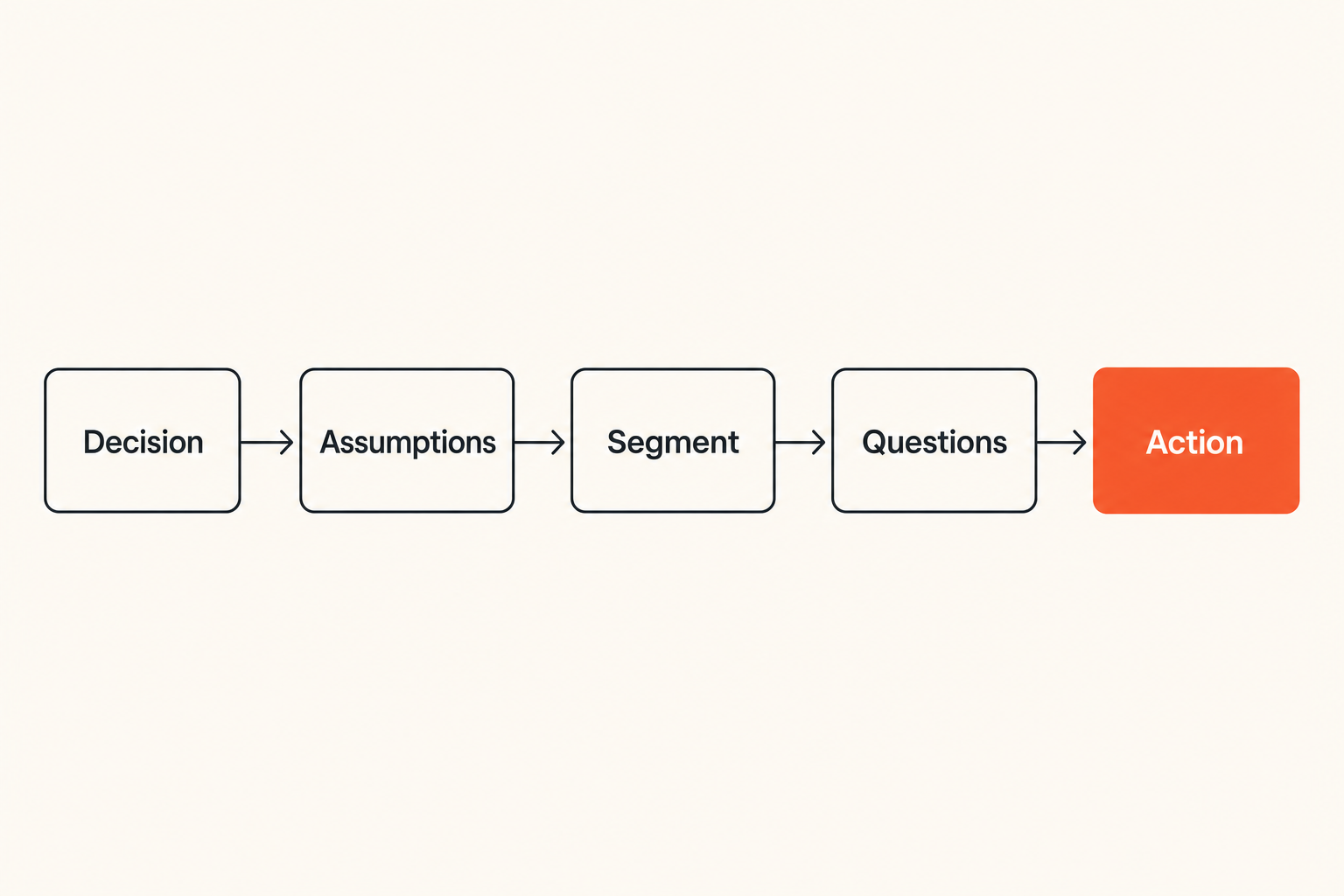
A useful way to think about it is this: a survey is an input device for a product decision system. If the decision system is unclear, better survey UX will not help.
Practical rule: Never launch a product research survey until you can write the sentence, If the answer is X, we will do Y.
Use surveys when the decision needs breadth
Surveys are useful when you need breadth across a defined audience. They help answer questions like:
- How common is this workflow problem among our target segment?
- Which customer group feels the pain most often?
- Which constraint blocks adoption for the largest share of qualified users?
- Which message maps best to how the market describes the problem?
They are not magic truth machines. They are best at measuring structured signals across a group.
If you are deciding whether a pain is widespread enough to justify a feature, survey research can help. If you are trying to understand the messy emotional context behind that pain, interviews are usually better first.
Do not ask surveys to do interview work
What breaks in practice is that teams use surveys to ask questions that require conversation.
Bad survey question:
- Tell us everything that frustrates you about managing product launches.
Better survey pattern:
- In the last 30 days, which launch planning task created the most rework?
- Who had to fix it?
- How did it affect the launch date?
- Would you be open to a 20-minute follow-up call?
The first question produces long, inconsistent text. The second pattern gives you measurable signal and a path to qualitative follow-up.
Related reading from our network: teams evaluating research and product tooling face similar buying workflow problems, and this guide to software review sites in 2026 is a useful adjacent look at how operators compare options before committing.
Product research surveys need decision architecture
Start with the decision you are willing to make
Before writing questions, define the decision. Not a vague theme. A decision.
Examples:
- Should we build this feature now, later, or not at all?
- Should we position this product for founders or product managers?
- Should our beta onboarding focus on templates, integrations, or guided setup?
- Should we charge per seat, per workspace, or per project?
That changes the conversation. You stop asking, What would be interesting to know? and start asking, What evidence would change the plan?
For teams trying to make launches repeatable, the research decision should plug into the same operating rhythm as roadmap review, release planning, and go-to-market prep. That is why product research often belongs beside product ops, not in a disconnected feedback folder. We covered that broader operating system in Product Operations in 2026, and surveys should feed that same shipping loop.
Map the assumptions behind the decision
Every product decision has assumptions hiding underneath it. A feature bet might assume:
- The problem happens frequently
- The current workaround is painful
- The buyer recognizes the pain
- The user has permission to change tools
- The feature would be used often enough to matter
- The customer would pay, upgrade, or retain because of it
Product research surveys should test the riskiest assumption first. If the riskiest assumption is wrong, the rest of the research is noise.
Here is a simple survey brief format:
survey_name: launch_planning_pain_check
decision: decide whether to build shared launch checklist templates
segment: founders and PMs shipping B2B SaaS products
risky_assumption: launch teams repeat the same coordination work every release
success_signal: at least one qualified segment reports repeated weekly rework
possible_actions:
  - build template MVP
  - run interviews with high-pain respondents
  - drop feature and test integration pain instead
owner: product lead
review_date: 2026-08-26
The format matters because it keeps the survey from becoming a suggestion box.
Separate discovery surveys from validation surveys
Discovery surveys explore where the pain may be. Validation surveys test a defined solution or message.
Do not mix them casually. If half the survey is broad discovery and the other half asks respondents to react to your feature idea, you will bias the answers and confuse the analysis.
A simple split:
| Survey type | Use it for | Good question style | Common mistake |
|---|---|---|---|
| Discovery | Finding pain patterns | Recent behavior and current workaround | Asking if people want your idea |
| Validation | Testing a specific bet | Tradeoff, willingness, priority | Treating polite interest as demand |
| Launch | Tuning positioning | Message clarity and adoption blockers | Asking users to write your copy |
| Retention | Understanding ongoing value | Frequency, outcomes, replacement risk | Surveying only happy customers |
Practical rule: If the survey asks about your solution before it understands the respondent's current behavior, it is probably measuring politeness.
Design questions that create usable product signals
Ask about recent behavior before opinions
Opinions are cheap. Recent behavior is more expensive, and therefore more useful.
Weak question:
- Would you use a tool that helps manage product launches?
Stronger questions:
- How many product launches did you coordinate in the last 90 days?
- Which launch task took longer than expected most recently?
- What tool or process did you use to manage the launch?
- What happened when something slipped?
The reason this works is simple: behavior anchors the answer. A respondent who has actually dealt with the problem can describe the workflow, constraints, and consequences.
For indie hackers and solopreneurs, this matters because small sample sizes are common. If you only get 25 responses, you need those 25 responses to be anchored in reality.
Force tradeoffs instead of collecting wishes
People will say yes to almost anything in a survey if there is no cost attached. That is why wish-list questions are dangerous.
Instead of asking, Which features would you like?, ask respondents to make tradeoffs:
- Pick the one feature you would use first.
- If we only improved one part of the workflow, which should it be?
- Which would you remove from your current stack if this worked well?
- Would you rather save setup time, reduce coordination errors, or improve reporting?
Tradeoffs create prioritization signal. They also expose segmentation differences. Founders may choose speed. Product managers may choose visibility. Customer success may choose fewer support escalations.
Keep rating scales tied to action
Rating scales are useful only when the team knows what to do with the score.
A 1 to 10 question without an action threshold creates analysis theater. A better pattern is to define what each range means before launch:
- 1 to 3: not a real pain for this segment
- 4 to 6: possible pain, needs interview follow-up
- 7 to 8: meaningful pain, compare with other priorities
- 9 to 10: acute pain, candidate for deeper validation
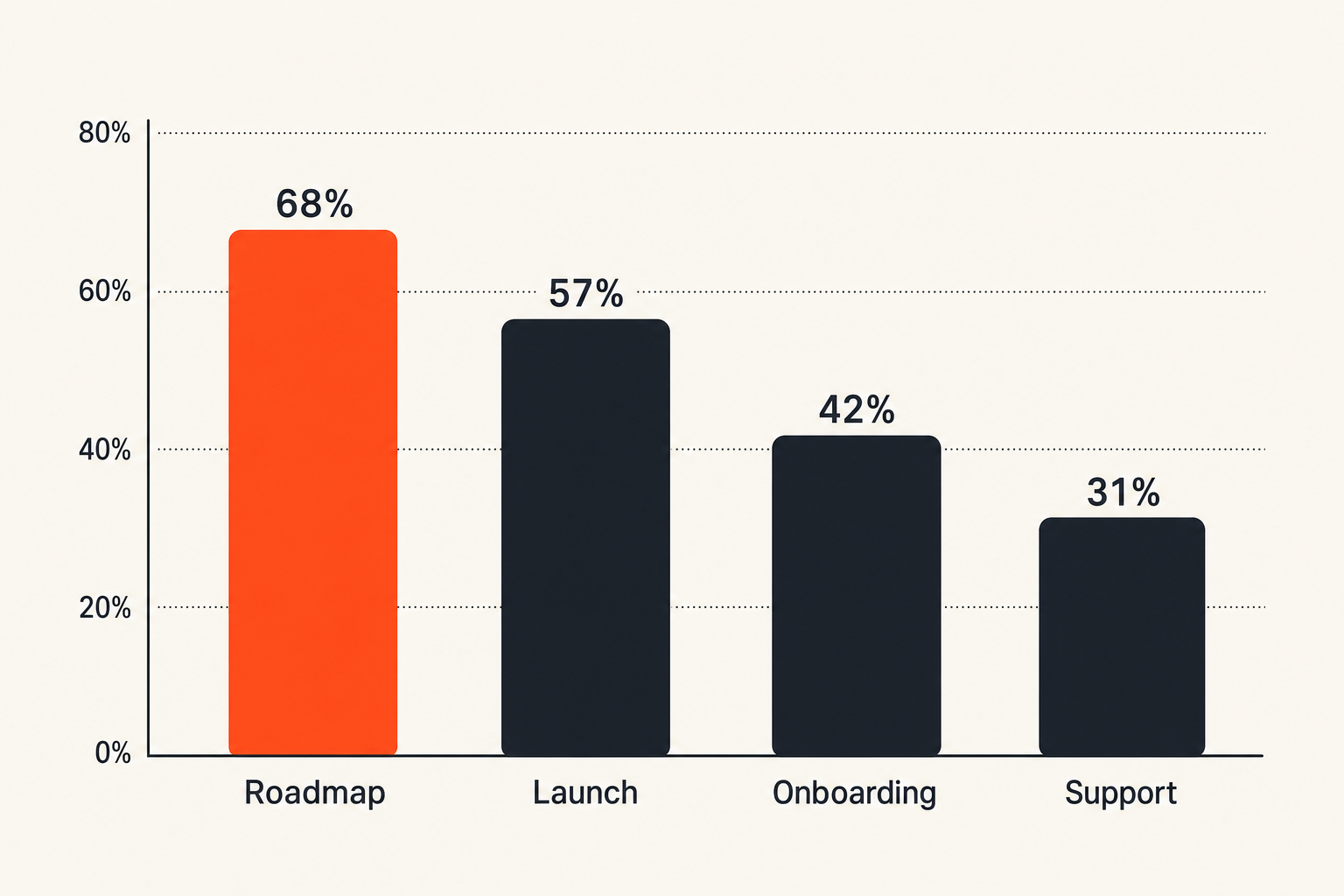
Even then, do not rely on averages alone. Averages hide polarized signals. Ten founders rating a problem as 10 and ten enterprise PMs rating it as 1 is not an average pain of 5.5. It is a segmentation insight.
Related reading from our network: remote collaboration has the same control-and-handoff problem when teams confuse access with workflow, and this piece on garage door opener remote thinking for remote teams is a useful analogy for designing safer product research handoffs.
Segment respondents before you analyze answers
Define who owns the problem
Most bad survey analysis starts with the wrong denominator. Teams say, 42 percent of respondents wanted this, but they never ask whether those respondents are the actual users, buyers, or influencers.
For product research surveys, segment around problem ownership:
- User: feels the workflow pain directly
- Buyer: controls budget or approval
- Admin: implements the product or process
- Influencer: recommends or blocks adoption
- Executive: cares about outcome, not workflow detail
A founder building a developer tool should not weigh a casual newsletter reader the same way as an engineering lead who has shipped the relevant workflow three times this quarter.
Capture context fields without bloating the survey
You need enough context to analyze the answers. You do not need a census.
Useful context fields often include:
- Role
- Company stage or team size
- Product type
- Current tool or process
- Frequency of the problem
- Budget or authority level, if relevant
- Launch or usage recency
Keep the survey short enough that qualified people finish it. If a context field will not change analysis or routing, remove it.
Practical rule: Every demographic or firmographic question must earn its place by changing how you interpret the answer.
Watch for sample quality problems
Sample quality is not an academic concern. It determines whether your product decision is grounded or misleading.
Common sample problems:
- Only fans respond, so pain looks stronger than the market reality
- Only frustrated users respond, so the product looks worse than it is
- Incentive hunters rush through the form
- Unqualified respondents answer because the survey was posted broadly
- Existing customers dominate a survey intended for prospects
The fix is not always a bigger sample. Often the fix is clearer targeting and better screening.
Add screening questions early:
- Have you shipped a software product in the last six months?
- Are you involved in launch planning?
- Which of these tasks have you personally handled?
Then analyze qualified responses separately from unqualified ones. Do not delete the rest automatically, but do not let them drive the decision.
Distribution is part of survey design
Each channel creates a different answer shape
The channel is not neutral. A survey sent to active customers produces different answers than one posted on X, a founder community, a waitlist, or an in-app prompt.
A useful way to think about it:
| Distribution channel | Likely respondent bias | Best use |
|---|---|---|
| Active customers | Familiar with current product | Retention, roadmap, workflow friction |
| Churned users | Experienced a mismatch | Loss reasons, unmet expectations |
| Waitlist | Interested but unproven | Positioning, urgency, qualification |
| Public social post | Broad and noisy | Early discovery, language mining |
| Niche community | Context-rich but opinionated | Segment-specific pain validation |
| In-app prompt | Behavior-adjacent | Feature friction, activation blockers |
This is why survey results should always be labeled by source. A result without source context is easy to overread.
Incentives change respondent behavior
Incentives are not bad. They are just design variables.
A gift card may increase completion volume but also attract low-quality responses. Early access may attract people who already like the idea. A discount may attract price-sensitive respondents. A personal reply from the founder may attract thoughtful operators but reduce scale.
Use incentives intentionally. If you need deep feedback from a small group, a high-touch incentive may be better than a generic reward. If you need quick directional signal, a lighter incentive may be enough.
Survey cadence should match shipping cadence
Surveys should not appear only when the team panics.
For a shipping-focused team, useful cadences include:
- Pre-build survey before committing engineering time
- Beta survey after users attempt the core workflow
- Launch survey after the first wave of adoption
- Churn or inactivity survey when usage drops
- Quarterly customer pulse for roadmap direction
The point is not to survey constantly. The point is to place product research surveys at decision points where the answers can still change the plan.
Turn product research surveys into product decisions
Use a decision log, not a slide deck graveyard
Many teams do the research, present the findings, and then lose the thread. Three weeks later, nobody remembers which decision was made or why.
Use a decision log. Keep it boring and structured:
| Field | Example |
|---|---|
| Decision | Build launch checklist template MVP |
| Survey | launch_planning_pain_check |
| Segment | PMs and founders shipping SaaS products |
| Key signal | Repeated launch coordination rework among qualified respondents |
| Confidence | Medium, needs beta validation |
| Action | Prototype templates and recruit 10 beta users |
| Owner | Founder or PM |
| Review date | Two weeks after beta start |
This turns survey data into operating memory. It also protects the team from revisiting the same debate every sprint.
Translate findings into roadmap options
Survey findings rarely produce one obvious roadmap answer. They usually produce options.
For example, a survey might show that users struggle with launch coordination, but the constraint differs by segment:
- Indie hackers need a simple checklist
- Product managers need cross-functional visibility
- Founders need accountability and launch confidence
- Agencies need repeatable client-facing templates
Those findings could map to different roadmap options:
- Build a lightweight checklist MVP
- Build collaboration and owner assignment
- Build launch readiness scoring
- Build reusable launch templates for teams
The survey does not choose automatically. It narrows the decision and shows where the team should investigate next.
This is also where a product catalog or launch architecture helps. If your team already maps features, audiences, launch assets, and ownership in one place, survey findings are easier to route. That operating model is adjacent to the approach described in Product Catalog Architecture for Software Teams.
Hand off the signal to launch and support
Research should not stop at product. Good survey findings help marketing, sales, onboarding, and support.
Examples:
- If respondents describe the problem using a specific phrase, test it in launch copy
- If a segment reports setup anxiety, build onboarding content before launch
- If buyers worry about switching cost, prepare migration guidance
- If users misunderstand the category, adjust positioning
- If support themes repeat, add help docs or product education
This is where product research surveys become part of go-to-market execution. A product marketing manager, founder, or PMM-minded operator can turn survey language into positioning and demand work. For a deeper look at that operator role, see Product Marketing Manager: The Operator Role That Turns Shipping Into Demand.
Tooling, data hygiene, and privacy boundaries
Choose tools around workflow, not aesthetics
Survey tools are rarely the bottleneck. Most popular tools can collect responses. The better question is whether the tool fits your workflow.
Look for:
- Conditional logic for screening
- Response export and API access
- CRM or spreadsheet integration
- Anonymous and identified response modes
- Team comments or review workflow
- Basic fraud and duplicate controls
- Ability to tag responses by source
The mistake teams make is choosing the prettiest form and then manually patching the workflow later. If responses need to inform roadmap, customer success, and launch messaging, pick tools that make handoff clean.
Normalize and clean responses early
Messy data slows decisions. Normalize early:
- Standardize role names
- Deduplicate email addresses
- Tag response source
- Separate qualified and unqualified respondents
- Convert free-text categories into controlled tags where possible
- Preserve raw text for language mining
Do not overclean the language itself. The exact words customers use can be valuable for positioning. Clean structure, not voice.
A simple response model might look like this:
respondent_id: resp_1842
source: waitlist
qualified: true
role: founder
team_size: 2-10
recent_launch: true
primary_pain: launch_coordination_rework
pain_frequency: weekly
severity: 8
follow_up_allowed: true
notes: keeps recreating launch docs for every release
Respect consent and sensitive data boundaries
Product research can drift into sensitive territory quickly. You may ask about revenue, team structure, tools, internal process, budgets, or failures. Treat that information with care.
At minimum:
- Tell respondents how the answers will be used
- Do not ask for sensitive data you do not need
- Separate research notes from public testimonials
- Get explicit permission before quoting someone
- Limit access to raw responses when needed
- Be careful with customer-identifiable feedback in public decks
Related reading from our network: payment teams face similar state, consent, and operational boundary problems in a different domain, and this architecture breakdown of solution peptides payment workflows is useful adjacent reading on why the visible UI is not the whole system.
Use product research surveys across the launch lifecycle
Before build, test the problem shape
Before build, the goal is not to validate your solution. The goal is to understand the problem shape well enough to decide whether the build is worth exploring.
Good pre-build survey questions:
- When did you last experience this problem?
- What triggered it?
- What did you do instead?
- Who was involved?
- What did it cost in time, money, reputation, or momentum?
- What have you already tried?
This helps you avoid building for a problem that sounds painful but happens rarely, or a problem that users complain about but will not change behavior to solve.
During beta, test adoption friction
Beta surveys should focus on behavior inside the product or prototype.
Ask:
- Did you complete the core workflow?
- Where did you hesitate?
- What did you expect to happen next?
- What would stop you from using this again?
- What would you need before inviting a teammate?
The beta survey is not a satisfaction poll. It is a friction map.
Combine survey responses with usage data where possible. If a user says the workflow was easy but never completes it, trust the behavior enough to investigate. If a user complains loudly but keeps using the product every week, investigate the complaint without assuming failure.
After launch, test retention and positioning
After launch, product research surveys should help answer two questions:
- Are the right users getting value?
- Is the market understanding the product correctly?
Useful post-launch questions:
- What were you trying to accomplish when you signed up?
- Did the product help you accomplish it?
- What nearly stopped you from continuing?
- What would you be disappointed to lose?
- How would you describe this to someone like you?
That last question is useful, but do not outsource positioning entirely to customers. Customers give you raw language. The team still has to turn that language into a clear market narrative.
What breaks when teams run surveys badly
Leading questions produce false confidence
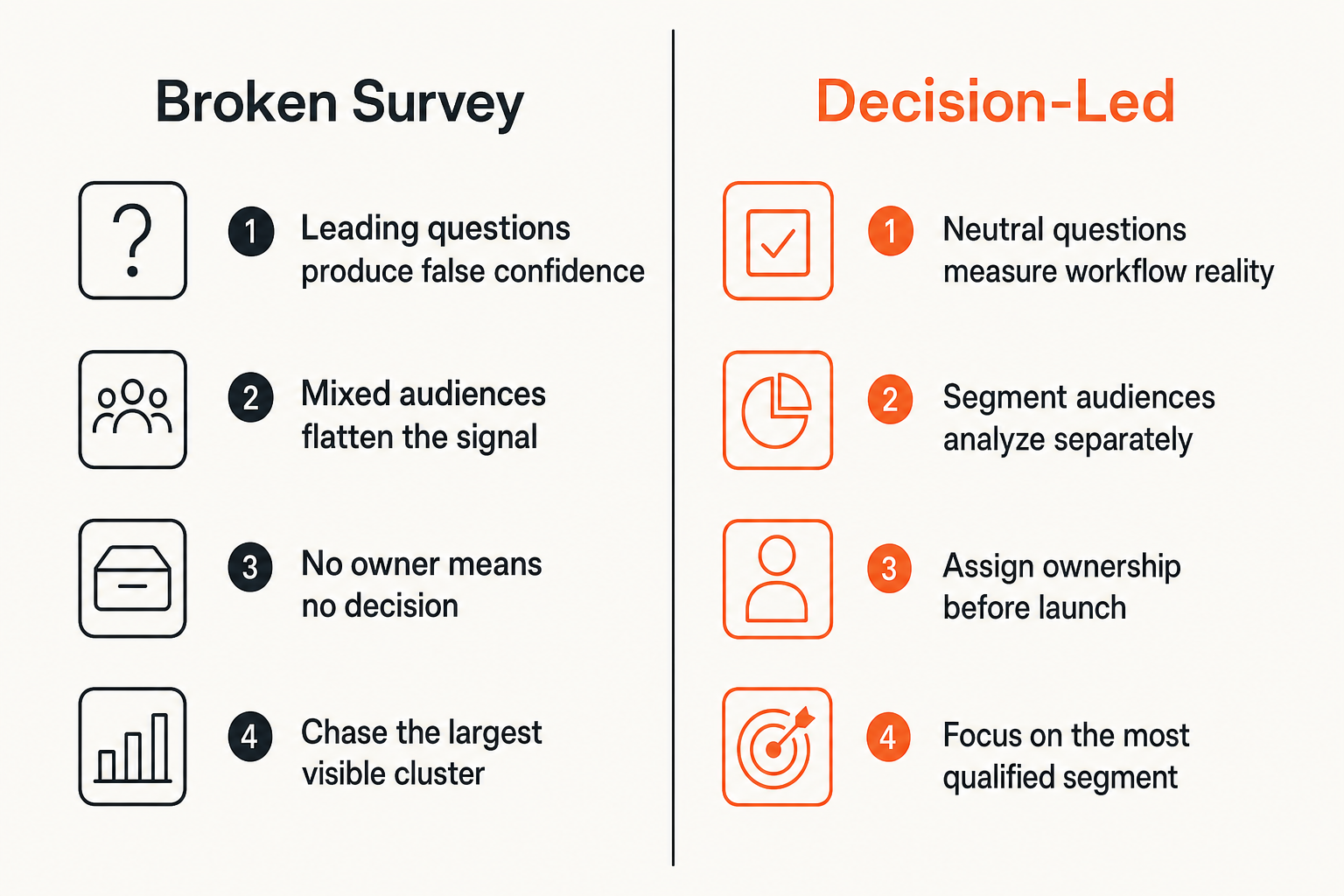
A leading question tells respondents what answer the team wants.
Bad:
- How useful would our powerful AI launch assistant be for your team?
Better:
- Which launch planning tasks currently require the most manual work?
- Have you tried using AI for any of those tasks?
- What worked and what failed?
The first question measures enthusiasm for your framing. The second measures workflow reality.
Mixed audiences flatten the signal
If your survey includes founders, enterprise PMs, students, consultants, and casual newsletter readers, the average answer may be meaningless.
Mixed audiences are not always bad, but they must be analyzed separately. If you cannot segment the responses, you cannot responsibly interpret the result.
What breaks in practice is that teams chase the largest visible cluster, not the most qualified one. A noisy audience can make a feature look attractive because it is broadly understandable, while a narrower but higher-value segment has a more urgent problem.
No owner means no decision
A survey without an owner becomes research inventory. Someone may read it. Someone may quote it. Nobody changes the roadmap.
Assign ownership before launch:
- Who writes the survey brief?
- Who approves the question set?
- Who monitors response quality?
- Who analyzes the findings?
- Who makes or recommends the decision?
- Who communicates the outcome?
If nobody owns the decision, do not run the survey yet.
Survey theater wastes trust
Survey theater happens when a team asks customers for feedback but has no intention of acting on it. Customers notice.
Sometimes the right answer is not to ask. If the roadmap is locked, say that. If the survey is only for message testing, say that. If you are exploring a future direction, say that.
Trust compounds when respondents see that their input led to a better product, clearer positioning, or at least a thoughtful follow-up. It erodes when every survey feels like a black hole.
Practical rule: Close the loop with respondents when possible. Even a short note explaining what you learned and what happens next makes future research easier.
What works and what fails in practice
What works
The product research surveys that work tend to share the same operational traits:
- They start with a decision, not a curiosity
- They define the target respondent clearly
- They ask about behavior before opinions
- They force prioritization and tradeoffs
- They segment answers before analysis
- They connect findings to roadmap or launch actions
- They preserve customer language for positioning
- They create follow-up paths for interviews or beta recruitment
This does not require a large research department. A founder can do it. A PM can do it. A solopreneur can do it with a spreadsheet and discipline.
The important part is not sophistication. It is traceability from question to signal to decision.
What fails
The surveys that fail usually fail before they are sent.
Common failure patterns:
- Asking everyone because the team is afraid to choose a segment
- Asking vague future-intent questions
- Treating feature requests as roadmap votes
- Using averages without segment analysis
- Making the survey too long for busy respondents
- Ignoring non-response bias
- Collecting free-text answers nobody has time to read
- Failing to connect findings to ownership
A bad survey can be worse than no survey because it gives the team false confidence. The team says, We researched this, when what really happened is they collected ambiguous opinions from an unclear audience.
A practical survey workflow
Use this sequence when you need a survey that can actually support a shipping decision:
- Write the decision statement in one sentence.
- List the assumptions behind the decision.
- Pick the riskiest assumption the survey can test.
- Define the qualified respondent segment.
- Choose distribution channels that reach that segment.
- Draft behavior-first questions and screening questions.
- Define analysis rules before responses arrive.
- Launch to a small pilot group and inspect response quality.
- Send the broader survey only after fixing confusing questions.
- Analyze by segment, source, and problem ownership.
- Write a decision log entry with confidence level and action.
- Route follow-up tasks to product, launch, onboarding, or support.
This workflow is intentionally plain. The value is not in making research look fancy. The value is in making the next product decision less dependent on guessing.
Where sh1pt.com fits into product research surveys
Research belongs inside the shipping system
Product research surveys should not live in a separate universe from product development. They should sit inside the same system that handles ideas, experiments, roadmap decisions, launch assets, and post-launch learning.
For founders and product teams, the architecture looks like this:
- Research identifies the pain
- Product turns the pain into options
- Engineering scopes the smallest useful build
- Product marketing turns the signal into positioning
- Launch execution tests the market response
- Support and analytics validate what happens after adoption
That loop is the work. The survey is just one input.
Use surveys to reduce launch risk
The best use of product research surveys is not to guarantee success. They cannot do that. The best use is to remove avoidable ambiguity before expensive work begins.
A good survey can tell you:
- Which segment is most urgent
- Which pain is real versus imagined
- Which message is clear or confusing
- Which adoption blocker must be solved before launch
- Which beta users are worth talking to next
- Which roadmap option deserves the next build cycle
That is practical leverage. Not hype. Not certainty. Just better decisions under uncertainty.
At sh1pt.com, the focus is helping people building and launching software products understand shipping strategies, product development processes, and growth tactics. Product research surveys fit that because they are not just research artifacts. They are part of how teams move from idea to market with fewer blind spots.
Try sh1pt.com
sh1pt.com is for people building and launching software products who want practical shipping strategies, product development processes, and growth tactics. If you want more operator-focused guides on product research surveys and launch execution, Try sh1pt.com.