
A Product Hunt launch can look deceptively simple: publish a page, ask for support, reply to comments, watch the ranking, then post a thank-you note.
That is how teams end up with a busy day, a traffic spike, and very little they can reuse.
Teams think the problem is getting more upvotes. The real problem is designing a launch workflow that turns attention into signal, conversations, activation, and follow-up. That changes the conversation.
Product Hunt is not a magic distribution channel. It is a public moment that compresses positioning, audience quality, product readiness, founder responsiveness, and operational discipline into one visible window. If the system around that moment is weak, the launch exposes it.
Table of contents
- Product Hunt is a system, not a day
- Decide if Product Hunt is the right channel
- Build the launch offer before the launch page
- Turn audience building into a pre launch workflow
- Product Hunt launch day execution
- The technical checklist behind a clean Product Hunt launch
- What breaks when teams implement Product Hunt badly
- Post launch follow up is where most value is captured
- Metrics that matter after Product Hunt
- Product Hunt as part of a larger shipping system
Product Hunt is a system, not a day
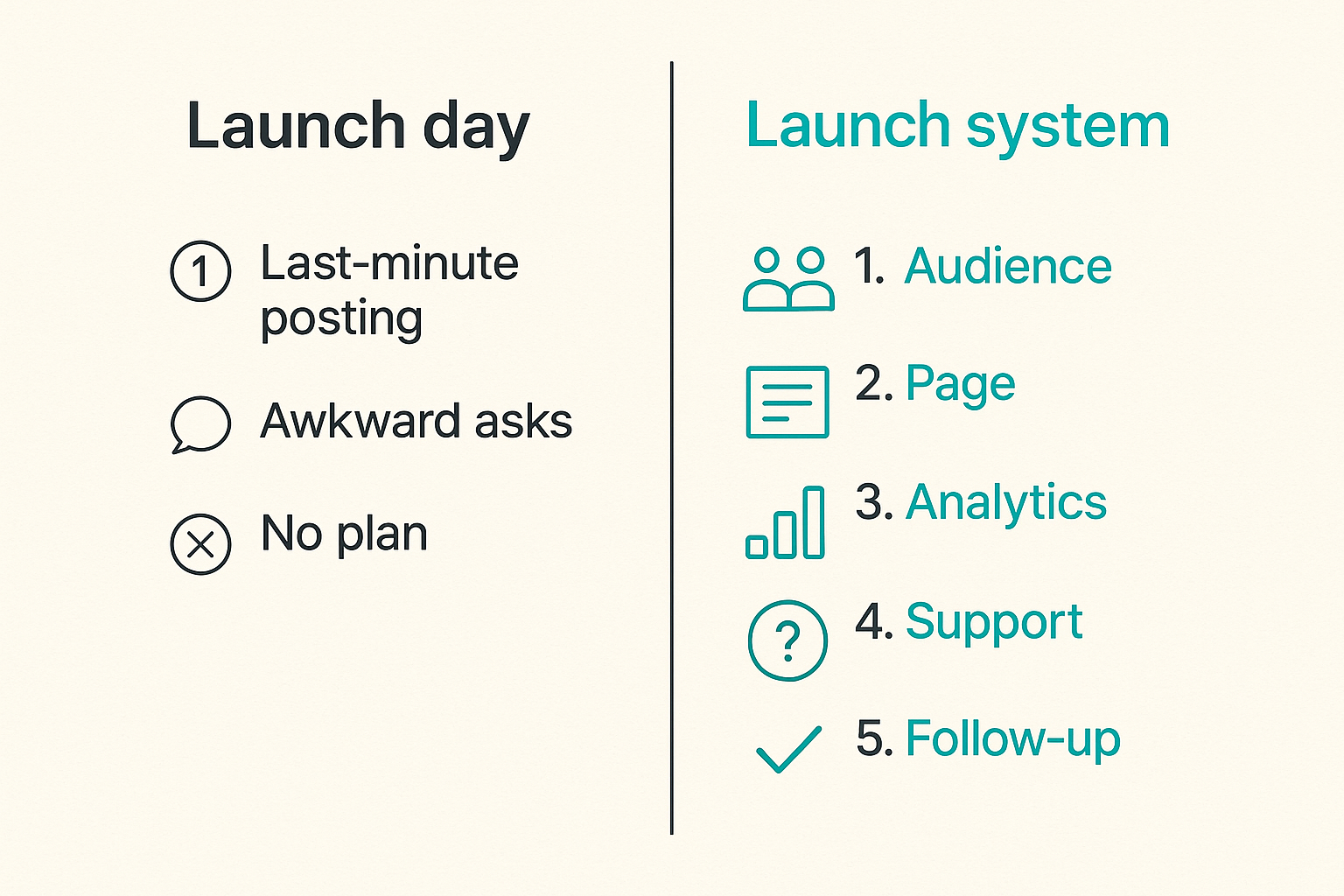
The mistake teams make is treating Product Hunt as a voting event. That creates bad behavior: last-minute posting, awkward asks, generic copy, and no plan for the people who actually show up.
A useful way to think about it is this: Product Hunt is a pressure test for your product story and your operating rhythm. It asks whether strangers can understand the product quickly, whether your existing audience cares enough to participate, whether your onboarding works under concentrated traffic, and whether your team can convert comments into useful action.
The ranking page is only one surface
The Product Hunt page is visible, but it is not the whole system. Around it sit your landing page, onboarding, email capture, demo flow, support queue, analytics, CRM, community posts, founder DMs, social threads, and follow-up campaigns.
If those surfaces are disconnected, the launch becomes noisy. A founder sees votes and comments but cannot answer basic questions:
- Which visitors became signups?
- Which signups activated?
- Which comments revealed a positioning problem?
- Which supporters should be thanked or re-engaged?
- Which users need help before they churn?
Practical rule: Do not launch on Product Hunt until you can trace a visitor from Product Hunt click to signup, activation event, and follow-up owner.
Why the launch window matters
Product Hunt compresses time. Normal discovery might happen over weeks. On launch day, feedback lands in hours. That is useful if you are ready. It is painful if you are not.
The practical question is not whether you can get attention. The practical question is whether the product, message, and team can absorb attention without losing context.
Launch day also creates public evidence. A clear comment from a real user can become sales material. A confused thread can reveal that the product category is not obvious. A bug report can show where onboarding breaks. The window matters because it turns vague assumptions into observable behavior.
What success actually means
Success depends on the product and the stage. For an indie tool, success may be 200 qualified visitors and 20 real conversations. For a SaaS startup, it may be demo requests from operators in a target segment. For a consumer app, it may be waitlist quality and share rate.
Do not let the leaderboard define your business goal. A high rank with poor activation is not better than a lower rank with qualified users.
Decide if Product Hunt is the right channel
Product Hunt works best when the audience can understand the product quickly, try it with low friction, and discuss it publicly. It is weaker when the buyer is hidden behind long procurement, heavy compliance, or enterprise-only context.
This does not mean B2B products cannot launch there. It means the offer has to match the environment. A self-serve diagnostic, free tool, template, dataset, calculator, or open beta usually fits better than a gated enterprise demo with no immediate payoff.
Good fit products
Strong Product Hunt candidates usually have at least three of these traits:
- A clear before-and-after story
- A visual or interactive demo
- A self-serve path
- A founder audience, maker audience, or early adopter audience
- A pricing or free plan that allows immediate trial
- A category that people can evaluate without a sales call
For broader planning, a Product Hunt push should sit inside your go-to-market system, not replace it. If you are building that operating model, this guide on go to market strategy in 2026 is the adjacent layer: audience, channels, launch workflow, metrics, and founder decisions.
Bad fit products
Bad fit does not mean bad product. It means the channel dynamics are wrong.
| Product pattern | Why Product Hunt may struggle | Better launch angle |
|---|---|---|
| Enterprise-only platform | Buyers cannot test quickly | Publish a focused tool or benchmark |
| Regulated workflow | Trust questions dominate | Use founder-led demos and expert validation |
| Complex infrastructure | Value is not obvious in screenshots | Launch a free analyzer, checklist, or integration |
| Local service marketplace | Audience mismatch | Launch in the local supply or demand channel |
| Internal admin tool | Low public excitement | Package a template, report, or workflow lesson |
The mistake teams make is forcing the entire product into Product Hunt instead of packaging the part that fits the audience.
Pick one launch goal
Pick one primary goal before you write copy:
- Validate positioning.
- Acquire early users.
- Build founder credibility.
- Drive waitlist signups.
- Recruit design partners.
- Test pricing interest.
- Create a public launch asset.
Secondary goals are fine, but one goal should drive decisions. If the goal is activation, reduce friction. If the goal is feedback, invite specific comments. If the goal is design partners, qualify visitors after signup.
Practical rule: A Product Hunt launch with five goals usually produces five ambiguous dashboards. Choose the decision you need the launch to help you make.
Build the launch offer before the launch page
A Product Hunt page is not positioning work. It is where positioning shows up. If the core offer is vague, the page will not save it.
The offer is the compact reason a busy maker, founder, or product manager should stop, click, try, and comment today. It must survive scanning.
Make one promise
Your promise should connect an audience, a painful job, and a specific outcome.
Weak: Project management for modern teams.
Better: Plan weekly engineering work from GitHub issues without maintaining a separate roadmap board.
Weak: AI assistant for productivity.
Better: Turn messy customer calls into prioritized product tickets with evidence attached.
The stronger version tells the reader who it is for, what workflow it touches, and why it is different enough to inspect.
Prepare the assets
Prepare assets before launch week:
- Product name and tagline
- Short description
- Maker comment
- Gallery images
- Demo video or GIF
- Landing page hero
- FAQ answers
- Social announcement copy
- Email or community update
- Support macros for expected questions
If you use AI to draft launch content, keep a human control point. AI is useful for variants, summaries, and repurposing, but the founder still owns the promise. The workflow in AI publishing shipping software is relevant here because launch content needs governance, not just more drafts.
Use incentives carefully
Discounts, lifetime deals, and free credits can help, but they also change the audience you attract. A steep discount may pull in deal collectors rather than long-term users. A free tier may create support load. A waitlist may reduce activation signal.
Offer something that reinforces the product behavior you want:
- Extra usage credits for users who complete onboarding
- Founder office hours for qualified teams
- Early access to a specific feature
- Templates that make the first session easier
- Migration help for a narrow segment
Practical rule: Incentives should improve activation, not just clicks.
Turn audience building into a pre launch workflow
Pre-launch is not a week of begging. It is a workflow for identifying who already has context, who should care, and how to make the launch relevant to them.
The practical question is: who can support the launch because they understand the product, not because they were spammed?
Map supporters by context
Create a simple supporter map:
- Current users
- Beta testers
- Newsletter readers
- Community peers
- Founder friends
- Investors or advisors
- People who gave feedback
- People who publicly discuss the problem
Then assign a reason to contact each group. If you cannot write a specific reason, do not send the message.
Warm people without spam
A useful pre-launch sequence looks like this:
- Two to three weeks before launch, share what you are building and ask for feedback.
- One week before launch, tell relevant people you are launching soon and why their perspective matters.
- One day before launch, send a short note with the launch timing.
- On launch day, share the Product Hunt link and ask for honest feedback, not just votes.
- After launch, thank people and share what you learned.
The language matters. Do not ask people to upvote if they have not seen the product. Ask them to check it out, comment if useful, and share feedback.
Write the internal operating doc
Even solo founders need an operating doc. It prevents launch day from becoming a cloud of tabs and half-answered messages.
Include:
- Launch time and timezone
- Product Hunt page link
- Landing page link
- Tracking links
- Announcement copy
- Support response snippets
- Owner for comments
- Owner for bugs
- Owner for social replies
- Escalation rules
- Post-launch follow-up list
Related reading from our network: teams coordinating launch rooms remotely face similar permission and handoff problems, and this piece on encrypted messaging screen sharing is a useful adjacent read on private sessions, logs, and team handoffs.
Product Hunt launch day execution
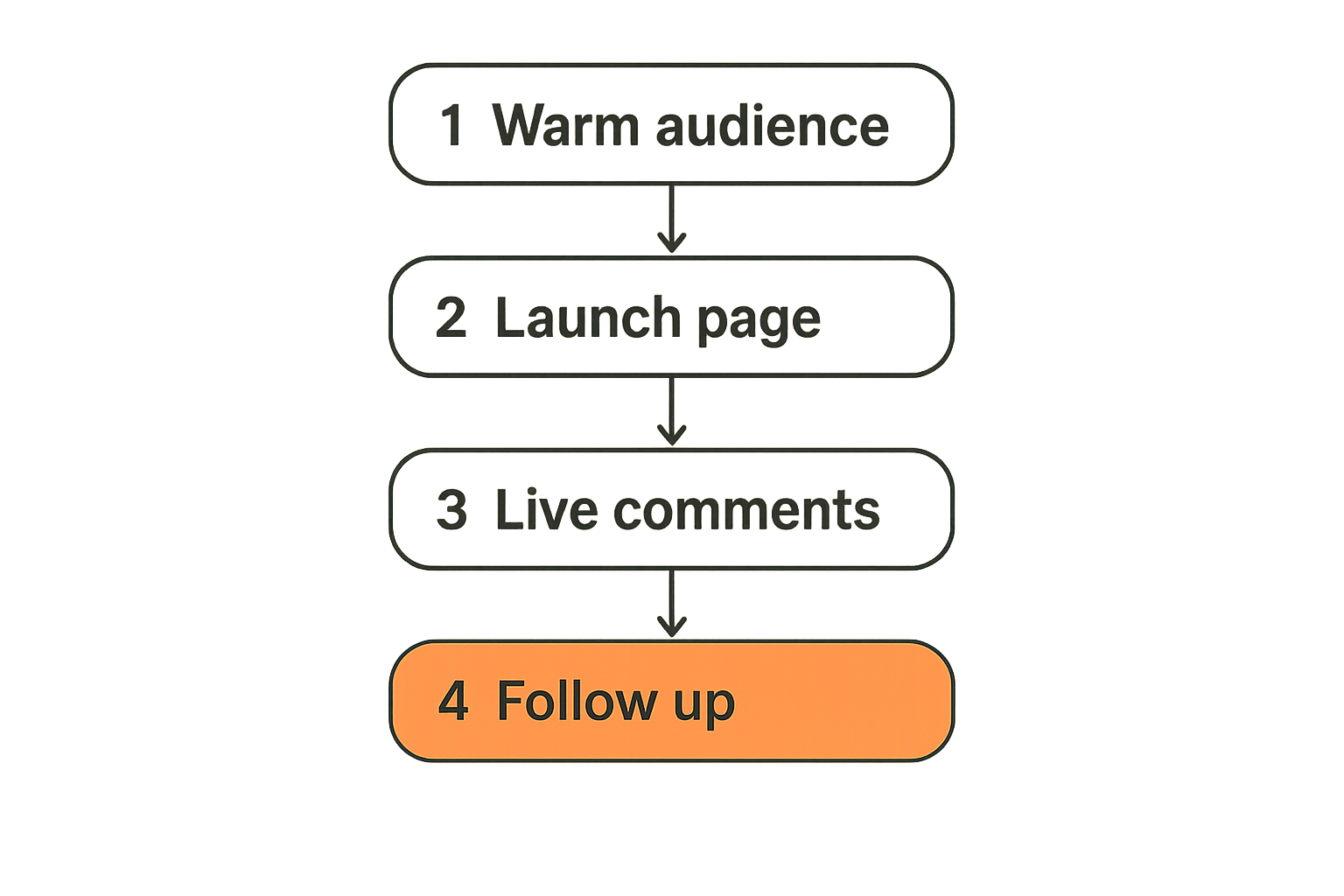
Launch day is an operations problem. The public page is the front end. The back end is response speed, context capture, and prioritization.
What breaks in practice is not usually the posting itself. It is the flood of small decisions: which comment to answer first, which bug matters, which social thread to amplify, which prospect to route to a call, and when to stop refreshing the ranking.
The first four hours
The first four hours set the tone. Have the founder or maker available. Product Hunt users often expect direct maker presence, not a brand account replying with canned messages.
A launch day workflow:
- Verify the Product Hunt page is live and correct.
- Publish the founder comment immediately.
- Send first-wave messages to high-context supporters.
- Announce on owned channels.
- Monitor comments, support, analytics, and errors.
- Capture every meaningful question in a feedback log.
- Route qualified leads to a follow-up list.
- Post updates when bugs are fixed or questions repeat.
Do not over-orchestrate every minute. Leave room for real conversations.
Comment operations
Good comment replies are specific. They answer the question, add context, and often invite a next step.
Bad reply: Thanks for checking us out.
Better reply: Thanks for trying it. The GitHub sync currently imports issues and labels, and milestones are on the short list. If your team plans sprints from milestones, I would like to understand that workflow.
Comments are not just community management. They are public product discovery.
Support triage
Set triage levels before launch:
- P0: Signup, payment, or core product unavailable
- P1: Onboarding blocker for many users
- P2: Confusing UX or missing explanation
- P3: Feature request or edge case
- P4: General comment or praise
This keeps the team from treating every message as equal. Related reading from our network: SaaS teams dealing with launch-day coordination also need reliable private communication norms, and this guide to encrypted messaging software for SaaS teams covers rollout, integrations, and workflow risks.
The technical checklist behind a clean Product Hunt launch
The UI is not the whole system. A clean Product Hunt launch requires working state, tracking, onboarding, billing, email, and support. If those systems fail, the launch produces confusion instead of signal.
Landing page readiness
Your landing page should handle impatient visitors. They came from a page where ten other products are one click away.
Check:
- Page loads quickly enough on mobile and desktop
- Hero explains the product without scrolling
- Primary CTA is obvious
- Demo path works
- Pricing or access expectations are clear
- Social proof does not require trust theater
- FAQ answers launch-day objections
- Product Hunt badge or launch note is visible but not distracting
A useful landing page does not repeat the Product Hunt page. It deepens the promise and moves the visitor to action.
Analytics and attribution
At minimum, track Product Hunt separately from generic referral traffic. Use UTMs consistently.
utm_source=producthunt
utm_medium=launch
utm_campaign=ph_2026_launch
utm_content=maker_comment
Track these events:
- Visit from Product Hunt
- CTA click
- Signup start
- Signup complete
- Onboarding step complete
- Activation event
- Payment or upgrade
- Demo request
- Support request
Do not wait until after launch to discover that your analytics drops the referrer during signup.
Account billing and onboarding
If you charge money, test billing. If you offer free access, test limits. If you require email verification, test deliverability. If you invite users into a workspace, test team creation.
Launch traffic often finds boring defects: expired API keys, broken OAuth callbacks, rate limits, missing empty states, confusing trial copy, and email templates that make no sense.
Related reading from our network: if your launch depends on CI/CD reliability or package updates, this practical guide to security service architecture for CI/CD is adjacent because release confidence is part of launch readiness.
Practical rule: Freeze risky product changes before launch, but keep the ability to ship small fixes quickly.
What breaks when teams implement Product Hunt badly
Bad Product Hunt launches usually fail before they go live. The page may publish on time, but the system around it is brittle.
The common failure modes are predictable.
Vanity traffic hides weak activation
A traffic spike feels good. It can also hide that visitors bounced, signups never activated, and the product did not explain itself.
What fails:
- Celebrating visits without cohort tracking
- Counting all signups as equal
- Ignoring onboarding completion
- Not separating curious makers from target buyers
- Letting the launch dashboard replace product judgment
What works:
- Compare Product Hunt visitors against other channels
- Look at activation by segment
- Read session recordings or support logs for friction
- Ask new users what they expected before clicking
- Follow up with users who reached value quickly
Fake engagement damages trust
Product Hunt users can smell forced engagement. Generic comments, vote circles, and copy-paste asks make the launch look weaker, not stronger.
Avoid:
- Buying votes
- Coordinated low-context comments
- Asking strangers for blind support
- Overposting in communities where you have no history
- Turning every founder DM into a transaction
The better path is slower but more durable: build context before the ask.
Founder availability becomes the bottleneck
The founder should be visible, but not every task should require founder judgment. If one person handles comments, bugs, billing, DMs, social posts, and analytics, the launch will drop context.
Even a tiny team can split roles:
- Founder: positioning, comments, high-value conversations
- Engineer: bugs, logs, deploys, performance
- Operator: supporter messages, tracking, CRM updates
- Support owner: tickets, docs, onboarding help
For a solo founder, use time blocks. Comments for 25 minutes, support for 15, analytics for 10, repeat. Chaos is not a strategy.
Post launch follow up is where most value is captured
Most teams underinvest here. They treat the Product Hunt launch as finished when the ranking day ends. In reality, the best signal often appears after people have had time to try the product.
The launch creates a list of people with different levels of intent. The follow-up system decides whether that list becomes learning, revenue, or just a memory.
Segment leads within forty eight hours
Segment quickly while context is fresh:
- Activated users
- Signed up but did not activate
- Visited but did not sign up
- Commented with a specific use case
- Asked about pricing
- Reported a bug
- Shared publicly
- Requested a feature
Each segment deserves a different follow-up. Do not send the same thank-you email to a user who hit a bug and a prospect who asked for team pricing.
Convert feedback into decisions
Create a feedback log with fields that force clarity:
| Field | Example |
|---|---|
| Source | Product Hunt comment |
| User type | Solo founder |
| Workflow | Changelog publishing |
| Problem | Wants GitHub issue import |
| Severity | Blocks adoption |
| Decision | Add to discovery queue |
| Owner | Product |
| Follow-up date | This week |
The goal is not to honor every request. The goal is to preserve context so the team can make better decisions.
Ship an aftershock release
An aftershock release is a small update shipped within days of launch. It shows that the product is alive and that feedback changed something.
Good aftershock releases include:
- Fixed onboarding bug
- Added requested export
- Clarified pricing page
- Published a workflow template
- Improved empty state
- Added integration instructions
Then tell the people who asked. This closes the loop and often starts better conversations than the launch itself.
Metrics that matter after Product Hunt
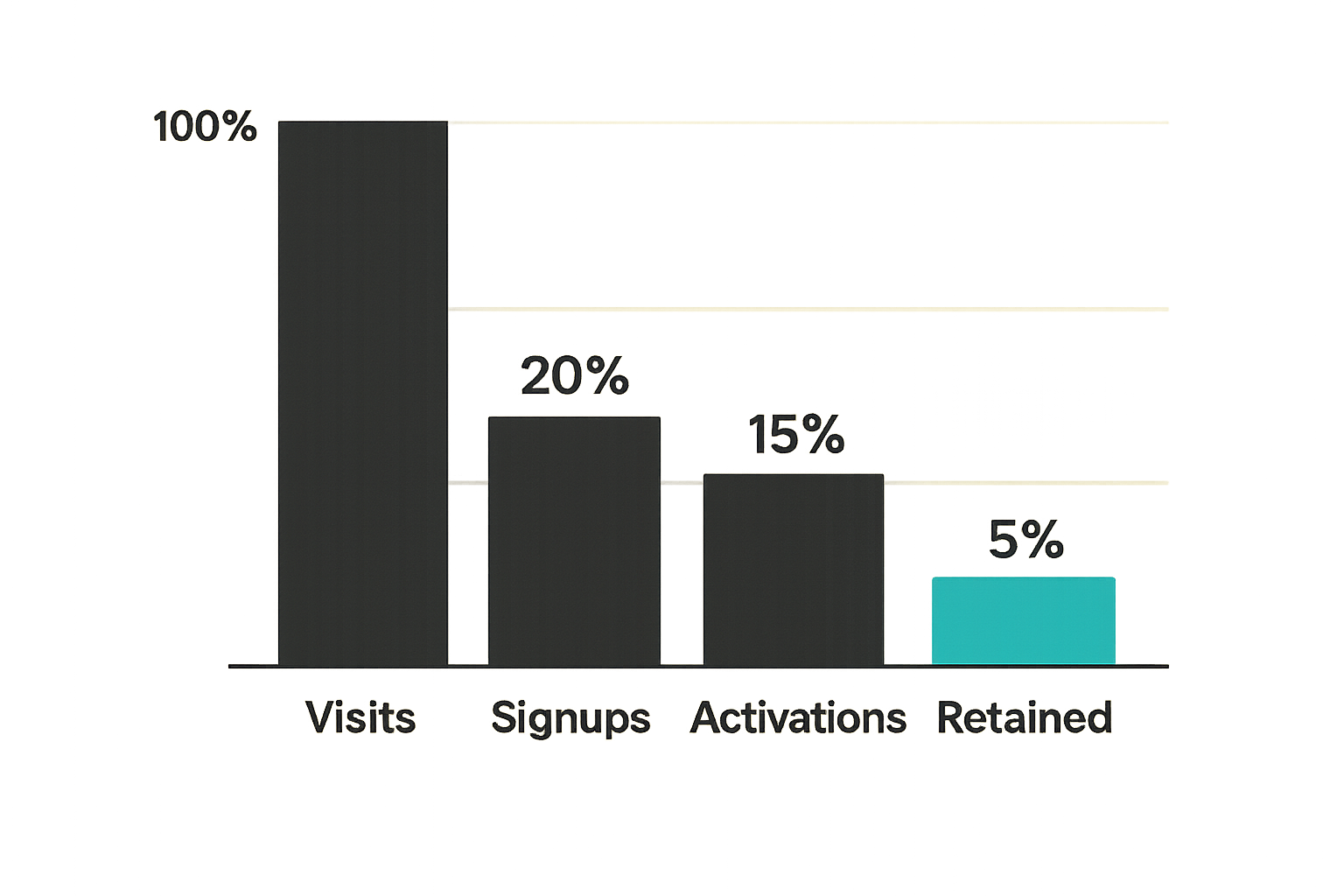
The Product Hunt leaderboard is a temporary scoreboard. Your product metrics are the operating system.
The mistake teams make is measuring launch success only at the top of the funnel. That rewards attention instead of progress.
Acquisition quality
Look at source quality, not just source volume:
- Product Hunt sessions
- New visitors versus returning visitors
- Signup conversion rate
- Email domain patterns
- Target segment percentage
- Demo request quality
- Geography or timezone if relevant
- Device split if onboarding is complex
If many visitors are curious builders outside your target segment, that is not bad. It just means you should not forecast revenue from raw traffic.
Activation and retention
Activation is the first meaningful outcome in the product. Define it before launch.
Examples:
- Created first project
- Connected GitHub
- Published first page
- Imported first customer call
- Invited a teammate
- Completed first checkout test
- Generated first report
Then watch whether Product Hunt users reach that event and return. If they sign up but do not activate, the launch did its job by exposing a product or onboarding problem.
Qualitative signal
Qualitative signal matters because Product Hunt is a conversation-heavy channel. Read the comments, DMs, support tickets, and social replies.
Look for:
- Repeated confusion about category
- Surprise at a specific feature
- Objections to pricing
- Requests from the wrong audience
- Use cases you did not expect
- Comparisons to competitors
- Language users repeat back to you
That language can become better landing page copy, sales discovery questions, onboarding steps, and roadmap inputs.
Product Hunt as part of a larger shipping system
Product Hunt should not be a one-off stunt. It should be one launch motion inside a larger shipping system.
The practical question is how the launch changes what you build, who you talk to, and how you go to market next.
Connect launch to roadmap
Before launch, define which roadmap questions you want answered. After launch, update the roadmap with evidence.
Examples:
- If users understand the product but do not activate, prioritize onboarding.
- If the wrong audience signs up, revisit positioning and channels.
- If one use case dominates comments, explore a narrower wedge.
- If pricing questions repeat, improve packaging.
- If users ask for integrations, validate whether integrations unlock activation or just sound good.
This is where Product Hunt connects to product management. The launch produces signals, but your system has to turn signals into decisions. For a deeper operating model, see this practical guide to a product development workflow that connects signals, releases, feedback, and repeatable decisions.
Build a repeatable launch loop
A repeatable launch loop looks like this:
- Pick the product or feature slice.
- Define the audience and launch goal.
- Write the promise.
- Prepare assets and tracking.
- Warm relevant supporters.
- Launch and capture signal.
- Segment users and feedback.
- Ship an aftershock release.
- Update positioning, roadmap, and next channel plan.
That loop can be used for Product Hunt, a newsletter launch, a community drop, a beta cohort, a marketplace listing, or a founder-led campaign. The channel changes. The operating discipline stays.
Practical rule: Treat Product Hunt as one public experiment in your shipping system, not as the shipping system itself.
Try sh1pt.com
sh1pt.com is for people building and launching software products who want to understand shipping strategies, product development processes, and growth tactics. If you are planning a Product Hunt launch, use it as a system for sharper positioning, cleaner execution, and better post-launch decisions. Try sh1pt.com.