
Product led growth sounds clean until you try to run it. The website says users discover the product, try it, activate, invite teammates, upgrade, and expand. In production, they sign up, click around, miss the core value, ask support a question your onboarding never answered, and disappear.
Teams think the problem is acquisition. The real problem is that the product, pricing, onboarding, support, analytics, and launch rhythm are not operating as one system.
That changes the conversation. Product led growth is not a button labeled Start free. It is an architecture decision about how your product creates trust before a sales call, how fast a new user reaches value, and how your team learns from every failed activation path.
The practical question is not whether PLG is good. The practical question is whether your product can carry enough of the buying, onboarding, and expansion workload without creating a hidden support mess.
Table of contents
- Why product led growth is an operating model
- Product led growth starts with the activation path
- Build the PLG data loop before you scale traffic
- Design monetization without breaking adoption
- What works in product led growth
- What fails when teams copy PLG tactics
- The product led growth implementation workflow
- Connect PLG with go to market systems
- Measure product led growth like a shipping system
- When sh1pt.com fits your PLG operating model
Why product led growth is an operating model
Teams think the problem is acquisition
Most founders encounter product led growth through a surface-level tactic: free trials, freemium plans, onboarding checklists, public templates, invite loops, or usage-based pricing. Those can help. They can also hide the actual work.
The mistake teams make is treating PLG as a cheaper acquisition channel. They assume that if they remove friction from sign-up, demand will convert itself. That works only when the product can educate, qualify, activate, and persuade users with minimal human intervention.
A solo founder with a simple browser extension might be able to do that quickly. A B2B SaaS product with permissions, imports, team setup, compliance concerns, and budget ownership cannot just copy the same motion.
PLG asks a product to do jobs that were previously handled by people:
- Explain the problem clearly.
- Show the correct first action.
- Prove value fast.
- Build confidence in data, security, and reliability.
- Surface upgrade moments at the right time.
- Route high-intent accounts to the right human workflow.
If the product cannot do those jobs, more top-of-funnel traffic only produces more noise.
The real problem is product motion design
A useful way to think about it is this: product led growth is a motion design problem. Not visual motion. Business motion.
You are designing how a user moves from curiosity to trust to habit to payment. That path has state transitions, dependencies, failure points, and recovery loops. The product is the interface, but the system includes support docs, lifecycle emails, pricing pages, analytics, launch notes, community posts, and founder follow-up.
This is why PLG belongs next to product strategy, not underneath marketing hacks. If your roadmap is disconnected from activation problems, your team will ship features that look useful but do not change conversion. If your launch calendar is disconnected from usage data, you will promote features your best users do not care about.
For teams still cleaning up the wider product machine, the operating model in Product Operations in 2026 is a useful companion because PLG depends on repeatable shipping, ownership, measurement, and launch hygiene.
Practical rule: Do not call a product led until the product can reliably move a new user to a measurable value moment without founder intervention.
Product led growth starts with the activation path
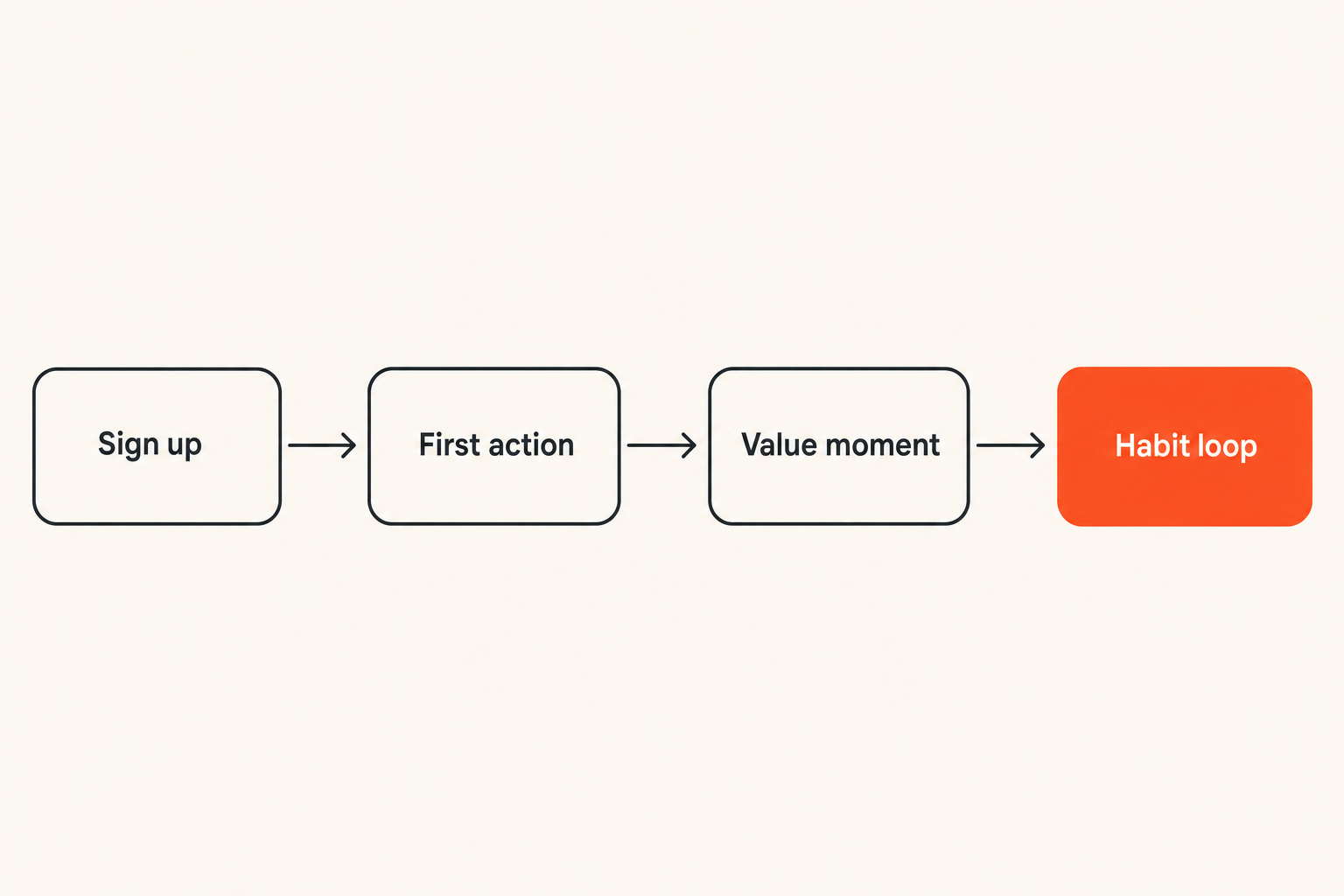
Define the first valuable outcome
Activation is not account creation. It is not completing onboarding. It is not watching a demo video. Activation is the first moment where the user can reasonably say, this product may solve my problem.
For a project management tool, activation might be creating a project, inviting one teammate, and moving the first task. For a developer API, it might be making a successful test request and seeing a realistic response. For an analytics product, it might be connecting a data source and viewing one meaningful chart.
The practical question is: what must happen before the user believes the product is worth another session?
Write that moment down in plain language:
- User imports their first data source and sees a useful insight.
- User publishes their first landing page and shares it.
- User creates a workflow that saves a manual step.
- User sends the first invoice and receives confirmation.
- User invites a teammate and completes one collaborative action.
Then instrument backward. Every step before that moment is either required, optional, or harmful.
Remove every nonessential dependency
What breaks in practice is dependency creep. Teams ask users to verify email, choose a workspace name, select a plan, configure integrations, invite teammates, answer segmentation questions, and watch a walkthrough before any value appears.
Some of that may be necessary. Most of it is not necessary on the first session.
The activation path should be designed like a production workflow:
| Activation element | Good PLG behavior | Bad PLG behavior |
|---|---|---|
| Sign-up | Fast path with minimal fields | Long form before value is visible |
| Sample data | Shows realistic value immediately | Empty state with no guidance |
| Onboarding | One next action at a time | Generic tour of every feature |
| Permissions | Deferred until needed | Blocks the user upfront |
| Upgrade prompt | Appears after value is felt | Appears before trust is built |
| Support | Contextual recovery path | Help center dumping ground |
A good rule is to create a demoable path that works even when the user has no data, no teammates, and no patience. Sample projects, templates, sandboxes, fake-but-realistic data, and guided imports often outperform clever tooltips because they reduce the blank page problem.
Practical rule: If the first session depends on perfect user motivation, the activation path is not production-ready.
Build the PLG data loop before you scale traffic
Track events that explain behavior
Many teams add analytics after they start growing. That is backwards. In product led growth, analytics is part of the product architecture because the product is responsible for teaching you where adoption breaks.
You do not need a complex warehouse on day one. You do need a clean event model around the activation path. Track events that explain the journey, not vanity activity.
A simple PLG event model might include:
- account_created
- onboarding_started
- template_selected
- integration_connected
- first_project_created
- teammate_invited
- value_moment_reached
- upgrade_prompt_viewed
- trial_limit_hit
- plan_upgraded
- churn_signal_triggered
The naming matters less than consistency. If every release changes the event names, your growth data becomes folklore. If the same action fires three events, your conversion review becomes an argument about instrumentation instead of a product decision.
Related reading from our network: Apple Developer Program for AI Agent Products is about a different domain, but the same production lesson applies: signing, events, privacy, and trust workflows need to be designed before scale exposes the gaps.
Separate learning metrics from board metrics
Founders often jump straight to revenue, CAC, LTV, and conversion rate. Those matter, but they are lagging indicators. PLG needs learning metrics that tell the team what to fix this week.
Use two layers:
- Business metrics: revenue, paid conversion, expansion, churn, payback.
- Motion metrics: activation rate, time to value, feature adoption, invite rate, upgrade trigger conversion, reactivation rate.
The motion metrics are where product teams can operate. If activation drops after a pricing change, that is a product problem. If time to value increases after a new onboarding flow, that is a product problem. If invited users never complete their first action, that is a collaboration design problem.
The mistake teams make is using dashboards as decoration. A useful PLG dashboard should create decisions. If no one can say what they would change when a metric moves, the metric is probably not operational.
Practical rule: Track fewer events than you want, but make every tracked event useful enough to change the roadmap.
Design monetization without breaking adoption
Choose the paywall by value timing
A paywall is not just a pricing decision. It is a trust boundary. Put it too early and users cannot evaluate the product. Put it too late and you build a free workload with weak commercial intent.
Different products need different paywall shapes:
| Paywall type | Best fit | Common failure |
|---|---|---|
| Free trial | Clear buyer intent and fast evaluation | Trial expires before value is reached |
| Freemium | Broad market and low marginal cost | Free users create support load with no path to revenue |
| Usage-based | Value scales with consumption | Users fear unpredictable bills |
| Feature-gated | Advanced use cases are clearly premium | Core value is accidentally locked away |
| Seat-based | Team collaboration drives value | Solo activation is blocked by team setup |
The practical question is when the user has enough context to judge value. Your monetization moment should happen after proof, not before understanding.
For technical products, a soft limit often works better than an early hard wall. Let the user build something real, then show what they will need to continue safely: more projects, exports, environments, collaborators, usage volume, audit history, or support guarantees.
Keep expansion tied to real usage
Expansion should feel like the natural next step, not a ransom note. If the user hits a limit while doing meaningful work, the upgrade conversation is grounded in value. If the user hits a limit while still confused, the upgrade prompt becomes friction.
Good expansion triggers include:
- More teammates need access.
- More workflows are being created.
- More data is being processed.
- More environments are needed.
- More admin controls are required.
- More support or reliability guarantees matter.
Bad expansion triggers include arbitrary feature withholding, confusing plan names, forced annual commitments before product trust exists, and usage limits that punish exploration.
This is where PLG and pricing need to meet weekly, not once a year. Pricing pages are not static brochures. They are part of the product experience. If support tickets repeatedly ask what plan includes a basic capability, your pricing architecture is leaking.
What works in product led growth
Short loops beat large launches
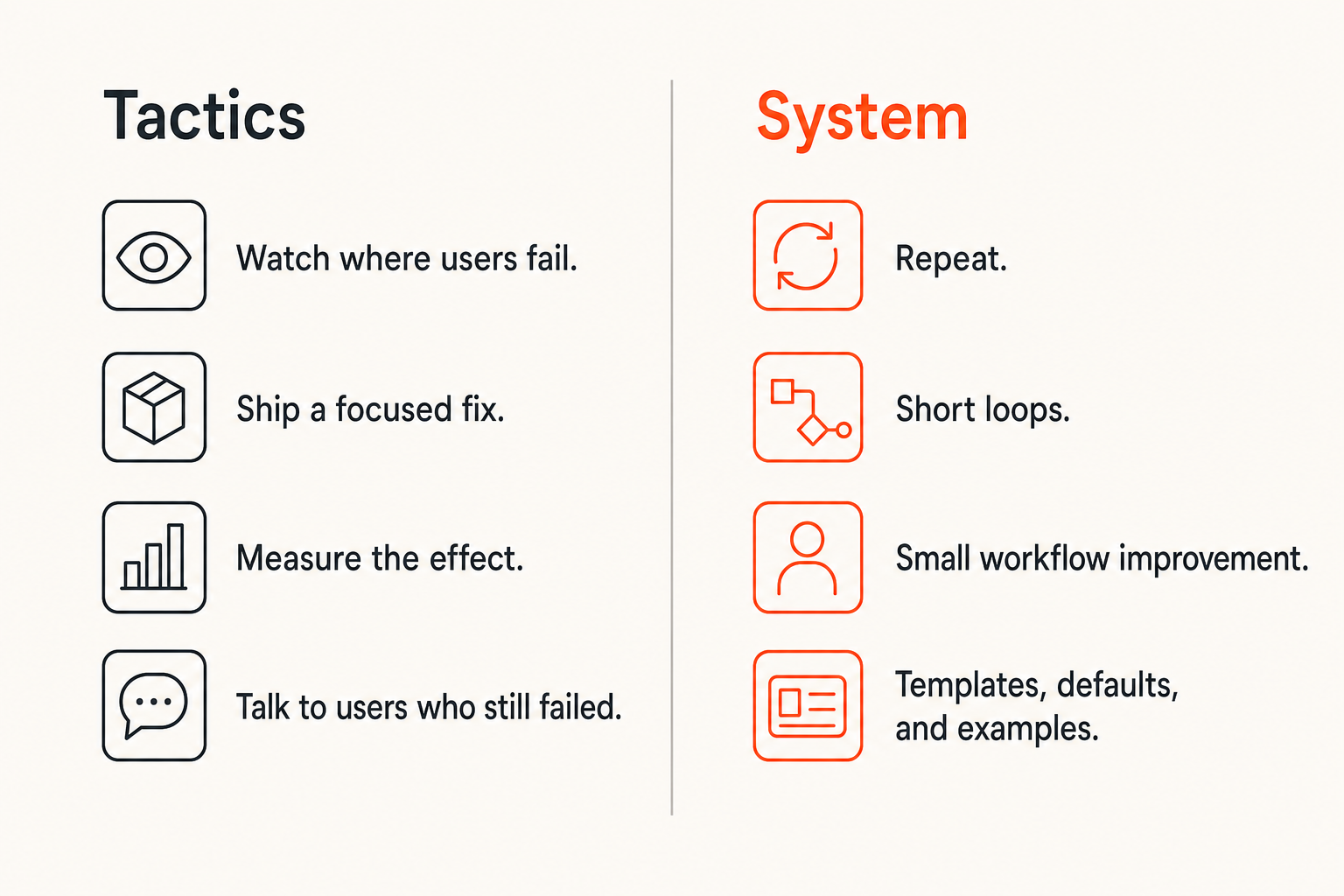
What works is usually less glamorous than the PLG playbooks make it sound. The teams that improve activation tend to run short loops:
- Watch where users fail.
- Ship a focused fix.
- Measure the effect.
- Talk to users who still failed.
- Repeat.
That sounds obvious. It is not how many teams operate. Many teams bundle onboarding changes into big launches, wait weeks for results, and then cannot isolate what mattered.
In product led growth, the unit of progress is often a small workflow improvement: a better empty state, a clearer import step, a more useful template, a smarter default, a recovery email after a failed integration, or a pricing prompt that appears at the right moment.
The point is not to avoid ambitious product work. The point is to make the activation system observable enough that small changes teach you something.
Templates defaults and examples matter
Templates are underrated because they look like content. In PLG, they are product infrastructure. A good template compresses time to value. It tells the user what good looks like. It reduces the need for setup, strategy, and imagination.
Defaults do the same job. Default project structures, starter workflows, sample dashboards, recommended integrations, and suggested next actions all reduce decision load.
For indie hackers and solopreneurs, this is a leverage point. You may not have a large growth team, but you can create a product path that assumes the user is busy, skeptical, and context-poor.
Related reading from our network: Field Service Management Software in 2026 covers a different buyer category, but its workflow-first lens is relevant because PLG adoption also depends on how well software fits the user’s actual operating day.
Practical rule: A template is not a content asset if it shortens time to value. It is part of the activation architecture.
What fails when teams copy PLG tactics
Freemium without a support model
Freemium is the tactic most likely to be misunderstood. It can be powerful when marginal cost is low, support demand is manageable, and free usage creates a credible path to paid expansion. It can also bury a small team under low-intent users.
What breaks in practice is that free users still need onboarding, documentation, bug fixes, abuse controls, billing explanations, and product clarity. If the free tier attracts people who are not close to your ideal customer, your roadmap starts reacting to noise.
Before launching freemium, answer these questions:
- What does a successful free user do that predicts payment later?
- Which support requests will you handle, automate, or ignore?
- What limits prevent abuse or runaway infrastructure cost?
- How will free users discover premium value?
- What product data will separate high-intent accounts from hobby usage?
If you cannot answer those, use a trial, waitlist, founder-led onboarding, or limited beta before opening the floodgates.
Viral loops that do not match the job
Invite loops are another common copy-paste mistake. Some products are naturally collaborative. Others are not. If inviting teammates is required before the user gets value, you may be adding social friction instead of growth.
A viral loop works when sharing is part of the job. A design review tool, shared workspace, scheduling product, or collaborative document can earn invites because the user needs other people involved. A personal productivity tool may not.
The mistake teams make is forcing virality where the product has no social surface. Users can feel when an invite prompt serves the company more than the workflow.
Useful invite prompts are contextual:
- Invite a reviewer when feedback is needed.
- Invite finance when approval is needed.
- Invite an engineer when implementation is needed.
- Invite a client when delivery is ready.
Bad invite prompts appear on step one because someone copied a growth teardown.
The product led growth implementation workflow
A seven step sequence for operators
If you are implementing product led growth in 2026, start with the operating sequence, not the pricing page. This sequence works for small teams because it turns PLG into a set of observable decisions.
- Define the ideal user and buying context. Be specific about who can self-serve and who cannot.
- Map the first valuable outcome. Identify the shortest path from sign-up to proof.
- Remove activation blockers. Cut fields, defer setup, add sample data, and rewrite empty states.
- Instrument the motion. Track the events that show progress, confusion, limits, and intent.
- Choose the monetization boundary. Place free, trial, usage, or feature limits after value is understood.
- Build recovery loops. Add lifecycle messages, help prompts, support routing, and sales alerts where users stall.
- Review weekly and ship fixes. Treat the PLG motion like a product surface with its own backlog.
This sequence is intentionally boring. Boring is good. PLG fails when teams jump from inspiration to tactics without a control loop.
If you need a broader roadmap discipline around bets, launches, and tradeoffs, the framing in Product Strategy in 2026 pairs well with PLG because it treats strategy as a shipping system instead of a slide deck.
Ownership across product marketing and support
PLG has no single natural owner. Product controls the experience. Marketing controls positioning and acquisition. Support hears confusion first. Sales may own expansion or larger accounts. Engineering owns performance, instrumentation, and reliability.
That makes ownership explicit or messy. There is no middle ground.
A practical ownership model:
| Area | Primary owner | Supporting owners | Review question |
|---|---|---|---|
| Activation path | Product | Design, engineering, support | Where do users fail before value? |
| Lifecycle messaging | Marketing | Product, support | What should users do next? |
| Event tracking | Product ops or engineering | Product, growth | Can we trust the data? |
| Pricing limits | Founder or product lead | Finance, sales, support | Does the limit match value? |
| Expansion signals | Sales or founder | Product, data | Which accounts need human follow-up? |
| Docs and recovery | Support | Product, marketing | What confusion repeats? |
For small teams, one person may wear several hats. That is fine. What matters is that every part of the PLG motion has an owner and a review cadence.
Connect PLG with go to market systems
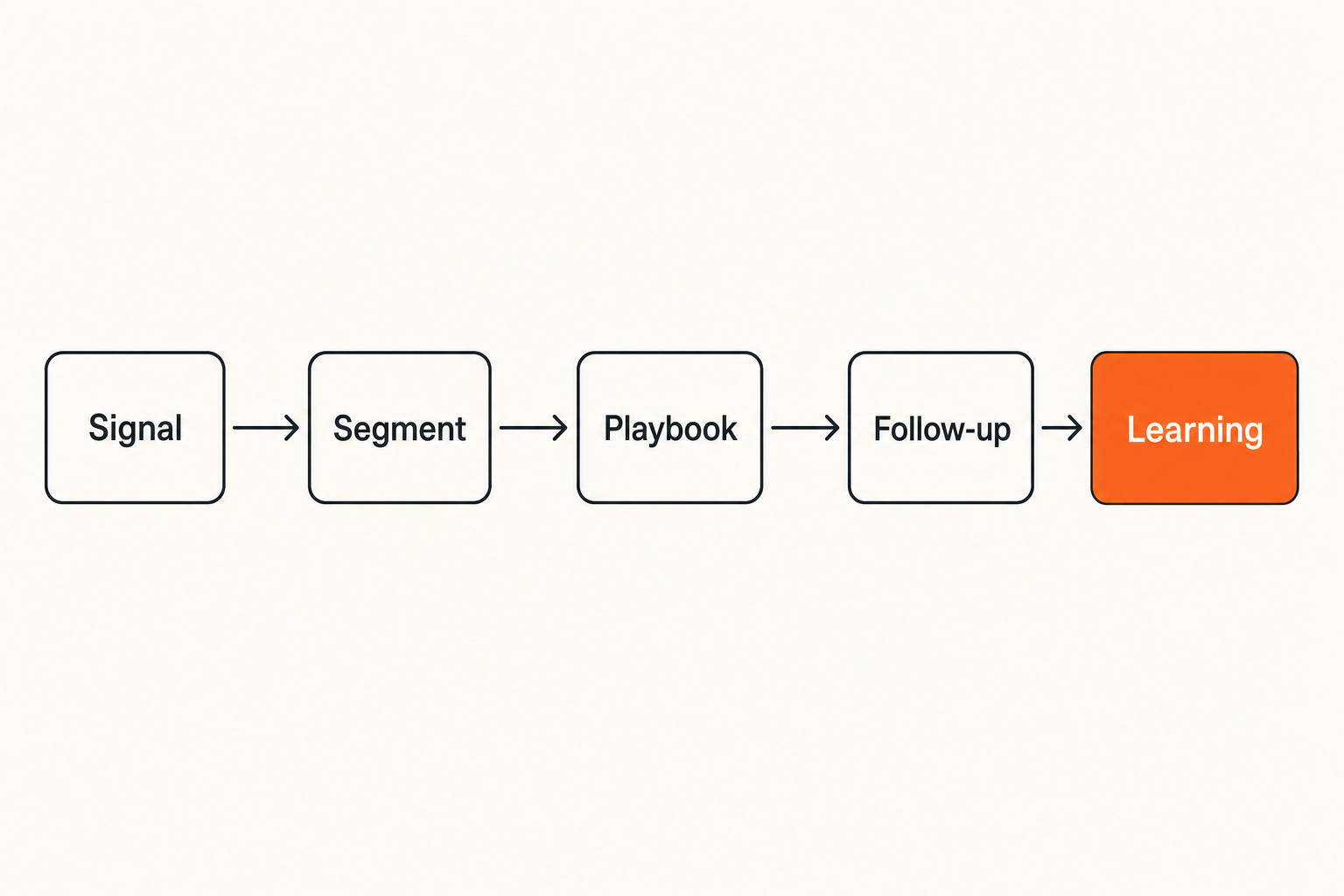
Product and sales can share the same signal
Product led does not mean sales-free. It means the product creates qualified demand before a human conversation. In many B2B products, the best motion is hybrid: self-serve for discovery and activation, sales-assisted for larger teams, security reviews, procurement, and expansion.
That changes the role of product data. Usage becomes a go-to-market signal. A team that invites five collaborators, connects production data, hits a usage limit, and visits the pricing page three times is not just an active account. It is a buying conversation waiting for the right intervention.
Sales should not chase every sign-up. Product should not hide intent signals. The operating question is which user actions justify human follow-up.
Good PLG sales signals include:
- Multiple users from the same domain activate.
- Admin or security settings are viewed.
- Usage approaches a paid limit.
- A user exports, shares, or publishes work.
- Billing pages are viewed after a value moment.
- A high-fit account repeats sessions across several days.
Bad sales signals include account creation alone, email open alone, or one random page visit.
Related reading from our network: Garage Door Opener Remote Thinking for Collaborative Screen Sharing is a useful adjacent example of permission design; PLG teams face similar tradeoffs when deciding when users can invite, control, share, or recover access.
Launches still matter in a PLG company
Some teams hear product led growth and assume launches become less important. That is wrong. Launches create focused attention, explain new value, reactivate dormant users, and generate external proof. The difference is that launches must connect back to product behavior.
A PLG launch should answer:
- Which user segment is this for?
- What behavior should change after the launch?
- What activation or expansion path does it improve?
- What in-product surface supports the announcement?
- What follow-up happens if users show intent but do not convert?
That is why PLG needs a go-to-market operating system, not just a changelog. The launch, onboarding, pricing, sales follow-up, and analytics need to tell the same story. For a deeper version of that workflow, see Go to Market Strategy in 2026, which treats GTM as an operating system rather than a one-time campaign.
What fails is the disconnected launch: marketing announces a feature, product hides it in a submenu, support is not briefed, sales does not know who should care, and analytics cannot tell whether anyone used it. That is not PLG. That is noise with a release note.
Measure product led growth like a shipping system
Metrics that show motion health
Product led growth should be measured like a shipping system because every metric should tie to a workflow your team can improve.
Useful PLG metrics include:
- Visitor to sign-up conversion.
- Sign-up to activation conversion.
- Time to first valuable outcome.
- Activated user to retained user conversion.
- Free to paid or trial to paid conversion.
- Usage limit hit rate.
- Expansion revenue from product-qualified accounts.
- Support tickets per activated account.
- Churn by activation path.
The last two are often ignored. They should not be. A PLG motion that increases conversion while doubling support load may not be healthy. A motion that produces paid users who churn after one month is not working; it is just collecting failed expectations faster.
A simple operating dashboard can group metrics by stage:
| Stage | Metric | Decision it should inform |
|---|---|---|
| Acquisition | Qualified sign-ups | Are we attracting the right users? |
| Activation | Time to value | What friction should we remove? |
| Adoption | Core action frequency | Is the habit forming? |
| Monetization | Upgrade trigger conversion | Is value aligned with payment? |
| Expansion | Team or usage growth | Which accounts need help? |
| Retention | Churn by cohort | Are expectations matching reality? |
Review cadence and decision rules
Metrics without cadence become dashboard theater. Set a weekly PLG review with a small agenda:
- What changed in activation, adoption, monetization, and support?
- Which cohort behaved differently?
- What shipped last week that may explain the movement?
- What user sessions, tickets, or interviews add context?
- What one change will we ship next?
The goal is not to analyze everything. The goal is to keep the system learning.
Decision rules help small teams avoid debate loops:
- If activation falls, inspect onboarding sessions before changing acquisition.
- If many users start but do not finish setup, reduce dependencies or add guided defaults.
- If users activate but do not return, improve habit loops and lifecycle prompts.
- If users hit limits but do not upgrade, review pricing clarity and value communication.
- If paid conversion rises but churn rises too, check whether the product is overpromising.
Practical rule: A PLG metric is only useful if the team knows what workflow to inspect when it moves.
When sh1pt.com fits your PLG operating model
Use sh1pt.com as a shipping strategy workspace
The product led growth conversation often gets stuck in tools. Analytics tools, onboarding tools, email tools, billing tools, session replay tools, feature flag tools. Those matter, but they do not replace the operating system underneath.
The deeper need is a shipping strategy workspace: a place to reason about what you are launching, who it is for, how the product path supports it, what signals matter, and what the team should change after users react.
That is where sh1pt.com fits naturally for founders, PMs, indie hackers, and solopreneurs. It is not trying to turn PLG into hype. It is for people building and launching software products who want practical ways to move from idea to market: shipping strategies, product development processes, and growth tactics that survive contact with users.
Use it when you need to:
- Clarify the product bet behind a PLG motion.
- Turn activation problems into shipping priorities.
- Connect launch planning with product usage signals.
- Think through pricing, onboarding, and adoption tradeoffs.
- Build a repeatable system for moving from idea to market.
The practical question is not whether you need another framework. The practical question is whether your team has a clear place to convert product learning into the next shipped improvement.
Try sh1pt.com
If you are turning product led growth into a real shipping system, Try sh1pt.com. You are writing for people building and launching software products who want to understand shipping strategies, product development processes, and growth tactics.