
A team can spend six weeks polishing a product strategy document and still ship the wrong thing.
The symptoms are familiar: a roadmap that looks reasonable, a launch date that keeps moving, customer research that never changes priorities, and a backlog full of work nobody wants to kill. Everyone is busy. Nobody can explain the bet.
Teams think the problem is product strategy. The real problem is that strategy has been separated from the shipping system.
That changes the conversation. Product strategy is not a positioning statement, a vision workshop, or a quarterly deck. For indie hackers, startup founders, PMs, and solopreneurs, the practical question is: how do you turn product strategy into a workflow that decides what to build, what to ignore, when to launch, and how to learn without creating theater?
Table of contents
- Product strategy is a shipping system, not a slide deck
- Start with the operating constraint
- Turn customer evidence into strategy inputs
- Define the product bet in one page
- Build a roadmap that reflects product strategy
- Connect product strategy to launch strategy
- Measure the strategy, not just the product
- What breaks when product strategy is implemented badly
- A practical product strategy workflow
- Make product strategy operational this week
Product strategy is a shipping system, not a slide deck
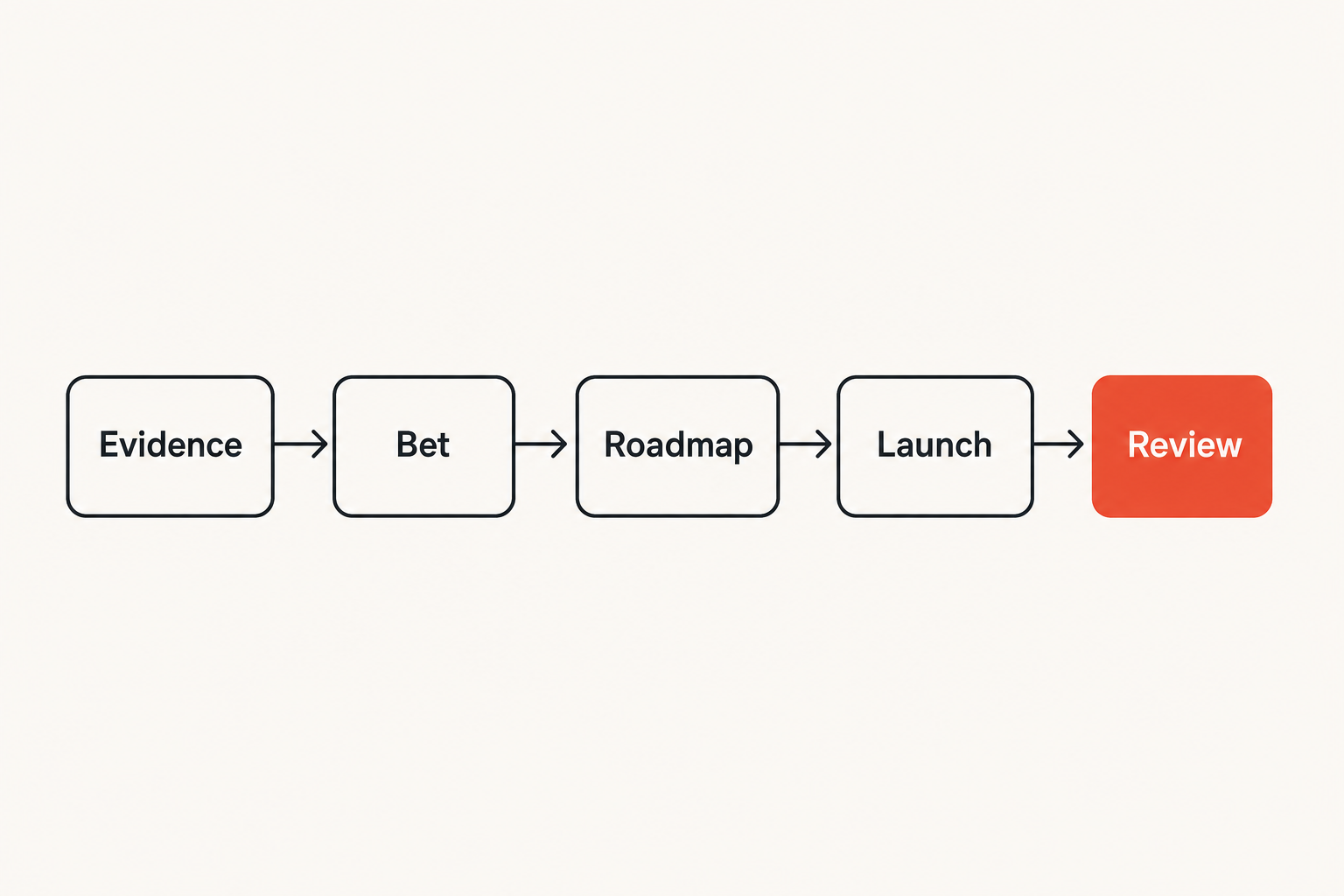
The strategy artifact is not the strategy
The mistake teams make is treating product strategy as a document that sits above the work. Someone writes the narrative, the team nods, and then the actual decisions happen in Slack, Linear, Jira, GitHub issues, customer calls, founder DMs, and launch crunch meetings.
That gap is where strategy dies.
A useful way to think about it is this: product strategy is the decision architecture for shipping. It should define which customer problem matters, why now, what the team will not do, how the next release proves or disproves the bet, and what changes after the result.
If the strategy does not change prioritization, scope, launch design, onboarding, pricing, or support expectations, it is not operational. It is internal content.
Practical rule: If a product strategy cannot kill a feature, narrow a launch, or change the next sprint, it is not a strategy yet.
Strategy has to survive contact with shipping
Shipping exposes weak strategy faster than planning does. A feature that sounded important becomes expensive. A customer segment that looked obvious does not convert. A launch channel underperforms. A dependency slips. A competitor ships something adjacent.
None of that means the strategy was useless. It means the strategy needs a feedback loop.
For a small software team, product strategy should answer four operational questions:
- What customer and use case are we prioritizing?
- What outcome would prove this direction is worth more investment?
- What are we deliberately not building right now?
- What will we do if the signal is weak, mixed, or negative?
The final question is usually missing. Teams prepare for success but not ambiguity. In production, most product learning is ambiguous. Users like part of the workflow. Activation improves but retention does not. Sales calls get warmer but close rates stay flat. Strategy has to handle that middle ground.
Start with the operating constraint
Pick the constraint before the features
Product strategy gets vague when teams start with features. Features are outputs. Constraints explain why certain outputs matter more than others.
For a solo founder, the constraint might be distribution: you can build, but you do not have enough attention. For a B2B startup, the constraint might be onboarding friction. For a product-led tool, the constraint might be time to first useful result. For an AI wrapper, the constraint might be trust, repeatability, or defensibility.
The practical question is not what should we build. It is what constraint, if improved, would make the product more viable.
Common strategic constraints look like this:
| Constraint | Bad strategy response | Better product strategy response |
|---|---|---|
| Low activation | Add more features | Shorten the path to first value |
| Weak retention | Send more emails | Improve the core recurring workflow |
| Low conversion | Redesign pricing page | Clarify the buyer, promise, and proof |
| Slow shipping | Hire before fixing process | Reduce scope size and decision latency |
| No differentiation | Copy competitors | Own a narrower use case better |
This is where product strategy becomes practical. The constraint tells you what the next release must change.
Make tradeoffs visible
Every team says it makes tradeoffs. Many teams just defer them.
A roadmap with too many top priorities is not ambitious. It is unpriced uncertainty. When everything is important, prioritization becomes a negotiation instead of a system.
A clear product strategy should make the tradeoff uncomfortable and visible. For example:
- We will optimize onboarding before adding advanced admin controls.
- We will win solo operators before expanding to teams.
- We will make reporting trustworthy before making dashboards prettier.
- We will support one integration deeply before supporting ten lightly.
Related reading from our network: teams evaluating workflow-heavy software face similar tradeoff pressure in this practical buying workflow for SaaS teams, where fit depends less on feature volume and more on rollout risk, integration depth, and support readiness.
Practical rule: Product strategy should make the cost of focus explicit. If nobody can name what you are delaying, the strategy is probably too soft.
Turn customer evidence into strategy inputs
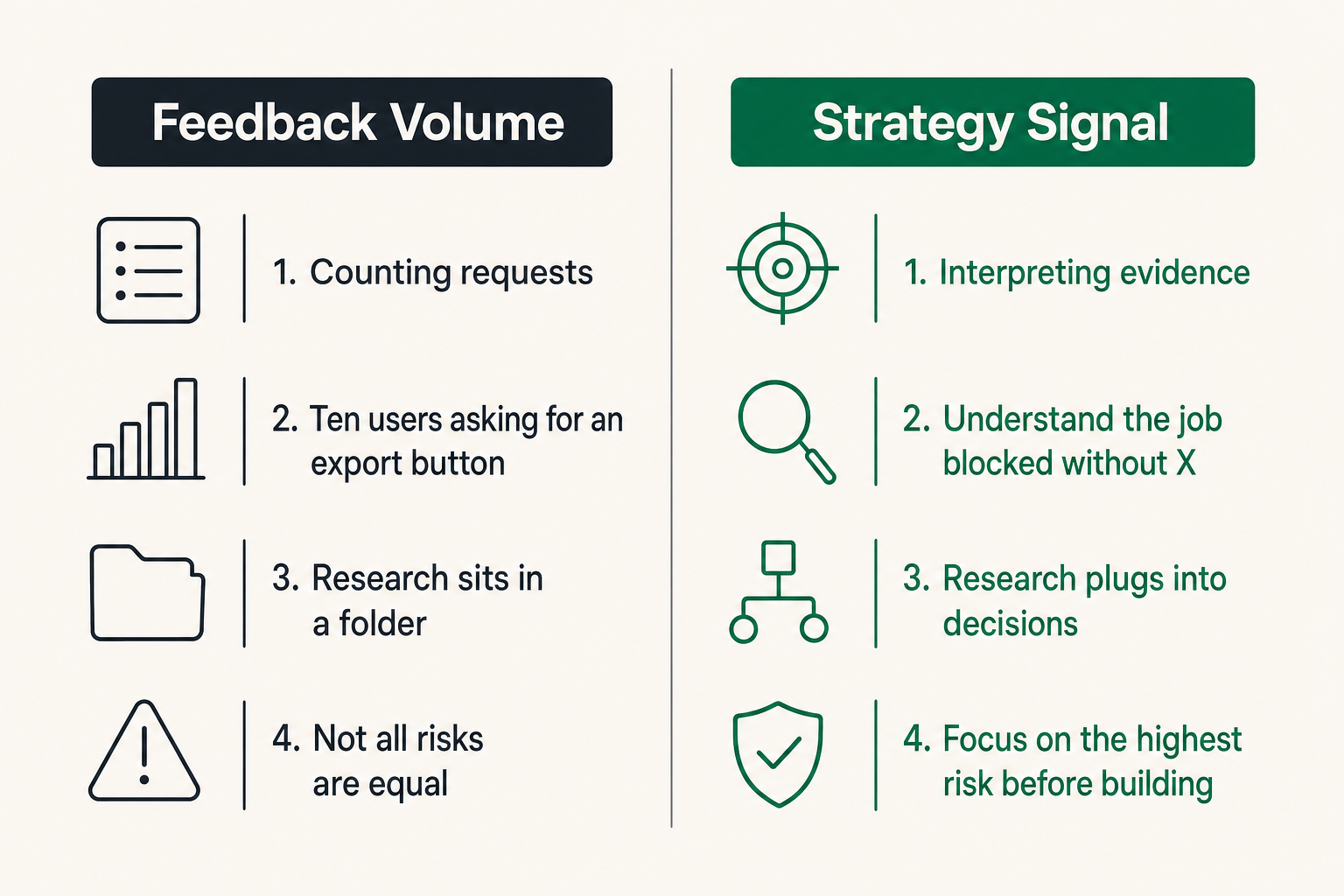
Separate signal from volume
Customer feedback is not product strategy. It is raw material.
The mistake teams make is counting requests instead of interpreting evidence. Ten users asking for an export button may be a feature request. It may also be a trust problem, a reporting gap, a procurement requirement, or a sign that the product is not where the work actually happens.
Strategy requires translation.
A useful customer evidence table should include:
| Evidence | What it sounds like | Strategy question |
|---|---|---|
| Repeated feature request | Can you add X? | What job is blocked without X? |
| Churn reason | Too hard to use | Where did value fail to appear? |
| Sales objection | We already use Y | What switching cost are we ignoring? |
| Support pattern | How do I do this? | Is the workflow unclear or incomplete? |
| Workaround | I export to a spreadsheet | Is the product missing a system boundary? |
This is why research needs to plug into decisions, not sit in a folder. If you are using surveys, the workflow matters more than the form itself; sh1pt has a practical breakdown of using product research surveys as a shipping workflow instead of treating them as generic feedback collection.
Use research to reduce decision risk
Product strategy is a risk reduction system. Not all risks are equal.
Before building, ask which risk is highest:
- Demand risk: Does anyone care enough?
- Workflow risk: Does this fit how users already work?
- Usability risk: Can users get value without hand-holding?
- Business risk: Will the value support pricing and acquisition cost?
- Technical risk: Can we deliver the experience reliably?
- Timing risk: Is the market ready now?
For early products, demand and workflow risk usually matter more than technical polish. For mature products, sequencing and integration risk often dominate. For founder-led products, the biggest hidden risk is often distribution: the product may be useful, but the team has no reliable way to reach the right buyer.
Practical rule: Match the research method to the risk. Do not run preference surveys when the real question is whether anyone will change behavior.
Define the product bet in one page
Write the bet before writing the roadmap
A roadmap without a bet is just a work queue.
Before planning features, write the product bet in plain language. Keep it short enough that the team can argue with it. A good one-page strategy should include:
- Target user or buyer
- Painful situation or job
- Current workaround
- Proposed product change
- Expected behavior change
- Primary constraint
- Evidence behind the bet
- Assumption that could be wrong
- First launch or test
- Decision after the test
Here is a simple structure:
We believe [specific user] will choose [product or feature]
when they are trying to [job or workflow]
because [current alternative] creates [pain or cost].
The next release should prove [behavior change]
by measuring [leading signal].
If we do not see [threshold or quality of signal], we will [decision].
Do not overcomplicate this. The value is not the template. The value is forcing the team to expose the logic before committing engineering time.
Name the assumption that would kill the idea
Every strategy has a load-bearing assumption. Most teams avoid naming it because it makes the plan feel fragile.
Name it anyway.
Examples:
- Users will connect their production data during onboarding.
- Founders will pay before they have a team.
- Developers will trust automated recommendations.
- Product managers will change roadmap decisions based on customer evidence.
- Buyers will accept a narrow tool if it solves the urgent workflow better.
Once the assumption is visible, you can design a smaller test. That is the point. Good product strategy does not remove uncertainty. It makes uncertainty cheaper to examine.
Build a roadmap that reflects product strategy
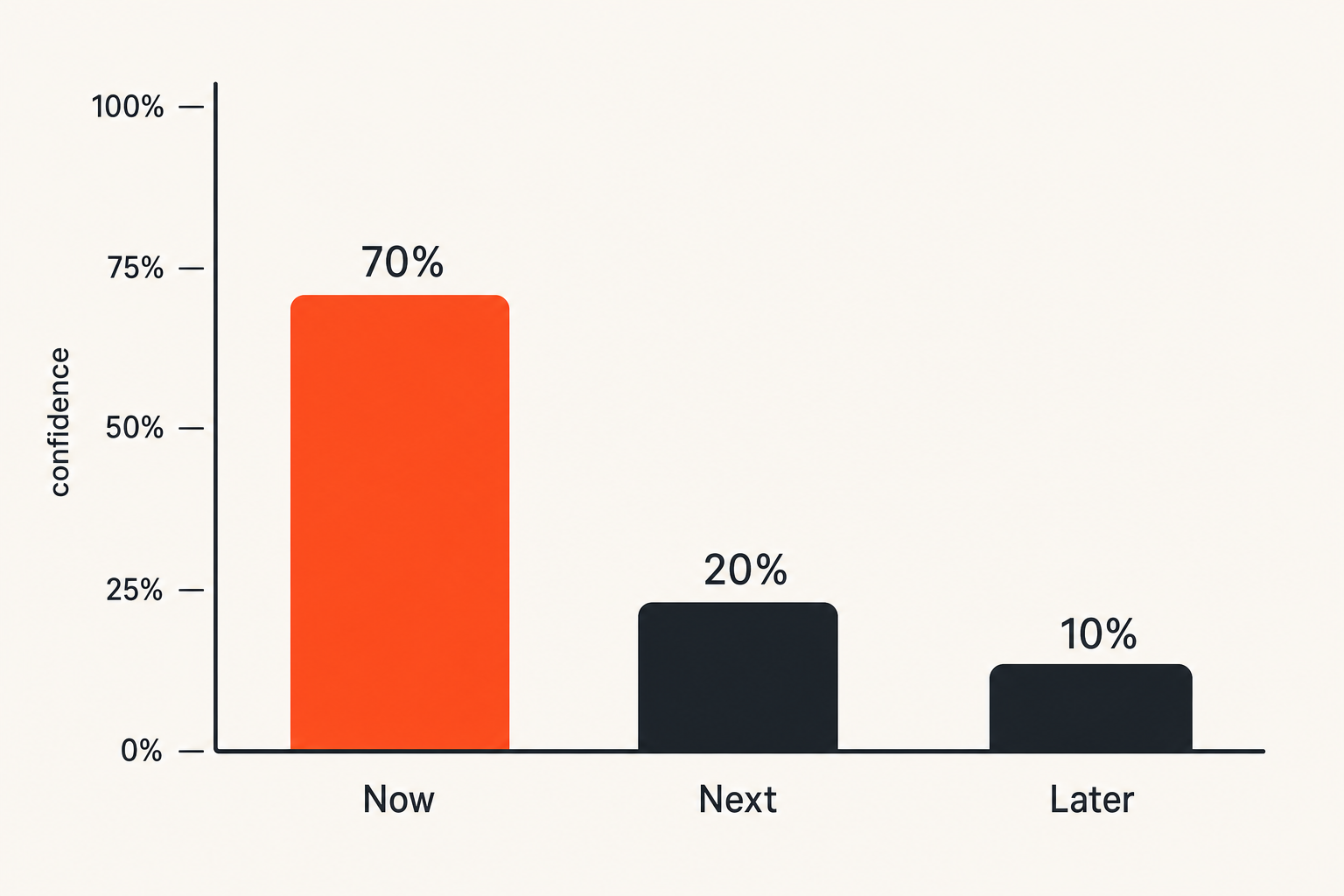
Roadmaps should expose sequencing logic
The roadmap is where product strategy becomes expensive. If the roadmap does not reflect strategy, the strategy is decorative.
What breaks in practice is sequencing. Teams build the right ideas in the wrong order. They ship advanced features before the activation path works. They invest in integrations before the core workflow is trusted. They add collaboration before a single user can get repeatable value.
A strategy-driven roadmap explains why now.
| Roadmap item | Weak rationale | Strategy-driven rationale |
|---|---|---|
| New dashboard | Users asked for it | Reduces time to understand weekly performance |
| Team roles | Enterprise needs it | Enables multi-seat trials after solo value is proven |
| API access | Competitors have it | Supports the highest-retention automation workflow |
| Template library | Nice growth asset | Helps new users reach first result without setup calls |
The roadmap should not only show what will ship. It should show what must be true before the next layer is worth building.
Use horizons instead of fake certainty
Dates are useful for coordination. They are dangerous when they create fake certainty.
For product strategy, horizons are often more honest than rigid long-range roadmaps:
- Now: committed work tied to the active strategic bet
- Next: likely work if current signals are positive
- Later: options that depend on learning, capacity, or market timing
This keeps the team aligned without pretending that a feature six months out deserves the same confidence as a release already in QA.
For teams trying to make this repeatable, product operations matters. The strategy has to connect to rituals, ownership, launch checklists, decision logs, and release review. sh1pt covered that operating layer in Product Operations in 2026, which is the part many teams skip when they try to scale shipping.
Connect product strategy to launch strategy
Launches are validation events
A launch is not just a marketing moment. It is a test of strategy under market conditions.
The mistake teams make is treating launch planning as the final step after product decisions are already done. That creates weak launches because the go-to-market motion is not designed to answer the strategic question.
If the strategy is about proving demand from solo founders, the launch should reach solo founders and measure their activation. If the strategy is about moving upmarket, the launch should test buyer objections, onboarding support, security expectations, and sales cycle friction. If the strategy is about a workflow wedge, the launch should show whether users repeat the workflow.
That changes the conversation from how do we announce this to what do we need to learn when this hits the market.
Design the launch around the strategic question
Here are examples of launch design tied to strategy:
| Strategic question | Launch design | Useful signal |
|---|---|---|
| Will users switch from spreadsheets? | Import template plus comparison page | Completed imports and repeated use |
| Is the buyer different from the user? | Founder demo calls plus buyer FAQ | Objections and buying committee patterns |
| Does the feature improve activation? | New-user onboarding experiment | Time to first useful result |
| Can we win a narrow niche? | Small community launch | Quality of replies and trial starts |
Do not make every launch a full launch. Some releases should be quiet tests. Some should be founder-led demos. Some should be waitlist conversions. Some should be content-led. The launch format should match the strategic risk.
Related reading from our network: the same control problem shows up in remote workflows, where permissions and handoffs matter more than the surface interface; garage door opener remote thinking for safer remote team control is a useful adjacent analogy for designing clear handoff and recovery paths.
Measure the strategy, not just the product
Choose metrics that match the bet
Most dashboards are too broad to help product strategy. They show product health, but not whether the current bet is working.
A strategic metric should connect to the behavior you expected to change. If the bet is onboarding, measure time to first useful result, completion of the key setup step, and second-session return. If the bet is collaboration, measure invited teammates, shared artifacts, and multi-user activity. If the bet is monetization, measure qualified conversion, expansion triggers, and sales objections, not just pricing page views.
The practical question is: what would we expect to see first if the strategy is right?
Do not wait for perfect lagging indicators. Revenue, retention, and expansion matter, but early teams need leading signals that arrive soon enough to influence the next release.
Review decisions, not dashboards
A strategy review should not be a passive metrics readout. It should be a decision meeting.
Use a simple review format:
- What did we believe would happen?
- What shipped?
- What signal did we observe?
- What surprised us?
- What decision changes now?
- What will we stop, continue, or narrow?
The last two questions matter most. Without them, reviews become reporting theater.
Practical rule: A product strategy review is successful only if it changes a decision or confirms that the current decision still deserves investment.
What breaks when product strategy is implemented badly
The backlog becomes a politics layer
When strategy is vague, the backlog becomes the place where unresolved arguments go to hide.
Sales adds requests from prospects. Support adds requests from frustrated customers. Founders add ideas from competitor pages. Product adds usability improvements. Engineering adds technical debt. All of these can be valid. Without strategy, they compete through volume, urgency, or seniority.
That is how a backlog turns into a politics layer.
A healthy backlog has a strategic filter. Items should map to a current bet, a future option, a maintenance obligation, or a deliberate parking lot. If everything is mixed together, prioritization becomes slow and emotionally expensive.
Product examples can help here when used correctly. The point is not to copy what another company shipped, but to analyze why a product decision worked in its context. sh1pt has a guide on using product examples as a practical system for roadmap decisions, UX teardown, and launch strategy.
The team mistakes motion for learning
Busy teams often confuse throughput with progress.
They ship tickets. They close cycles. They publish changelogs. They run campaigns. But the strategic uncertainty remains untouched.
This usually happens when work is scoped around internal delivery instead of external behavior. A release is considered done when code is merged, not when the team learns whether users changed behavior.
Common failure modes include:
- Building around the loudest customer instead of the target segment
- Measuring adoption without measuring repeat use
- Running research after the roadmap is already committed
- Treating launch feedback as marketing feedback only
- Avoiding kill decisions because the team already invested effort
- Adding process without clarifying ownership
Related reading from our network: software teams face the same failure mode in security and delivery pipelines, where tools do not help unless ownership, validation, and response are defined; this security system installation guide for CI/CD and software supply chains is adjacent but useful for thinking about operational accountability.
A practical product strategy workflow
The six-step operating loop
Product strategy needs a loop, not a ceremony. Here is a practical sequence that works for small teams and scales better than a quarterly deck.
- Identify the active constraint. Pick the one constraint that limits growth, retention, activation, revenue, or trust right now.
- Define the product bet. Write the target user, workflow, assumption, expected behavior change, and decision threshold.
- Gather focused evidence. Use interviews, surveys, support analysis, sales notes, product analytics, or manual concierge tests based on the risk.
- Scope the smallest credible release. Build enough to test the bet without pretending the first version is the final system.
- Launch to the right audience. Choose a launch format that exposes the strategic question to the correct users or buyers.
- Review and decide. Continue, narrow, pivot, pause, or kill based on signal quality and strategic fit.
This loop is simple by design. The hard part is not understanding it. The hard part is refusing to add work that does not serve the active bet.
What works and what fails
Here is the blunt version.
| What works | What fails |
|---|---|
| One active strategic constraint | Five priorities with equal urgency |
| Written assumptions | Vague confidence |
| Small releases tied to learning | Large releases tied to internal excitement |
| Launches designed as tests | Launches designed only as announcements |
| Decision reviews | Dashboard walkthroughs with no action |
| Clear ownership | Shared ownership that means no owner |
A useful way to think about it is that strategy creates permissions. It gives the team permission to say no, permission to ship smaller, permission to delay attractive features, and permission to stop work that no longer matches the bet.
For indie hackers, this is especially important. You do not have enough time to pursue every plausible idea. Product strategy is the mechanism that protects your limited attention.
Make product strategy operational this week
The one-week reset
You do not need a retreat to improve product strategy. You need a sharper operating loop.
Run this reset over one week:
- Monday: Write the current constraint in one sentence.
- Tuesday: List the top three roadmap items and the assumption behind each.
- Wednesday: Pick one bet and define the behavior change you expect.
- Thursday: Remove or park backlog items that do not support the bet.
- Friday: Design the next launch or test around one strategic question.
Then schedule a review before the work starts, not after it drifts. Decide what signal will cause you to continue, narrow, or stop.
This is not about making product strategy feel more formal. It is about making shipping less random.
If the team can connect customer evidence, roadmap choices, launch design, and decision reviews, product strategy becomes a working system. If those pieces stay disconnected, the strategy will keep looking good in documents and failing in execution.
Try sh1pt.com
sh1pt.com is for people building and launching software products who want practical shipping strategies, product development processes, and growth tactics. If you want to turn product strategy into a repeatable shipping system, Try sh1pt.com.