
Most founders do not have a product management problem because they lack ideas. They have a product management for founders problem because every idea arrives with urgency, emotion, customer context, investor pressure, and incomplete data.
One customer wants an enterprise feature. A power user wants a workflow fix. A competitor ships something loud. The team is already halfway through another release. Suddenly the founder is not choosing between features. The founder is choosing between futures.
Teams think the problem is prioritization. The real problem is operating without a product decision system.
That changes the conversation. Product management for founders is not about copying how a 200-person product org writes PRDs. It is about building a founder-scale workflow for turning signals into bets, bets into shipped software, and shipped software into learning before the company runs out of attention.
Table of contents
- Product management for founders is an operating system, not a job title
- What founders actually own in product management
- Build a signal system before you build a roadmap
- Turn strategy into a small number of product bets
- Prioritization is a risk-management exercise
- Product management for founders in the build cycle
- Launch is part of product management, not marketing cleanup
- Metrics founders should actually use
- What breaks when founders implement product management badly
- A practical weekly workflow for founder-led product management
- Where sh1pt.com fits in the founder product system
Product management for founders is an operating system, not a job title
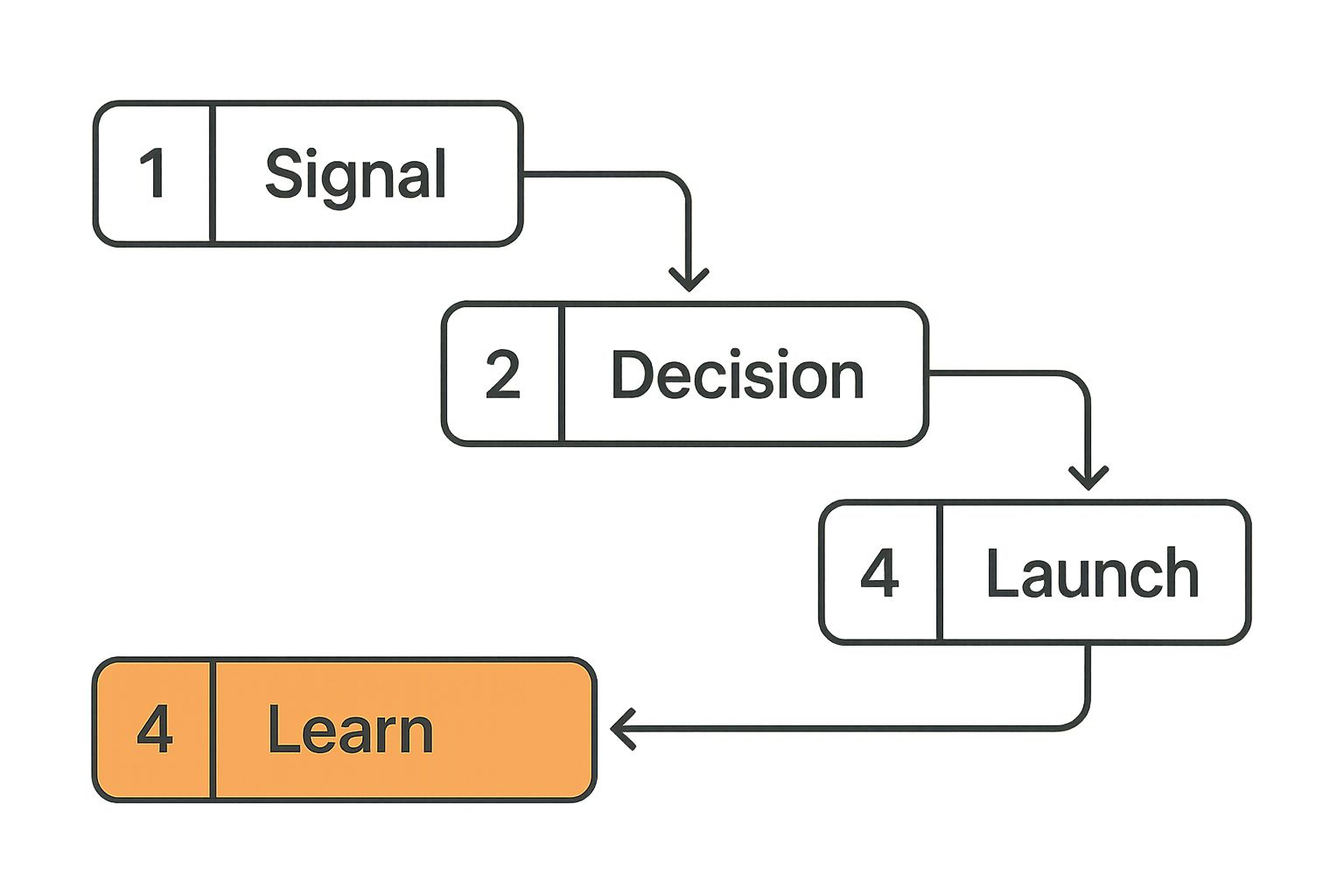
The mistake teams make is hiring the vocabulary of product management before they have the workflow. They add roadmap tools, prioritization frameworks, feature templates, and status meetings. Then they wonder why the company still feels reactive.
A useful way to think about it is simple: product management for founders is the operating system that decides what the company learns next.
In a small company, product management is not a department. It is a set of repeatable behaviors around evidence, tradeoffs, releases, and feedback. The founder may write code, sell deals, handle support, and decide pricing in the same week. The product system has to survive that reality.
The founder version is narrower and sharper
Enterprise product management often optimizes for alignment across many teams. Founder product management optimizes for decision quality under constraint.
You do not need a 20-page requirements document for every change. You do need a clear answer to these questions:
- What customer pain are we addressing?
- Why now?
- What are we not doing because we are doing this?
- What signal would prove this was worth building?
- What signal would tell us to stop?
That is enough structure to keep speed without letting every week become improvisation.
Practical rule: If a product process does not improve a decision, shorten a cycle, or preserve context, it is probably overhead.
The decision stack matters more than the roadmap
A roadmap is an output. The decision stack is the machinery that produces it.
The stack usually looks like this:
| Layer | Founder question | Bad version | Useful version |
|---|---|---|---|
| Strategy | Where are we trying to win? | Broad ambition | Specific wedge |
| Signals | What are we seeing? | Anecdotes and pressure | Tagged evidence |
| Bets | What are we testing? | Feature list | Assumption-driven work |
| Scope | What will ship? | Expanding checklist | Smallest useful release |
| Measurement | Did it work? | Vanity dashboard | Bet-specific learning |
When this stack is missing, the roadmap becomes a political document. When it exists, the roadmap becomes a snapshot of current judgment.
Related reading from our network: teams evaluating workflow-heavy tools face a similar issue in content operations, where the useful question is not whether AI is present but whether the workflow improves decisions; see this guide to AI content SaaS workflow systems.
What founders actually own in product management
Founder-led product management is not about personally approving every button label forever. It is about owning the product choices that can change the company trajectory.
The practical question is: which decisions are too important to delegate too early?
Vision is not a substitute for product judgment
Founders often have strong vision. That helps. It can also create blind spots.
Vision says the product should exist. Product judgment decides what version should exist next.
The difference matters because customers do not buy your long-term vision in a vacuum. They buy the next usable step that removes pain, creates leverage, saves time, reduces risk, or makes them look competent to their own stakeholders.
Product judgment is the discipline of turning the broad vision into near-term choices without flattening the ambition.
The founder owns tradeoffs until the system can
Early teams do not have enough organizational memory to make tradeoffs automatically. The founder often holds context from sales calls, support tickets, investor conversations, engineering constraints, and market shifts.
That context is useful only if it is converted into decisions the team can inspect.
A founder should own:
- The customer segment being prioritized right now
- The pain the product is trying to become known for solving
- The tradeoff between revenue expansion and product focus
- The quality bar for launch
- The definition of a successful release
A founder should not permanently own:
- Every ticket priority
- Every UI detail
- Every customer request interpretation
- Every release note
- Every internal status update
The goal is not to remove founder involvement. The goal is to make founder involvement less random.
Build a signal system before you build a roadmap
Most messy roadmaps are downstream of messy signal intake. Founders collect signal everywhere: DMs, calls, support threads, analytics, churn notes, demos, competitor screenshots, community comments, and their own product intuition.
What breaks in practice is that these signals stay scattered. The founder remembers the emotional ones. The team sees the ticket ones. Sales repeats the urgent ones. Engineering notices the technically annoying ones.
Then prioritization becomes a meeting where everyone brings a different reality.
Separate signal from volume
A request repeated 20 times is not automatically strategic. A request from one ideal customer may be more important than 50 casual complaints from the wrong segment.
Useful product signals usually include context:
- Who experienced the problem?
- What were they trying to do?
- What workaround did they use?
- What did the failure cost them?
- Did it block activation, retention, expansion, or referral?
- Is this aligned with the product wedge?
Volume matters, but volume without context creates backlog inflation.
Practical rule: Never count a request without tagging the customer type, workflow stage, and business impact behind it.
Create one intake path for product evidence
You do not need a complex research repository on day one. You need one place where evidence lands consistently.
A simple founder-scale intake template can look like this:
signal:
  source: support_call | demo | analytics | churn | founder_observation
  customer_segment: indie | smb | mid_market | enterprise | internal
  workflow_stage: activation | usage | collaboration | billing | expansion
  pain: short description of the problem
  evidence: quote, metric, screenshot, or event
  severity: low | medium | high
  confidence: weak | medium | strong
  linked_bet: optional
The point is not bureaucracy. The point is to keep product memory from living only in the founder's head.
If you need a broader operating model for collecting signals and turning them into releases, sh1pt has a detailed guide to building a product development workflow that pairs well with this founder-level system.
Turn strategy into a small number of product bets
Strategy becomes useful when it constrains action. If your strategy allows every feature to sound important, it is not strategy. It is branding.
Founders need a way to translate strategic intent into product bets that are small enough to ship and meaningful enough to teach the company something.
Use bets instead of feature lists
A feature list says what to build. A bet says what you believe will change.
Bad:
- Add team workspaces
- Add PDF export
- Add Slack integration
Better:
- We believe team workspaces will increase invited collaborators per activated account because current solo workarounds break during handoff.
- We believe PDF export will reduce sales friction for agencies that need client-facing reports.
- We believe Slack alerts will increase weekly return usage for teams that forget to check the dashboard.
That changes the conversation. Instead of debating whether a feature is generally good, the team debates whether the belief is important, testable, and aligned with the current company goal.
Define the kill criteria before the build starts
Founder-led teams are especially vulnerable to sunk cost. Once a founder has sold a feature internally, it becomes emotionally expensive to admit that the signal was weak.
Define kill criteria before implementation:
- If fewer than 20 percent of targeted beta users activate it, we do not expand scope.
- If the feature requires a second major surface area before it is useful, we cut the release down.
- If the customer segment requesting it is outside our current wedge, we defer it.
- If support load increases without retention improvement, we revisit the design.
These numbers are examples, not universal rules. The important part is deciding what would change your mind before the build creates its own gravity.
Prioritization is a risk-management exercise
Prioritization frameworks often create false precision. RICE, ICE, MoSCoW, effort-impact matrices, and scoring boards can help, but they can also hide weak thinking behind decimals.
The practical question is not which framework is best. The practical question is what risk you are reducing with the next release.
Score for learning, not just revenue
Early products need revenue. They also need learning. Sometimes the most important release is not the one that closes the biggest deal. It is the one that proves the product can serve a sharper customer segment repeatedly.
A founder-friendly scoring model can include:
| Criterion | Question | Score 1 means | Score 5 means |
|---|---|---|---|
| Segment fit | Is this for the customer we want more of? | Edge case | Core segment |
| Pain severity | Does it remove a real blocker? | Mild annoyance | Workflow blocker |
| Learning value | Will it validate a key assumption? | Little new learning | Major assumption tested |
| Distribution value | Can we talk about it clearly? | Hidden utility | Strong launch story |
| Build risk | Can we ship safely? | High uncertainty | Low complexity |
Do not let the total score make the decision for you. Use it to expose the assumptions.
Do not let the loudest channel become the roadmap
Sales, support, founders, investors, and power users all distort reality in different ways.
- Sales overweights deals in motion.
- Support overweights pain that is easy to complain about.
- Founders overweight strategic intuition.
- Investors overweight market narratives.
- Power users overweight advanced workflows.
None of these sources are bad. All of them are incomplete.
Practical rule: A roadmap item should survive contact with at least two evidence types: customer context, behavioral data, revenue impact, support cost, or strategic fit.
Related reading from our network: software teams dealing with supply-chain risk face a similar prioritization trap, where noise can drown out the real constraint; this piece frames CI/CD supply chain security as a workflow problem rather than a tool purchase.
Product management for founders in the build cycle
Product management for founders becomes real during the build cycle. It is easy to sound disciplined during planning. It is harder when engineering finds a dependency, a customer asks for a variation, and the founder sees a competitor launch a similar capability.
The build cycle needs just enough structure to prevent panic from becoming scope.
Write just enough product spec
A founder-scale product spec should fit on one or two pages for most releases. If the team needs more, the problem may be complex. Or the decision may be unclear.
A useful lightweight spec includes:
- Customer problem
- Target segment
- Current workaround
- Product bet
- Non-goals
- User flow
- Edge cases
- Launch plan
- Success signal
- Open decisions
Non-goals are especially important. They protect the release from becoming a container for every related idea.
Example:
## Non-goals
- We are not building admin permission tiers in this release.
- We are not supporting custom branding yet.
- We are not migrating historical data automatically.
- We are not exposing this to all accounts until beta feedback is reviewed.
The spec should make the next decisions easier. It should not become a document everyone pretends to read.
Protect scope with decision checkpoints
Scope creep usually starts as reasonable improvement. The team learns something during implementation. A design edge case appears. A founder asks whether the release would be more compelling with one more thing.
Set checkpoints before the build:
- Design checkpoint: Does the flow solve the primary job without extra surfaces?
- Engineering checkpoint: Has complexity changed enough to revisit scope?
- Beta checkpoint: Are users reaching the intended outcome?
- Launch checkpoint: Is the story clear enough to ship?
This keeps the team from having the scope debate every day.
For deeper iteration mechanics after a release is in users' hands, the sh1pt guide to product iteration best practices covers feedback loops, reviews, and release learning in more detail.
Launch is part of product management, not marketing cleanup
Founders often treat launch as the announcement that happens after product work is done. That is a mistake.
Launch is where positioning, onboarding, documentation, support, pricing, and feedback capture collide. If the product team does not design that system early, the launch becomes a screenshot, a tweet, and a support queue.
Design the launch surface early
Every release needs a launch surface. Not every release needs a major public campaign.
Launch surfaces include:
- In-app onboarding
- Changelog entry
- Customer email
- Demo script
- Sales enablement note
- Help doc
- Pricing page update
- Community post
- Founder walkthrough
- API or developer documentation
Pick the surfaces based on the bet. If the bet is activation, the in-app surface matters more than the launch tweet. If the bet is expansion, sales and customer success context may matter more than public traffic.
Make feedback capture part of the release
A launch without feedback capture is just distribution. Product management requires learning.
Before launch, decide:
- Where will feedback arrive?
- Who tags it?
- What questions are we asking users?
- What behavior will we inspect after one week?
- What support issues would indicate confusing design?
- When is the post-launch review?
This is where many founder-led teams lose the thread. They ship, celebrate, move on, and then rediscover the same product questions three months later.
Related reading from our network: publishing teams have the same launch-system problem at a different layer; this guide to AI blog publishing software workflow architecture is useful if your product motion includes content, approvals, and distribution gates.
Metrics founders should actually use
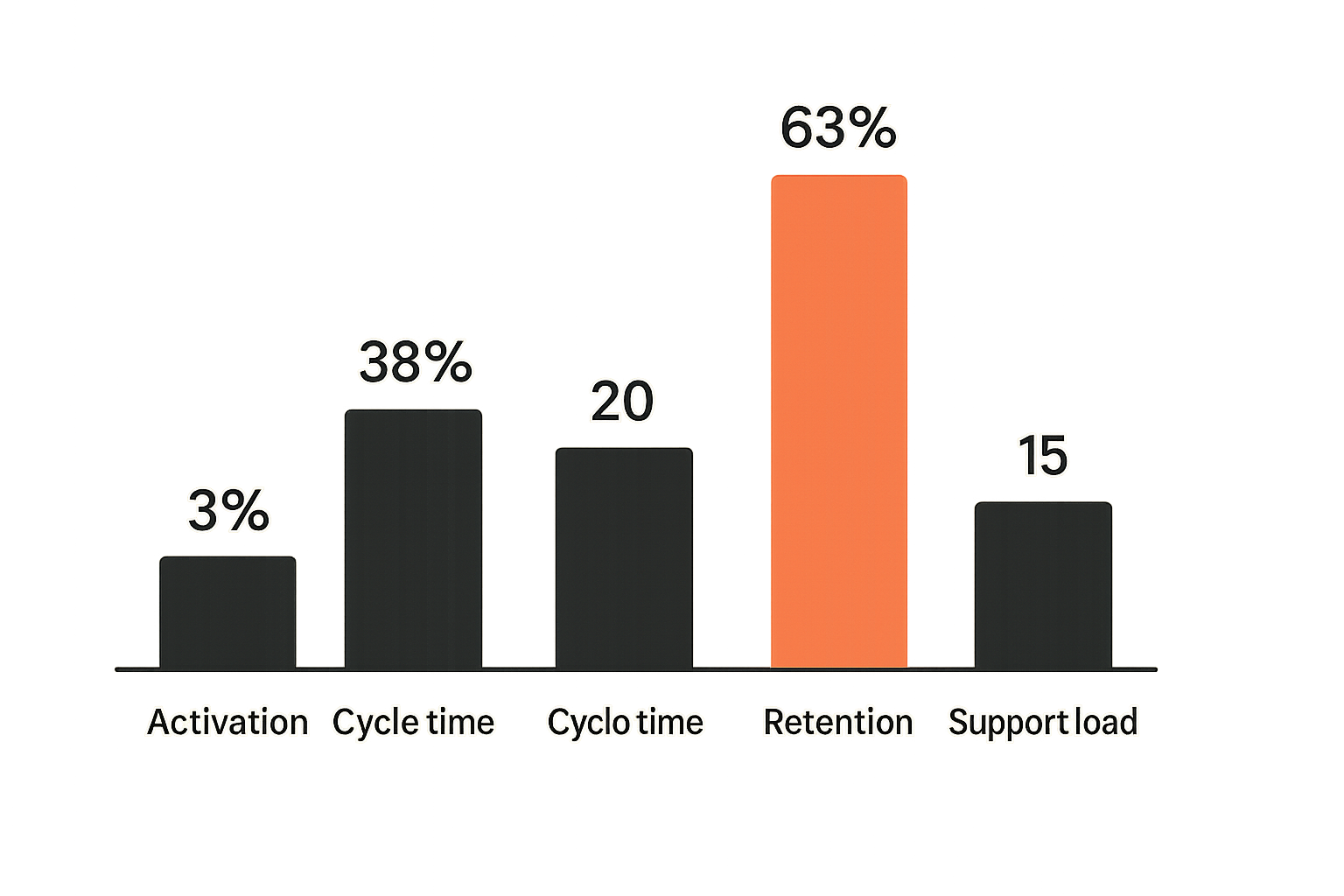
Metrics should sharpen product judgment. In many early teams, they do the opposite. Founders either track everything and learn nothing, or avoid measurement because the numbers feel too small to be meaningful.
The mistake teams make is assuming metrics only matter at scale. Early metrics matter because they reveal friction, confusion, and false assumptions.
Choose metrics tied to the bet
Do not start with a generic dashboard. Start with the bet.
If the bet is that a new onboarding flow improves activation, measure activation steps. If the bet is that collaboration improves retention, measure invited teammates, shared projects, and repeat usage. If the bet is that a reporting feature helps agencies close client work, measure report creation, export frequency, and customer quotes.
A simple mapping:
| Product bet | Primary metric | Supporting signal | Watch-out |
|---|---|---|---|
| Improve activation | Time to first value | Drop-off step | More signups hiding weak activation |
| Increase collaboration | Invites per account | Shared object creation | Invites sent but not accepted |
| Reduce churn | Weekly retained usage | Support themes | Discounts masking product pain |
| Support expansion | Feature adoption by paid teams | Upgrade conversations | One-off enterprise requests |
Metrics do not replace customer conversation. They tell you where the conversation should go.
Measure friction, not just outcomes
Outcome metrics lag. Friction metrics show the product breaking.
Examples of friction metrics:
- Setup attempts abandoned
- Error states per active account
- Time from signup to first successful action
- Number of support tickets per new account
- Repeated visits to docs for the same feature
- Manual workarounds reported in calls
Friction metrics are useful because they are actionable. If users are not activating, the founder can inspect the flow. If power users are asking for advanced controls, the founder can check whether the core segment has already adopted the basic workflow.
A founder does not need a perfect analytics stack. But you do need enough instrumentation to avoid product management by memory.
What breaks when founders implement product management badly
Bad product management rarely announces itself as bad process. It usually looks responsible at first: more meetings, more tickets, more roadmap visibility, more stakeholder input.
Then the team slows down and nobody can explain which decisions improved.
Roadmap theater replaces customer learning
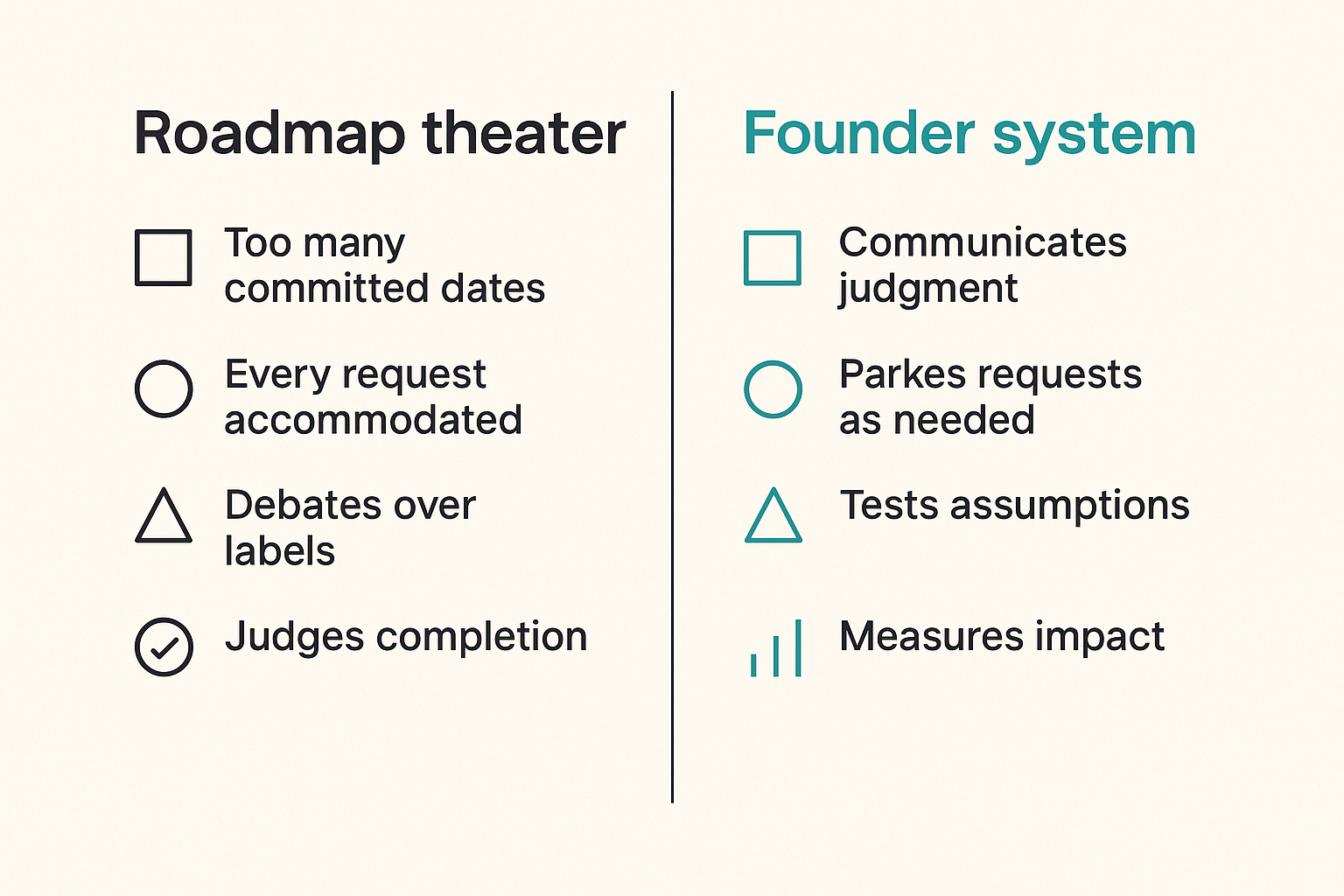
Roadmap theater happens when the artifact becomes more important than the judgment behind it.
Symptoms:
- The roadmap has too many committed dates.
- Every customer request gets parked somewhere to avoid saying no.
- The team debates labels more than assumptions.
- Leadership asks for status but not learning.
- Releases are judged by completion instead of impact.
What fails is not planning. What fails is confusing planning with progress.
A roadmap should communicate intent, sequence, and tradeoffs. It should not become a public debt ledger for every idea the company has heard.
The team ships more and understands less
This is the dangerous failure mode for ambitious founders. The team is busy. Releases go out. Customers see motion. But the company does not accumulate product knowledge.
You can spot it when:
- The same debates repeat every quarter.
- Nobody knows whether a feature changed behavior.
- Support still explains the same confusing workflows.
- Sales keeps selling around the same product gaps.
- Engineers do not know why they are building the next thing.
The fix is not to stop shipping. The fix is to attach learning to shipping.
Practical rule: Every meaningful release should leave behind one reusable asset: a decision note, a validated assumption, a rejected assumption, a customer segment insight, or a metric baseline.
A practical weekly workflow for founder-led product management
A founder-led product system should fit into the week. If it requires a separate operating religion, it will not survive sales calls, bugs, hiring, fundraising, and customer escalations.
Here is a practical sequence that works for many small teams.
The weekly product loop
- Collect signals by Friday. Pull support themes, sales notes, analytics changes, churn reasons, and founder observations into one intake view.
- Tag signals before discussing solutions. Segment, workflow stage, severity, confidence, and business impact come first.
- Review active bets on Monday. Ask whether the current work still addresses the most important assumption.
- Make one prioritization decision. Choose what starts, stops, shrinks, or waits. Avoid reopening everything.
- Confirm scope and non-goals. Make the build small enough to learn from.
- Ship or inspect progress midweek. Look for scope drift, blocked decisions, and unclear ownership.
- Capture launch feedback. Tag reactions and behavior against the original bet.
- Write a short decision note. Preserve what changed and why.
This loop is intentionally boring. Boring workflows survive.
The founder review questions
A 30-minute founder review can be enough if the questions are sharp:
- What did we learn last week that should change the roadmap?
- Which customer segment is overrepresented in our requests?
- Which active bet has the weakest evidence?
- What are we building because it is strategically right, not just urgent?
- What should we explicitly not build this month?
- Which shipped feature needs follow-up measurement?
- What decision is blocked because context is trapped in my head?
The last question is the one founders should take personally. A product system gets stronger when founder context becomes team context.
If discoverability through AI systems is part of your product growth motion, product teams also need to think about how features, docs, and positioning become machine-readable; sh1pt covers that angle in answer engine optimization product management.
Where sh1pt.com fits in the founder product system
Product management for founders is easier when you have practical references for the work around the product: shipping strategy, launch mechanics, iteration loops, positioning, workflow design, and growth experiments.
That is where sh1pt.com fits. It is not a replacement for talking to customers or making hard tradeoffs. It is a reference layer for founders and product builders who want to move from idea to market with less process theater and more operational clarity.
Use it as a shipping reference layer
Use sh1pt.com when you are trying to answer questions like:
- How should we structure our product development workflow?
- What should happen after a launch?
- Which product iteration practices are worth keeping?
- How do we connect product decisions to growth work?
- How do we avoid turning a small team into a slow team?
The best use is not passive reading. Take a workflow, adapt it to your team size, and run it for two or three cycles. Keep what improves decisions. Cut what becomes ceremony.
Product management for founders should make the company more honest about what it knows, what it is assuming, and what it is willing to trade away. That is the standard.
Try sh1pt.com
sh1pt.com is for people building and launching software products who want to understand shipping strategies, product development processes, and growth tactics.
Try sh1pt.com and build a cleaner operating system for product management for founders.