
A product marketing manager usually shows up in the conversation after a painful launch.
The product shipped. The changelog went out. The founder posted on social. A few friendly users clicked. Then nothing much happened. The team starts asking whether they need better copy, more content, a bigger launch list, or someone who can finally make the website sound less vague.
Teams think the problem is marketing output. The real problem is market translation.
A product marketing manager is not valuable because they produce more launch assets. The leverage comes from turning product work into buyer understanding, buyer understanding into positioning, positioning into launch decisions, and launch learning back into the roadmap. That changes the conversation. In 2026, when small teams can build faster than they can explain, the product marketing manager is less a department hire and more an operating system for shipping software people actually understand.
Table of contents
- Product marketing manager is a workflow, not a job title
- When a product marketing manager creates leverage
- The product marketing manager operating system
- Positioning and messaging that survives contact with buyers
- Launch planning is a dependency graph
- Customer research without turning it into theater
- Channels, content, and sales enablement
- Metrics for product marketing manager performance
- Common failure modes
- How sh1pt.com thinks about product marketing manager work
Product marketing manager is a workflow, not a job title
Why founders feel the gap before they hire
Most founders do product marketing before they know the label. They explain the product in sales calls. They rewrite the homepage at midnight. They choose which feature gets the launch spotlight. They decide whether the pitch is for developers, operators, creators, agencies, or teams that look like all of the above.
The pain starts when those decisions stop fitting inside the founder's head.
A new feature ships, but support hears a different story than sales. The website says one thing, the onboarding says another, and the roadmap is full of features requested by users who may not represent the market. Everyone is busy. Nobody owns the connective tissue.
The mistake teams make is treating product marketing manager as a late-stage title. In reality, the work appears as soon as there is a gap between what the product does and what the market understands.
For indie hackers and solopreneurs, that does not always mean hiring a full-time PMM. It may mean building the workflow into your weekly shipping process. For a startup founder, it may mean giving one person explicit ownership over positioning, launch readiness, and market feedback. For a product manager, it may mean partnering with someone who can pressure-test whether the roadmap is creating value buyers can recognize.
The output is market clarity, not more assets
A weak PMM function produces assets: landing pages, decks, emails, launch posts, battlecards, release notes.
A strong PMM function produces decisions: who this is for, what pain it is attached to, why now, which alternatives it replaces, which proof matters, which channels deserve attention, and which users should not shape the roadmap yet.
That is the difference between content production and market architecture.
A useful way to think about it is this: product builds the capability, product marketing defines the market-facing meaning of that capability. The artifact might be a launch page, but the real work happened earlier. It happened when someone forced the team to answer uncomfortable questions before writing copy.
Practical rule: If the product marketing manager only gets involved after the feature is built, the team is asking them to decorate decisions they did not help make.
This matters more in 2026 because software teams can ship faster with AI-assisted development, templates, integrations, and no-code operations. Shipping speed is no longer rare. Clear market interpretation is still rare.
When a product marketing manager creates leverage
Signals that the role is needed
You do not need a product marketing manager just because a hiring plan says so. You need PMM work when your product, market, and message are drifting apart.
Common signals:
- The team ships often, but users do not notice or understand what changed.
- Sales calls repeatedly explain the same basic context.
- The homepage is rewritten every few weeks because no one trusts it.
- Product decisions are driven by loud users rather than clear segments.
- Launches create traffic but little activation or pipeline.
- Competitors sound clearer even when your product is stronger.
- Support tickets reveal that customers bought for the wrong reason.
- The founder is still the only person who can explain the product well.
The practical question is not whether you need marketing. It is whether the business has a repeatable way to translate product progress into market progress.
For adjacent thinking on how shipping workflows can stay controlled as content volume rises, see sh1pt.com's guide to an AI publishing shipping software workflow. The same principle applies here: speed without control creates more surface area for confusion.
Work that should remain with product or sales
A product marketing manager should not become the team's dumping ground for every external-facing problem.
Product still owns product strategy, prioritization, usability, and delivery. Sales still owns active pipeline conversations, relationship management, and deal execution. Customer success still owns adoption, retention workflows, and account health. The PMM connects those systems, but should not replace them.
Here is a simple operating split:
| Area | Product owns | Product marketing manager owns | Sales or success owns |
|---|---|---|---|
| Roadmap | What gets built and why | Market implications and launch sequencing | Customer pressure and account context |
| Positioning | Product truth and constraints | Buyer framing and differentiation | Objection feedback |
| Launch | Release readiness | Narrative, audience, channels, enablement | Outreach and follow-up |
| Research | Usage data and product behavior | Buyer language and market patterns | Deal and renewal signals |
| Metrics | Activation and retention | Message, conversion, qualified demand | Pipeline, close, expansion |
The mistake teams make is expecting PMM to fix weak strategy with better words. Better words help only when the underlying choices are coherent.
The product marketing manager operating system
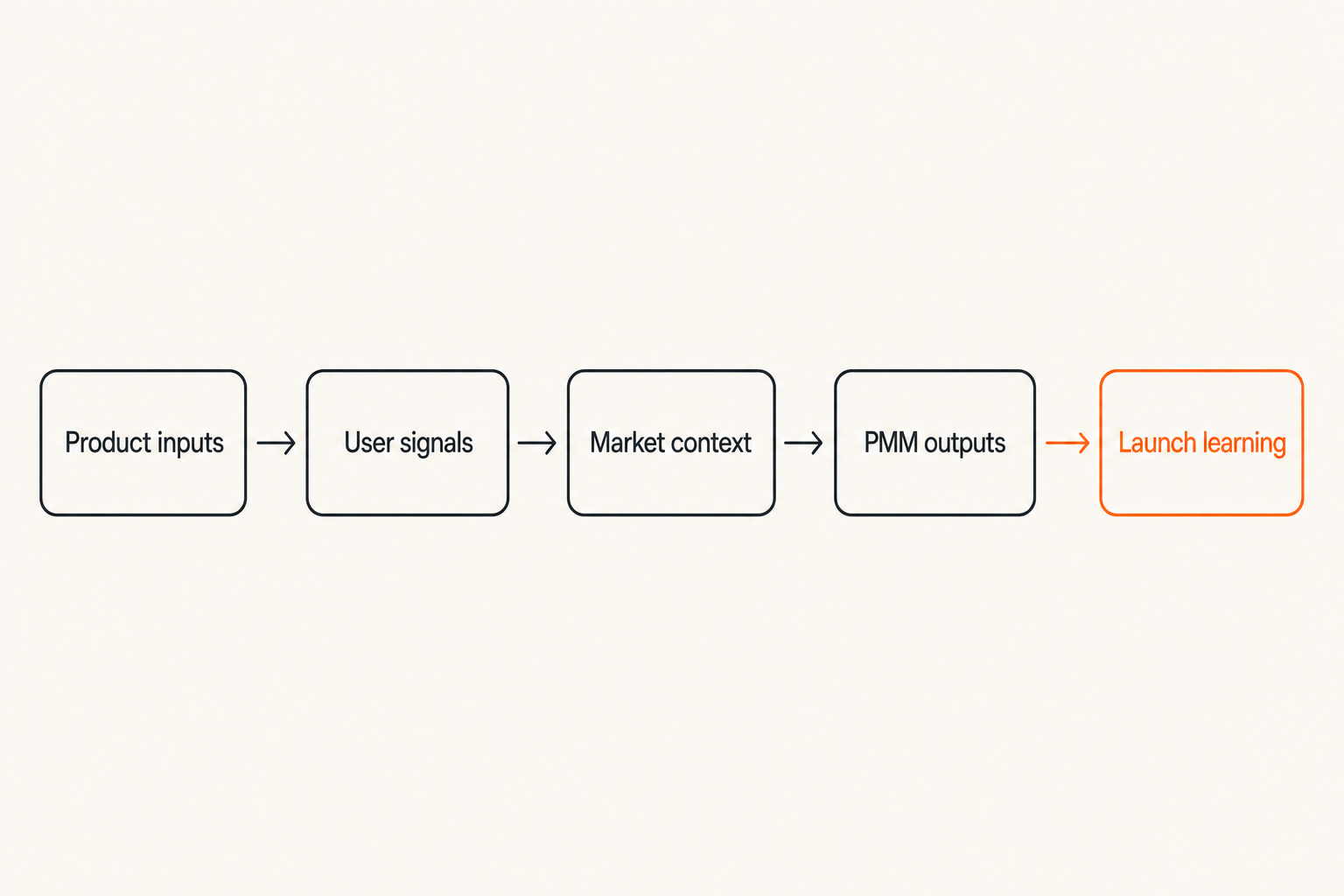
Inputs from product, users, and market
A product marketing manager needs a stable input system. Otherwise they become reactive: a launch request here, a deck request there, a founder opinion dropped into Slack ten minutes before publish.
Useful inputs include:
- Roadmap themes, not just feature tickets.
- Customer interviews and sales call notes.
- Support patterns and onboarding drop-offs.
- Competitor positioning and pricing changes.
- Win-loss notes from deals or signups.
- Search queries, community threads, and social language.
- Usage data tied to specific segments.
The point is not to collect everything. The point is to see enough signal to make better market decisions.
What breaks in practice is that product teams over-index on product data, while marketing teams over-index on channel data. Product data tells you what users do. Channel data tells you what people click. PMM work has to connect both to why buyers care.
Related reading from our network: teams choosing finance tools face a similar workflow problem in this practical budgeting software guide, where the real decision is not the tool category but ownership, cadence, and rollout fit.
Outputs that change decisions
The core PMM outputs are not random documents. They should change what the team does next.
A lightweight PMM operating system produces:
- Positioning brief: target segment, pain, alternatives, differentiated value.
- Message map: headline, supporting claims, proof, objections, excluded claims.
- Launch brief: audience, goal, tier, channels, timeline, owner map.
- Research synthesis: customer language, recurring triggers, objections, decision criteria.
- Enablement notes: who needs to say what, when, and with which proof.
- Learning loop: what happened after launch and what should change.
If these outputs do not affect roadmap, copy, onboarding, sales motion, or channel focus, they are theater.
Practical rule: A PMM artifact is useful only if it changes a decision, reduces ambiguity, or prevents repeated explanation.
Cadence beats campaign theater
Many teams only activate product marketing when a big launch is coming. That is backwards.
The launch is the public moment. The leverage is in the weekly cadence before it.
A practical cadence for a small team:
- Review roadmap changes once per week.
- Capture customer language from calls, support, and community.
- Update positioning assumptions when patterns repeat.
- Decide launch tier before work is complete.
- Draft message map before writing assets.
- Ship launch assets with clear owner handoffs.
- Review performance and qualitative feedback after release.
This does not require bureaucracy. It requires a rhythm. The smaller the team, the more important rhythm becomes because there are fewer people to catch drift.
Positioning and messaging that survives contact with buyers
Start with the specific switching moment
Positioning usually fails because it starts too high-level.
Teams say they are building a productivity platform, a collaboration layer, an AI assistant, a workflow engine, or an operating system for some category. Buyers do not usually wake up looking for abstractions. They wake up with a specific problem, constraint, trigger, or broken workflow.
The product marketing manager should identify the switching moment:
- What got painful enough that the buyer started looking?
- What current tool or workaround are they replacing?
- What risk makes them hesitate?
- What result would make the switch feel justified?
- What language do they already use to describe the pain?
For example, an indie analytics tool is not just analytics for creators. It might be a way for solo SaaS founders to see activation without setting up a full data warehouse. That switching moment is more useful than the category label.
A positioning statement should be specific enough to exclude some buyers. If it can describe five different products, it is not positioning. It is category wallpaper.
Build a message map before launch copy
Copy should come after structure.
A message map prevents launch writing from becoming a taste debate. It gives the team a shared model for what must be communicated and what can be left out.
A simple message map:
- Primary audience: who should care first.
- Pain: the expensive or annoying problem.
- Trigger: why they care now.
- Promise: the outcome the product helps create.
- Differentiator: why this approach is meaningfully different.
- Proof: what makes the claim credible.
- Objections: what smart buyers will worry about.
- Non-goals: what the product is not trying to be.
Then write the homepage, launch post, product page, onboarding email, demo script, and sales notes from the same map.
This is why product examples can be useful when handled correctly. They are not inspiration boards. They are working reference material for understanding choices. sh1pt.com's piece on using product examples as a practical system is useful if your team needs a repeatable way to study positioning, UX, and launch tradeoffs without copying surface details.
Practical rule: Do not write launch copy until the team agrees on audience, pain, proof, and what the product is not.
Launch planning is a dependency graph
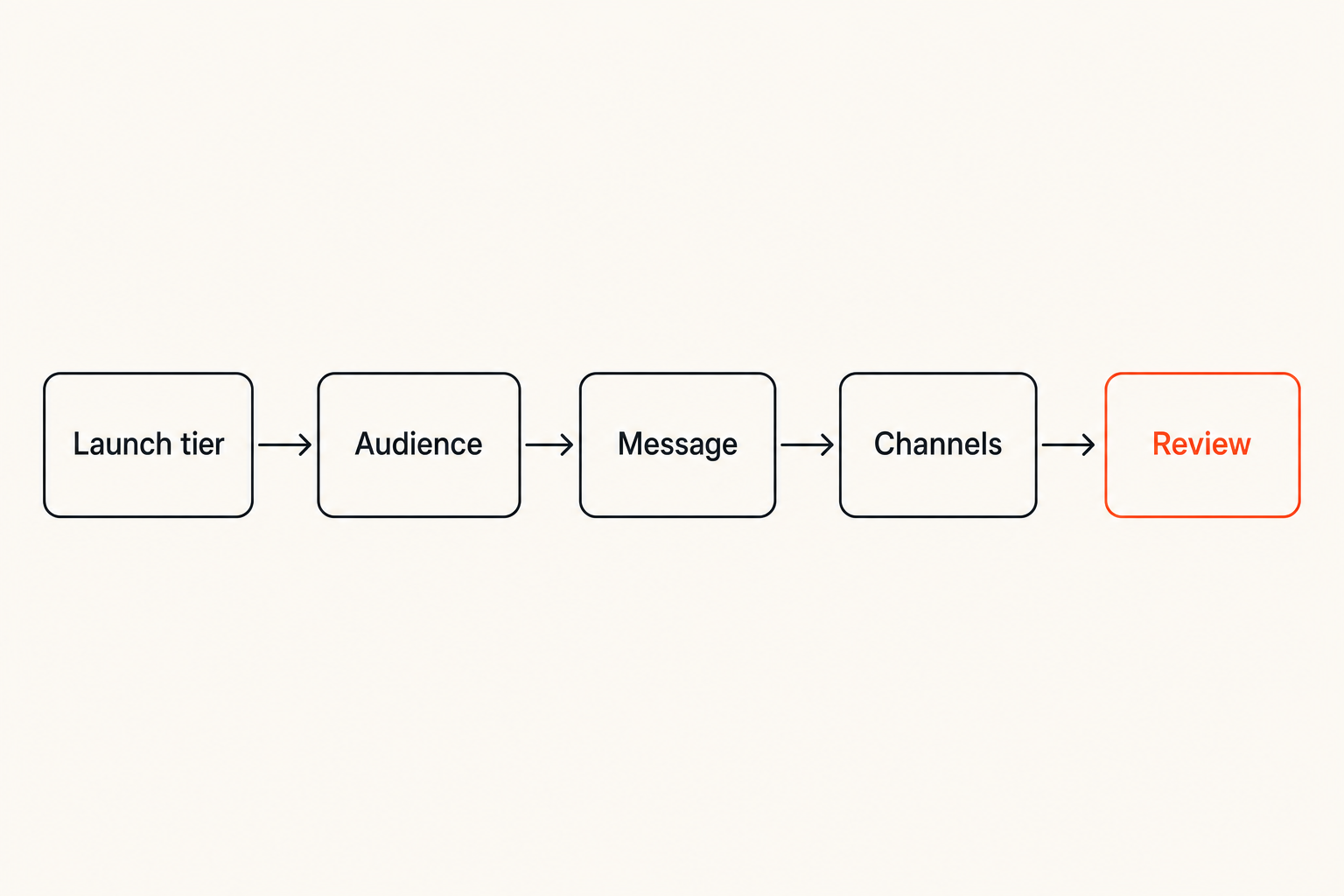
The launch workflow sequence
Launch planning looks like a content calendar from the outside. In practice, it is a dependency graph.
The product marketing manager has to coordinate product readiness, narrative readiness, audience readiness, channel readiness, and support readiness. If one is missing, the launch may still publish, but the business outcome usually suffers.
A practical launch sequence:
- Define launch tier.
- Is this a small update, meaningful feature, major release, pricing change, repositioning, or new product?
- Define the audience.
- Existing users, trial users, lost opportunities, waitlist, community, partners, developers, buyers, or press?
- Define the promise.
- What specific user progress does this release enable?
- Validate product truth.
- What is live, what is beta, what has limitations, what requires setup?
- Build the message map.
- Claims, proof, objections, and exclusions.
- Choose channels.
- Email, changelog, blog, social, community, in-app, partner, sales outreach, marketplace, or paid.
- Prepare internal handoffs.
- Support notes, sales notes, FAQ, known issues, escalation path.
- Publish and monitor.
- Watch activation, replies, objections, support volume, conversion, and qualitative signal.
- Run the post-launch review.
- Keep, change, or kill assumptions.
This is where PMM work becomes operational rather than decorative. Someone must know which decisions are blocked, which claims are unsafe, which audience is first, and what the team will do if the launch creates confusion.
What breaks when launch owners are unclear
Bad launches rarely fail only because the post was weak. They fail because ownership was vague.
Common breakpoints:
- Product ships late, but the launch date does not move.
- Marketing promises a workflow that requires setup the product does not support.
- Sales hears about the release after customers ask about it.
- Support has no answer for obvious edge cases.
- The email links to a page that explains benefits but not activation.
- The launch drives signups from the wrong segment.
- Nobody reviews whether the message worked.
The product marketing manager does not need to own every task. They need to own launch coherence.
Related reading from our network: remote teams run into similar handoff problems, and this piece on collaborative control workflows is a useful adjacent reminder that permissions, ownership, and handoffs matter more than the surface interface.
Customer research without turning it into theater
Interview for decisions, not compliments
Customer research gets bloated fast. Teams schedule interviews, collect quotes, paste snippets into a doc, and feel closer to the market. Then roadmap decisions continue as before.
The practical question is: what decision will this research change?
For product marketing manager work, interviews should focus on market translation:
- What was happening before the user looked for a solution?
- What alternatives did they consider?
- What words did they search, ask, or say internally?
- What almost stopped them from trying the product?
- What made the product feel credible or risky?
- What outcome did they expect in the first session, week, or month?
- What would they tell a peer who had the same problem?
Avoid asking users whether they like your positioning. They will be polite, vague, or accidentally misleading. Ask about the situation that made the product relevant.
For early-stage teams, five good conversations with the right users can be more useful than a large survey with poorly segmented answers. The issue is not sample size alone. It is whether you are hearing from people with the same job, trigger, and buying constraint.
Turn patterns into claims you can test
Research should become testable claims.
Example pattern:
- Users mention that setup speed matters because they are replacing spreadsheet-based reporting.
- They worry that analytics tools become too complex.
- They describe value as knowing what to fix this week.
A PMM can turn that into claims:
- Set up activation tracking in an afternoon.
- See the product bottleneck that matters this week.
- No data team required for your first useful dashboard.
Those claims can be tested on landing pages, onboarding flows, sales calls, demos, community posts, and support conversations.
A useful research synthesis should include:
- Repeated language.
- Trigger events.
- Alternative solutions.
- Decision criteria.
- Anxiety points.
- Proof that mattered.
- Segments that did not match.
- Messaging hypotheses to test next.
The mistake teams make is treating research as a brand exercise. For PMM, research is a decision engine.
Channels, content, and sales enablement
Match channel to buyer intent
A product marketing manager should not turn every launch into the same distribution checklist.
Different channels carry different intent.
- Search captures existing demand and problem awareness.
- Community captures peer context and credibility.
- Email captures existing relationship and user expansion.
- In-app messaging captures activation and feature adoption.
- Sales outreach captures account-specific relevance.
- Partner channels capture borrowed trust.
- Product-led loops capture usage-driven discovery.
The channel plan should follow the audience and trigger. A major workflow change for existing users may need in-app education and support readiness more than a public launch post. A new product category bet may need long-form positioning, founder-led narrative, and repeated education before conversion appears.
This is also where many indie hackers waste energy. They post everywhere because distribution feels like effort. But effort is not strategy. The PMM question is which channel gives the right person enough context to take the next step.
Enablement is decision support
Sales enablement sounds enterprise-heavy, but small teams need it too.
If a founder, PM, support lead, or community manager has to explain the product, they need enablement. That might be a one-page objection guide, a demo flow, a comparison note, a pricing explanation, or a set of support macros.
Good enablement answers:
- Who is this for?
- What problem should we lead with?
- What should we not promise?
- How do we explain the difference from alternatives?
- What proof should we use?
- What objections should we expect?
- When should we disqualify?
Bad enablement is a graveyard of decks nobody opens. Good enablement is short, current, and tied to live conversations.
Related reading from our network: when teams handle sensitive communication, the same clarity around ownership and constraints appears in this secure messaging architecture guide. Different niche, same operator lesson: the workflow behind the interface determines whether the system holds up.
Metrics for product marketing manager performance
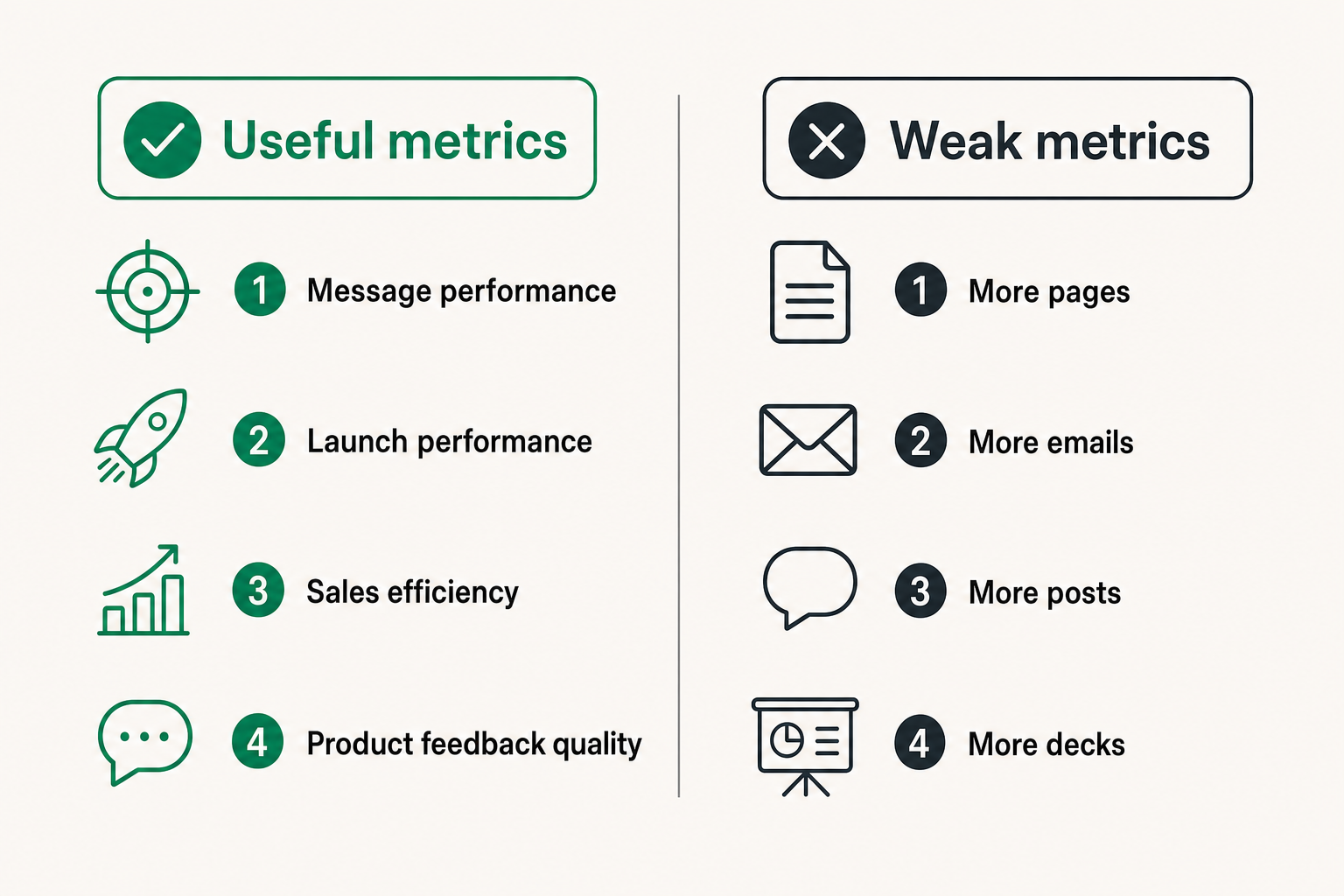
Measure quality of demand, not activity volume
Measuring a product marketing manager by asset volume is a good way to create noise.
More pages, more emails, more posts, and more decks may help, but only if they improve understanding and conversion. The better measurement question is whether market-facing work is creating better demand, faster decisions, and fewer repeated explanations.
Useful PMM metrics depend on company stage, but common categories include:
- Message performance: conversion rate, reply quality, demo request quality, activation from launch pages.
- Launch performance: target audience reached, activation, adoption, expansion, support burden, qualitative objections.
- Sales efficiency: repeated objections reduced, discovery quality improved, sales cycle friction lowered.
- Product feedback quality: clearer segment patterns, better roadmap inputs, fewer vague requests.
- Content usefulness: pages that assist signup, onboarding, sales, support, or expansion.
- Positioning health: fewer internal contradictions, stronger differentiation, easier explanation.
Some of these are quantitative. Some are operational signals. Early-stage teams should not pretend every useful PMM outcome fits neatly into a dashboard.
The practical question is whether the work reduces uncertainty in the business.
A practical scorecard
Use a scorecard that combines outcomes, signals, and operating quality.
| Metric area | Good signal | Weak signal |
|---|---|---|
| Positioning | Team explains product consistently | Every page uses different language |
| Launch | Target users activate or respond | Launch creates traffic but no learning |
| Research | Patterns change claims or roadmap | Quotes sit in a doc unused |
| Sales support | Objections are anticipated | Sales asks for one-off assets repeatedly |
| Content | Pages help users decide or act | Content exists because calendar needed filling |
| Feedback loop | Post-launch learning changes next release | Team moves on without review |
A lightweight monthly PMM review can ask:
- What did we learn about the market this month?
- Which message or claim became stronger?
- Which assumption became weaker?
- Which launch produced real adoption or pipeline?
- Which asset reduced repeated explanation?
- Which segment should get more or less attention?
- What should product know before the next roadmap decision?
Practical rule: Measure product marketing by the quality of decisions it improves, not by the quantity of assets it ships.
Common failure modes
What fails when PMM becomes the copy desk
The most common failure mode is simple: PMM becomes the copy desk.
Product decides what to build. Leadership decides when to launch. Sales asks for a deck. Support asks for an FAQ. Then the product marketing manager gets told to make it sound good.
What breaks:
- Positioning becomes reactive.
- Launches inherit bad assumptions.
- Research is separated from decisions.
- Copy improves, but strategy does not.
- PMM burns out from context switching.
- The company mistakes polish for clarity.
This is not a writing problem. It is an operating design problem.
If PMM is accountable for market clarity, they need access to product planning, customer conversations, roadmap tradeoffs, launch tiering, and post-launch learning. Without that access, the role can only treat symptoms.
What fails when PMM owns everything after build
The opposite failure is also common. The team assumes anything that happens after product development belongs to PMM.
That creates a different kind of mess:
- PMM owns launch, website, content, sales enablement, research, lifecycle, analytics, support docs, pricing pages, competitive work, community posts, and sometimes customer onboarding.
- Product stops caring about market framing.
- Sales outsources customer understanding.
- Leadership asks for strategy but funds only execution.
- Nobody can tell whether the PMM is succeeding.
A product marketing manager should be close to many systems, but not be the owner of all of them.
The clean model is shared accountability with clear interfaces. Product owns what is built. PMM owns market interpretation and launch coherence. Sales and success own customer conversations and commercial execution. Leadership owns strategy tradeoffs and resourcing.
For a deeper operator view of the broader discipline, sh1pt.com has a related guide to product marketing in 2026 that expands the workflow beyond the individual product marketing manager role.
How sh1pt.com thinks about product marketing manager work
Product-fit for builders shipping lean
At sh1pt.com, the useful lens is simple: shipping is not only delivery. Shipping is the movement from idea to market.
That means product marketing manager work matters even if you are a solo founder with no PMM title, a product manager at a small startup, or an indie hacker launching your third side project. Someone still has to decide who the product is for, what pain it attaches to, why it is different, how it launches, and what the market taught you after release.
For lean teams, the PMM workflow can be small:
- One positioning brief per major product bet.
- One message map per launch.
- One customer language review per week.
- One launch owner map before publish.
- One post-launch review after enough signal arrives.
The point is not to create process for its own sake. The point is to stop wasting shipped work because the market-facing system is vague.
The practical next step
If you are not ready to hire a product marketing manager, build the operating rhythm first.
Start with three documents:
- A positioning brief for your current product.
- A launch brief for your next meaningful release.
- A research synthesis from your last ten useful customer conversations, support tickets, or sales calls.
Then compare them. If the audience, pain, proof, and channel plan do not line up, you found the gap. Fixing that gap is product marketing work.
If you are hiring, do not screen only for copywriting, launch energy, or big-brand experience. Screen for judgment. Ask candidates how they would find signal, challenge positioning, sequence a launch, handle unclear ownership, and turn feedback into decisions. A good product marketing manager should make the team more honest about the market, not just more visible in it.
The closing point is straightforward: a product marketing manager turns shipping into a repeatable market workflow. For founders, PMs, solopreneurs, and indie hackers in 2026, that may be the difference between releasing software and building demand for it.
Try sh1pt.com
sh1pt.com is for people building and launching software products who want practical shipping strategies, product development processes, and growth tactics. Try sh1pt.com.