Product names look harmless until they block the launch checklist.
You have the build mostly working. The landing page is drafted. The onboarding emails are queued. Then someone asks whether the name is final, whether the domain is good enough, whether the GitHub repo should match, whether support can pronounce it, whether another product already owns the search result, and whether the name still makes sense after the next roadmap pivot.
Teams think the problem is creativity. The real problem is operational fit.
A product name is not just a label. In 2026, product names touch search, app stores, AI answers, support scripts, investor decks, API docs, invoices, legal screening, analytics properties, and customer memory. The practical question is not whether a name feels clever in a meeting. The practical question is whether it can survive the workflow around shipping software.
Table of contents
- Product names are a shipping dependency, not a branding exercise
- Decide what the name must do before you brainstorm
- Build a naming brief your team can actually use
- Generate product names with constraints, not vibes
- Screen product names before they reach the roadmap
- Test product names in real launch contexts
- Compare naming patterns by business model
- Operationalize the chosen name across the stack
- Failure modes: what breaks when product names are treated casually
- Make product names part of your launch operating system
Product names are a shipping dependency, not a branding exercise
The mistake teams make is treating naming as the final coat of paint. They build the product, then ask for a name once the demo video is due. That creates pressure, and pressure creates bad naming decisions: rushed domains, inconsistent handles, confusing docs, and launch copy that explains around the name instead of using it.
A useful way to think about it is this: a product name is a shared identifier across your whole delivery system. If that identifier is unstable, every downstream artifact becomes unstable too.
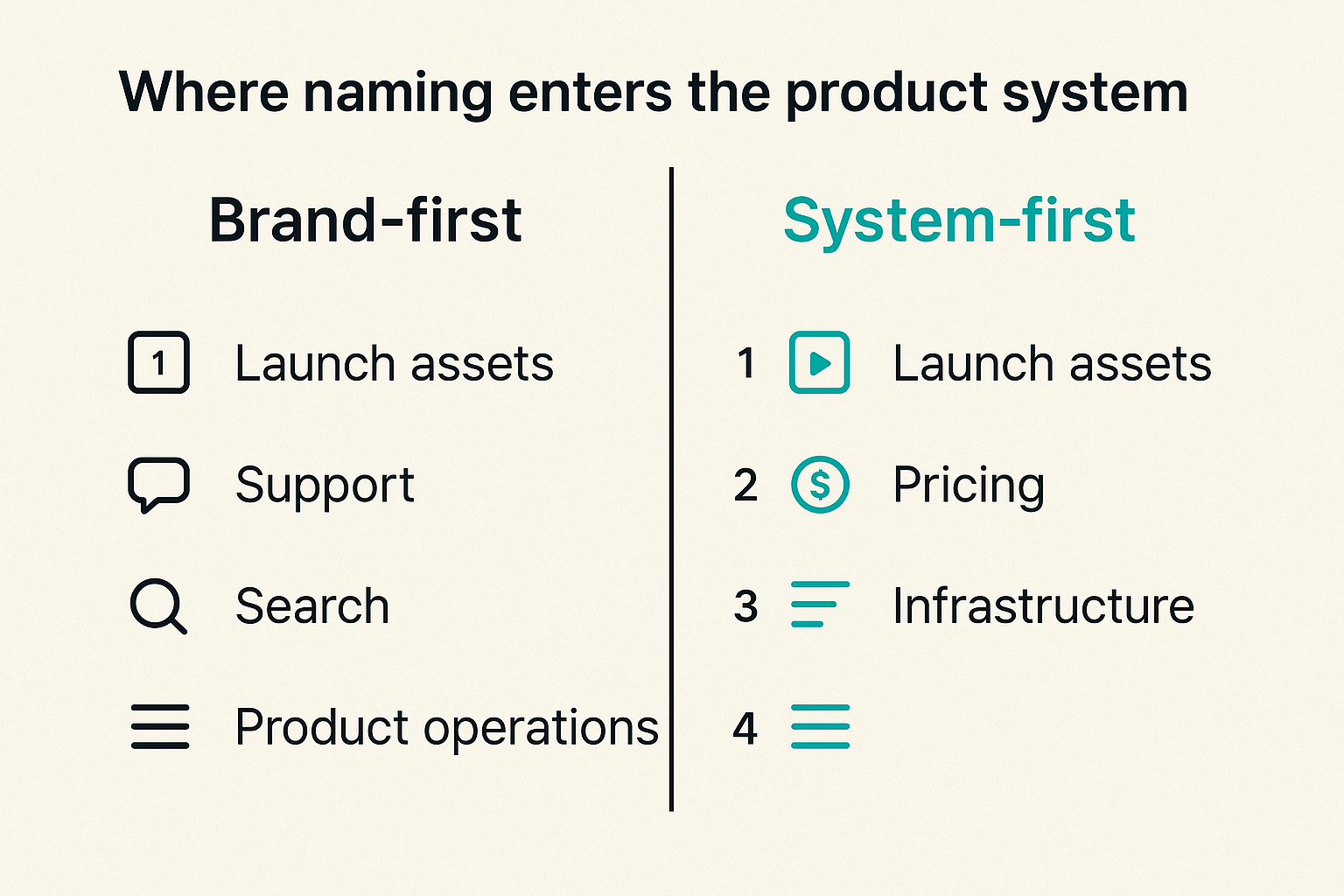
Where naming enters the product system
A name shows up earlier and more often than most teams expect:
- In the repository, package, database, and environment names
- In the domain, subdomain, and email sender identity
- In onboarding screens and empty states
- In pricing pages, invoices, and receipts
- In support macros and help center articles
- In analytics dashboards and event naming
- In sales calls, demos, and investor updates
- In app store listings, marketplace pages, and SEO titles
That changes the conversation. The question is no longer whether the name sounds cool. The question is whether it can function as infrastructure.
Practical rule: Do not approve a product name until you have seen it in a headline, a URL, a support reply, a pricing line, and a customer sentence.
What breaks when the name is chosen too late
Late naming creates hidden rework. The landing page headline changes. The product tour screenshots change. The release notes change. The repo naming convention changes. The team debates whether the feature flag should use the old codename or the new public name.
What breaks in practice is not one big item. It is dozens of small mismatches:
- The product is called one thing in the UI and another thing in the docs.
- The founder uses a shorthand that customers never hear.
- The domain has a hyphen, but the social handle does not.
- The app name is singular, the legal entity is plural, and invoices use an abbreviation.
- The SEO title targets a category the product no longer fits.
None of this feels catastrophic during build week. It becomes expensive during launch week, when every hour should be spent improving the offer, not reconciling naming drift.
Decide what the name must do before you brainstorm
Before you generate product names, define the job. A naming process without a job definition turns into taste arbitration. Founders argue about what feels premium, friendly, technical, bold, or memorable. Those are not useless qualities, but they are not operating criteria.
Map the job of the name
Different products need different names because they do different market work.
A bootstrapped developer tool might need immediate category clarity because buyers compare alternatives quickly. A consumer app might need emotional recall because usage starts with a recommendation. A B2B workflow product might need credibility because procurement, budget owners, and end users all see it.
Ask four questions before brainstorming:
- Does the name need to explain the category?
- Does the name need to signal a specific audience?
- Does the name need to stretch across multiple future products?
- Does the name need to rank in search for an existing problem?
If the answer to all four is yes, you are not looking for a clever word. You are designing a durable naming architecture.
Separate brand name, product name, and feature name
Many early teams collapse everything into one name. That works until the company ships more than one thing.
There are three layers:
- Brand name: the company or umbrella identity customers remember.
- Product name: the specific product customers buy, install, or use.
- Feature name: the internal or external label for a capability inside the product.
For a single-product startup, these may be the same. That is fine. The risk is not simplicity. The risk is pretending the decision has no future cost.
If the brand is the product, changing direction later gets harder. If the product name is too narrow, roadmap expansion gets messy. If every feature gets a branded name, onboarding becomes a vocabulary test.
Related reading from our network: teams working through permissions and shared control face similar naming and handoff issues in remote team control workflows, where labels only help if everyone can act on them consistently.
Define naming constraints early
Constraints make naming faster. They also prevent the team from falling in love with names that cannot ship.
Useful constraints include:
- Maximum syllables
- Preferred word type: descriptive, suggestive, invented, acronym, compound
- Domain tolerance: exact .com, modified .com, app domain, country domain, subdomain
- Search tolerance: unique term, category phrase, or competitive phrase
- Legal screening depth required before launch
- International pronunciation risks
- Banned words, prefixes, suffixes, and category cliches
Practical rule: A name that cannot pass your constraints is not a finalist. It is a distraction with good taste.
Build a naming brief your team can actually use
A naming brief is not a brand manifesto. It is a decision document. Its job is to stop subjective debates from resetting the process every time a new stakeholder joins.
The brief should be short enough to use and specific enough to reject options.
Write the positioning sentence first
Start with one sentence:
For [audience], [product] helps [job] by [mechanism], unlike [alternative].
Example:
For solo SaaS founders, LaunchLedger helps track launch tasks, channel experiments, and revenue signals in one operating view, unlike project tools that separate marketing from product shipping.
You do not need that exact format forever. You need it before naming because the name has to live next to the positioning. If the sentence is unclear, the name will carry too much weight.
This is where product examples help, but only if you use them as inputs instead of mood boards. A practical teardown process, like the one in Product Examples Are Not Inspiration, can show how comparable products connect names, positioning, pricing, and onboarding.
Capture audience language
Product names fail when founders name the product from the inside out. They use their internal metaphor, their build codename, or a phrase from the architecture instead of the customer workflow.
Collect raw language from:
- Customer interviews
- Support tickets
- Reddit and community posts
- Search queries
- Competitor reviews
- Sales objections
- Demo call notes
- Existing spreadsheets or hacks customers use
Look for verbs and nouns customers already use. A name does not need to copy them directly, but it should not fight them.
For example, if users say they need to reconcile payments, calling the product DriftNest might create unnecessary distance. If users say they want a launch command center, a name that signals control, status, or coordination may carry more useful meaning.
Set the rejection rules
A good naming brief says no. That is the point.
Include rejection rules such as:
- Reject names that sound like existing competitors.
- Reject names that require spelling corrections more than once.
- Reject names that only make sense after a founder explains the metaphor.
- Reject names that box the product into one feature if the roadmap is broader.
- Reject names that create awkward plurals, verbs, or possessives.
The mistake teams make is preserving too many options. Optionality feels safe, but it delays commitment. The brief should reduce the list.
Generate product names with constraints, not vibes
Brainstorming is useful once the system is clear. Without constraints, it produces noise. With constraints, it produces comparable options.
The practical question is not how to generate a thousand names. It is how to generate enough usable candidates across different naming lanes so the team can see tradeoffs.
Use naming lanes instead of random lists
Create lanes before generating. Each lane represents a different strategy.
Common lanes for software product names:
- Descriptive: says what the product does, such as InvoiceSync or DeployWatch.
- Outcome-based: points to the result, such as ClearPath or FastClose.
- Audience-based: names the user or market, such as FounderDesk.
- Metaphor-based: borrows meaning from another domain, such as Relay or Compass.
- Invented: creates a distinctive word, such as Vercel or Figma.
- Compound: combines familiar words into a new phrase, such as Airtable.
Each lane has a cost. Descriptive names are easier to understand but harder to own. Invented names are easier to own but harder to explain. Metaphor names can be memorable or vague, depending on execution.
Create enough options to see patterns
Do not ask for three names. Ask for ranges.
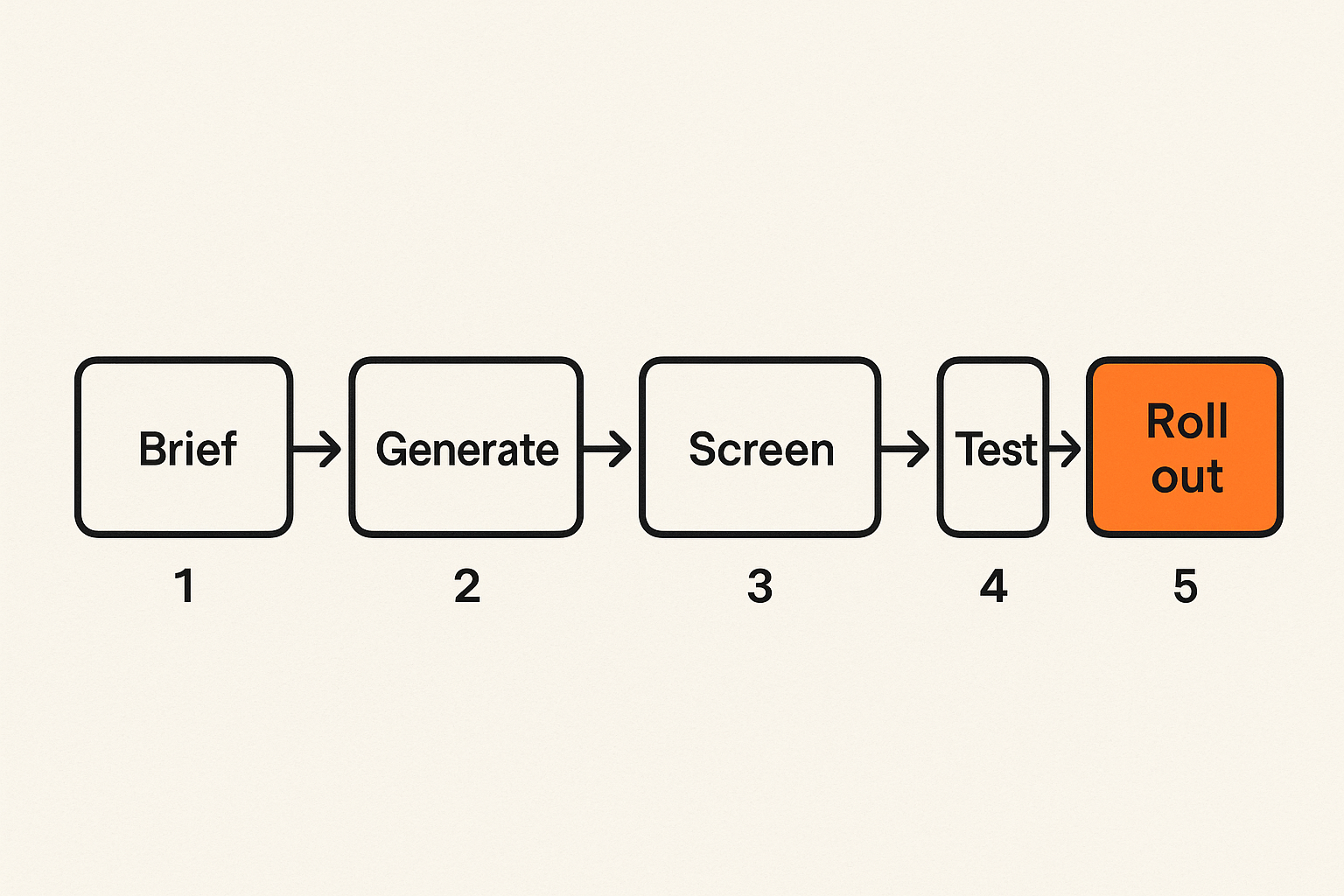
A practical generation workflow:
- Generate 20 descriptive names.
- Generate 20 outcome-based names.
- Generate 20 metaphor names.
- Generate 20 compound names.
- Generate 20 intentionally bad names to expose cliches.
- Remove anything that violates hard constraints.
- Cluster the survivors by pattern.
- Select 8 to 12 candidates for screening.
The intentionally bad list is useful. It reveals the words your team should avoid. In many markets, everyone uses the same suffixes: hub, stack, flow, base, lab, desk, pilot, pulse. None are automatically bad. They are bad when they make you indistinguishable.
Keep AI useful but bounded
AI can help generate product names, but it can also average you into category mush. If you ask for names for an AI productivity app, you will get a pile of names that sound like every AI productivity app.
Use AI for variation, not final judgment. Give it the brief, constraints, banned words, competitor list, and naming lanes. Ask it to generate options by lane and explain the tradeoff of each option.
Do not ask: Give me the best product name.
Ask: Generate 30 two-syllable suggestive names for a workflow product used by product managers. Avoid the words flow, sync, AI, lab, hub, and task. The name should work in a sentence like: We use [name] to decide what ships next.
If your launch system includes content, changelogs, launch pages, and social distribution, naming also has to survive repeated publishing. The workflow perspective in AI Publishing Shipping Software is useful here because the name becomes an input to every asset, not a one-time creative choice.
Screen product names before they reach the roadmap
A name should not become real just because the team likes it. It becomes real after screening.
Screening is where you turn taste into risk management. You are not trying to eliminate all risk. You are trying to remove obvious avoidable problems before they spread into product and launch assets.
Check search and domain collisions
Search the exact name, close variants, plural forms, misspellings, and category combinations.
For each finalist, check:
- Exact match search results
- Name plus software
- Name plus app
- Name plus your category
- Name plus competitor category
- Domain availability
- Social handle availability
- App marketplace conflicts if relevant
- GitHub, npm, PyPI, Docker, or plugin ecosystem conflicts if relevant
A name does not need a perfect exact-match .com. Many teams ship with modified domains. But you need to know the tradeoff. If customers hear the name on a podcast and cannot find you, the domain saved you money while costing you demand.
Related reading from our network: software supply-chain teams deal with a harder version of this identity problem when package names, repos, and build assets drift; this CI/CD defense operating system shows why naming consistency matters in technical environments.
Check pronunciation, spelling, and support risk
Say the name aloud in realistic contexts:
- Thanks for trying [name].
- I will send you the [name] invite.
- Search for [name] in the marketplace.
- The webhook is from [name].
- Your invoice from [name] is attached.
Then ask someone to spell it after hearing it once.
This is basic, but many teams skip it. They choose a visually interesting name that fails in spoken channels. That matters if you sell through calls, podcasts, referrals, demos, community events, or support.
Support teams pay for naming ambiguity. If users cannot spell the product, find the docs, or identify official emails, ticket volume increases. Naming is a support load decision.
Check future product surface area
A name should fit where the product is going, not just where it starts.
Ask:
- Does the name still work if we add collaboration?
- Does it still work if we move upmarket?
- Does it still work if we remove the original core feature?
- Does it still work if we launch an API?
- Does it still work if we create templates, courses, or services around the product?
Do not over-optimize for a fantasy roadmap. But do avoid names that are already too small.
Practical rule: Pick the narrowest name that matches the real wedge, but not so narrow that the next obvious feature makes it obsolete.
Test product names in real launch contexts
Product names are not tested in surveys. They are tested in context.
The problem with asking people which name they like is that liking is not the job. Customers do not buy names. They notice, remember, trust, search, repeat, and refer them.
Put the name inside the actual funnel
Create realistic assets for each finalist:
- A landing page hero
- A pricing page line
- An onboarding email subject
- A support reply
- A demo script intro
- A social launch post
- A docs page title
- A product screenshot with the name in navigation
Then review the name in those surfaces. Some names look strong in isolation and weak in a headline. Others look plain alone but become effective when paired with the positioning.
Example:
LaunchOS might feel generic in a list. But if the hero says LaunchOS: plan, publish, and measure every product launch from one workspace, the category becomes clearer. Conversely, a clever invented name may need too much explanation above the fold.
Test memory, not opinions
Use lightweight recall tests:
- Show someone the landing page for 10 seconds.
- Hide it.
- Ask what the product is called.
- Ask what they think it does.
- Ask what they would search to find it again.
You are looking for mismatch. If they remember the category but not the name, the name may be too generic. If they remember the name but not the product, the positioning may be weak. If they cannot search for it, distribution gets harder.
This is not statistically pure. It does not need to be. It is an early warning system.
Watch for channel-specific failure
Names behave differently by channel.
A name that works in a developer community may fail in an executive sales call. A name that ranks well in search may sound dull in a launch video. A name that works on a website may be hard to say on a podcast.
Map your first three channels and test there first. If your go-to-market motion depends on founder-led LinkedIn posts, the name must work in short written explanations. If it depends on app marketplace search, category terms matter. If it depends on referrals, pronunciation matters.
Related reading from our network: small teams rolling out process tools hit the same adoption issue, and this guide to Asana project management software workflows is a useful adjacent example of why labels, rollout, and behavior need to line up.
Compare naming patterns by business model
There is no universal best naming pattern. The right product names depend on business model, distribution channel, and buyer behavior.
The table below is not a formula. It is a decision aid.
Descriptive names
Descriptive names say what the product does. They reduce explanation cost.
They work well when:
- The category already exists.
- Buyers are searching for a known solution.
- The product competes on clarity and speed.
- The audience is practical and low-patience.
They fail when:
- The name is indistinguishable from competitors.
- The product needs emotional distinctiveness.
- The roadmap will move beyond the initial function.
Suggestive names
Suggestive names imply a benefit, motion, or metaphor without fully describing the product.
They work well when:
- You need some memorability without full abstraction.
- The product has a clear positioning sentence.
- The market is crowded with literal names.
- You want room to expand.
They fail when:
- The metaphor is too private.
- The name could apply to any startup.
- The product needs immediate category comprehension.
Invented names
Invented names can be ownable and distinctive. They also require more education.
They work well when:
- You have strong distribution.
- You can repeat the name often.
- The product experience is memorable.
- You want a brand that can stretch.
They fail when:
- You have weak reach.
- The spelling is not obvious.
- The name sounds like every other invented SaaS word.
| Naming pattern | Best fit | Main advantage | Main risk | Good early-stage test |
|---|---|---|---|---|
| Descriptive | Search-led tools, utilities, plugins | Fast comprehension | Hard to own | Can users tell what it does from the name? |
| Suggestive | SaaS, workflow tools, prosumer products | Balance of clarity and memory | Vague metaphor | Can users repeat the name and describe the job? |
| Invented | Category creation, design-led products, platforms | Distinctive and extensible | Requires education | Can users spell it after hearing it once? |
| Compound | B2B tools, collaboration products | Familiar but ownable | Can sound generic | Does it work in a sentence customers would say? |
| Acronym | Enterprise, technical, internal tools | Compact | Low meaning | Does anyone outside the team know what it means? |
Operationalize the chosen name across the stack
Choosing the name is not the end. It is the start of a rollout.
The mistake teams make is announcing the chosen name in Slack and assuming everyone will use it correctly. They will not. People will keep using codenames, old repo names, temporary page titles, and shorthand unless the rollout is explicit.
Treat naming rollout like a release
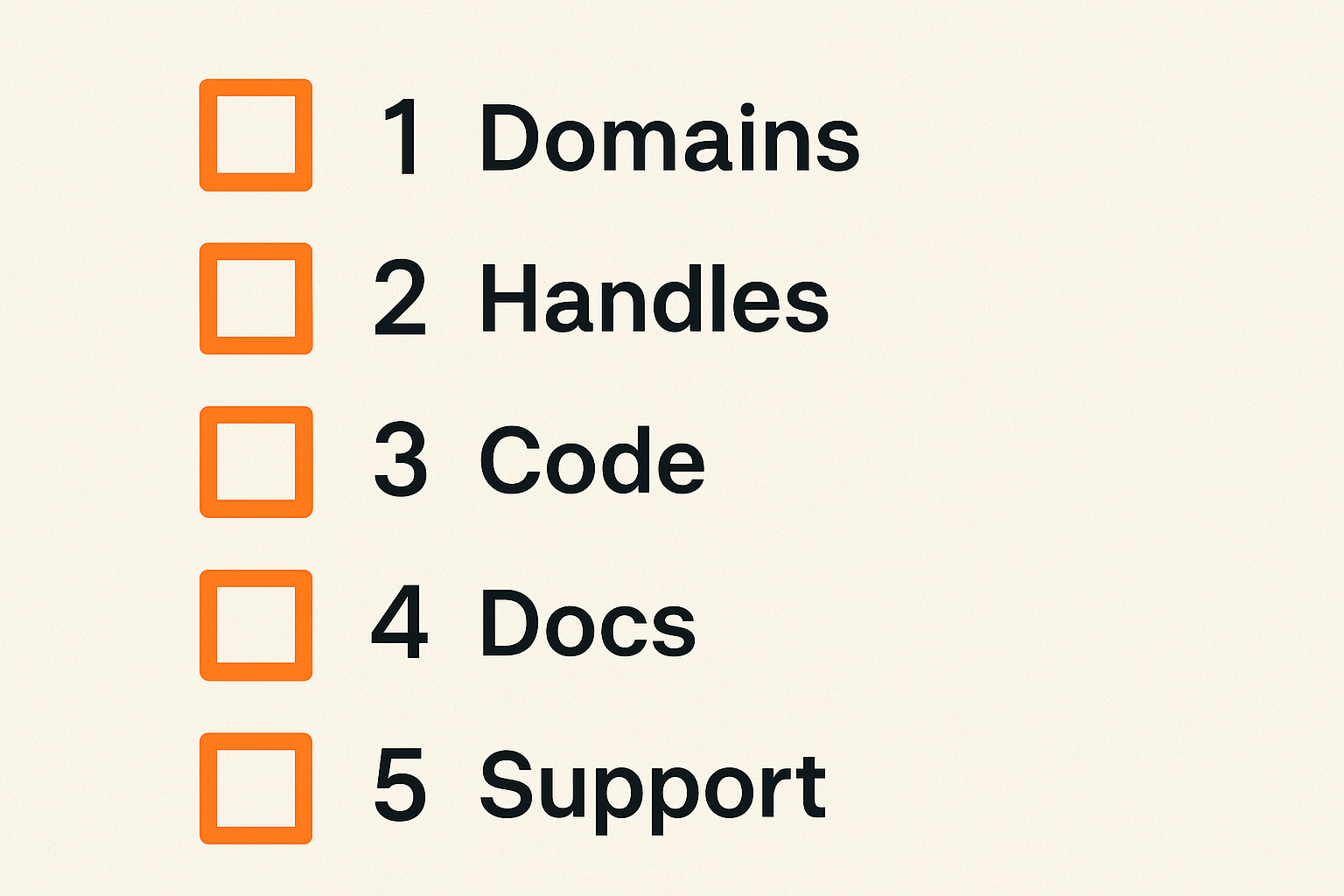
Use a small release plan:
- Freeze the public name and spelling.
- Decide the canonical capitalization.
- Decide the domain and redirect strategy.
- Update product UI strings.
- Update documentation titles and screenshots.
- Update analytics property names and dashboards.
- Update email sender names and templates.
- Update invoices, receipts, and billing descriptors.
- Update support macros and help center articles.
- Update launch assets and social profiles.
This sounds tedious because it is. But it is cheaper than letting naming inconsistency leak into customers, search engines, and support.
Create a naming source of truth
Create one document or config file that defines:
- Public product name
- Short name if allowed
- Banned abbreviations
- Tagline
- One-sentence description
- Boilerplate description
- Domain
- Social handles
- Support email
- Sender name
- Legal entity if different
- Product category label
- Feature naming rules
For a technical team, a simple file can help:
product_name: LaunchLedger
short_name: none
canonical_capitalization: LaunchLedger
category: launch operations workspace
domain: launchledger.app
support_sender: LaunchLedger Support
banned_terms:
  - LL
  - Launch Ledger App
  - Ledger Launch
feature_name_rule: describe features by job, not branded metaphors
This is not bureaucracy. It is a way to prevent small inconsistencies from multiplying.
Plan redirects, aliases, and migration paths
If you used a codename publicly, plan the transition.
You may need:
- Redirects from old landing pages
- Alias domains
- Updated Open Graph metadata
- Updated app store listing names
- Updated docs paths
- Email explaining the rename
- Changelog entry
- Support macro for confused users
- Analytics annotation marking the change
If the product has an API, be careful. Public API names, package names, and webhook event names have longer half-lives than marketing copy. You can rename a landing page in an afternoon. You may support an old package name for years.
Failure modes: what breaks when product names are treated casually
Bad product names rarely fail alone. They create friction that compounds across acquisition, onboarding, support, and roadmap work.
The problem is not that the name is imperfect. Every name is imperfect. The problem is when the imperfection attacks the business model.
The name is clever but unsearchable
Some names are clever in the room and invisible in the market.
Common causes:
- The word is too common.
- The spelling is non-obvious.
- The term is dominated by another industry.
- The name collides with a famous product, band, book, or game.
- The domain forces users to remember an awkward modifier.
What works:
- Pair a less unique name with a clear category phrase.
- Use consistent metadata across pages.
- Own a memorable modified domain if exact match is unavailable.
- Make the first search result easy to recognize.
What fails:
- Assuming customers will remember the full domain.
- Changing spelling to force availability.
- Using punctuation or missing vowels that people cannot pronounce.
The name traps the roadmap
Early names often describe the first feature too tightly. That feels efficient until the product expands.
A tool called ScreenshotBugReport may work for a tiny wedge. But if the roadmap expands into session replay, issue triage, customer feedback, and release QA, the name starts fighting the product.
Sometimes that tradeoff is worth it. A narrow descriptive name can help you get early users. The key is being honest about the cost.
If your wedge is narrow but your ambition is broad, consider a brand architecture that lets the first product be descriptive while the umbrella has room to grow.
The team cannot enforce consistency
Inconsistent naming creates trust leakage.
Customers notice when the product name in the UI does not match the invoice. They notice when the docs use an old name. They notice when the OAuth screen says a different app is requesting access. Even if they do not consciously care, it creates hesitation.
This is especially painful for products that require access to sensitive data, payments, repositories, analytics, or customer records. The name needs to reassure, not create a security question.
Practical rule: If a customer sees three names during signup, they will assume there are three systems. Consistency is part of trust.
Make product names part of your launch operating system
Product names should sit inside the same operating system you use for positioning, roadmap, content, analytics, and launch execution.
That does not mean turning naming into a six-month agency process. It means giving the decision enough structure that it does not create avoidable drag.
Connect naming to go to market
A name is a go-to-market input. It affects the hook, the category, the search strategy, the referral loop, and the sales explanation.
If your launch plan is built around SEO, you may need a descriptive or category-adjacent name. If your launch plan is built around community and founder-led storytelling, a more suggestive name can work if the story is repeatable. If you are building a platform, the name may need to stretch across multiple products and partner integrations.
The naming decision should sit next to your launch motion. The framework in Go to Market Strategy in 2026 is relevant because naming only works when it connects to audience, channel, offer, and measurement.
Assign ownership before launch week
Someone needs to own naming quality after the decision is made.
That owner should check:
- New pages use the canonical name.
- Product UI does not leak old codenames.
- Support and billing names match.
- Social profiles and launch assets are consistent.
- Docs and screenshots are updated.
- Analytics dashboards use the final label.
- Feature names follow the naming rules.
This does not need to be a brand team. In an indie or early startup, it may be the founder, PM, designer, or growth lead. The important part is that someone has the authority to say: this label is wrong, fix it before launch.
Product names are not magic. A strong name will not save a weak product, unclear positioning, or lazy distribution. But a bad naming system can slow down a good product. Treat the name as part of the shipping architecture, and the launch gets cleaner.
Try sh1pt.com
sh1pt.com is for people building and launching software products who want practical shipping strategies, product development processes, and growth tactics. If you want to turn product names into a cleaner launch workflow, Try sh1pt.com.