
A promotional products supplier looks like a simple vendor choice until the launch calendar starts slipping.
The landing page is ready. The waitlist is segmented. The product team is still fixing onboarding. Then someone asks whether the launch box, sticker pack, desk mat, hoodie, event giveaway, or customer thank-you item will arrive before the announcement goes live.
Teams think the problem is finding a cheaper supplier with a better catalog. The real problem is choosing an operating partner that can fit into the launch workflow without creating support debt, brand risk, or fulfillment chaos.
That changes the conversation. A promotional products supplier is not just where you buy swag. For a software launch, the supplier becomes part of your go-to-market system: audience targeting, timing, personalization, shipping, attribution, support, and post-launch learning.
The practical question is not which item looks clever in a mockup. The practical question is whether the supplier can help you ship a physical touchpoint that supports a digital product motion.
Table of contents
- Why a promotional products supplier is a launch workflow decision
- Promotional products supplier evaluation starts with the campaign model
- What works when merch supports a software launch
- What fails with a promotional products supplier
- Supplier architecture: catalog, customization, fulfillment, data
- The implementation workflow for founders and product teams
- Comparison: traditional vendor vs launch-ready supplier
- Budgeting, timing, and risk controls
- Measurement and post-launch learning
- Where sh1pt.com fits in this decision
Why a promotional products supplier is a launch workflow decision
The real buying decision is operational fit
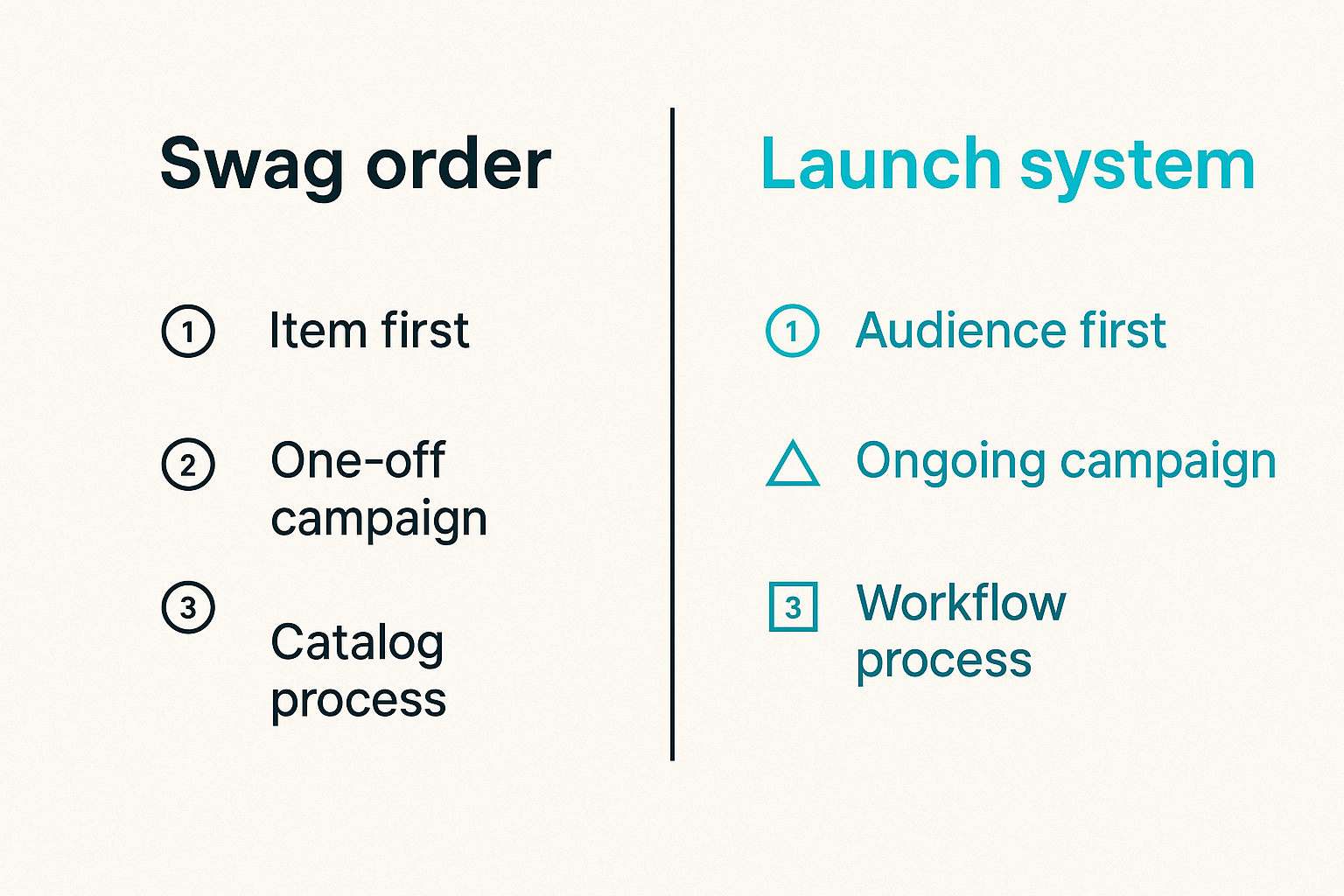
The mistake teams make is treating a promotional products supplier like a print shop with a search bar. They look for the item first, then try to force the operational details into the launch plan later.
That works for a one-off conference table. It breaks when you are sending product-related physical items to beta users, design partners, creators, customers, investors, employees, or community members across different geographies.
A useful way to think about it is this: the supplier is either an input vendor or a workflow component. Input vendors give you items. Workflow components help you move a campaign from audience list to delivered experience to measurable outcome.
Practical rule: If the campaign depends on timing, segmentation, personalization, or follow-up, evaluate the supplier like infrastructure, not like a catalog.
The supplier becomes part of your launch surface
For software teams, every launch surface matters. Your changelog, onboarding flow, docs, emails, product tour, community post, and sales follow-up all shape the market signal.
Physical items are no different. If a package arrives late, damaged, off-brand, or without context, the recipient does not blame the supplier. They blame the company that sent it.
That means the promotional products supplier touches brand trust. It also touches customer support. Bad addresses, duplicate shipments, customs issues, missing items, and poor packaging all become operational noise for a small team that should be focused on product adoption.
What changes in 2026
In 2026, software launches are more fragmented. Founders launch on Product Hunt, LinkedIn, X, newsletters, founder communities, marketplaces, Discord groups, events, and private customer channels. One big launch day is often less important than a sequence of coordinated release moments.
That makes supplier selection more important. You may need small batches, fast reorder windows, creator drops, customer gifting, regional fulfillment, or launch kits tied to onboarding milestones. The promotional products supplier has to handle smaller, more specific campaigns without forcing you into old-school bulk buying.
Promotional products supplier evaluation starts with the campaign model
Map the audience before choosing merch
Start with the audience, not the object. A hoodie for everyone is usually a lazy decision. A founder beta group, enterprise champion, developer community, student ambassador, and internal launch team do not need the same item or the same message.
The campaign model should answer:
- Who receives something?
- Why do they receive it?
- What action should happen after delivery?
- What information must be collected before fulfillment?
- Who handles exceptions?
- What does success look like after 30 days?
If the audience is undefined, supplier comparison becomes noise. You will over-weight unit cost and under-weight the parts that determine whether the campaign actually works.
For a broader operating model around launch planning, the same audience-first logic applies to a full go to market strategy, not just to promotional items.
Separate launch moments from ongoing touchpoints
A launch moment is time-sensitive. An ongoing touchpoint is relationship-sensitive. They use different supplier capabilities.
Launch moments include:
- Public launch kits for creators or community members
- Event giveaways connected to a release
- Customer thank-you packages for early adopters
- Founder mailers tied to a funding or product announcement
- Internal team kits for a major release
Ongoing touchpoints include:
- Customer onboarding gifts
- Referral rewards
- Partner enablement packs
- Renewal or milestone gifts
- Community contributor recognition
The mistake teams make is using the same process for both. A launch drop needs timeline control. An ongoing program needs consistency, inventory visibility, and clean exception handling.
Decide who owns decisions
Supplier projects fail when ownership is vague. Marketing owns the idea. The founder approves the item. Operations handles addresses. Support receives complaints. Finance asks why shipping cost more than the items.
That structure creates delays because every decision crosses functions after it is already urgent.
Before you talk to a supplier, assign one owner for the campaign. That person should control scope, budget, approval, supplier communication, and post-launch reporting. They do not need to do every task, but they need authority to make tradeoffs.
What works when merch supports a software launch
Give the item a job
The best promotional item is not necessarily the most creative. It is the one with a clear job in the launch system.
Common jobs include:
- Reinforce a product category or positioning idea
- Create a reason for a user-generated post
- Reward early feedback
- Help a sales champion share the product internally
- Make a virtual launch feel tangible
- Give community members a visible identity
If you cannot describe the job, do not buy the item.
Practical rule: Every physical item in a software launch should map to a behavior you want to increase.
This is where many teams confuse novelty with utility. A clever object can create a short spike of attention, but a useful object can keep the product visible after the announcement window closes.
Match format to activation stage
Different stages need different formats. Early beta users may value something personal and low-volume. Public launch audiences may need something lightweight, shareable, and easy to ship. Enterprise buyers may need a higher-quality object that signals care, not hype.
A rough mapping looks like this:
| Launch stage | Better item type | Supplier capability needed |
|---|---|---|
| Private beta | Small personalized gift | Low minimums, custom notes |
| Public launch | Shareable lightweight item | Fast production, simple shipping |
| Creator campaign | Visually distinctive kit | Packaging control, tracking |
| Customer onboarding | Durable daily-use item | Repeat fulfillment, inventory |
| Enterprise expansion | Premium stakeholder gift | Quality control, approvals |
The promotional products supplier should be able to explain tradeoffs across these stages. If they only push whatever is in stock, you are not getting launch advice. You are getting inventory pressure.
Build small feedback loops
Do not wait until the full campaign ships to discover that the item photographs poorly, the QR code is too small, the package looks cheap, or the insert copy is confusing.
Run feedback loops at three levels:
- Internal review: does the item support the positioning?
- Physical sample: does the item match the mockup and quality bar?
- Recipient test: does a real person understand why they received it?
For teams using merch as part of a software launch, this connects closely to the operating system described in promotional products for software launches, where the physical item is treated as one component of audience, timing, fulfillment, and learning.
What fails with a promotional products supplier
The swag-first mistake
The swag-first path usually sounds efficient. Someone picks an item, requests a quote, approves a mockup, pays the invoice, and hopes it arrives before launch day.
What breaks in practice is everything around the item:
- The address collection form is missing consent language.
- International recipients are excluded at the last minute.
- The design does not match the updated product positioning.
- The supplier cannot split shipments by audience segment.
- The campaign has no link to product activation.
- Support has no answer when someone asks where the package is.
Swag-first is fast until it becomes rework.
The deadline blind spot
Software teams are used to shipping close to the deadline. You can merge a fix, deploy a landing page, update copy, or change pricing late in the launch process.
Physical goods do not behave that way. Production, proofing, packaging, freight, customs, address errors, and last-mile delivery create hard constraints.
A supplier that does not push back on your timeline may feel easy to work with. Be careful. Good suppliers are willing to say no, or at least say this date is possible only if scope changes.
Practical rule: If the launch date cannot move, the supplier timeline must include proofing, sampling, production, packing, shipping, and exception handling as separate line items.
The attribution gap
The most expensive failure is not a late box. It is a campaign nobody can learn from.
Many teams send products and then measure success by screenshots, compliments, or founder intuition. That is not useless, but it is weak. If you cannot connect delivery to activation, reply, referral, renewal, post, demo booked, or feedback submitted, you do not know what worked.
Promotional product campaigns should produce learning. Even if attribution is imperfect, the team should know which audience segments responded, which items created useful behavior, and which fulfillment issues created friction.
Supplier architecture: catalog, customization, fulfillment, data
Catalog depth is not the same as selection quality
A huge catalog can hide a weak supplier. More options often create slower decisions, inconsistent quality, and more room for bad item-market fit.
Selection quality means the supplier can narrow the catalog based on your launch goal. They should ask about audience, timing, shipping geography, brand tone, unit economics, and recipient behavior before recommending items.
If every recommendation starts with top sellers, push harder. Your launch is not the same as a trade show giveaway for a regional insurance broker.
Related reading from our network: teams buying operational tools face a similar trap when they choose breadth over workflow fit, as covered in this guide to remote access software architecture.
Customization needs proof not hope
Mockups are useful, but they are not proof. They can hide scale issues, print limitations, color mismatch, embroidery distortion, packaging problems, or QR code failures.
Ask for:
- A digital proof with exact placement and dimensions
- A physical sample when quality matters
- Material and size specifications
- Packaging examples
- Photo evidence from similar jobs
- Approval checkpoints before production
The smaller your team, the more valuable proof becomes. A founder should not spend launch week arguing about whether the logo color is close enough.
Fulfillment is a system not a box
Fulfillment is where promotional product ideas become operational reality. It includes address collection, validation, packing rules, shipping methods, tracking, failed deliveries, returns, customs, inventory, reorders, and recipient communication.
If the supplier cannot explain how fulfillment exceptions are handled, assume your team will handle them manually.
Good supplier questions include:
- Can you ship to individual recipients, not only one office?
- Can you batch by segment or launch date?
- Can you include personalized inserts?
- Can you provide tracking exports?
- How do you handle failed deliveries?
- What happens when inventory runs low?
The UI is not the whole system. A nice ordering portal does not matter if tracking data arrives in a spreadsheet nobody owns.
The implementation workflow for founders and product teams
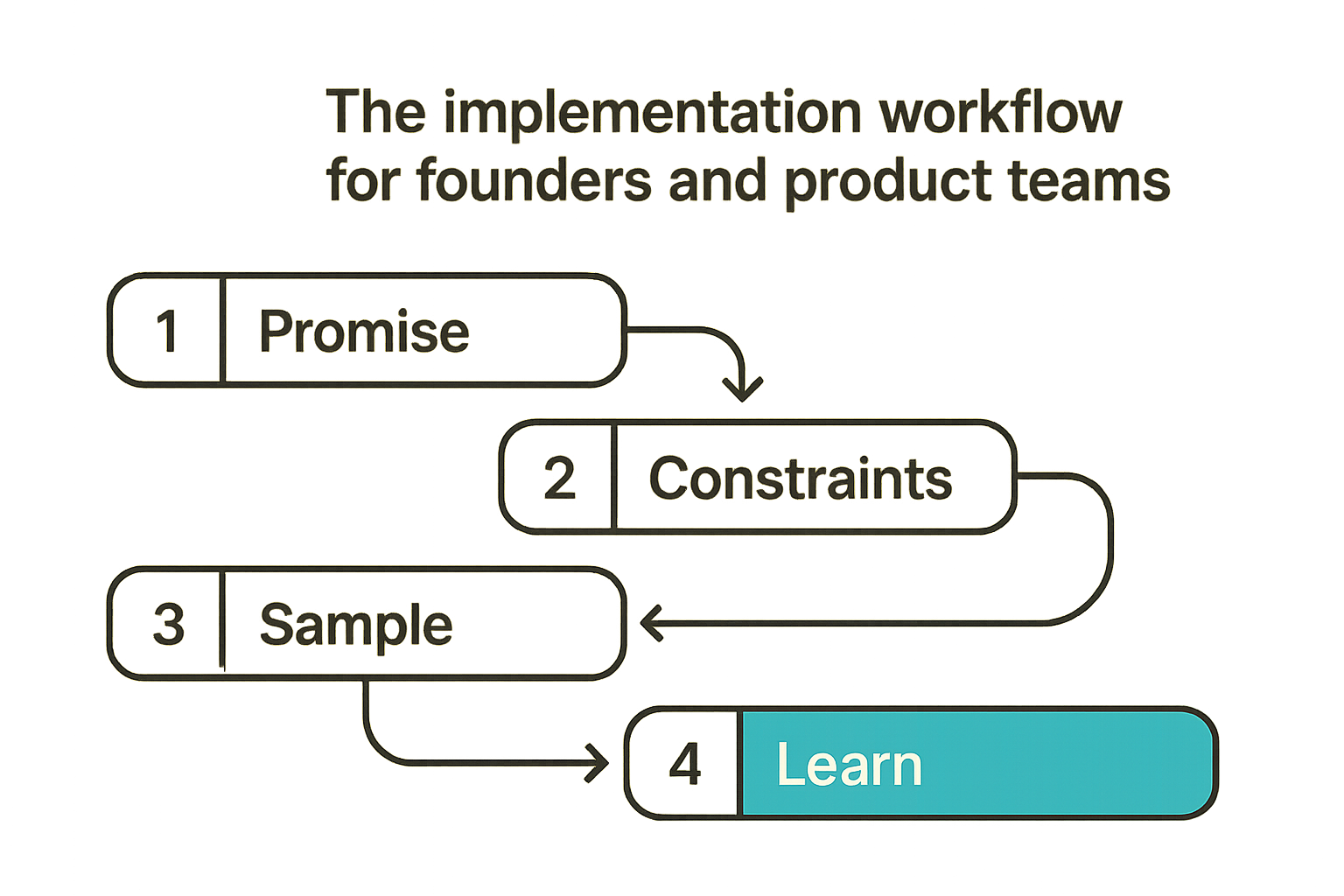
Step 1 define the launch promise
Before sourcing anything, define what the physical touchpoint is supposed to communicate.
Use a simple statement:
- We are sending this to this audience because this launch promise matters, and we want them to take this next action.
Examples:
- We are sending a compact desk item to beta users because they helped shape the product, and we want them to share one specific lesson from the beta.
- We are sending a premium notebook to enterprise champions because they are introducing the tool internally, and we want to support their rollout meeting.
- We are sending sticker packs to community contributors because they identify with the category, and we want them to invite peers into the launch.
This statement keeps the supplier conversation grounded.
Step 2 shortlist supplier constraints
Build a shortlist around constraints, not vibes.
Your constraint list should include:
- Required in-hand date
- Quantity range
- Domestic and international shipping needs
- Personalization requirements
- Packaging requirements
- Brand approval process
- Data handling expectations
- Budget ceiling
- Reorder likelihood
Then ask suppliers to respond against those constraints. The goal is not to find the lowest quote. The goal is to find the fewest hidden failure modes.
Step 3 run a sample and ops test
Run a small test before the real campaign.
A practical sequence:
- Select one item and one backup item.
- Request proof and sample.
- Send test packages to three internal or friendly external recipients.
- Track production time, shipping time, packaging quality, and recipient comprehension.
- Record every manual exception.
- Decide whether to scale, simplify, or cancel.
This test does not need to be bureaucratic. It needs to reveal whether the supplier can execute under real launch conditions.
Related reading from our network: publishing teams face similar handoff problems between automation and human review, which is why this piece on publishing automation software workflow architecture is useful adjacent reading.
Step 4 connect fulfillment and learning
The last step is connecting delivery data to product or marketing signals.
At minimum, maintain a campaign sheet or CRM view with:
- Recipient segment
- Item sent
- Shipment status
- Delivery date
- Follow-up owner
- Desired action
- Action completed
- Notes from support or sales
More advanced teams can connect this to lifecycle emails, CRM tasks, referral tracking, or product analytics. The key is that someone reviews the campaign after launch and decides what to repeat.
Comparison: traditional vendor vs launch-ready supplier
Where traditional suppliers still fit
Traditional promotional product vendors are not bad. Many are excellent for bulk orders, event tables, employee gear, office shipments, and straightforward branded items.
If your use case is simple, a traditional supplier may be enough. You do not need a complex workflow for 500 pens going to one conference booth.
The risk appears when the campaign has many recipients, segments, deadlines, data dependencies, or follow-up paths. That is where the supplier needs to act less like a vendor and more like an operational partner.
Where launch-ready suppliers win
A launch-ready supplier is stronger when you need coordination. They may still sell the same categories of items, but the service model is different.
| Capability | Traditional vendor | Launch-ready supplier |
|---|---|---|
| Starting point | Item request | Campaign objective |
| Main strength | Bulk ordering | Workflow fit |
| Fulfillment | Often centralized | Often recipient-level |
| Advice | Product catalog | Audience and timing tradeoffs |
| Data | Quote and invoice | Shipment and campaign status |
| Risk control | Proof approval | Proof, timeline, exceptions |
| Best use | Simple orders | Launch campaigns |
This table is not about labels. Some traditional vendors can support launch-ready workflows. Some modern suppliers cannot. The point is to evaluate behavior, not branding.
The practical scorecard
Use a scorecard to remove emotion from supplier selection.
Score each supplier from 1 to 5 on:
- Audience fit: did they ask who receives the item?
- Timeline realism: did they break down schedule risk?
- Proofing quality: did they provide clear approvals?
- Fulfillment model: can they ship the way you need?
- Data visibility: can you track status without chasing?
- Exception handling: do they own problems clearly?
- Reorder path: can the campaign continue if it works?
- Strategic pushback: did they challenge bad assumptions?
The best supplier may not have the cheapest quote. But the cheapest quote can become expensive if your team spends launch week doing manual recovery work.
Budgeting, timing, and risk controls
Set budget by audience value
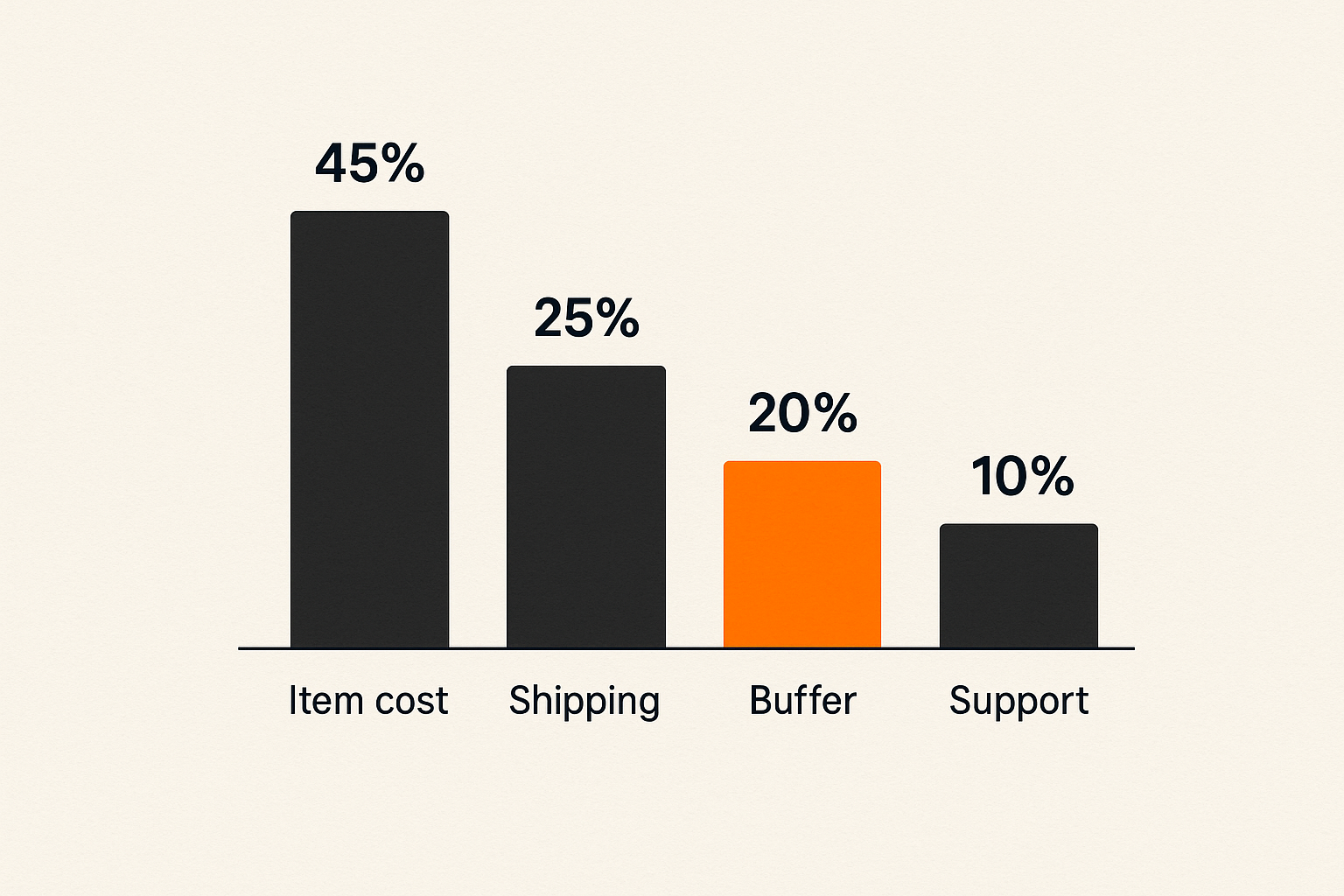
A promotional products supplier will usually quote item cost, setup fees, customization, packaging, and shipping. Founders often focus on the item cost because it is visible.
That is the wrong anchor. Set budget by audience value and campaign purpose.
A $12 item can be wasteful if it goes to an unqualified audience with no follow-up. A $75 item can be rational if it helps an enterprise champion onboard a team or recognizes a customer who provided critical feedback.
Budget categories should include:
- Item cost
- Setup and customization
- Packaging and inserts
- Domestic shipping
- International shipping
- Samples
- Rush fees
- Replacement shipments
- Internal handling time
If a campaign cannot survive realistic shipping and exception costs, it is not ready.
Add timeline buffers deliberately
Launch teams need a reverse calendar. Work backward from the in-hand date, not the announcement date.
A basic timeline might include:
- Campaign brief approved
- Supplier selected
- Item selected
- Proof received
- Sample reviewed
- Production approved
- Packing rules finalized
- Address list locked
- Shipments released
- Exceptions reviewed
- Follow-up campaign triggered
The biggest mistake is allowing product launch uncertainty to leak into physical production. If positioning may change, keep the design flexible. If the feature name may change, do not print the feature name. If the launch date may move, avoid copy that depends on a specific day.
Protect the brand with approval gates
Brand risk is not only about ugly merchandise. It is about misalignment.
Approval gates should cover:
- Logo usage
- Color accuracy
- Message and copy
- Item quality
- Packaging appearance
- Recipient list
- Privacy and consent
- Shipping communication
Practical rule: No promotional product should move into production until one owner has approved design, recipient logic, timeline, and exception handling.
This sounds slower. In practice, it is faster than resolving avoidable mistakes after the order is placed.
Measurement and post-launch learning
Measure actions not vibes
Merch can create good feelings. Good feelings are not a measurement system.
Decide the action before the campaign launches. The action might be:
- Post a launch photo
- Submit product feedback
- Book a rollout call
- Invite a teammate
- Join a community channel
- Complete onboarding
- Refer another user
- Renew or expand usage
Then build the follow-up path around that action. A QR code, short link, email sequence, manual founder note, or CRM task can all work. The mechanism matters less than the discipline.
For teams looking at practical examples from other products, product examples as a system can help you separate useful patterns from surface-level inspiration.
Reconcile shipments with product events
Reconciliation is where learning becomes concrete. Match shipment records against product and marketing events.
You do not need a perfect attribution model. You need enough signal to make a better next decision.
A simple reconciliation view can show:
| Recipient | Segment | Delivered | Follow-up sent | Desired action | Outcome |
|---|---|---|---|---|---|
| Beta user | Power user | Yes | Yes | Feedback | Completed |
| Creator | Audience partner | Yes | Yes | Social post | Pending |
| Customer | Expansion lead | Delayed | No | Team invite | Blocked |
| Prospect | Event lead | Yes | Yes | Demo booked | Completed |
This view makes operational problems visible. If delayed shipments correlate with poor follow-up, the issue is not the item. It is timing and ownership.
Turn support tickets into launch insight
Support issues are not just annoyances. They are feedback about the campaign system.
Track the reasons people contact you:
- Did not receive package
- Address problem
- Wrong size or item
- Damaged item
- Confusing instructions
- Customs or duties issue
- No clear next step
If the same issue appears repeatedly, fix the workflow before the next campaign. This is especially important for small teams because every avoidable ticket competes with product support, sales follow-up, and founder time.
Related reading from our network: remote teams see the same pattern when meetings become disconnected from decisions, which is the core argument in this piece on Zoom video chat and collaboration architecture.
Where sh1pt.com fits in this decision
Use merch as one layer of the shipping system
sh1pt.com is written for people building and launching software products who care about the operating details: what to ship, when to ship, how to structure the launch, and how to learn from the market.
That is the right lens for choosing a promotional products supplier. The supplier is not the strategy. The item is not the strategy. The strategy is the workflow that connects audience, promise, delivery, action, and learning.
A promotional item can support a launch when it makes the product more memorable, creates a useful follow-up reason, or rewards behavior you want to see more often. It becomes waste when it is disconnected from the product motion.
When a supplier conversation should happen
Bring the supplier into the process after the campaign model is clear but before the launch calendar is locked.
Too early, and you will shop without constraints. Too late, and you will accept bad tradeoffs because the deadline controls every decision.
The right moment is when you can explain:
- The audience
- The launch promise
- The desired action
- The in-hand date
- The quantity range
- The quality bar
- The follow-up path
- The measurement plan
If a supplier can work from that brief, you have a real conversation. If they ignore it and send a generic catalog, keep looking.
Choosing a promotional products supplier is not about making a software launch feel bigger. It is about making the right audience touchpoint more intentional, more operationally reliable, and easier to learn from.
Try sh1pt.com
sh1pt.com helps people building and launching software products understand shipping strategies, product development processes, and growth tactics.