
Selling digital products looks simple until the first real customers arrive.
You can set up a checkout in an afternoon. You can upload a course, template, playbook, dataset, design kit, software license, or private community invite. You can post the link and call it a launch.
Then the work starts: buyers ask which version is right for them, emails fail, refunds expose unclear promises, access breaks, affiliates want tracking, tax records get messy, and your launch spike turns into a flat line.
Teams think the problem is selling digital products. The real problem is building a repeatable operating system for offer design, checkout, delivery, support, feedback, and distribution. That changes the conversation. The practical question is not just what can we sell? It is what can we sell, deliver, improve, and support without turning the founder into the entire backend?
Table of contents
- Selling digital products is an operating system, not a checkout page
- Choose the market before you choose the format
- Design the offer as a system
- Pricing and packaging without guessing forever
- The selling digital products workflow from idea to repeatable revenue
- Build the delivery architecture
- Acquisition is a distribution workflow
- Metrics that matter when selling digital products
- Common failure modes when selling digital products
- Where sh1pt.com fits in your shipping system
Selling digital products is an operating system, not a checkout page
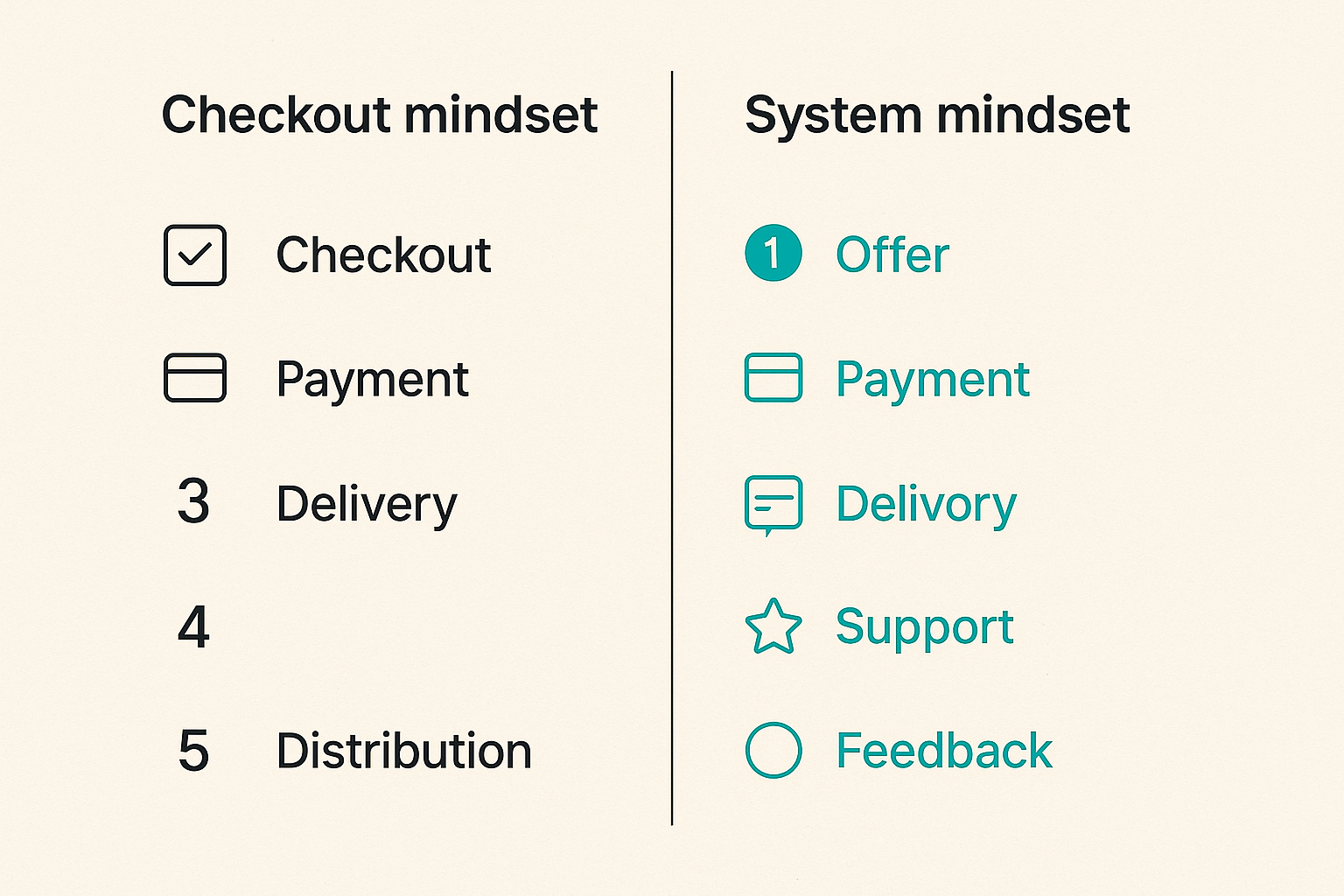
The mistake teams make is treating a digital product like a file with a payment button. That is fine for a hobby project. It breaks when the product has real buyers, updates, refunds, license boundaries, support tickets, and ongoing promotion.
A useful way to think about it is this: selling digital products is a state machine. A visitor becomes a lead. A lead becomes a buyer. A buyer becomes an activated user. An activated user may become a repeat buyer, referral source, testimonial, churned subscriber, refund request, or support burden.
If you do not design those states, your inbox becomes the state machine.
The checkout is only one state transition
The checkout event is important, but it is not the business. It is one transition: unpaid to paid.
Before checkout, the buyer needs enough trust to believe the product fits their situation. During checkout, they need a low-friction payment path. After checkout, they need access, orientation, and proof that they made a reasonable decision.
The practical question is: what happens in the first ten minutes after payment?
For many digital products, that window determines whether the buyer uses the thing or quietly disappears. A template that lands without instructions feels unfinished. A course without a clear first module feels like homework. A software product without activation guidance feels like another login.
Practical rule: Do not optimize the buy button until you can describe the first successful customer session after purchase.
The buyer experience includes support
Support is not a separate department for most indie hackers, solopreneurs, and early startup teams. It is part of the product architecture.
If the sales page promises a transformation but the product requires hidden expertise, support demand increases. If buyers cannot find access links, support demand increases. If refund terms are vague, support demand increases. If updates are not announced clearly, support demand increases.
What breaks in practice is not usually the payment processor. It is the ambiguous handoff between marketing promise and product reality.
Support needs a lightweight system:
- A confirmation email that explains access and next steps.
- A searchable help page or FAQ for repeat questions.
- Clear refund, license, and update policies.
- A tag or field showing which product and tier a buyer owns.
- A feedback loop from tickets back into the product and sales page.
Your product is a promise
Every digital product sells a promise. The file, lesson, dataset, workflow, plugin, or membership is only the delivery mechanism.
A promise like learn marketing is too broad. A promise like write your first partner outreach sequence in one afternoon is sharper. A promise like replace your ad hoc launch checklist with a reusable launch operating system is even sharper if the target buyer already feels that pain.
The more precise the promise, the easier it is to design the product, price it, write the page, onboard buyers, and measure success.
Choose the market before you choose the format
A lot of founders start with format: should I sell a course, template, ebook, Notion dashboard, paid newsletter, mini SaaS, community, or toolkit?
That is backwards.
Format is a delivery decision. Market is the demand decision. If the market does not have urgent pain, format polish does not save you.
Pain beats novelty
Novel digital products get attention. Pain-driven digital products get purchased.
A founder trying to close enterprise pilots does not need another generic startup guide. They may pay for a concrete outbound sequence library, objection-handling scripts, CRM pipeline board, and weekly teardown process. A freelance designer may not need a broad productivity course. They may buy a client onboarding pack that reduces revision chaos.
You are looking for pain with three traits:
- The buyer already knows the problem exists.
- The buyer has tried to solve it manually.
- The buyer can explain why delay is expensive, embarrassing, risky, or distracting.
If you have to educate the buyer that the problem exists, your distribution burden increases.
Segment by workflow, not persona
Personas can be useful, but they often stay too abstract. Founder, creator, marketer, product manager, and designer are not buying contexts. They are labels.
Workflow segmentation is sharper:
- Founders preparing a Product Hunt launch.
- Product managers writing onboarding experiments.
- Solopreneurs packaging a paid template library.
- Developers turning internal scripts into paid tools.
- Consultants standardizing client delivery.
Each workflow has inputs, constraints, deadlines, tools, and failure points. That makes the product easier to scope.
Related reading from our network: teams coordinating launch reviews and customer calls face similar workflow issues in Zoom video chat for remote collaboration, especially when meetings are treated as isolated events instead of part of the operating system.
Use examples without copying
Product examples are useful when they reveal mechanics: pricing logic, onboarding flow, audience selection, positioning, packaging, and retention loops. They are dangerous when you copy the surface.
If you study another digital product, ask:
- What urgent job is this product doing?
- What trust asset makes the buyer believe it?
- What format supports the promise?
- What parts of the sales page reduce uncertainty?
- What operational burden does this model create?
We have written separately about using product examples as a practical system instead of treating them as inspiration boards. The same rule applies here: copy the reasoning, not the screenshot.
Design the offer as a system
The offer is not the product title. It is the full buying logic: who it is for, what it helps them do, what is included, how it is delivered, how success is measured, what is excluded, and why now.
Weak offers create weak operations. If buyers cannot tell whether the product fits them, they either do not buy or they buy and become support load.
Package outcomes, not files
A file is not an outcome. A checklist is not an outcome. A video library is not an outcome.
The outcome is the improved state the buyer can reach faster, cheaper, or with less confusion because your product exists.
Bad packaging:
- 87-page PDF about launching.
- 50 Notion templates for creators.
- Complete guide to product management.
Better packaging:
- Launch plan builder for founders shipping a paid digital product in 14 days.
- Client onboarding workspace for freelance designers who need fewer revision loops.
- Product experiment brief kit for PMs who need stakeholder approval before engineering starts.
The product can still include PDFs, templates, videos, scripts, spreadsheets, and examples. But those assets should be organized around a job.
Put constraints in the offer
Constraints make the offer stronger.
This feels counterintuitive. Founders often want to keep the product broad so more people can buy. In practice, broadness increases refunds and weakens conversion because nobody feels specifically understood.
Good constraints include:
- Skill level: for first-time founders, not growth teams.
- Company stage: pre-revenue, not Series B.
- Tooling: works with Stripe and Webflow, not custom ERP.
- Time horizon: launch this week, not build a full brand system.
- Exclusions: does not include legal advice, tax filing, or custom implementation.
Practical rule: If your offer has no exclusions, your support inbox will create them for you.
Compare common digital product models
Different models create different operational shapes. The wrong model can make a good idea painful to run.
| Model | Works when | Operational risk | Best first version |
|---|---|---|---|
| Ebook or guide | Buyer needs structured knowledge | Low completion, weak differentiation | Short tactical guide with examples |
| Template pack | Buyer wants speed and reuse | Support around customization | Opinionated template plus walkthrough |
| Course | Buyer needs sequencing and explanation | High production time, low completion | Cohort, mini course, or workshop replay |
| Toolkit | Buyer needs multiple assets for one workflow | Scope creep | Small bundle around one job |
| Community | Buyer values access and feedback | Requires constant facilitation | Paid small group or office hours |
| Software-lite | Buyer needs automation | Bugs, access, ongoing maintenance | Narrow utility with clear limits |
| Subscription | Buyer has recurring need | Churn and content treadmill | Monthly update pack or data feed |
The mistake teams make is choosing the model that sounds most scalable. Scalability only matters after the product can sell, deliver, and retain trust.
Pricing and packaging without guessing forever
Pricing digital products is uncomfortable because the marginal cost of delivery looks low. That leads founders to underprice, over-discount, or create too many tiers.
The practical question is not what is the file worth? It is what is the solved problem worth to this buyer, in this context, at this moment?
Price against urgency
Urgency changes willingness to pay.
A generic resume template is cheap. A resume rewrite system for laid-off senior engineers applying this week is more valuable. A launch checklist is cheap. A launch command center for a team with a public date, partners, newsletter slots, and paid ads is more valuable.
Look for moments where delay is costly:
- Before a launch date.
- Before a client kickoff.
- Before investor updates.
- Before hiring or onboarding.
- Before tax, compliance, or reporting deadlines.
- Before a campaign or public announcement.
Related reading from our network: small business teams see the same deadline-driven value in operational tools like turbotax software workflow planning, where the product is only useful if records, ownership, and timing are handled correctly.
Use tiers to separate jobs
Tiers should not be random value ladders. They should separate different buyer jobs.
A clean structure might look like this:
- Starter: self-serve product for one person solving the problem alone.
- Pro: includes examples, advanced templates, updates, or office hours.
- Team: includes multiple seats, permissions, implementation notes, and invoicing.
Do not add tiers just because pricing pages usually have three columns. Add tiers when buyers genuinely differ by urgency, complexity, team size, or required confidence.
Discounting creates support debt
Discounts are not evil. They are a tool. But they attract buyers with different expectations.
A launch discount can create momentum and reward early buyers. A permanent discount trains the market to wait. A deep discount may bring in buyers who are less committed, less qualified, and more likely to ask for help on basics your product was not meant to cover.
Practical rule: Use discounts to create a decision window, not to compensate for unclear positioning.
If conversion only works at 70 percent off, you probably have a positioning, audience, or trust problem.
The selling digital products workflow from idea to repeatable revenue
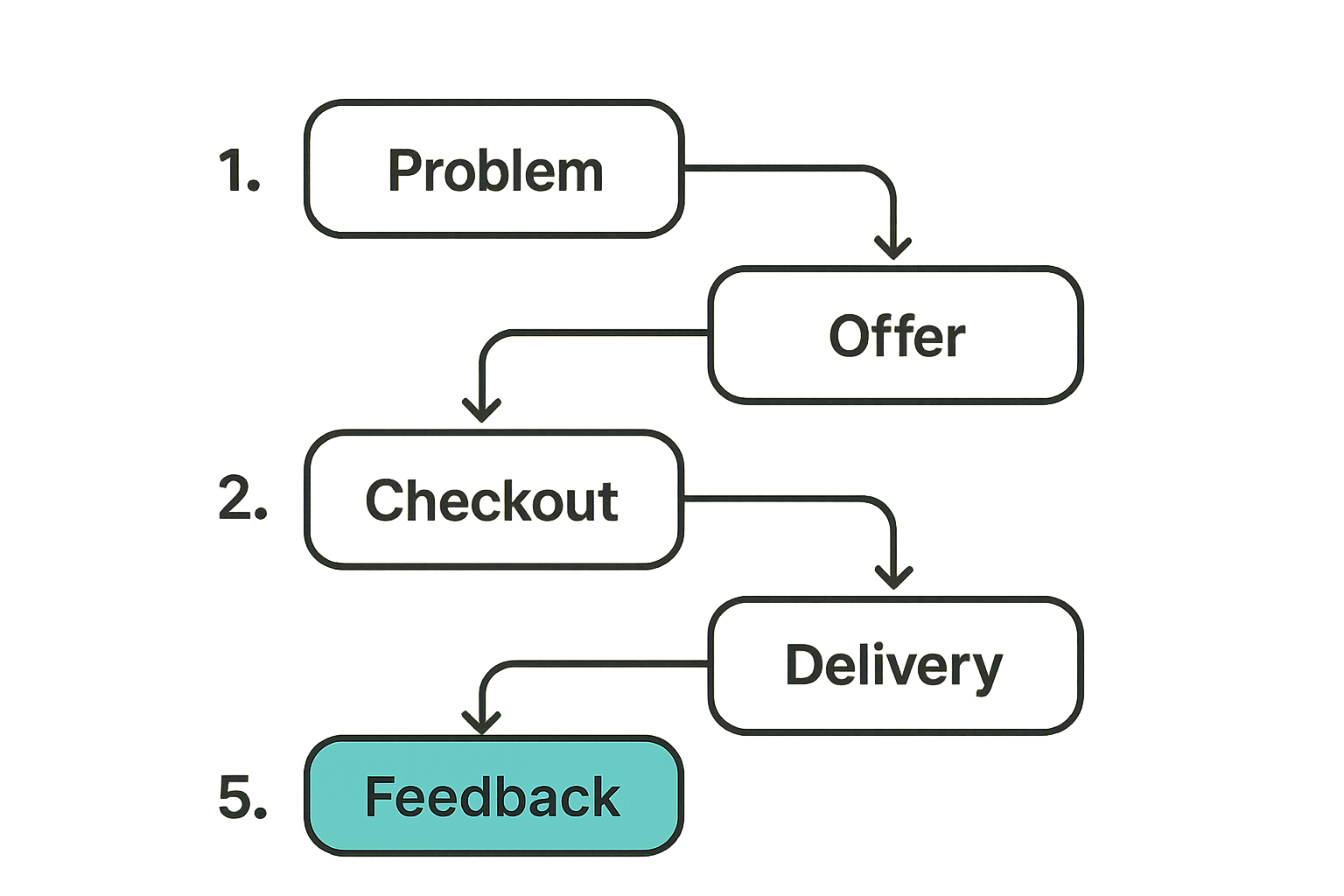
Selling digital products gets easier when you stop thinking in launches and start thinking in workflow loops.
A launch is a moment. A workflow is the system that keeps improving the product, message, acquisition, and delivery after that moment passes.
A practical implementation sequence
Here is a sequence that works for many early products:
- Pick one painful workflow. Do not start with a broad audience. Start with a specific job that already causes friction.
- Define the buyer state. Write down what the buyer is doing before purchase, what blocks them, and what successful use looks like.
- Draft the offer before building. Write the headline, bullets, exclusions, guarantee, and FAQ first. If you cannot sell the promise clearly, building more assets will not fix it.
- Build the smallest complete product. Complete does not mean large. It means the product can deliver the promised outcome without hidden work.
- Create the checkout and fulfillment path. Payment, receipt, access, onboarding, support, refund policy, and update plan.
- Launch to a constrained audience. Use a list, community, founder network, direct outreach, or content channel where the workflow pain is visible.
- Interview buyers and non-buyers. Learn what created trust, what caused hesitation, and what confused people.
- Improve the system. Update the page, onboarding, product assets, pricing, FAQ, and distribution assets based on evidence.
This sequence is deliberately boring. Boring is useful. It reduces founder fantasy.
What works in the first launch
First launches work best when they are narrow, manual, and close to the buyer.
What works:
- Selling before polishing every asset.
- Offering a founder-led walkthrough to early buyers.
- Asking buyers where they almost got stuck.
- Using direct messages or calls to understand the workflow.
- Updating the product quickly based on repeated friction.
- Keeping the promise small enough to fulfill.
If you are choosing what to build, a practical catalog of digital products to sell in 2026 can help you compare formats, but the decision still comes back to buyer pain and operational fit.
What fails after the first launch
A launch spike can hide weak infrastructure.
What fails after the first launch:
- The only acquisition channel was founder enthusiasm.
- The product needs manual delivery every time.
- Buyers do not know what to do after purchase.
- The founder cannot explain why some people bought and others did not.
- There is no review cadence for refunds, support tickets, and conversion data.
- Testimonials are collected randomly instead of mapped to use cases.
The first launch proves attention. The next few weeks prove whether the system can learn.
Build the delivery architecture
Digital delivery seems trivial until you have multiple products, tiers, updates, coupons, affiliates, support cases, and failed payment events.
The UI is not the whole system. State, access, receipts, entitlement, communication, and recovery are the real work.
Checkout, access, and fulfillment
At minimum, your delivery architecture needs to answer five questions:
- Who paid?
- What did they buy?
- What access should they receive?
- What communication should they get?
- What happens if something fails?
For a simple product, this can be Gumroad, Lemon Squeezy, Paddle, Stripe Payment Links, Shopify Digital Downloads, a course platform, or a custom stack. The tool matters less than the state model.
A simple entitlement record might look like this:
{
  "customer_email": "buyer@example.com",
  "product_id": "launch-system-v1",
  "tier": "pro",
  "payment_status": "paid",
  "access_status": "active",
  "purchase_date": "2026-07-07",
  "refund_status": "none"
}
You do not need a complex backend on day one. You do need a source of truth.
Webhooks, email, and account state
If you use a payment provider and separate delivery platform, webhooks become important. A payment event should trigger the right access event. A refund should remove access when appropriate. A subscription cancellation should update account state. An email failure should be visible.
Even a no-code stack has state transitions:
- Payment succeeded.
- Payment failed.
- Product access granted.
- Welcome email sent.
- Login created.
- Refund requested.
- Access revoked.
- Update shipped.
What breaks in practice is silent failure. The buyer paid, but the automation did not run. The email landed in spam. The wrong tier was assigned. The founder notices only after an angry message.
Protect the boring paths
The boring paths are where trust is won:
- Receipts.
- Invoices.
- Password resets.
- Download links.
- License keys.
- Team seat changes.
- Refunds.
- Update notifications.
- Changelog access.
These are not growth hacks. They are the infrastructure of a credible digital product business.
For a small operation, create a weekly delivery audit:
- Reconcile orders against access records.
- Check failed payments and failed emails.
- Review support tickets by category.
- Confirm refund requests were handled within policy.
- Test the checkout and access path yourself.
Acquisition is a distribution workflow
Selling digital products does not end with the product page. Most founders need a repeatable distribution workflow, not a one-time launch thread.
A good distribution system connects audience, message, channel, asset, conversion path, and follow-up.
Map channels to buyer intent
Different channels carry different intent.
Search captures existing demand. Social creates discovery. Communities create contextual trust. Email converts warm attention. Partners borrow trust. Marketplaces bring buyers but limit control. Direct outreach works when the buyer pain is visible and specific.
Do not ask every channel to do the same job.
| Channel | Best job | Weakness | Useful asset |
|---|---|---|---|
| Search | Capture known problems | Slow ramp | Problem-led landing page |
| Social | Surface opinions and proof | Short attention | Sharp teardown or story |
| Convert warm buyers | Requires list quality | Launch sequence | |
| Community | Build trust in context | Easy to overpromote | Useful answer or live demo |
| Partners | Borrow audience trust | Needs alignment | Co-created resource |
| Direct outreach | Learn and sell early | Manual work | Specific workflow diagnosis |
A proper go to market strategy operating system connects these choices instead of treating launch, content, sales, and product feedback as separate projects.
Launch assets are reusable infrastructure
A launch is easier when every asset has a second use.
Your launch thread can become a sales page section. Your webinar can become onboarding material. Your FAQ can become support documentation. Your buyer interviews can become testimonials, objection notes, and roadmap inputs. Your teardown can become search content.
The mistake teams make is producing launch assets as disposable campaign material. That creates a treadmill.
Instead, build an asset library:
- Problem explanation.
- Before and after example.
- Founder story.
- Product walkthrough.
- Buyer FAQ.
- Objection handling.
- Use case pages.
- Case studies.
- Email sequences.
- Short social clips or posts.
Related reading from our network: content-heavy teams face a similar control problem when using publishing automation software, because automation only helps if review lanes, approvals, and measurement stay connected.
Content compounds only when it is connected
Random content rarely compounds. Connected content does.
For digital products, connected content usually means:
- One core problem page.
- Several use case pages.
- Comparison or alternative pages.
- Workflow guides.
- Founder notes from building the product.
- Customer examples.
- Changelog posts that show momentum.
Each piece should move a buyer to a clearer next step: subscribe, download a sample, watch a walkthrough, buy the starter tier, book a team demo, or reply with a question.
If content has no next state, it is just publishing.
Metrics that matter when selling digital products
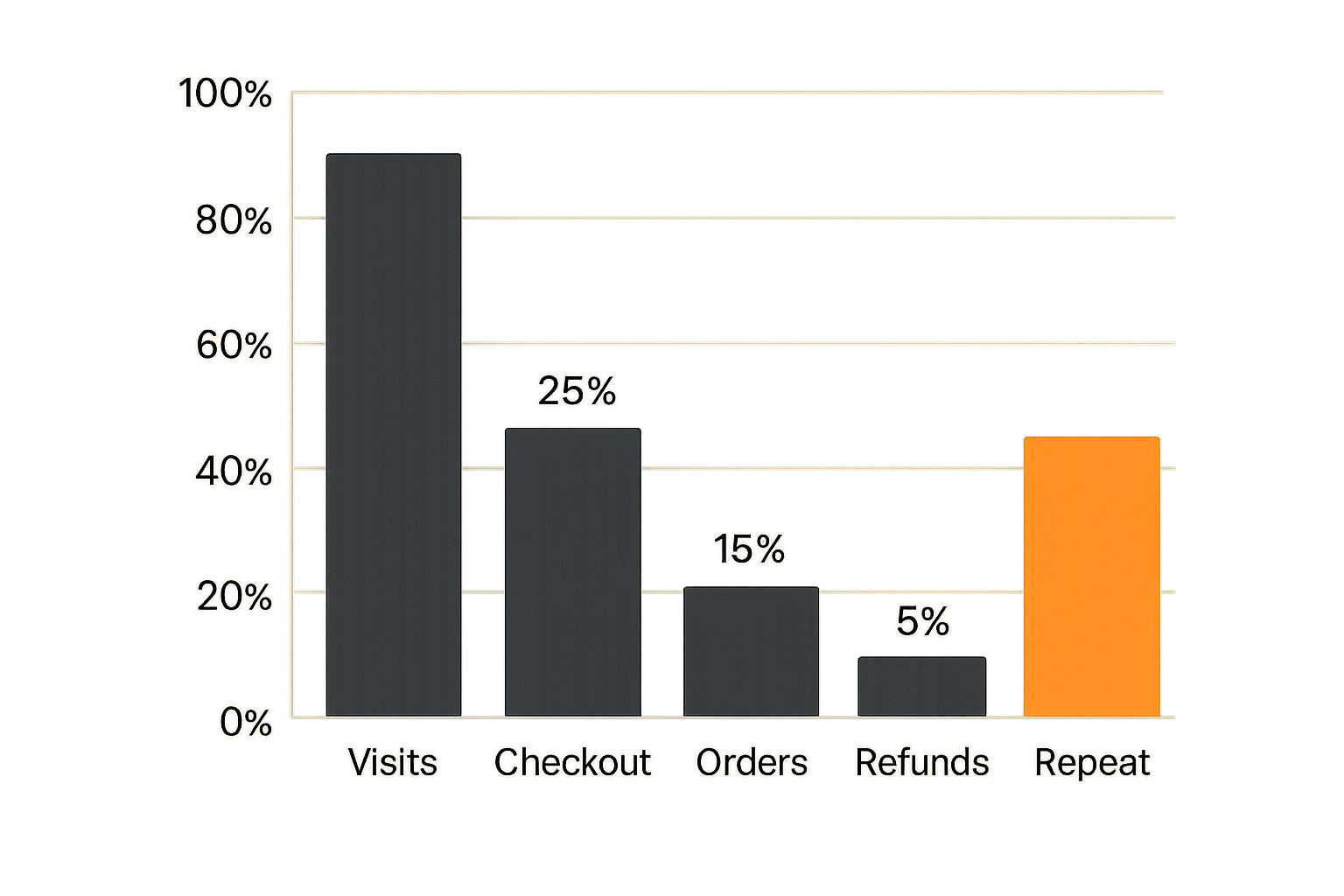
Metrics are useful only when they change decisions. Early digital product teams do not need a dashboard with 40 charts. They need a small set of signals that explain where the workflow is leaking.
Track state changes
Track the buyer journey as state changes:
- Visitor to email subscriber.
- Visitor to checkout started.
- Checkout started to purchase completed.
- Purchase completed to first use.
- First use to success moment.
- Buyer to repeat buyer.
- Buyer to refund.
- Buyer to testimonial.
This tells you where the system is weak.
If many people visit but few start checkout, the offer may be unclear or misaligned. If many start checkout but few complete, pricing, payment options, trust, or checkout friction may be the issue. If many buy but do not use, onboarding or product complexity may be the issue. If many refund, the promise may be wrong.
Watch refund and support signals
Refunds are not just lost revenue. They are product intelligence.
Support tickets are not just interruptions. They are UX research with urgency attached.
Tag them by cause:
- Access issue.
- Product did not match expectation.
- Buyer bought wrong tier.
- Technical problem.
- Too advanced.
- Too basic.
- Missing example.
- Billing or invoice request.
- Refund policy confusion.
Patterns matter more than individual complaints. One refund may be noise. Five refunds mentioning the same missing setup step is an implementation bug.
Practical rule: Every repeated support question should become one of three things: product improvement, onboarding improvement, or sales page clarification.
Review weekly, not constantly
Founders often stare at revenue dashboards during launches. It feels productive. It usually is not.
Use a weekly review instead:
- What changed in traffic?
- What changed in conversion?
- What support themes repeated?
- What objections showed up before purchase?
- What caused refunds?
- Which channel produced the best buyers, not just the most clicks?
- What should we change this week?
A weekly cadence prevents panic edits while keeping the system honest.
Common failure modes when selling digital products
Most digital product businesses fail in boring ways. The product is vague. The buyer is too broad. The checkout works but fulfillment is sloppy. The launch gets attention but there is no follow-up. The founder keeps adding features instead of fixing the buying and activation path.
The product is too broad
Broad products feel safer because the market looks bigger. In reality, broad products are harder to sell.
A complete productivity system for everyone has to compete with every app, book, course, and habit guru in the market. A sprint planning kit for two-person SaaS teams shipping weekly has a clearer buyer, clearer pain, and clearer distribution path.
Narrow does not mean small forever. It means sharp enough to enter the market.
What works:
- Start with one workflow.
- Write for one buyer state.
- Include examples from that context.
- Price for the urgency of that context.
- Expand only after you understand repeat demand.
What fails:
- Adding modules for every possible buyer.
- Writing generic sales copy.
- Avoiding exclusions.
- Treating confused leads as a reason to broaden the product.
The founder becomes the integration layer
This is the hidden operational trap.
The founder manually sends access links, answers the same onboarding questions, reconciles payments, updates buyers one by one, fixes spreadsheet rows, writes custom instructions, and remembers who gets which bonus.
At low volume, this feels like customer intimacy. At higher volume, it becomes a fragile backend.
Manual work is fine when it is deliberate learning. It is dangerous when it is accidental infrastructure.
Create a simple rule: if a task happens three times, document it. If it happens ten times, automate or delegate it. If it creates buyer risk, monitor it.
The launch has no second act
A launch without a second act is just a traffic event.
The second act can be:
- A customer story.
- A version update.
- A live workshop.
- A use case page.
- A partner bundle.
- A comparison page.
- A new tier.
- A public teardown.
- A cohort start date.
The point is to keep learning and create new reasons to talk about the product without pretending every week is launch week.
The practical question is: what will you ship after the launch that makes the product more trustworthy?
Where sh1pt.com fits in your shipping system
Selling digital products in 2026 is not about finding a magic format or copying a creator funnel. It is about building a product and launch system that survives contact with real buyers.
That means sharper product decisions, clearer launch workflows, better operational habits, and a distribution plan that does not depend on luck.
Use it to sharpen shipping decisions
sh1pt.com is written for people building and launching software products who want practical thinking around shipping strategy, product development process, and growth tactics.
The product may be digital, but the work is still product work: identify the job, scope the promise, build the smallest complete version, ship it, learn from buyers, and improve the system.
Use sh1pt.com when you need operator-focused thinking on questions like:
- What should we ship first?
- How narrow should the product be?
- What does the launch workflow need?
- Which examples are worth studying?
- How do we connect product, marketing, and feedback?
Connect product work to go-to-market
The strongest digital product teams do not separate build decisions from go-to-market decisions.
They ask whether the product can be explained clearly. They ask which buyer state has urgency. They ask how support will work. They ask what the launch teaches them. They ask which metrics will change next week’s decisions.
That is the real system behind selling digital products: not just making something downloadable, but creating a workflow that turns buyer pain into a clear offer, a reliable delivery path, and a repeatable launch motion.
Try sh1pt.com
sh1pt.com is for people building and launching software products who want to understand shipping strategies, product development processes, and growth tactics.
If you are selling digital products and want more practical operator guides for moving from idea to market, Try sh1pt.com.