
Most founders do not fail to sell products online because they picked the wrong button color or the wrong landing page template.
They fail because the selling system is unfinished. The product exists, the checkout technically works, and a launch post goes out. Then the founder has to answer confused support emails, reconcile messy payments, manually deliver access, guess which channel worked, and decide what to build next with half a dashboard.
Teams think the problem is getting a store live. The real problem is building a workflow that can turn attention into orders, orders into fulfillment, fulfillment into learning, and learning into the next better offer.
That changes the conversation. Selling products online in 2026 is not a definition problem. It is an architecture problem. The practical question is not which platform lets you publish fastest. The practical question is which system lets you ship, sell, learn, and repeat without creating operational debt you cannot see until customers are already waiting.
Table of contents
- Why sell products online is an operating system, not a checkout button
- Choose the product unit before the platform
- The workflow required to sell products online in 2026
- Build the storefront around decisions, not pages
- Payments, fulfillment, and support are one system
- Channel strategy for founders who need signal
- Metrics that matter when you sell products online
- What breaks when teams implement this badly
- What works: a lean architecture for repeat sales
- Where sh1pt.com fits in the launch workflow
Why sell products online is an operating system, not a checkout button
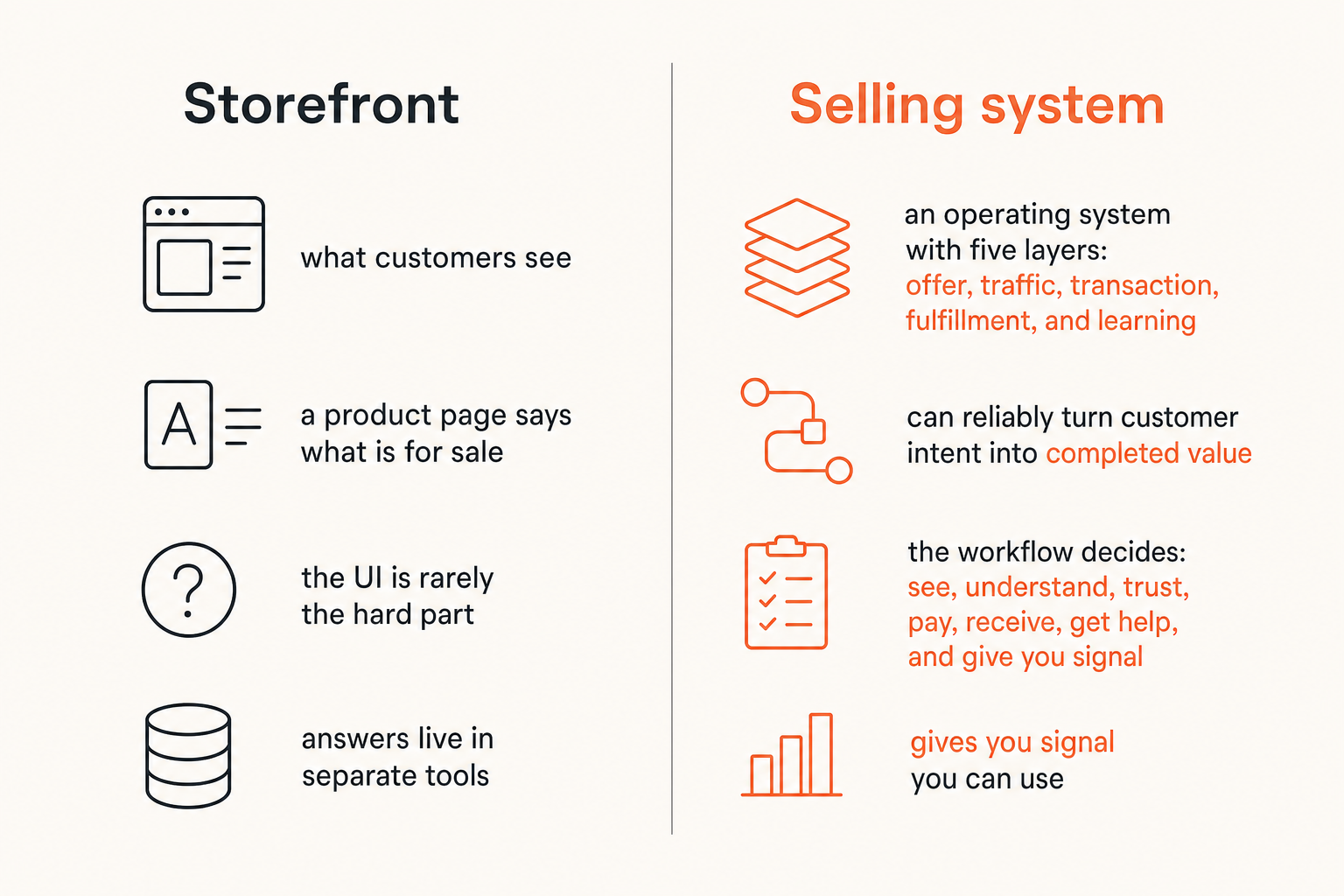
The mistake teams make is treating online selling as a storefront project. They spend weeks comparing site builders, payment processors, product page layouts, and promo banners. Those choices matter, but they are downstream from a more important question: can the business reliably turn customer intent into completed value?
A useful way to think about it is an operating system with five layers: offer, traffic, transaction, fulfillment, and learning. If any layer is missing, the system still looks alive from the outside, but it cannot compound.
The visible store is the smallest part
The store is what customers see. The system is what customers experience.
A product page says what is for sale. The workflow decides whether the right buyer sees it, understands the promise, trusts the price, completes payment, receives the product, gets help when stuck, and gives you signal you can use.
For software products, templates, courses, design assets, paid communities, or serviceized products, the UI is rarely the hard part. What breaks in practice is state. Who bought what? Which version did they receive? Did the invite email send? Did the customer activate? Did the refund request reveal a positioning issue or a product bug?
If those answers live in separate tools, you are not running a selling system. You are running a public page with a private spreadsheet behind it.
The real asset is a repeatable selling loop
A repeatable loop has a clear input and output.
Input: a defined audience with a painful job. Output: a paid customer who receives the promised outcome and teaches you something useful.
Between those two points, you need a loop that can run more than once:
- identify a customer segment
- package an offer
- publish a clear promise
- send traffic from one or two channels
- collect payment
- fulfill the product
- capture objections and usage data
- update the offer, page, onboarding, or roadmap
Practical rule: if you cannot describe the path from first touch to fulfilled customer in one page, you are not ready to scale traffic.
This is why a good launch system matters more than a perfect storefront. A storefront can generate transactions. A launch system generates learning.
What changed in 2026
The tools got easier. The market got less forgiving.
Anyone can create a landing page, connect payments, generate product mockups, and publish content. That means buyers see more offers, more launches, more bundles, and more promises than ever. The easy part became noisier.
The winners are not always the teams with the most polished shop. Many are the teams with tighter operating rhythm: faster offer tests, cleaner onboarding, better customer context, and fewer broken handoffs. If you want the broader launch lens, the same principle applies to a full go to market strategy as an operating system, not a one-time campaign doc.
Choose the product unit before the platform
Before you choose Shopify, Gumroad, Lemon Squeezy, Stripe Checkout, Paddle, WooCommerce, a marketplace, or a custom flow, define the unit you are actually selling. The platform choice becomes much easier when the product unit is explicit.
The mistake teams make is asking which tool is best. The better question is which tool matches the product behavior.
Software, templates, services, and bundles behave differently
Different product types create different operational load.
| Product type | What the buyer expects | Operational risk | Best early signal |
|---|---|---|---|
| SaaS subscription | continuous access and improvement | churn, support, billing state | activation and retention |
| Digital template | instant download and clarity | refund requests from mismatch | completion and reuse |
| Course or guide | transformation over time | low consumption after purchase | lesson completion and questions |
| Productized service | delivered outcome | scope creep and scheduling | repeatable delivery margin |
| Bundle | perceived value and convenience | messy entitlement rules | attach rate and support tickets |
A Notion template, a subscription app, and a productized audit can all be sold online. They should not use the same fulfillment assumptions.
For example, instant download is fine for a worksheet. It is weak for software that requires account provisioning. A calendar intake form is fine for a consulting sprint. It is a bad fit for a self-serve micro-tool.
The offer must survive support
A product is not just what is purchased. It is what must be supported after purchase.
If your offer requires you to explain the same caveat in every email, the offer is unclear. If every customer needs a manual exception, the product unit is too flexible. If customers keep buying the wrong tier, the pricing architecture is doing damage.
Practical rule: write the top ten support questions before launch. If you cannot answer them clearly, your product page is not ready.
Support is not just a cost center. It is where false promises show up first. A clean online selling workflow treats support questions as product design inputs, not interruptions.
Pricing is an operations decision
Pricing is usually discussed as positioning. It is also operations.
A low price can increase volume and support load. A high price can increase expectation and onboarding needs. A lifetime deal can create future maintenance obligations without future cash flow. A bundle can lift average order value but complicate entitlements.
The practical question is: what does each order require after payment?
If the answer is near-zero marginal work, self-serve pricing can be aggressive. If every order triggers onboarding, QA, customization, or a live handoff, the price has to include that cost. Otherwise, growth becomes a backlog.
The workflow required to sell products online in 2026
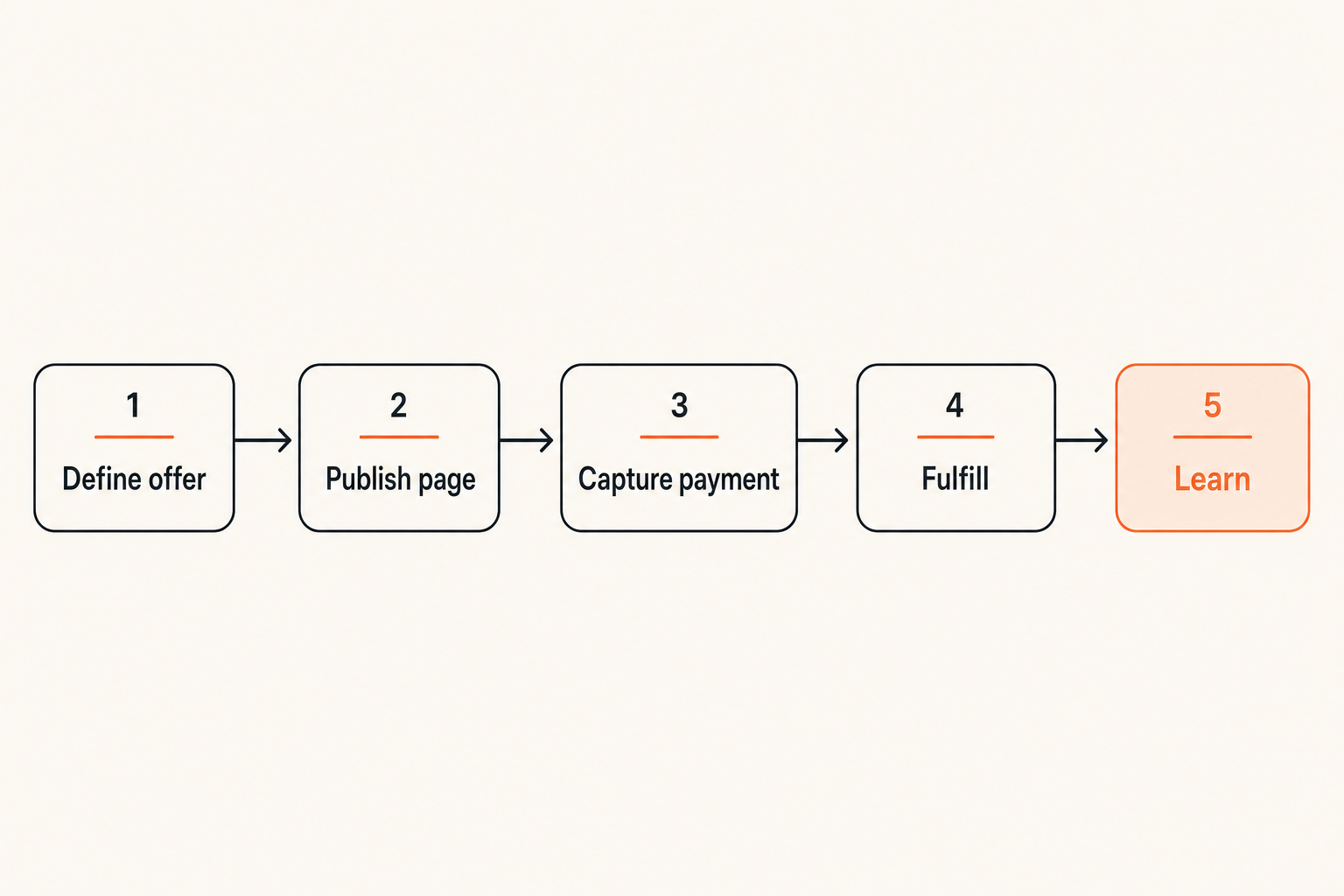
To sell products online consistently, design the workflow before you push traffic. This does not mean building a huge internal system. It means defining the minimum chain of events that must happen every time.
Think of it like product operations for revenue. The page, checkout, email, fulfillment, analytics, and support queue are all part of one product surface. This is where the ideas behind product operations for cleaner launches become directly useful.
A practical launch-to-cash sequence
Here is a lean sequence that works for many indie hackers, startup founders, product managers, and solopreneurs:
- Define the buyer, painful job, product unit, and promise.
- Create a product page with one primary conversion action.
- Connect checkout with tax, receipt, refund, and payment failure behavior defined.
- Trigger fulfillment automatically when payment is confirmed.
- Send an onboarding or delivery email that explains the first successful action.
- Tag the buyer by source, offer, product, and cohort.
- Route support questions into one visible queue.
- Review conversion, fulfillment, activation, refund, and objection data weekly.
- Update one part of the system before sending the next traffic wave.
This sequence is deliberately boring. Boring is good. Boring means you can see where the system fails.
Minimum event model
Even a simple product should have a small event model. You do not need enterprise analytics. You need enough state to understand the buyer journey.
A practical minimum might look like this:
events:
  - product_page_viewed
  - checkout_started
  - payment_succeeded
  - payment_failed
  - product_fulfilled
  - first_value_reached
  - support_ticket_opened
  - refund_requested
properties:
  - product_id
  - offer_version
  - traffic_source
  - launch_cohort
  - customer_email
  - payment_provider_id
The exact names do not matter. Consistency matters. If you change the product page but do not version the offer, you cannot tell whether the new promise improved conversion or merely changed traffic quality.
Where automation helps and where it lies
Automation is useful for handoffs: payment to access, purchase to email, support tag to queue, refund to entitlement removal. It is less useful when it hides judgment.
Automating a broken offer produces broken outcomes faster. Auto-email sequences can create a fake sense of sophistication while customers remain confused. AI-generated product copy can increase publishing speed but also flatten your positioning if nobody owns the promise. Related reading from our network: teams facing similar workflow-control issues in content operations can learn from AI publishing software workflow architecture.
Practical rule: automate the handoff only after you understand the failure mode manually.
Build the storefront around decisions, not pages
A store is not a brochure. It is a decision environment. Every section should reduce one specific uncertainty: is this for me, will it solve my problem, can I trust it, what happens after I buy?
The mistake teams make is adding more content when the buyer needs clearer routing.
The promise has to be testable
A good promise is specific enough to be falsified.
Weak promise: grow your startup faster. Stronger promise: ship a landing page, checkout, and first customer interview workflow in seven days.
Weak promise: premium design templates. Stronger promise: 40 conversion-focused SaaS landing sections built for early-stage product pages.
If the customer cannot tell whether the product worked, support becomes subjective and testimonials become vague. When the promise is testable, the entire selling system sharpens: landing page copy, onboarding, refund policy, case studies, roadmap, and pricing.
Product pages need routing logic
Most product pages try to convince everyone. Better pages route buyers.
Useful routing sections include:
- who this is for
- who this is not for
- what is included
- what is not included
- required prerequisites
- expected time to value
- refund and support boundaries
- next step after purchase
This is not negative copy. It is qualification. A customer who should not buy is not lost revenue. They are avoided support load, avoided refund risk, and avoided bad word of mouth.
Checkout should remove uncertainty
Checkout is not the place to introduce surprises.
Before the buyer pays, they should know:
- total price and billing cadence
- taxes or fees if applicable
- what happens after payment
- how access or delivery works
- refund policy
- support channel
- account requirements
For software, make account creation predictable. For digital downloads, make delivery immediate and resendable. For services, clarify scheduling and intake. The checkout should feel like the last step of a decision already made, not a new negotiation.
Payments, fulfillment, and support are one system
Founders often split these into separate decisions: payment tool, delivery tool, help desk. Customers do not experience them separately. They experience one promise.
If payment succeeds and fulfillment fails, the customer sees a broken purchase. If fulfillment succeeds but onboarding is unclear, the customer sees a confusing product. If support has no payment context, every ticket starts with detective work.
Treat payment state as source of truth
Payment state should drive access state. Not vibes. Not manual memory. Not a spreadsheet updated when someone has time.
At minimum, define behavior for:
- payment succeeded
- payment failed
- chargeback opened
- subscription canceled
- refund issued
- trial converted
- trial expired
- invoice overdue
For a one-time digital product, this may be simple. For subscriptions or bundles, it becomes critical. The system should know what the customer is entitled to without requiring a founder to inspect three dashboards.
Fulfillment needs recovery paths
The happy path is easy: pay, receive, use. Recovery paths are where trust is won or lost.
Ask these questions before launch:
- What if the delivery email is blocked?
- What if a download link expires?
- What if account creation fails after payment?
- What if the customer buys twice by mistake?
- What if a payment succeeds but the webhook is delayed?
- What if a refund is approved but access remains active?
These sound like edge cases until they happen during launch week. Then they are the whole day.
Related reading from our network: operational systems in other categories have the same handoff problem, and the workflow view in staff scheduling software for coverage and rollout risk is a useful adjacent comparison.
Support is part of conversion
Support quality affects conversion before the ticket exists. Buyers look for signals that someone competent is behind the product: clear docs, honest scope, visible updates, simple refund policy, and a path to ask a question.
A small founder team does not need a giant support operation. It needs one reliable intake and one owner.
Good early support setup:
- one public contact path
- one internal support queue
- saved replies for common questions
- buyer context attached to tickets
- weekly review of objections and confusion
- clear escalation path for bugs or access issues
Support is not separate from sales. It is where the sale either becomes trust or regret.
Channel strategy for founders who need signal
Traffic is not the same as signal. Many early teams drive a burst of visitors, get weak conversion, and conclude the product is wrong. Sometimes it is. Sometimes the channel was wrong, the audience was mixed, or the promise did not match the source.
A useful way to think about it is channel-market-offer fit. You need enough consistency to learn.
Start with one acquisition motion
Pick one primary motion for the first version of the selling system:
- founder-led audience and build-in-public
- SEO content and comparison pages
- community participation
- outbound to a narrow segment
- partnerships and affiliates
- marketplace discovery
- paid acquisition
Do not mix five channels before you can read one. If ten buyers come from ten unrelated sources, the learning is muddy. If ten buyers come from the same niche community after seeing the same promise, you can improve the system.
Practical rule: scale a channel only after you can explain why the last five customers bought.
Content, communities, and partnerships require different assets
A content-led motion needs durable pages, search intent, comparisons, and proof. A community motion needs credibility, responsiveness, and useful participation before promotion. A partnership motion needs a clear shared audience, incentive structure, and co-marketing assets.
Do not reuse the same launch asset everywhere. A detailed teardown might work in a founder community. A concise use-case page might work from SEO. A partner needs a forwarding message that makes them look useful to their audience.
This is why the best products often have a shipping system behind them, not just a launch announcement. The pattern is similar to the practical system behind products that actually break through: offer clarity, repeatable workflow, and tight feedback.
Paid traffic exposes weak economics fast
Paid acquisition is useful because it creates pressure. It also exposes weak unit economics quickly.
Before paying for traffic, know your rough numbers:
- gross margin per order
- refund rate
- support time per order
- activation or consumption rate
- conversion rate by source
- acceptable customer acquisition cost
If you do not know these, paid traffic becomes an expensive research tool. That can be fine if you budget for learning. It is dangerous if you expect scale before the system is ready.
Related reading from our network: even remote collaboration tools face similar permission and handoff constraints, and this piece on garage door opener remote lessons for remote teams is a useful reminder that control design matters outside ecommerce too.
Metrics that matter when you sell products online
Most early dashboards are either too shallow or too crowded. Page views alone are not enough. A 40-widget analytics setup is not useful if nobody knows what decision each metric supports.
The point of metrics is not reporting. It is deciding what to improve next.
Separate attention metrics from business metrics
Attention metrics tell you whether people noticed:
- impressions
- page views
- clicks
- email opens
- social engagement
Business metrics tell you whether the system worked:
- checkout start rate
- purchase conversion rate
- average order value
- refund rate
- fulfillment success rate
- activation or first value rate
- repeat purchase or retention
- support tickets per order
Both matter. But do not confuse attention with demand. A launch can be popular and still fail commercially. A quiet launch can produce strong buying signal from a narrow segment.
Cohorts beat blended dashboards
Blended metrics hide the truth.
If one launch cohort bought a discounted bundle from Twitter and another bought full-price from search, averaging them together tells you little. Cohorts let you compare offer versions, traffic sources, product types, and launch waves.
Useful cohort labels include:
- launch date
- traffic source
- product version
- offer version
- price point
- audience segment
- campaign or partner
Cohorts do not need to be complex. Even a spreadsheet can work if the labels are consistent.
A simple weekly scorecard
Use a scorecard that fits on one screen.
| Metric | Why it matters | Review question |
|---|---|---|
| Qualified visits | channel quality | Did the right people arrive? |
| Checkout starts | buyer intent | Did the offer create action? |
| Purchases | revenue conversion | Did the price and trust hold? |
| Fulfillment success | delivery reliability | Did buyers receive value? |
| First value reached | product usefulness | Did customers get the promised outcome? |
| Refunds | expectation mismatch | What promise failed? |
| Support themes | operational friction | What confused buyers? |
The weekly meeting can be solo. The discipline is the point. Look at the loop, pick one constraint, make one change.
What breaks when teams implement this badly
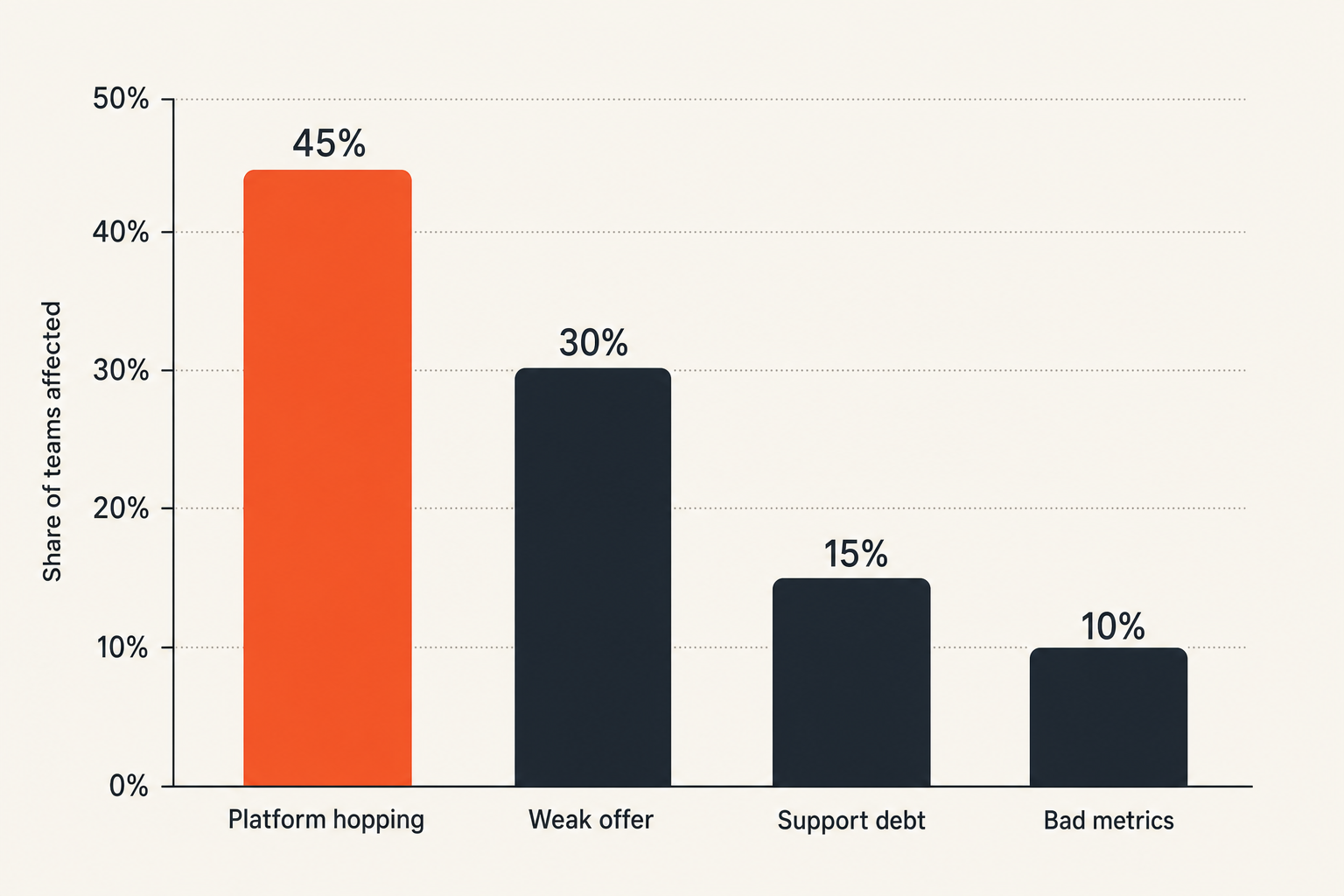
Bad online selling systems usually do not fail dramatically. They degrade slowly. A founder feels busy, revenue is inconsistent, support gets noisier, and nobody can tell whether the product, price, page, or channel is the real issue.
What breaks in practice is not one tool. It is the lack of ownership across the full journey.
Platform hopping hides offer problems
Switching platforms can be useful when the current one blocks a required workflow. But many teams switch because they do not want to confront a weak offer.
A new store builder will not fix unclear positioning. A prettier checkout will not fix wrong audience. A marketplace will not fix low trust. A new payment processor will not fix customers who do not understand the outcome.
Before migrating, write down the exact constraint:
- Is checkout abandonment caused by missing payment methods?
- Is fulfillment failing because webhooks are unreliable?
- Is support overloaded because product scope is unclear?
- Is conversion low because traffic is unqualified?
- Is churn high because the product does not create first value?
If you cannot name the constraint, platform migration is probably avoidance.
Discounting can train the wrong customer
Discounts are not evil. Undisciplined discounts are.
A discount can help test demand, reward early adopters, or create urgency around a limited launch window. It can also teach buyers to wait, attract customers with high support needs, and make your normal price feel fake.
The key is to define what the discount is testing. Are you testing price sensitivity? Audience fit? Bundle value? Channel responsiveness? If the answer is just more sales, you may be borrowing revenue from future trust.
Manual fulfillment becomes invisible debt
Manual work is fine at the start. It becomes dangerous when nobody measures it.
Early founders often say, I will just handle access manually. That works for five customers. At fifty, it creates delays. At five hundred, it creates mistakes. The debt is invisible because it sits in founder time, not the product backlog.
Track manual touches per order:
- manual email sent
- access provisioned by hand
- invoice corrected
- support explanation repeated
- refund processed manually
- customer data copied between systems
When a manual task repeats, decide whether to automate it, document it, price for it, or remove it.
What works: a lean architecture for repeat sales
The best early selling system is not the most complex. It is the one with clear ownership, clean handoffs, and enough instrumentation to learn.
A lean architecture should let you answer four questions quickly: what did we promise, who bought, did they receive value, and what should change next?
The smallest viable selling stack
A practical stack for many founders looks like this:
| Layer | Minimum requirement | Common tools or patterns |
|---|---|---|
| Offer source | one canonical product definition | doc, CMS, product database |
| Storefront | page with clear promise and CTA | landing page builder, custom site |
| Checkout | reliable payment and receipts | Stripe, Paddle, Lemon Squeezy, marketplace |
| Fulfillment | automatic delivery or access | webhook, email, account provisioning |
| Customer record | source of buyer context | CRM, database, spreadsheet early on |
| Support | single queue with buyer context | email inbox, help desk, shared tracker |
| Metrics | weekly cohort scorecard | analytics plus spreadsheet |
Do not overbuild this on day one. But do not pretend the layers do not exist. If a layer is manual, label it manual. If a layer is missing, label it missing.
Ownership rules keep the system clean
Even solo founders need ownership rules because future you is a different person under pressure.
Define:
- who owns the offer copy
- who owns checkout configuration
- who owns fulfillment failures
- who owns support replies
- who owns the weekly scorecard
- who decides pricing changes
- who approves refunds and exceptions
In a small team, one person may own several. The point is not bureaucracy. The point is avoiding orphaned decisions.
Practical rule: every broken customer experience should map to an owner, a system state, and a next fix.
Feedback loops turn buyers into roadmap data
The buyer journey is product research with money attached.
Useful feedback loops include:
- checkout abandonment notes from session recordings or surveys
- post-purchase question: what made you buy today?
- first-value check after delivery or onboarding
- support theme tagging
- refund reason review
- customer interview from each launch cohort
Do not ask for feedback only after things go wrong. Ask when the customer has context. A buyer who just paid can explain the promise that convinced them. A user who just reached first value can explain what mattered. A refund request can reveal where your sales page overpromised.
Where sh1pt.com fits in the launch workflow
Selling online is not separate from shipping. It is one of the strongest tests of whether your product development process is connected to a real market.
If the team treats sales as a final step after building, the launch becomes a reveal. If the team treats selling as part of the product workflow, the launch becomes a learning system.
Use shipping strategy as the control plane
The product roadmap, offer design, launch calendar, channel plan, and customer feedback loop should not live in separate mental folders. They should inform each other.
That is the role of a shipping strategy. It helps you decide what to build, what to sell, who to show it to, how to measure response, and what to change after the first wave of customers.
For indie hackers and solopreneurs, this prevents random motion. For startup founders and product managers, it prevents disconnected teams. The practical outcome is the same: fewer performative launches, more repeatable learning.
How to apply this this week
Do not rebuild everything. Audit the system you already have.
Use this checklist:
- write the product unit in one sentence
- write the promise in one measurable sentence
- identify the one primary buyer segment
- map the path from page view to fulfilled customer
- list every manual handoff
- define payment, refund, and access states
- add cohort labels to buyers
- create a weekly scorecard
- review the last ten support questions
- choose one constraint to fix before sending more traffic
If you are pre-launch, this becomes your launch plan. If you are already selling, this becomes your cleanup plan.
The closing point is simple: to sell products online, you need more than a storefront. You need a shipping system that connects promise, payment, fulfillment, support, and learning.
Try sh1pt.com
sh1pt.com is for people building and launching software products who want to understand shipping strategies, product development processes, and growth tactics. If you want a more practical way to sell products online, Try sh1pt.com.