
Most founders do not lose because the idea was bad. They lose because the product never becomes legible enough for a specific buyer to care, try, adopt, and tell someone else.
That is the uncomfortable part of building tops products in 2026. The market is full of competent software. The bar is not whether you can ship a working app. The bar is whether your product can survive the messy path from attention to activation to retention.
Teams think the problem is finding the best product idea. The real problem is building a shipping system that turns a specific promise into a product, a launch, a feedback loop, and a repeatable operating cadence.
That changes the conversation. Tops products are not only a list of trending apps or successful launches. A useful way to think about it is: products that earn distribution because the workflow behind them makes the promise clear, the user path short, and the learning loop fast.
Table of contents
- What tops products really means in 2026
- The tops products architecture: signal, scope, shipping, story
- Start with the product promise, not the feature list
- Build a launch workflow before you build a launch campaign
- Compare product opportunities with an operator scorecard
- Instrument feedback loops before traffic arrives
- Package the offer so adoption is easy
- Common failure modes when teams chase tops products
- Tooling and product operations for repeatable launches
- How sh1pt.com fits into a tops products shipping system
- Closing checklist for building tops products
What tops products really means in 2026
Ranking is an outcome, not a strategy
The mistake teams make is treating tops products as a category they can copy. They look at what is trending on launch platforms, social feeds, app stores, or AI directories, then reverse engineer the visible surface: landing page, pricing, feature set, launch copy.
That misses the hidden system. The visible product is the last mile. Before it, there was a sequence of decisions about who the product serves, what pain it compresses, which channel can reach the buyer, how quickly the user gets value, and what signal tells the team to keep going.
A product that tops a chart usually has at least one unfair operational advantage. It may be a sharper wedge, a faster onboarding path, a stronger founder distribution loop, a better integration into an existing workflow, or a pricing model that removes friction. None of that is visible if you only copy the homepage.
Practical rule: Do not benchmark a successful product by its feature list. Benchmark it by the workflow it makes easier and the distribution path it can repeatedly use.
The operating question behind every breakout product
The practical question is not: what should we build that could become popular? The better question is: what product can we ship, explain, validate, support, and improve faster than alternatives in a narrow market?
That question forces constraints. It makes you choose a user segment. It makes you decide what the first version will not do. It makes you define the proof you need before hiring, fundraising, or adding another integration.
For indie hackers, startup founders, product managers, and solopreneurs, this is the difference between a clever project and a product system. A clever project can get applause. A product system can produce learning every week.
The tops products architecture: signal, scope, shipping, story
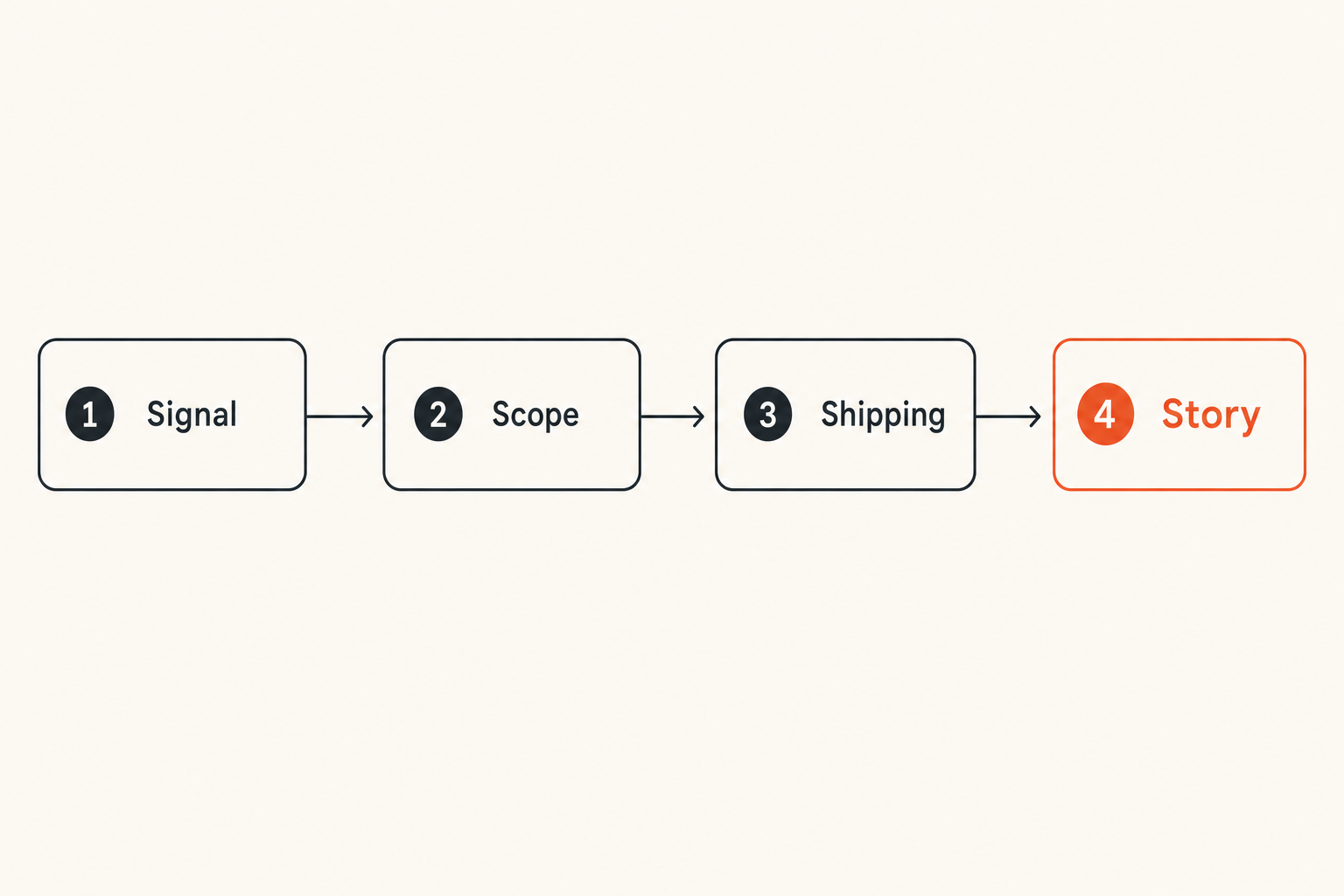
The four layers
A useful way to think about it is four layers: signal, scope, shipping, and story.
Signal is the evidence that a real audience has a real pain. This can come from sales calls, search demand, support tickets, community complaints, churn reasons, manual workarounds, or repeated requests in your current product.
Scope is the boundary of the first useful product. It defines the user, the job, the must-have path, the non-goals, and the success metric. Scope is where most products are won or lost because it determines how fast the team can learn.
Shipping is the operating cadence. It includes release planning, QA, analytics, launch assets, onboarding, support, changelog updates, and post-launch review. Good shipping turns uncertainty into a controlled sequence instead of a heroic sprint.
Story is the market-facing explanation. It is not decoration. It tells the user why this exists, why now, why it is different, and why trying it is worth the switching cost. If the story is weak, even useful products look optional.
For teams that manage multiple modules, plans, or launch surfaces, the same logic shows up in product catalog decisions. A structured catalog makes it easier to connect features, packaging, launch notes, and buyer promises; the deeper version is covered in product catalog architecture for software launches.
Where founders usually overbuild
What breaks in practice is scope. Founders add features to protect the idea from criticism. Product teams add settings because enterprise buyers might ask for them. Solopreneurs add automations because the demo looks stronger.
The result is a product that takes longer to ship, has more paths to debug, and still does not answer the core adoption question: can the target user get a meaningful result quickly?
Overbuilding also hides weak positioning. If the promise is vague, the team compensates by adding more capability. But users do not adopt capability in the abstract. They adopt a better path to an outcome.
Practical rule: If you cannot describe the first successful user session in one paragraph, your product is probably scoped too broadly.
Start with the product promise, not the feature list
Convert audience pain into a narrow promise
A product promise is the operational contract between your product and your user. It says: if you are this kind of person with this problem, this product helps you get this specific result with less effort, risk, time, or coordination.
Bad promises sound like categories. AI workspace. Creator CRM. Analytics dashboard. Launch tool. These may be useful labels, but they do not create urgency.
Stronger promises sound like a compressed workflow. Turn customer interviews into prioritized roadmap evidence. Publish a launch page and collect qualified waitlist feedback in one afternoon. Find the three onboarding steps where new users drop before they ever see value.
The narrower promise is easier to build, explain, and measure. It also makes it easier to decide what not to build.
Define the smallest believable outcome
The smallest believable outcome is not the smallest feature. It is the smallest result a user would recognize as progress.
For a founder building a customer research tool, the smallest believable outcome might be: import five interview notes and get a ranked list of repeated pains. For a PM building an internal launch tracker, it might be: see which launch tasks are blocked and who owns the unblock. For a solopreneur building a landing page tester, it might be: publish two variants and learn which promise gets more qualified signups.
This matters because users do not judge early products by roadmap ambition. They judge them by the first serious result. A product can be tiny and still feel valuable if the first result is concrete.
Practical rule: Ship the smallest believable outcome, not the smallest technical slice. A working button is not an MVP if it does not produce a user-recognized result.
Build a launch workflow before you build a launch campaign
The nine step workflow
Launch campaigns are visible. Launch workflows are what keep them from becoming theater.
Here is a practical sequence for shipping a product that has a chance to become one of your own tops products:
- Define the target user and excluded users.
- Write the product promise in one sentence.
- Map the first successful user session.
- Build only the path required for that session.
- Instrument activation, failure, and retention events.
- Recruit a small test group from the intended audience.
- Run onboarding manually before automating it.
- Launch to the channel where the audience already pays attention.
- Review results within seven days and decide whether to narrow, improve, or expand.
This is not complicated. It is just easy to skip. Many teams jump from build to announcement because the announcement feels like progress. But if the product path, analytics, support plan, and follow-up cadence are not ready, the launch mostly creates noise.
For a deeper operating model that connects product, audience, channels, launch workflow, and founder decisions, the go-to-market layer is covered in go to market strategy as an operating system.
Ownership beats enthusiasm
Launch work fails when everyone is excited and nobody owns the boring handoffs. Someone needs to own copy. Someone needs to own analytics. Someone needs to own support. Someone needs to own the post-launch decision.
In a small team, one person may own all of it. That is fine. The problem is not small-team constraints. The problem is pretending a launch is handled because the team talked about it in chat.
A simple ownership model works better than a complex calendar:
- Product owner: promise, scope, user path, success criteria.
- Engineering owner: build, release, instrumentation, rollback plan.
- Growth owner: channel, launch assets, waitlist, follow-up.
- Support owner: known issues, response templates, user feedback capture.
- Decision owner: post-launch review and next action.
What works vs what fails
What works is a launch workflow that creates evidence. What fails is a launch campaign that creates impressions but no decisions.
Good launch work has constraints. It defines the audience, channel, offer, onboarding path, feedback method, and review date. Bad launch work treats visibility as the goal and assumes learning will happen naturally.
Related reading from our network: teams working in distributed environments face similar context and ownership issues, and remote work architecture for collaboration is a useful adjacent lens on keeping decisions from disappearing across tools.
Compare product opportunities with an operator scorecard
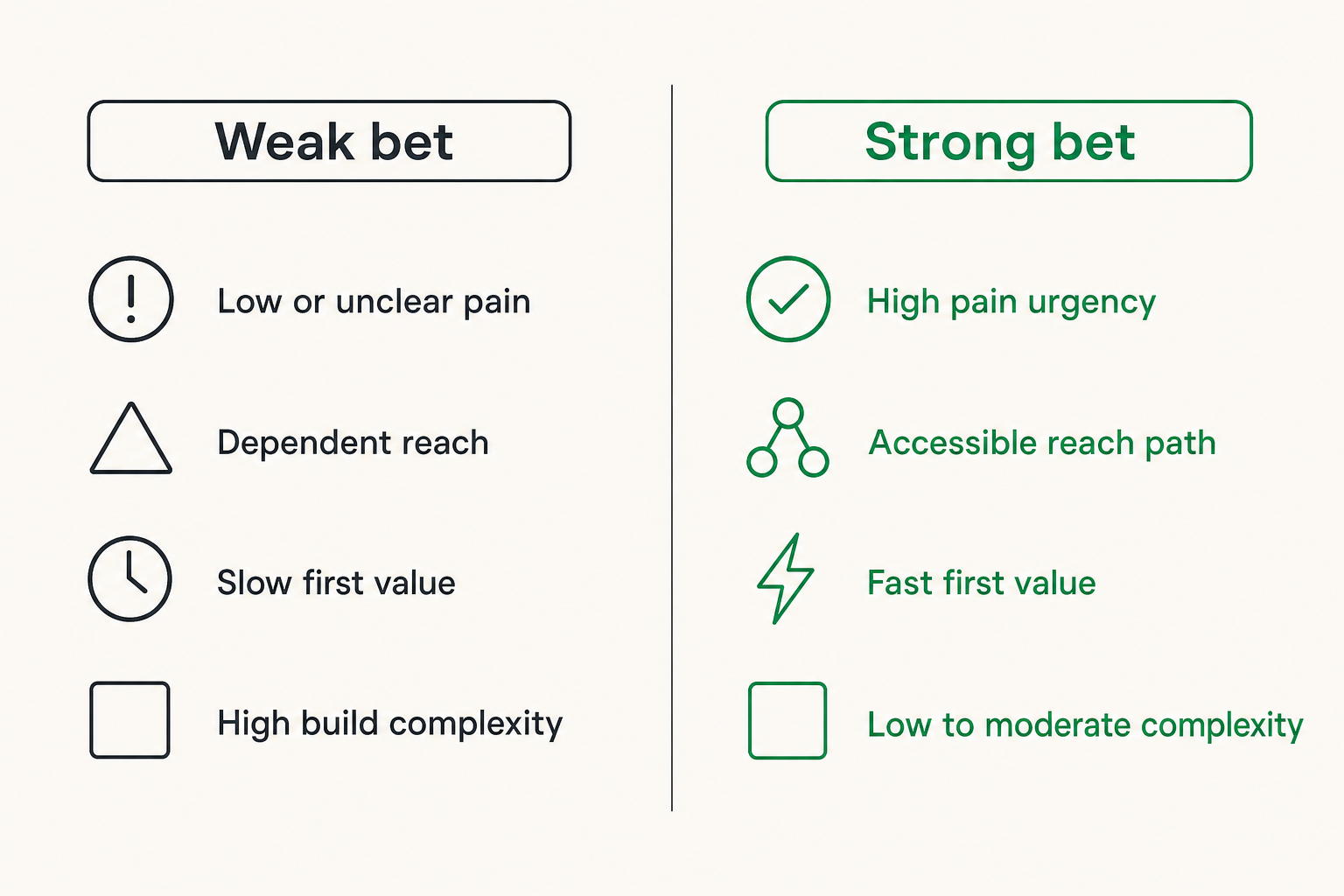
The scorecard fields that matter
Most product opportunity scoring is either too abstract or too political. RICE, ICE, and similar models can help, but only if the inputs are honest and tied to operating reality.
For early products, use a scorecard that forces practical tradeoffs:
- Audience pain: how urgent and repeated is the problem?
- Reach path: can you access the audience without paid dependency from day one?
- Speed to first value: can a new user see progress quickly?
- Build complexity: can you ship the first believable outcome without a long platform build?
- Support load: can you handle edge cases without drowning?
- Retention logic: is there a reason users come back?
- Expansion path: can the product grow naturally after the wedge works?
This is not a math exercise. It is a decision forcing function. The scorecard makes hidden assumptions visible before you commit months of work.
A simple comparison table
| Product opportunity | Pain urgency | Reach path | First value speed | Build complexity | Retention logic | Operator call |
|---|---|---|---|---|---|---|
| AI notes for founder interviews | High if targeted at active discovery teams | Communities, founder audience, templates | Fast if import and summary work well | Moderate | Medium if tied to roadmap decisions | Good wedge if differentiated by workflow |
| Generic productivity dashboard | Low without a specific role | Broad and expensive | Slow because setup is vague | High | Weak unless daily habit forms | Avoid unless niche is narrowed |
| Launch readiness checklist for SaaS teams | Medium to high before releases | Product and founder channels | Fast if checklist maps to real tasks | Low to moderate | Medium around repeated launches | Strong small product or lead wedge |
| Developer security launch gate | High in regulated or scaling teams | Engineering and DevOps channels | Medium if integrated into CI/CD | High | Strong if it blocks real risk | Viable with credibility and integration depth |
The goal is not to find a perfect score. The goal is to avoid fooling yourself. A low-complexity product with weak retention may be a good audience builder but a bad standalone business. A high-urgency product with no reach path may be real but inaccessible.
Related reading from our network: if your product touches developer workflows, cyber security software for CI/CD and supply chain defense shows how integration points, policy, and response ownership can matter more than surface features.
Instrument feedback loops before traffic arrives
Events, cohorts, and qualitative notes
Analytics after launch are usually too late. The first version should ship with enough instrumentation to answer basic questions:
- Who signed up?
- Where did they come from?
- Did they reach the first meaningful action?
- Where did they stop?
- Did they come back?
- What did they ask for or complain about?
You do not need an enterprise analytics stack. You need clean event names, a consistent user identifier, a way to segment early cohorts, and a habit of reviewing the data.
A minimal event map could look like this:
signup_created marks intent.
project_created marks setup.
first_result_generated marks first value.
result_shared marks collaboration or external proof.
return_session_started marks early retention.
upgrade_clicked marks monetization intent.
The exact names matter less than consistency. If every release changes the meaning of activation, you cannot learn from cohorts.
Support requests are product telemetry
Founders often treat support as interruption. That is a mistake. In early products, support is one of the highest fidelity feedback loops you have.
A confused user is telling you where the product promise, onboarding, or mental model broke. A refund request is telling you where expectation and outcome diverged. A workaround is telling you where the product could become more valuable.
Capture support themes in the same operating system as product decisions. Do not let them rot in email. Tag requests by promise mismatch, onboarding friction, missing integration, pricing confusion, bug, or feature request. Then review them with activation and retention data.
Practical rule: If support feedback and analytics live in different worlds, your roadmap will overreact to loud anecdotes and underreact to repeated friction.
Package the offer so adoption is easy
Pricing, onboarding, and proof
The offer is not just the price. It is the full adoption path: what the user gets, what they must do, what risk they take, and how quickly they can prove value.
Many useful products stall because the offer creates too much coordination cost. The buyer has to invite a team, change a workflow, migrate data, configure permissions, understand a new pricing model, and trust an unknown vendor before seeing value.
For early-stage products, reduce that load. Offer a single-player path before team rollout. Provide sample data. Make the first result exportable. Show proof near the action, not buried in a testimonial carousel. Make pricing explainable without a call unless the product genuinely requires sales-led onboarding.
Good packaging answers four questions quickly:
- What do I get?
- How fast can I see value?
- What do I need to connect or change?
- What happens if this does not work for me?
Reduce the buyer coordination cost
Buyer coordination cost is the hidden tax on adoption. It is the number of people, systems, approvals, and behavior changes required before the product can prove itself.
A solo founder buying a writing tool has low coordination cost. A product team adopting a release process tool has higher coordination cost. A company adding security gates to CI/CD has higher cost still because it touches engineering workflows, risk policy, and response ownership.
If your product requires coordination, design for it. Add invite flows, role-based onboarding, implementation checklists, admin previews, and clear rollback paths. If your product does not require coordination, do not accidentally create it with unnecessary setup.
Related reading from our network: tool selection often comes down to workflow fit and rollout risk, which is why this monday.com vs ClickUp workflow guide is a useful comparison point even outside project management software.
Common failure modes when teams chase tops products
Trend chasing without distribution
The first failure mode is chasing a hot category without a believable reach path. In 2026, this often shows up around AI wrappers, automation dashboards, and niche productivity tools. The product may work, but the audience has no reason to notice it.
Distribution is not something you bolt on after build. It affects the product itself. If your reach path is founder-led content, the product needs a story that can be demonstrated publicly. If your reach path is outbound, the pain needs a clear buyer and trigger. If your reach path is integrations, the product needs to fit where users already work.
The mistake teams make is assuming market heat reduces distribution work. It usually increases it because more teams are saying similar things.
Shipping polish before learning
The second failure mode is polishing before the product has earned polish. This does not mean shipping broken software. It means not spending weeks refining settings, animations, dashboards, and edge-case admin flows before proving the core result matters.
Polish is useful when it reduces friction in a validated path. Polish is wasteful when it protects the team from having to show an uncertain product to real users.
What breaks in practice is emotional sequencing. Teams want the product to feel complete before feedback. But early feedback is supposed to reveal incompleteness. The point is not to impress everyone. The point is to learn from the right people.
Confusing attention with activation
The third failure mode is measuring launch success by attention. Upvotes, likes, comments, and newsletter mentions can help. They are not adoption.
A launch with 5,000 visitors and 20 activated users may be less useful than a launch with 300 visitors and 80 activated users from the exact audience. Attention is only valuable if it enters a product path that can convert into learning, retention, revenue, or referral.
For tops products, attention and activation reinforce each other. The story earns attention. The product path earns activation. The feedback loop improves the next story.
Tooling and product operations for repeatable launches
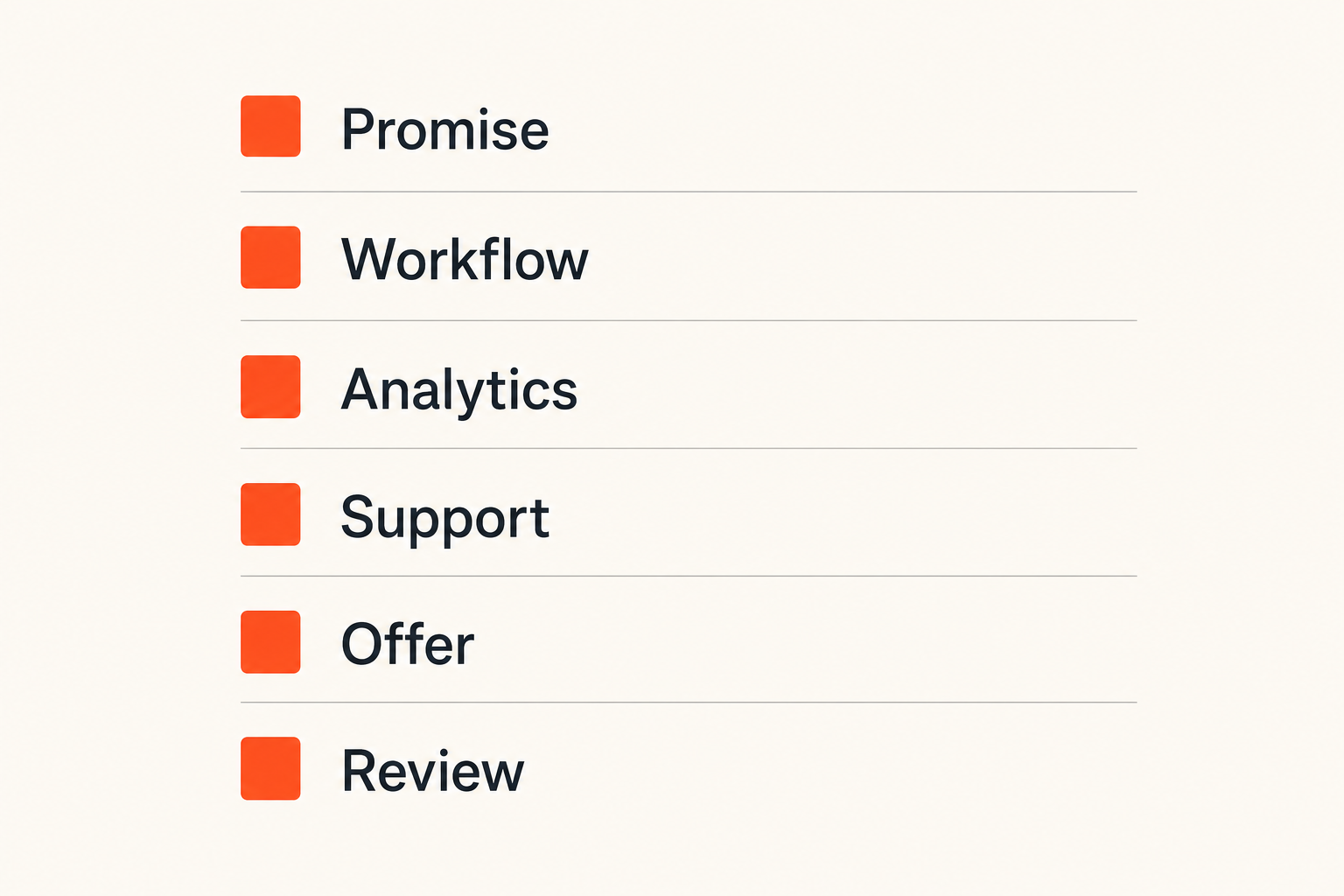
The minimum stack
You can run a serious launch system with a small stack. The minimum is:
- A source of truth for product scope and release status.
- A place for launch assets and messaging.
- Analytics for activation, retention, and conversion.
- Support capture with tags and ownership.
- A lightweight CRM or list for waitlist and customer follow-up.
- A post-launch review template.
The tools matter less than the operating agreement. If the roadmap is in one tool, feedback in another, analytics in a third, and decisions in chat, the team will lose context unless someone actively stitches it together.
This is where product operations becomes practical, not bureaucratic. Product ops is the connective tissue that keeps launches from depending on memory. The broader shipping system is covered in product operations for faster, cleaner launches.
Handoffs, docs, and rituals
A repeatable launch system needs a few boring artifacts:
- Launch brief: user, promise, scope, channel, success metric.
- Release checklist: code, QA, analytics, docs, support, rollback.
- Messaging doc: positioning, objections, examples, screenshots.
- Feedback log: themes, severity, user segment, next action.
- Review note: what happened, what changed, what ships next.
The ritual matters too. Hold a pre-launch readiness review. Hold a post-launch review within a week. Do not let the launch end when the announcement goes live.
Practical rule: If a launch cannot be reviewed, it cannot be improved. Every launch should leave behind a clearer system than the one before it.
How sh1pt.com fits into a tops products shipping system
Use it as an operator reference layer
sh1pt.com is useful when you treat shipping as an operating problem rather than a motivational slogan. The point is not to collect more ideas. The point is to improve how you decide, build, launch, and learn.
For founders and product teams, that means using practical breakdowns as reference material while you design your own system. When you are stuck on positioning, look for examples of clearer product promises. When launches feel chaotic, study operating workflows. When growth feels random, connect product decisions back to audience and channel assumptions.
The best use case is not passive reading. It is borrowing patterns, adapting them to your market, and turning them into checklists, templates, and review habits.
When the fit is strong
The fit is strongest if you are building or launching software products and want a pragmatic view of shipping strategy. That includes indie hackers testing small bets, solopreneurs packaging expertise into tools, startup founders moving from idea to market, and PMs trying to make launches less chaotic.
It is less useful if you want generic inspiration or abstract product theory. The bias is operational: what to ship, how to scope it, how to launch it, what to measure, and what breaks when the workflow is weak.
That is also the useful lens for tops products. The question is not which product category is fashionable this month. The question is whether your product system can create enough clarity, value, and learning to compound.
Closing checklist for building tops products
The practical checklist
Before you chase the next shiny category, run your idea through this checklist:
- Can you name the exact user and the excluded user?
- Can you state the product promise in one sentence?
- Can a new user reach a meaningful result in the first session?
- Do you know which channel can reach the audience?
- Have you instrumented activation, failure, and retention?
- Is support feedback captured where roadmap decisions happen?
- Does the offer reduce risk and coordination cost?
- Do you have a post-launch review date before launch day?
If the answer is no, the problem is probably not ambition. It is architecture. Tops products are built through sharper promises, tighter scope, cleaner workflows, better feedback, and operating discipline that survives beyond the launch announcement.
The practical question is what you will improve in the system before you ask the market for attention.
Try sh1pt.com
sh1pt.com is for people building and launching software products who want practical shipping strategies, product development processes, and growth tactics.