
A software engineer is often the most expensive person in a small product team, and somehow the least clearly used.
The founder has a backlog. The product manager has customer notes. The designer has screens. The software engineer gets tickets, asks hard questions, and suddenly everyone feels slowed down.
Teams think the problem is engineering speed. The real problem is the shipping system around the engineer.
That changes the conversation. A software engineer is not just a person who converts ideas into code. In a serious launch workflow, the engineer is part architect, part risk manager, part product debugger, and part operations partner. If you treat that role like a ticket machine, you get late surprises, brittle releases, and support debt. If you design the workflow correctly, engineering becomes the mechanism that turns uncertain product bets into stable customer-facing software.
Table of contents
- Why a software engineer is a shipping system, not a ticket machine
- What a software engineer actually owns in a launch
- The working contract between founders, PMs, and engineers
- Software engineer hiring and selection for small teams
- Turning product strategy into engineering work
- The implementation workflow that prevents launch drag
- What breaks when teams use engineers badly
- What works when engineers are part of the shipping loop
- The tooling stack around a software engineer
- How sh1pt.com fits this software engineer workflow
- Closing checklist for working with a software engineer
Why a software engineer is a shipping system, not a ticket machine
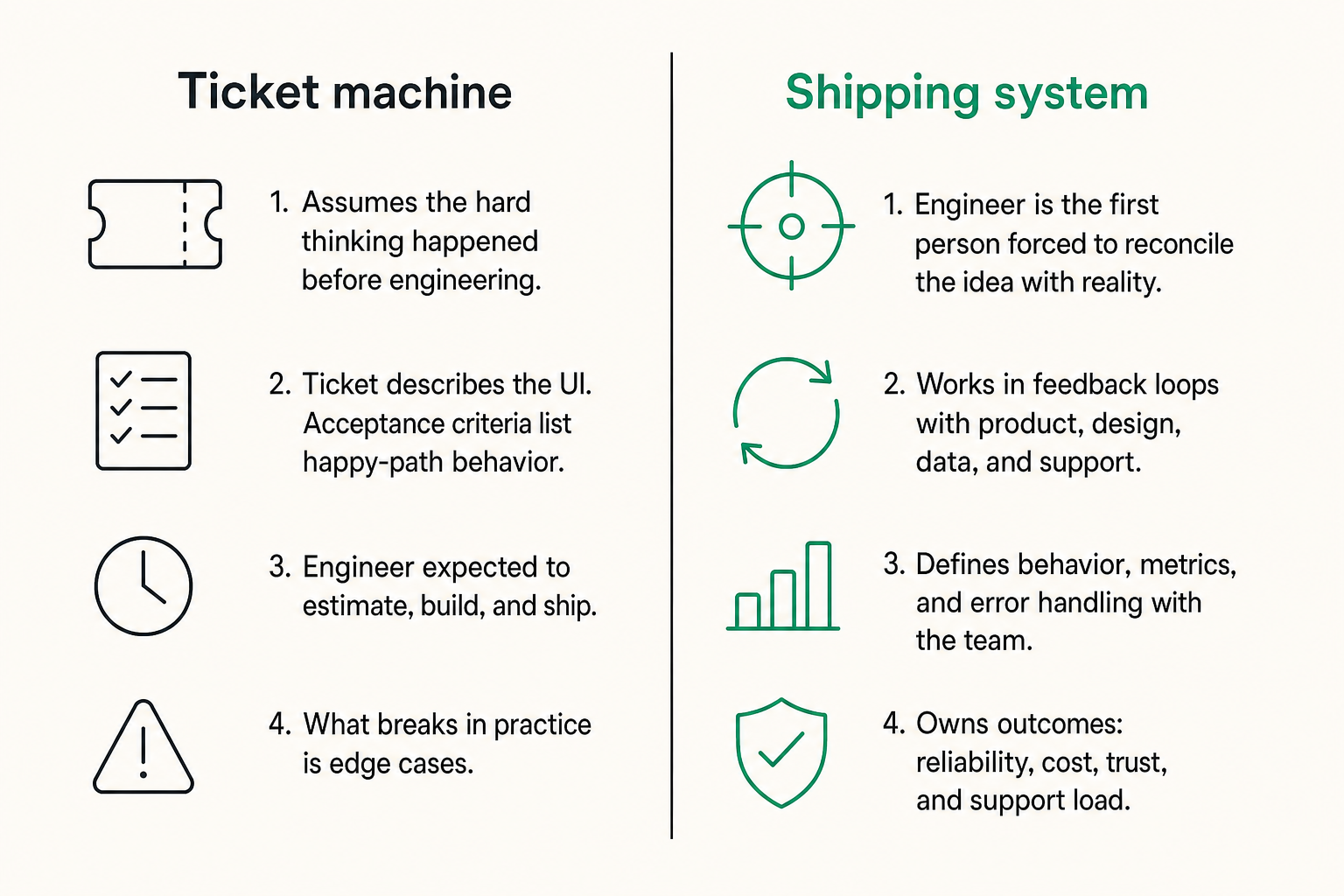
The mistake teams make is treating engineering as the final stage of product work. Someone decides what should exist, someone writes it down, and then the software engineer implements it.
That looks clean on a roadmap. It fails in production because real product work is full of unresolved questions: What should happen when payment fails? What does the user see while data is loading? Which admin action is reversible? Which metric proves the feature worked? Who gets paged if the launch breaks?
A useful way to think about it is this: the engineer is the first person forced to reconcile the idea with reality.
The ticket machine model fails under ambiguity
A ticket machine workflow assumes the hard thinking happened before engineering. The ticket describes the UI. Acceptance criteria list happy-path behavior. The engineer is expected to estimate, build, and ship.
What breaks in practice is edge cases. The ticket says add team invitations. It does not say what happens when an invited user already has an account, when the invitation expires, when the domain is blocked, when billing seats are exhausted, or when support needs to resend the invite.
Those are not merely engineering details. They are product behavior, cost control, trust, security, and support load.
Practical rule: If a ticket cannot describe the failure paths, it is not ready for implementation. It is ready for a design and engineering conversation.
The shipping system model exposes risk early
In a shipping system, the software engineer participates before the build phase. They help identify unknowns, technical constraints, data dependencies, and launch risks.
This does not mean every engineer becomes a product manager. It means the workflow uses engineering judgment while decisions are still cheap.
The practical question is not, can the engineer build this? It is, what must be true for this feature to ship safely, teach us something, and not create operational mess?
That question changes estimation. It changes scope. It changes what gets cut.
Why this matters more in 2026
Small teams now ship with more leverage: AI coding tools, managed infrastructure, no-code operations layers, API-first products, and global distribution from day one. That leverage is useful, but it also makes it easier to create fragile systems quickly.
Many founders can prototype faster than they can operate. That is the new bottleneck.
A software engineer in 2026 is valuable not because they type code faster than tools. They are valuable because they can decide which code should exist, where complexity belongs, how the system fails, and how the team will know whether the launch worked.
What a software engineer actually owns in a launch
A launch is not a button press. It is a chain of product behavior, implementation decisions, release mechanics, monitoring, customer support, and iteration.
The software engineer does not own all of that alone. But if engineering owns only code, the launch has no technical operator.
The product behavior layer
Product behavior is the exact way the software responds to user actions. It includes states, permissions, errors, empty screens, billing rules, notifications, and admin flows.
Founders and PMs often think behavior lives in design files. It does not. Design files are proposals. Product behavior becomes real when the system enforces it.
For example, a founder may say users can invite teammates. The engineer has to decide or ask:
- Can viewers invite other users, or only admins?
- Can an invitation be transferred?
- What happens if the invitee signs up with Google instead of email?
- Does billing update immediately or at renewal?
- Can support override the workflow?
These decisions define the product more than the button label does.
The technical path to production
A software engineer also owns the path from local code to production behavior. That includes branch strategy, review, tests, deployment, environment variables, database migrations, feature flags, rollback options, and observability.
Small teams often underinvest here because they want to move quickly. The irony is that weak deployment paths slow teams down after the first serious launch.
A launch path should answer:
- How do we test this before customers see it?
- Can we release to a small group first?
- Can we turn it off without reverting the whole app?
- How do we know if it is failing?
- Who makes the call to roll back?
The feedback and recovery loop
The engineer's work continues after release. Logs, analytics, support tickets, customer interviews, and session recordings all contain implementation signals.
If users fail to activate because an integration setup is confusing, that is not only a product problem. If error rates rise after a billing change, that is not only an infrastructure problem. The loop has to connect customer symptoms to product and engineering changes.
Related reading from our network: teams dealing with delivery pipelines face similar operational tradeoffs in network security for CI/CD and software supply chains, especially where release speed meets system risk.
The working contract between founders, PMs, and engineers
Most engineering frustration is not caused by hard problems. It is caused by unclear ownership of decisions.
The working contract solves that. It defines what goes into engineering, what comes out, who decides when tradeoffs appear, and how fast the team resolves blocked questions.
Inputs engineers need before implementation
A software engineer needs more than a feature title and a Figma link. At minimum, the input should include:
- The user problem being solved
- The target segment or customer type
- The smallest useful release
- Known constraints and non-goals
- Key edge cases
- Success signals
- Launch deadline, if real
- Support and operational impact
This sounds like overhead. It is cheaper than rework.
Practical rule: Give engineers context before conclusions. A strong engineer can improve a weak solution if they understand the problem. They cannot reliably fix a solution-only ticket.
Definition of ready and definition of done
Definition of ready is the bar before engineering starts. Definition of done is the bar before a feature counts as shipped.
For a small product team, ready might mean:
- The problem is clear
- The first customer segment is named
- Designs cover core states
- Open decisions are listed
- The engineer has identified technical risks
Done might mean:
- Code is merged and deployed
- Feature is behind the right flag or available to the right cohort
- Critical events are tracked
- Error states are handled
- Support has notes
- The team reviewed first usage data
Without these bars, teams confuse merged code with shipped product.
The cadence that keeps decisions moving
The best cadence is usually lightweight:
- Weekly planning for priorities and tradeoffs
- Short technical shaping before major work
- Daily or near-daily unblock checks during active build
- Pre-release review for launch readiness
- Post-release review based on customer behavior
The goal is not ceremony. The goal is fast decision flow.
If the engineer has to wait two days for every product answer, the sprint is already damaged. If the founder changes scope every morning, the sprint is also damaged. The cadence protects both sides.
Software engineer hiring and selection for small teams
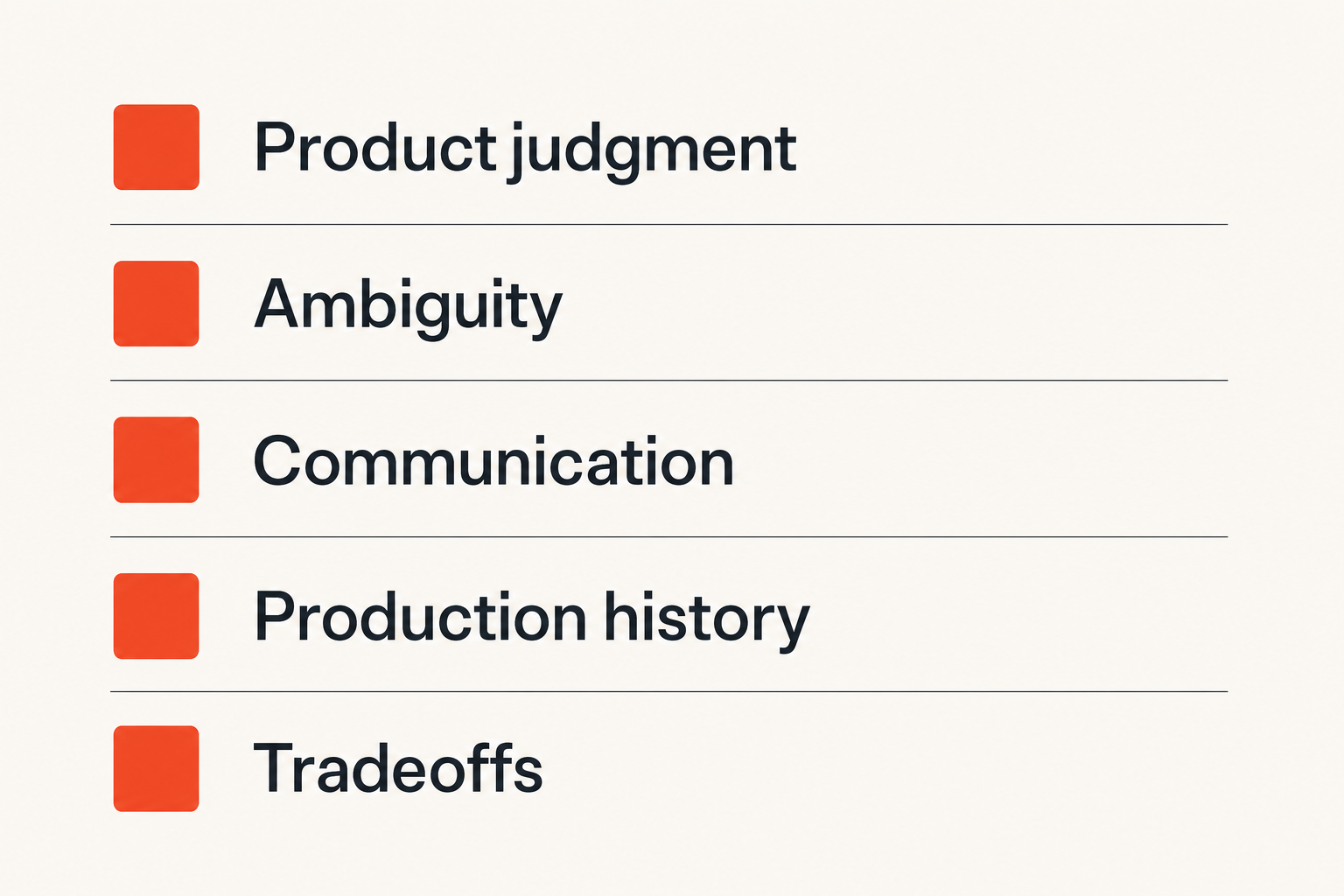
Hiring a software engineer for a small team is different from hiring one into a large department. You are not only buying implementation capacity. You are adding judgment to your shipping system.
A brilliant specialist may struggle if your product changes weekly. A decent generalist with strong product instincts may outperform them in an early-stage environment.
Look for product judgment, not only stack fit
Stack fit matters, but it is often over-weighted. Most competent engineers can move across adjacent tools. Product judgment is harder to train under pressure.
Ask candidates about tradeoffs:
- When did they cut scope to ship faster?
- When did they push back on a feature request?
- How do they handle vague requirements?
- How do they decide what to test?
- How do they recover from a bad release?
You are looking for evidence that the engineer can reason about users, systems, and time.
Use trial work to test ambiguity handling
A useful trial project is not a puzzle. It should resemble your actual work: incomplete context, a product goal, a small implementation surface, and a request to explain tradeoffs.
For example:
- Give the candidate a short product brief.
- Provide a small existing codebase or architecture sketch.
- Ask them to propose the smallest shippable slice.
- Let them identify risks and missing questions.
- Have them implement one narrow path or write a technical plan.
- Review how they communicate decisions.
The output matters. The thinking matters more.
Related reading from our network: collaborative control has similar permission and handoff problems, and the remote-work framing in garage door opener remote thinking for safer collaborative screen sharing is a useful analogy for engineering ownership boundaries.
Red flags that show up before the offer
Some red flags are technical. Others are operational.
Watch for candidates who:
- Cannot explain tradeoffs in plain language
- Treat product questions as interruptions
- Over-engineer small problems by default
- Avoid talking about production incidents
- Need perfect specifications before making progress
- Dismiss tests, logs, or documentation as bureaucracy
- Cannot name what they would cut under deadline pressure
For a small team, these behaviors compound. The wrong engineer does not just slow down tickets. They distort the product workflow.
Turning product strategy into engineering work
Strategy is useless if it cannot become shipped behavior. Engineering work is chaotic if it is not tied to strategy.
The mistake teams make is jumping from roadmap themes to tasks. That creates a pile of work without a clear learning sequence.
For a practical system that connects bets, roadmaps, and launches, the sh1pt.com guide to product strategy as a shipping system is a useful companion to this engineering workflow.
Translate bets into slices
A product bet is a belief about customer behavior. A slice is the smallest product change that can test or exploit that belief.
Bet: Freelance designers will upgrade if client approvals are easier.
Bad engineering translation: Build a complete client portal.
Better slice: Add a shareable approval link with comment capture and a visible approval state.
The second version is smaller, testable, and easier to support. It also gives the engineer a clearer system boundary.
Sequence for learning, not internal comfort
Teams often sequence work by technical convenience: database first, then backend, then frontend, then analytics, then launch.
Sometimes that is necessary. But when possible, sequence around learning risk:
- What assumption could kill the feature?
- What behavior needs validation first?
- Which integration is most uncertain?
- Which user group should see this earliest?
That may mean building a rough admin workflow before a polished user-facing screen. It may mean shipping a manual backend process behind a clean UI. The point is to spend engineering effort where it reduces uncertainty.
Make tradeoffs explicit before code starts
Tradeoffs should be written down before implementation, not discovered in a tense pre-launch meeting.
A simple engineering brief can include:
Feature: Client approval links
Goal: Reduce approval friction for freelance teams
First slice: Shareable approval page with comment and approve action
Non-goals: Full client accounts, role-based portals, custom branding
Known risks: Public link security, notification noise, unclear approval authority
Cut line: If timeline slips, remove comments before removing approval state
Success signal: Approval completed without support intervention
This is not heavyweight process. It is decision compression.
The implementation workflow that prevents launch drag
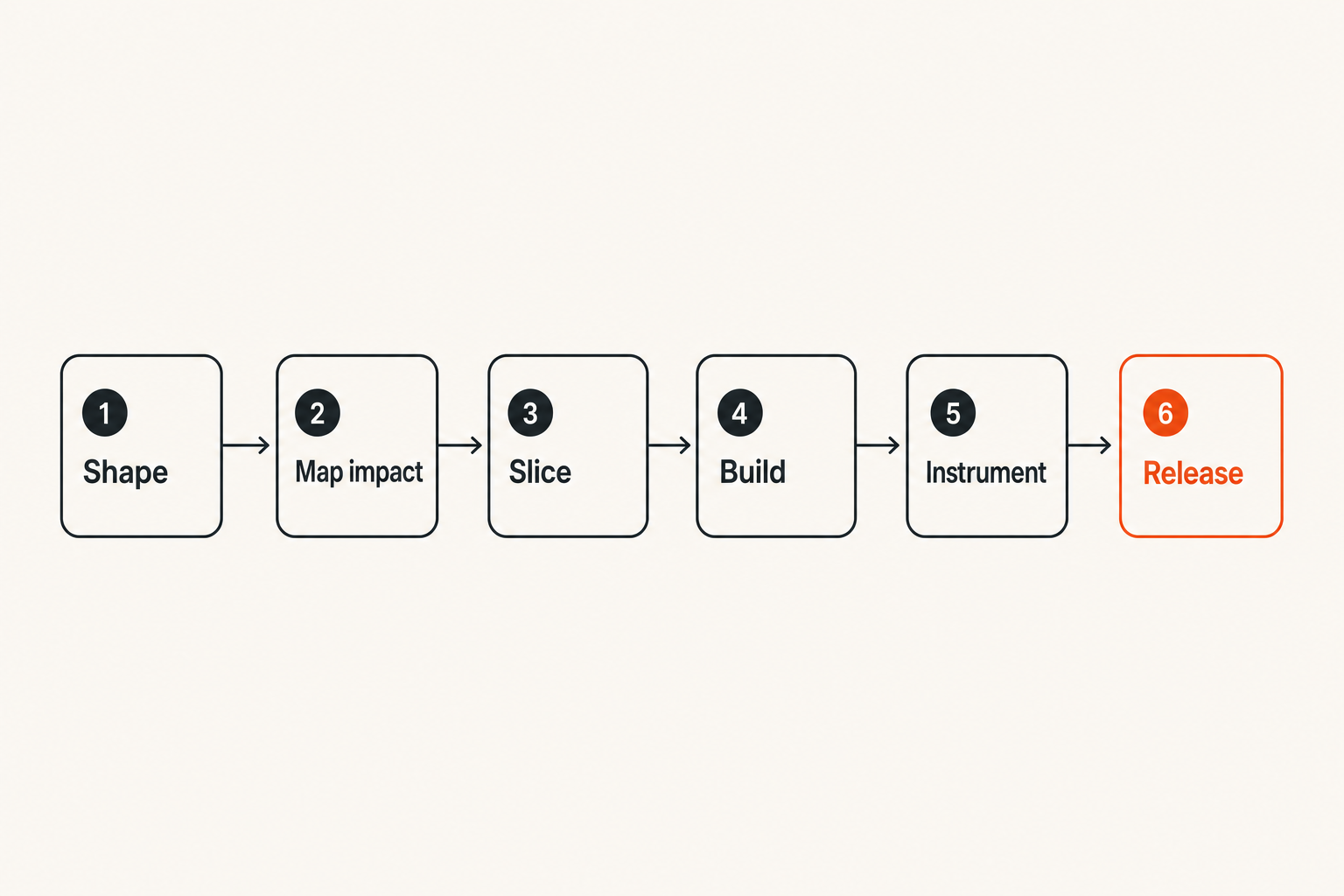
Launch drag happens when code is moving but the product is not getting closer to release. Teams feel busy. Pull requests exist. Standups happen. Yet every week reveals another missing decision.
The solution is a workflow that treats implementation as progressive risk reduction.
A seven-step engineering workflow
A practical workflow for a software engineer in a small product team looks like this:
- Shape the problem. Confirm user problem, segment, constraints, and smallest useful release.
- Map system impact. Identify data model changes, permissions, integrations, migration needs, and failure paths.
- Define the slice. Cut the feature into a shippable unit with a clear non-goal list.
- Build behind control. Use feature flags, limited cohorts, admin toggles, or staged rollout where appropriate.
- Instrument the behavior. Track key events, errors, and operational signals before launch.
- Release deliberately. Deploy through a known path with rollback or disable options.
- Review real usage. Compare customer behavior against the original bet and decide the next change.
Practical rule: If instrumentation and rollback are not discussed until launch day, they were not part of the workflow. They were an afterthought.
Review code for product risk, not style alone
Code review should catch more than formatting. For product teams, reviewers should ask:
- Does this implement the intended product behavior?
- Are edge cases handled consistently?
- Are permission checks in the right place?
- Does this create support ambiguity?
- Are events named clearly enough for analysis?
- Can this be disabled or rolled back?
Style consistency matters, but it is rarely what ruins a launch. Hidden product risk does.
Release controls for small teams
Release controls do not need to be enterprise-grade. A small team can get far with:
- Feature flags for risky flows
- Staging environments with production-like data shape
- Database migration review
- Basic smoke tests
- Error monitoring
- Deployment notes
- A rollback owner
The goal is not to eliminate risk. The goal is to make risk visible and recoverable.
What breaks when teams use engineers badly
Bad engineering workflow creates predictable failure modes. They are easy to rationalize in the moment because everyone is busy.
But the pattern is usually obvious afterward: unclear decisions moved downstream until they became code problems.
Preloaded solutions create expensive rewrites
A preloaded solution is a ticket that says exactly what to build without explaining why. It prevents the engineer from spotting cheaper or safer alternatives.
Example: Build a complex notification preferences center.
The real problem: Trial users are missing onboarding reminders.
A smaller answer might be one email preference, better defaults, or a digest. But if the engineer only receives the solution, the team may spend two weeks on infrastructure that was not needed.
Async handoffs hide missing decisions
Async work is useful. Async dumping is not.
A long ticket with screenshots and no decision owner creates false clarity. The engineer starts building, then finds gaps. Questions go into comments. Answers arrive late. The implementation drifts.
What fails is not remote work. What fails is decision routing.
A good async handoff says who can decide what, by when, and which tradeoffs are acceptable.
Activity metrics reward the wrong behavior
If you measure engineers by tickets closed, points burned, or commits pushed, you will get local optimization. Engineers will prefer smaller visible tasks, avoid ambiguous shaping work, and push complexity into later phases.
For product shipping, better signals include:
| Signal | What it tells you | How teams misuse it |
|---|---|---|
| Cycle time | How long work takes from start to release | Treating all work as equal |
| Escaped defects | What users found after release | Blaming individuals instead of workflow |
| Rollback frequency | How often releases need recovery | Hiding rollbacks to look stable |
| Activation impact | Whether the feature changed behavior | Claiming success at deployment |
| Support volume | Whether the feature is understandable | Ignoring qualitative tickets |
Metrics should improve decisions. They should not turn engineers into output performers.
What works when engineers are part of the shipping loop
The best software engineer workflows are not complex. They are disciplined about small decisions.
They reduce batch size, expose risk early, and connect production behavior back to product choices.
Small batches reduce coordination cost
Small batches are not about building tiny features forever. They are about making each release understandable.
A small batch has:
- One primary user outcome
- A short list of system changes
- Clear launch control
- Clear success signal
- A known follow-up path
Large batches create coordination debt. When a launch includes billing changes, onboarding redesign, new permissions, and analytics updates, nobody knows which part caused the result.
Instrumentation turns opinions into evidence
Instrumentation is where product and engineering meet reality.
Before shipping, the team should decide what it needs to know. That might include:
- Feature viewed
- Setup started
- Setup completed
- Error encountered
- Invite sent
- Approval completed
- Upgrade clicked
Event names should be boring and stable. Dashboards should answer launch questions, not impress the team.
If product research is still fuzzy, structured customer input helps. The sh1pt.com workflow for product research surveys pairs well with engineering instrumentation because both convert vague opinions into decision signals.
Lightweight documentation protects momentum
Documentation does not need to become a corporate wiki graveyard. The most useful docs for a small team are short and current:
- Feature brief
- System notes
- Launch checklist
- Decision log
- Support notes
- Post-launch review
The decision log is especially valuable. It prevents the team from relitigating why a shortcut was taken or why a feature was cut.
Practical rule: Document decisions, not everything. Future speed comes from knowing why the system is the way it is.
The tooling stack around a software engineer
Tools do not fix a broken workflow. But weak tools can make a good workflow harder than necessary.
The practical question is what information the software engineer needs at each stage of shipping.
Planning tools should show decision state
A backlog should not be a warehouse of wishes. It should show decision state.
Useful statuses might be:
- Idea
- Needs research
- Needs shaping
- Ready for engineering
- In build
- In review
- In rollout
- Measuring
- Done
This helps founders and PMs see that not every item is equally actionable. It also prevents engineers from becoming the cleanup crew for unclear ideas.
Related reading from our network: SaaS buyers face a similar workflow issue when comparing options, and this guide to Capterra alternatives in 2026 frames evaluation as an operating process rather than a list of tools.
CI, environments, and deployment paths matter
Continuous integration is not just for larger teams. Even a solo founder benefits from repeatable checks.
A basic setup might include:
checks:
  - install dependencies
  - run unit tests
  - run type checks
  - run lint rules
  - build app
release:
  - deploy preview
  - smoke test critical path
  - promote to production
  - monitor errors
The exact tooling depends on the stack. The principle is stable: important releases should not depend on memory.
Support and customer feedback need a path back
Support tickets are product data. Sales objections are product data. Churn notes are product data. If those signals do not reach engineering in a usable form, the team keeps guessing.
A simple loop works:
- Tag support issues by feature or workflow.
- Review the top recurring friction weekly.
- Link high-signal examples to roadmap items.
- Let the engineer inspect logs or user paths when needed.
- Decide whether the fix is product, copy, code, or support process.
This is where product operations matter. If your team is growing past ad hoc launches, the sh1pt.com article on product operations as a shipping system is directly adjacent to the engineering workflow described here.
How sh1pt.com fits this software engineer workflow
sh1pt.com is built for people trying to move from idea to market without turning shipping into theater.
That includes indie hackers who are their own software engineer, founders hiring their first technical teammate, PMs trying to reduce launch chaos, and operators building repeatable product systems.
Founders need a shipping operating system
Most founders do not need more generic advice about building faster. They need a way to make better product decisions under constraint.
That means connecting:
- Customer discovery
- Product strategy
- Engineering scope
- Launch sequencing
- Feedback loops
- Growth experiments
- Operational cleanup
A software engineer is central to that system because engineering is where abstract strategy becomes product behavior.
Use content to tighten the loop
The best use of sh1pt.com is not passive reading. Use it to improve one part of your shipping loop each week.
Pick a current feature and ask:
- Is the product bet clear?
- Is the smallest slice actually small?
- Does the engineer know the customer context?
- Are edge cases decided or just postponed?
- Will we know if this launch worked?
- What breaks if usage is higher than expected?
If those questions create uncomfortable answers, good. That is where the workflow improves.
Closing checklist for working with a software engineer
The software engineer role is not shrinking in importance. It is changing shape.
Tools can generate code. Templates can scaffold apps. Platforms can deploy faster. But someone still has to decide how the product should behave, where complexity belongs, and how the team recovers when reality disagrees with the plan.
The practical checklist
Before your next build cycle, check whether your engineering workflow covers:
- Problem context before solution details
- Clear decision owner for tradeoffs
- Ready and done definitions
- Explicit non-goals
- Failure paths and edge cases
- Instrumentation before launch
- Rollback or disable path
- Support notes
- Post-launch review
If several are missing, do not blame the engineer for moving slowly. Fix the system around the engineer.
The next sprint move
The fastest improvement is to add a shaping step before implementation.
Take the next meaningful feature and spend 45 minutes with the founder, PM, designer, and software engineer. Write the user problem, first slice, non-goals, key risks, success signal, and cut line.
Then build.
That small shift usually reveals how many launches were previously running on assumptions. It also gives the software engineer the context needed to make better technical decisions without asking permission for every detail.
Working well with a software engineer is not about adding process for its own sake. It is about making the path from idea to production shorter, clearer, and safer.
Try sh1pt.com
sh1pt.com is for people building and launching software products who want practical shipping strategies, product development processes, and growth tactics. Try sh1pt.com.