
Specialty products sound like a category decision. Pick a niche, make the product more specific, charge more, and avoid the bloodbath of horizontal software.
That is the tidy version. In production, it gets messier.
Teams think the problem is finding a narrow audience. The real problem is designing a product, launch motion, onboarding path, pricing model, and support workflow that all reinforce the same specialty. If one part stays generic, the whole thing starts leaking trust.
That changes the conversation. Specialty products are not just smaller products. They are sharper systems. The practical question is whether your product can own a specific job better than a broad tool can fake it.
Table of contents
- Why specialty products are a launch architecture problem
- Specialty products vs horizontal products
- Choose the constraint before you choose the feature set
- Validate specialty products with operational proof
- Design the specialty product workflow
- Build the go to market system around the specialty
- Specialty products need different metrics
- What breaks when teams implement specialty products badly
- What works in practice for founders and product teams
- Where sh1pt.com fits in the shipping workflow
Why specialty products are a launch architecture problem

Generic demand is not a market
The mistake teams make is treating specialty products as a branding exercise. They rename a generic product for lawyers, agencies, creators, clinics, sales teams, or local operators, then expect the market to reward the label.
That rarely holds. A specialty product has to remove a specific operational burden. The buyer should feel that the product understands their constraint before they ever see a feature grid.
A useful way to think about it is this: generic products sell optional capability. Specialty products sell reduced interpretation. The customer does not want to translate a blank canvas into their workflow. They want the product to arrive with assumptions that match how their work actually happens.
For software teams, this turns specialty into an architecture problem. Your data model, onboarding sequence, templates, defaults, integrations, pricing, support language, and launch channels all need to agree on who the product is for and what job it owns.
Practical rule: A product is not specialized because the landing page names a niche. It is specialized when the default workflow is wrong for everyone except the intended customer.
Focus changes what you build
Focus is not just subtraction. It changes the shape of the product.
A broad project management app may need flexible views, custom fields, permissions, automations, dashboards, and integrations. A specialty product for home renovation coordinators may need permit tracking, subcontractor handoffs, photo logs, owner approvals, and deadline exceptions caused by inspections.
Both products might look like project management from a distance. They are not the same product operationally.
That is why founders get trapped when they ask, can this be bigger later. The better first question is, what can we assume now that a horizontal competitor cannot assume without alienating other customers. Those assumptions create speed, clarity, and trust.
Specialty products vs horizontal products
The comparison that matters
Horizontal products maximize addressable surface area. Specialty products maximize fit for a constrained use case. Neither approach is morally better. They simply produce different operating systems.
| Dimension | Horizontal product | Specialty product |
|---|---|---|
| Promise | Flexible tool for many teams | Purpose-built tool for a known job |
| Onboarding | User configures the workflow | Product encodes the workflow |
| Positioning | Broad category language | Specific pain and context |
| Feature strategy | More options, more integrations | Fewer choices, stronger defaults |
| Sales motion | Educate on capability | Prove fit and switching value |
| Support load | Many edge cases across segments | Deeper questions inside one segment |
| Risk | Commoditization and noise | Overfitting and small market assumptions |
What breaks in practice is when teams want specialty trust with horizontal behavior. They say the product is built for a segment, but onboarding asks the customer to define everything from scratch. They say it saves time, but the first run requires migration, configuration, and guessing.
When narrow beats broad
Narrow beats broad when the buyer has a high-cost workflow that generic tools make them assemble manually.
This usually shows up in one of four places:
- The customer uses spreadsheets plus screenshots plus chat to complete one recurring job.
- The workflow has domain-specific exceptions that broad tools do not model well.
- The buyer has compliance, handoff, approval, or reporting constraints.
- The cost of making the wrong decision is higher than the subscription price.
Specialty products win when they compress the buyer's path from problem to competent execution. They do not need to be feature-rich at first. They need to be interpretation-light.
Practical rule: If the buyer still has to design the workflow after buying your specialty product, you probably built a generic tool with niche copy.
Choose the constraint before you choose the feature set
Segment constraint
A segment constraint defines who the product serves. This sounds basic, but many teams define segments too loosely. Founders say creators, agencies, consultants, dev teams, or SMBs. Those words are not enough.
A useful segment definition includes the buyer, the operator, the trigger, the existing workaround, and the budget owner. For example, a product for solo newsletter operators with paid sponsorship workflows is much more useful than a product for creators.
The segment has to be narrow enough that conversations repeat. If every call reveals a totally different job, you do not yet have a specialty. You have a theme.
Workflow constraint
A workflow constraint defines the job the product owns. This is where specialty products get real.
Do not start with features. Start with the painful sequence the customer already runs. Who initiates it. What information enters. What decisions happen. What tools are used. Where does it slow down. Who gets blamed when it fails.
Related reading from our network: teams evaluating operational tools face similar workflow ownership questions in this guide to pivotal software rollout risk, especially around integrations, ownership, and adoption.
The workflow constraint gives you permission to ignore attractive distractions. If a feature does not improve the owned workflow, it is probably expansion work, not launch work.
Distribution constraint
A distribution constraint defines how the intended customer will discover and trust the product.
Specialty products often fail because distribution is treated as generic demand capture. The team builds for a niche, then markets like a horizontal SaaS company. They run vague content, broad ads, unfocused launch posts, and one-size-fits-all demos.
Distribution should match the way the niche already learns. That might be founder-led outreach, expert communities, templates, partner channels, marketplace listings, industry-specific search, or embedded workflows inside an existing ecosystem.
The launch channel is part of the product strategy. If the market does not gather in public, a Product Hunt launch might create noise but not pipeline. If the buyer relies on peer proof, case-study depth may matter more than traffic.
Validate specialty products with operational proof
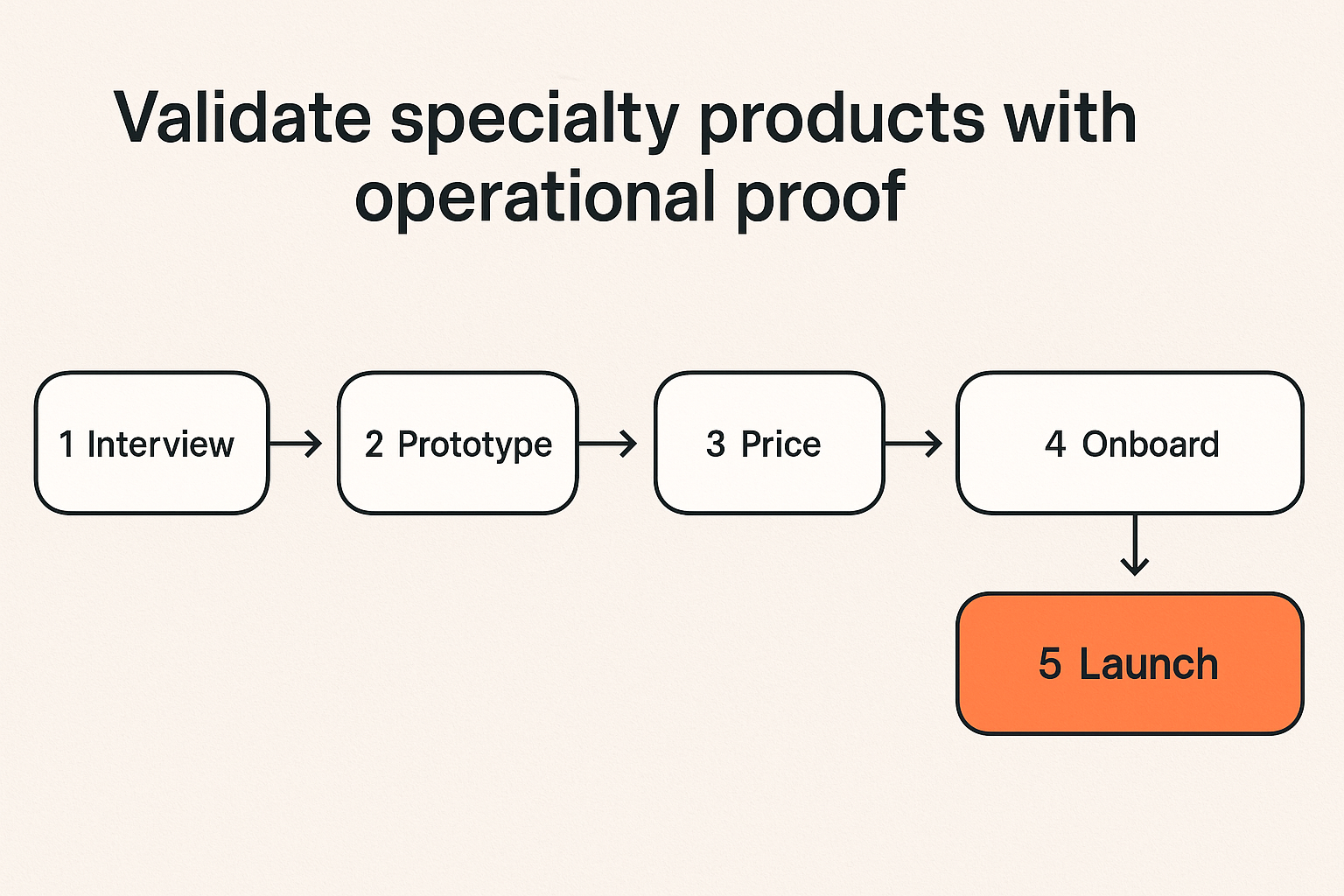
Interview for switching pressure
Customer interviews for specialty products should not ask whether the idea is interesting. Interesting is cheap.
Ask about the last time the workflow happened. What triggered it. What tools were open. What went wrong. What took too long. Who reviewed the output. What happened when it was late or inaccurate. What workaround exists today.
You are looking for switching pressure, not compliments. The signal is not that the person likes your idea. The signal is that the current workflow is expensive enough that they have already built rituals around it.
Good discovery questions sound like this:
- Walk me through the last time this happened.
- What did you use before, during, and after the task.
- Where did you copy data manually.
- Who had to approve or fix the work.
- What would make this urgent enough to switch this quarter.
Prototype the expensive moment
Do not prototype the whole product first. Prototype the moment where the customer currently loses time, money, confidence, or control.
For a specialty analytics product, that might be the weekly report the operator has to explain to a client. For a compliance workflow, it might be evidence collection. For a launch planning tool, it might be deciding which tasks belong to product, marketing, founder outreach, and support.
The expensive moment is where trust is created. If your prototype handles that better than the workaround, the surrounding product can be rough. If it misses that moment, polish will not rescue it.
Price before polish
Pricing is validation because it forces the buyer to classify the product. Is it a nice-to-have utility, a team workflow, a business system, or a risk reducer.
For specialty products, price should reflect the cost of the workflow and the urgency of the segment. A tiny team may pay well for software that removes a recurring operational bottleneck. A larger team may resist paying for something that feels like another tool to manage.
The practical question is not what should we charge in the abstract. It is what budget does this replace, protect, or unlock.
Practical rule: Validate willingness to pay before you validate visual preference. Specialty products are bought for operational fit, not interface approval.
Design the specialty product workflow
Map the before state
Before building the happy path, document the current messy path. This is where many teams skip steps.
Map the workflow as it exists across tools, people, documents, approvals, reminders, and exceptions. Include the ugly parts: screenshots, forwarded emails, duplicate spreadsheets, Slack pings, calendar reminders, and manual checks.
Related reading from our network: even something as simple as screen sharing can become an operational system, as shown in this practical breakdown of remote team screen sharing workflows.
That comparison matters because software launches fail the same way. Teams obsess over the visible interface and ignore the handoffs around it. The UI is not the whole system. The workflow is.
Define the owned outcome
A specialty product should own a measurable outcome, not just a set of tasks.
Examples:
- Not manage content, but ship sponsor-ready newsletters without missed approvals.
- Not track customers, but recover stalled onboarding accounts before churn risk rises.
- Not organize launches, but move a product from idea to public release with clear owner decisions.
- Not store files, but produce audit-ready evidence packages for a specific review.
The owned outcome tells you what the product should make easier, faster, safer, or more reliable. It also tells you what not to build.
Keep the first release deliberately incomplete
Specialty does not mean complete. In fact, complete is often a trap.
The first release should be deliberately incomplete in areas that do not affect the owned outcome. That might mean fewer integrations, fewer roles, fewer dashboards, or fewer customization options.
The danger is not launching small. The danger is launching ambiguous. A narrow product with a clear owned workflow can earn trust. A broad product with shallow coverage usually creates more evaluation work for the buyer.
Build the go to market system around the specialty
Positioning is a routing function
Positioning is not decoration. It routes the right people into the right expectation.
For specialty products, positioning should answer five questions fast:
- Who is this clearly for.
- What workflow does it improve.
- What pain does it remove.
- What existing workaround does it replace.
- What tradeoff does it make on purpose.
If you are designing the full launch motion, it helps to treat go to market as an operating system rather than a campaign. The sh1pt.com guide to go to market strategy in 2026 is useful here because it connects audience, channels, workflow, and metrics instead of treating launch as a checklist.
The mistake teams make is hiding the constraint because they fear excluding people. But exclusion is the point. If your product is for everyone, the buyer has to do more work to decide whether it is for them.
Channels should match the niche
Specialty channels are often smaller and more trusted than general startup channels.
A founder building for Shopify agencies may get more from ten partner conversations than from a viral post. A product for fractional CFOs may need webinars, templates, and referral loops. A product for open-source maintainers may need GitHub-native proof, transparent docs, and community credibility.
Do not copy a launch channel because another startup used it. Ask where the buyer already goes when the problem hurts.
If the answer is search, write pages that match operational intent. If the answer is peers, build artifacts they can share. If the answer is consultants, create enablement material that helps them look smart.
Launch assets need operational context
A specialty product launch needs more than a product page and a demo video. It needs assets that reduce the buyer's interpretation cost.
Useful launch assets include:
- Before and after workflow diagrams.
- Migration notes from the common workaround.
- Templates that encode the product's assumptions.
- Pricing explanations tied to the workflow cost.
- Use-case pages for the highest-intent segment.
- Founder walkthroughs showing the expensive moment.
This is also where physical or tangible launch artifacts can support a software motion when used carefully. The sh1pt.com article on promotional products for software launches is relevant because it treats launch assets as part of attribution, timing, and follow-up, not as random swag.
Specialty products need different metrics
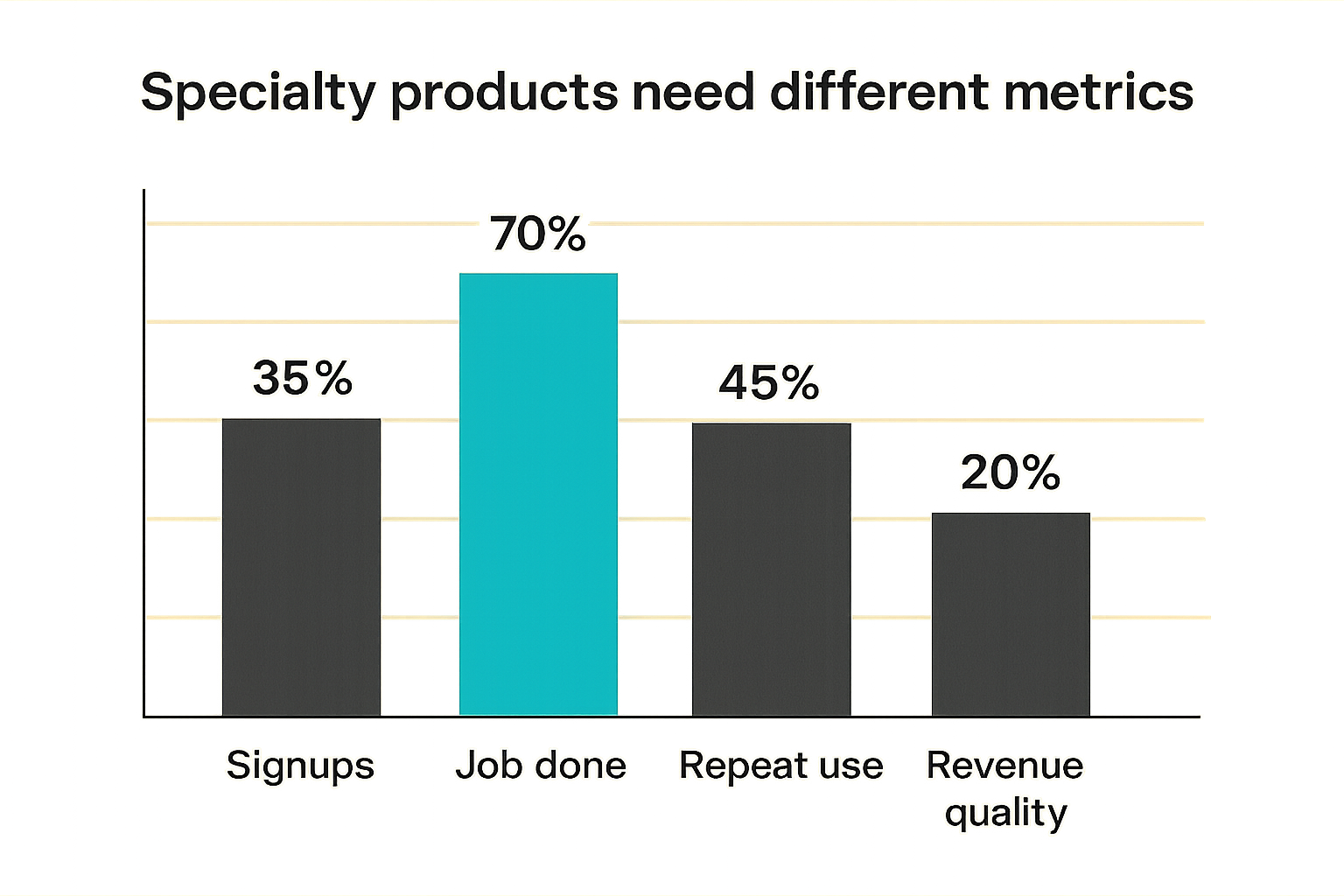
Activation by job completion
Generic activation metrics often mislead specialty product teams. Account created, project created, invite sent, and dashboard viewed might be useful events, but they do not prove the product delivered the specialized value.
Activation should measure completion of the first meaningful job.
For example:
| Product type | Weak activation metric | Better specialty activation metric |
|---|---|---|
| Launch planning tool | User created workspace | Launch plan reviewed with owners assigned |
| Client reporting tool | Dashboard connected | First client-ready report exported or shared |
| Compliance evidence tool | Files uploaded | Evidence package approved for review |
| Sponsorship workflow tool | Campaign created | Sponsor approval completed without manual chase |
The product should guide the user toward that job as quickly as possible. If onboarding celebrates setup rather than completion, you are measuring your database, not customer value.
Retention by repeat constraint
Retention for specialty products depends on whether the constraint repeats.
A product built around a one-time event may need expansion, adjacent workflows, or a marketplace to survive. A product built around a recurring operational burden can earn retention through rhythm.
Ask how often the job happens. Daily, weekly, monthly, quarterly, seasonally, or only during a crisis. Then design the product's reminders, reports, and success moments around that cadence.
A weekly workflow product should not feel dead six days a week unless that quietness is the value. A quarterly workflow product should resurface context before the customer forgets why they bought it.
Revenue quality over signup volume
Specialty products can look weak on top-of-funnel volume and strong on revenue quality. That is normal.
The metric stack should include:
- Qualified conversations by segment.
- Activation by owned workflow completion.
- Time to first useful output.
- Expansion inside the same workflow.
- Support questions caused by unclear assumptions.
- Churn reasons tied to segment fit versus product gaps.
Do not panic because a narrow product has fewer casual signups. Panic when the right buyers arrive and cannot understand the workflow, cannot reach the expensive moment, or cannot justify the price.
What breaks when teams implement specialty products badly
They confuse niche with small
A niche is a constraint. Small is a market size assumption. They are not the same thing.
Some narrow markets are economically deep because the workflow is frequent, painful, regulated, or revenue-adjacent. Some broad markets are shallow because nobody cares enough to switch.
When teams confuse niche with small, they underinvest in seriousness. The product feels like a side project. The landing page is vague. Support is informal. Pricing is timid. The result is predictable: serious buyers do not trust it, and casual users do not pay.
Specialty products need credible depth even when the first version is narrow.
They overfit the loudest customer
The opposite failure is overfitting.
A loud early customer asks for custom fields, custom reports, special exports, extra roles, and integration with their internal stack. The founder says yes because revenue is close. Six weeks later, the product has become a private tool with public pricing.
The fix is to separate segment truth from account preference. If three similar buyers have the same workflow pain, build it. If one buyer wants a configuration that only makes sense inside their company, be careful.
Practical rule: Early revenue is useful, but customer-specific complexity can quietly destroy a specialty product before the market ever sees it.
They hide the tradeoffs
Every specialty product makes tradeoffs. It should.
The failure mode is pretending otherwise. Teams claim the product is simple but flexible, focused but customizable, niche but universal, powerful but lightweight. Buyers hear that mush and assume the product is immature.
Clear tradeoffs increase trust. Say what you do not support yet. Say which teams are a bad fit. Say when a horizontal tool is better. The right buyers will feel safer because the product has boundaries.
Related reading from our network: builders dealing with emerging infrastructure face the same boundary problem, and this architecture guide to decentralized compute validation patterns is a useful adjacent example of making constraints explicit.
What works in practice for founders and product teams
A practical implementation sequence
The practical question is how to move from idea to market without turning specialty into endless research. Use a sequence that forces decisions.
- Define the segment in one sentence with buyer, operator, trigger, and current workaround.
- Map the existing workflow from trigger to completed outcome.
- Identify the expensive moment where time, money, trust, or control is lost.
- Prototype only that moment with enough surrounding context to test it.
- Run five to ten workflow interviews using recent real examples.
- Price the outcome before polishing the interface.
- Build onboarding around first job completion, not account setup.
- Launch through the channel the niche already trusts.
- Measure activation, retention, and churn against the owned workflow.
- Decide what to deepen, ignore, or expand based on repeated evidence.
This sequence is intentionally operational. It prevents the team from hiding inside brand work, feature planning, or launch theater.
The operating cadence
Specialty products need a cadence that keeps product, marketing, and customer learning connected.
A simple weekly cadence works:
- Monday: review qualified conversations and segment fit.
- Tuesday: inspect activation recordings or onboarding drop-offs.
- Wednesday: ship one workflow improvement.
- Thursday: publish one asset that explains the use case.
- Friday: review sales objections, support themes, and churn risks.
This is not complicated. The hard part is discipline. Specialty products become strong when the team compounds small pieces of workflow knowledge.
For messaging and launch clarity, the sh1pt.com guide to product marketing for shipping products is a good companion because it frames product marketing as an operator system, not a slogan workshop.
The decision log
Keep a decision log. Not a bloated product requirements document. A lightweight record of what you believe and why.
Track:
- Target segment definition.
- Workflow owned.
- Explicit non-customers.
- Pricing hypothesis.
- Assumptions encoded in defaults.
- Features rejected because they dilute focus.
- Repeated customer evidence.
- Open risks.
The decision log matters because specialty products invite drift. A founder sees adjacent demand. A sales call pulls the roadmap sideways. A competitor launches a broad feature. Without a written operating memory, every week becomes a new strategy.
Where sh1pt.com fits in the shipping workflow
Use specialty thinking to reduce launch waste
sh1pt.com is for people building and launching software products who want to understand shipping strategies, product development processes, and growth tactics. That makes specialty product thinking especially relevant.
The core problem for indie hackers, startup founders, product managers, and solopreneurs is not a shortage of launch advice. It is too much advice that assumes every product should launch the same way.
Specialty products break that assumption. They force better questions:
- Who needs this enough to switch.
- What workflow are we really improving.
- Which launch channel matches buyer trust.
- What proof reduces interpretation cost.
- Which metrics show real value instead of motion.
That is the useful frame. Shipping is not just pushing code live. Shipping is making a focused promise, delivering the first valuable outcome, and learning whether the market repeats the behavior.
Closing the loop on specialty products
Specialty products are not a shortcut around strategy. They are strategy made visible in the product.
The build choices are more constrained. The launch copy is less vague. The onboarding has fewer escape hatches. The metrics are more honest. The support questions are more revealing.
That is why the specialty path can work so well for small teams. You do not need to outspend horizontal competitors. You need to understand a workflow deeply enough that your product feels obvious to the right customer and irrelevant to the wrong one.
The mistake teams make is trying to look bigger than they are. Specialty products win by looking more precise than the alternatives. In 2026, that precision is a practical advantage for software teams that need to ship, learn, and survive without wasting cycles on generic demand.
Try sh1pt.com
sh1pt.com helps people building and launching software products understand shipping strategies, product development processes, and growth tactics. Try sh1pt.com.